Low-Level System Design For High-Throughput C++ Services
Asked of: Software Engineer
Last updated
What's being tested
Interviewers probe your ability to design and reason about low-latency, high-throughput C++ services: efficient use of CPU, memory, and networking; concurrency models that avoid contention; and pragmatic tradeoffs between latency, throughput, and correctness. They want to see that you can turn SLOs (throughput, p99/p999 latency) into concrete architecture, pick appropriate data structures and synchronization, and identify hot-path optimizations and observability hooks.
Core knowledge
-
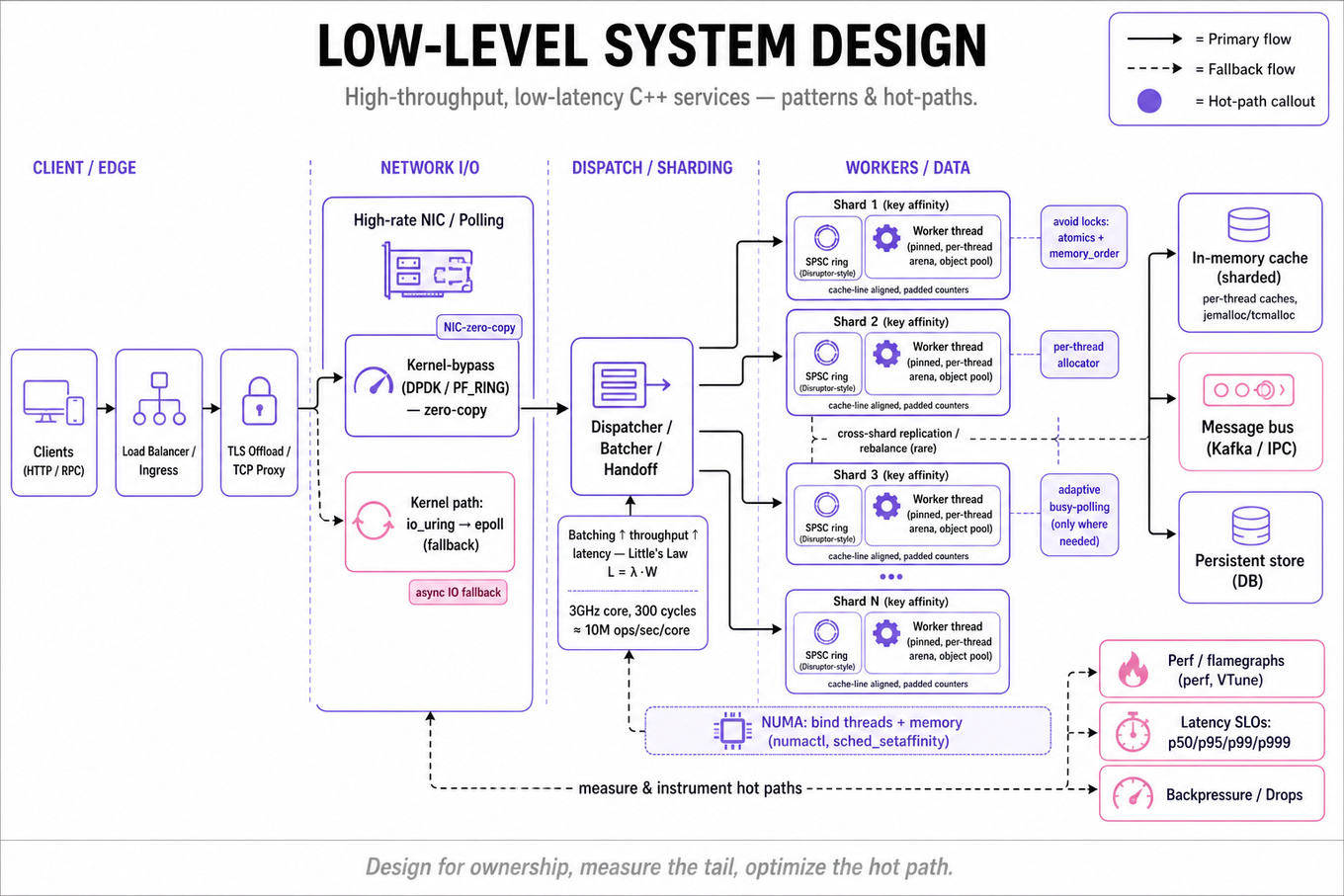
Latency vs throughput tradeoff: know that batching increases throughput but raises latency; quantify with Little's Law and relate queue depth to tail latency.
-
CPU cost budgeting: a 3GHz core ~3e9 cycles/s; if hot-path needs 300 cycles, max throughput/core ≈ 10M ops/s; use this to dimension cores and sharding.
-
Cache and false sharing: align hot objects to cache-line boundaries (typically 64B); pad per-thread counters to avoid cross-core invalidations.
-
Lock-free / wait-free primitives: use
std::atomicwith appropriatememory_order_*semantics; prefer SPSC/SPSC ring buffers (Disruptor-style) for handoff to avoid blocking syscall overhead. -
Work partitioning: prefer sharding by key (affinity) to make processors own state exclusively, eliminating cross-shard locks and enabling linear scalability.
-
Network I/O patterns: for high rate use
recvmmsg/sendmmsgbatching or kernel-bypassDPDK/PF_RING; fallback isio_uringfor async I/O on modern Linux,epollfor scalable event demux. -
Memory allocation: avoid per-message
new/delete; use object pools, per-thread arenas, orjemalloc/tcmallocwith per-thread caches to avoid contention and fragmentation. -
Polling vs interrupt: busy-polling reduces latency jitter; use adaptive busy-polling only where SLOs demand it, because it consumes CPU.
-
I/O zero-copy: use scatter/gather syscalls and pinned
mmap/huge pages where copying dominates CPU; for NIC-level zero-copy considerDPDK/RDMA when required. -
NUMA and thread affinity: bind threads and memory to CPU sockets to avoid remote memory access; measure with
numactland pin viasched_setaffinity. -
Profiling toolchain: use
perf,bpftools,VTune,gdb,heaptrack, and flamegraphs; measure p50/p95/p99 across end-to-end path, not only function-level. -
Failure and correctness: design for graceful degradation (backpressure, drop-in favor of tail control), idempotency for retries, and audit logs for post-mortem. Persist critical events asynchronously with strict ordering if required.
Worked example — "Design a low-latency order ingestion and matching service in C++"
First 30s clarifying questions: target throughput (orders/sec, messages/sec), latency SLOs (p50/p99), loss tolerance, protocol (UDP/TCP), persistence durability (sync/async), and deployment topology (single machine or cluster). Skeleton of a strong answer:
-
Ingress: high-performance packet reader (
recvmmsg/DPDK) with minimal parsing, deserialize in-place. -
Demux & validation: per-instrument shard mapping to a single core/thread to avoid locking.
-
Matching core: in-memory order book per shard, implemented with cache-friendly data structures (arrays + index maps), and risk checks inline.
-
Acks/persistence: ack to client immediately; persist trades/events asynchronously via batching to disk or append-only log.
-
Observability and backpressure: track queue depths, latencies, and apply backpressure (reject or throttle) when queues exceed thresholds.
Key tradeoff to flag: synchronous persistence increases durability but multiplies latency—use batched fsync with bounded queueing to keep p99 within SLO. Close by saying: "If more time, I'd prototype the hot-path with microbenchmarks, run perf to find mem-copy hotspots, and present measured CPU/latency envelopes."
A second angle — "Scale a C++ market-data consumer to 1M messages/sec with p99 < 200µs"
Here the workload is read-only and multicast-heavy. Design pivots:
-
Use
recvmsg/recvmmsgwith large batch sizes orDPDKto avoid kernel overhead. -
Decode messages in-place; employ a preallocated object pool and per-thread caches to avoid allocations.
-
Maintain per-subscription state on the consuming thread; push updates to consumers via lock-free ring buffers.
-
Optimize for memory layout (struct-of-arrays vs array-of-structs) depending on access pattern to improve SIMD/prefetch.
Constraints change tradeoffs: since no persistence and fewer consistency needs, accept looser ordering for performance, but implement sequence-number checks and small reassembly buffers to detect and heal gaps.
Common pitfalls
Pitfall: Confusing average latency with tail latency. Averaging hides jitter; designing for p50 but not
p99/p999will fail real workloads. Always instrument and budget for tails.
Pitfall: Reaching for locks first. Saying "we'll lock a shared map" in a high-throughput hot path is tempting but unacceptable; instead show partitioning, lock-striping, or lock-free alternatives and measure their costs.
Pitfall: Omitting observability and test harness. A design that lacks microbenchmarks, synthetic-load tests, and
perf-driven measurement is speculation. Propose specific metrics and how you'd load-test the service.
Connections
Interviewers may pivot to distributed consistency (e.g., ordering across shards) or to hardware acceleration (FPGA/NIC offload) once low-level design is solid. They might also ask about fault tolerance patterns (replication, consensus) if the role intersects reliability.
Further reading
-
[LMAX Disruptor paper/blog] — seminal design pattern for low-latency ring buffers and SPSC/SPSC handoff.
-
Brendan Gregg, Systems Performance — deep systems profiling and performance analysis techniques.
-
[Intel/DPDK documentation] — when you need kernel-bypass networking, this is the canonical source.
Related concepts
- Performance Profiling And Capacity Planning For C++ Services
- Production System Design TradeoffsSystem Design
- Distributed Systems Consistency And Low-Latency DesignSystem Design
- Low-Level Performance EngineeringSystem Design
- Low-Latency Consistency and ConcurrencySystem Design
- C++ Systems, Memory, Concurrency, And VirtualizationSoftware Engineering Fundamentals