M7 Org Strategy And Execution
Asked of: Software Engineer
Last updated
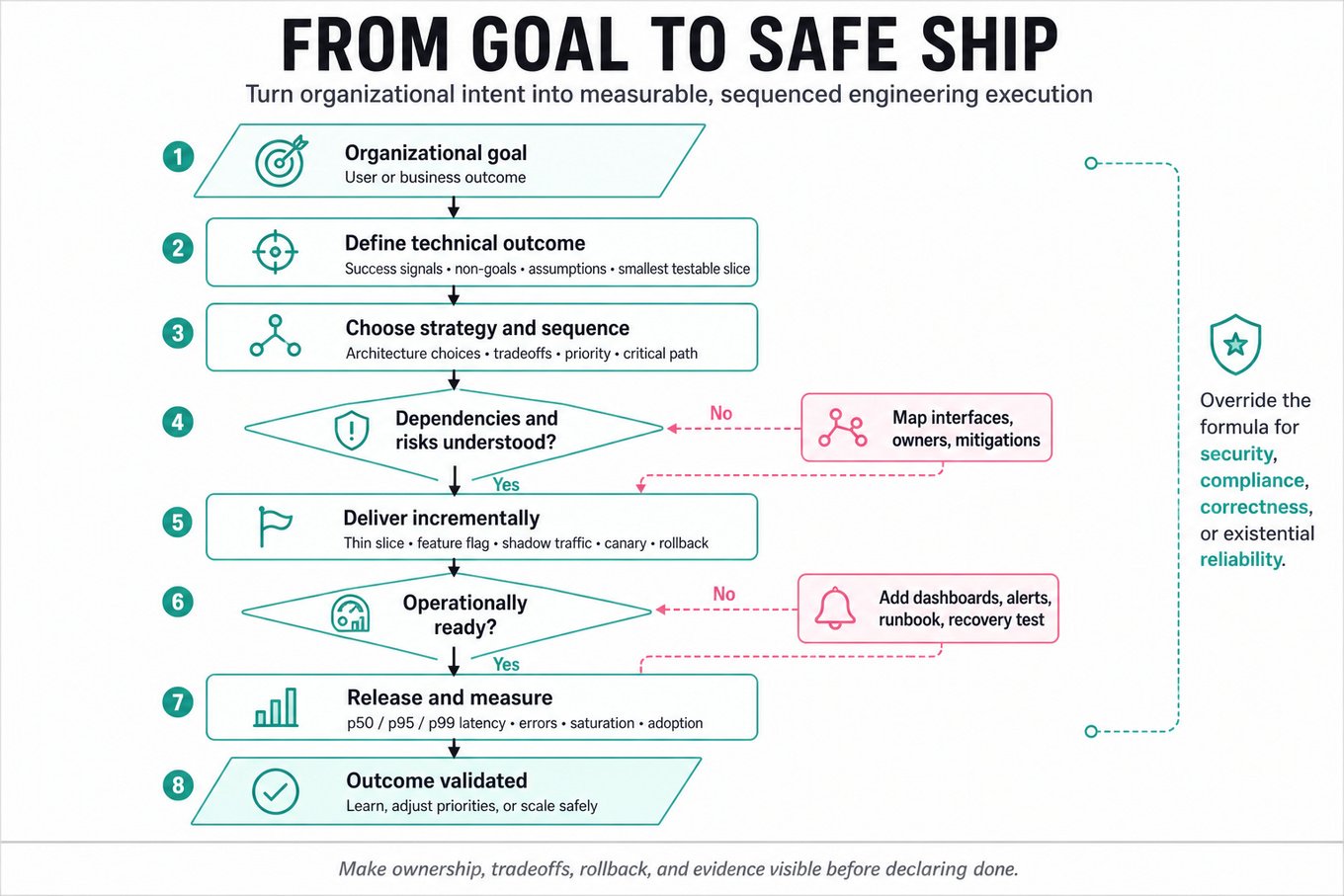
What's being tested
This topic tests whether you can translate an organizational goal into an executable engineering plan: define the technical outcome, identify dependencies, sequence delivery, and make tradeoffs visible. The interviewer is probing judgment under ambiguity rather than asking you to recite a project-management framework. Coinbase needs engineers who can ship safely across teams, protect reliability and security, and adjust execution when priorities, constraints, or market conditions change.
Core knowledge
-
Outcome-oriented planning connects engineering work to a measurable user or business result, while preserving technical constraints. State the desired outcome, success signals, non-goals, assumptions, and the smallest deliverable that can validate direction.
-
Technical strategy is a coherent set of architectural choices and sequencing decisions, not a list of projects. Explain why a platform investment, API change, reliability effort, or migration enables future execution and which alternatives you rejected.
-
Prioritization should account for impact, urgency, confidence, effort, risk reduction, and dependencies. A useful heuristic is , but explicitly override it for security, compliance, correctness, or existential reliability work.
-
Dependency mapping identifies upstream APIs, data contracts, client releases, infrastructure capacity, compliance reviews, and other teams’ milestones. Build a dependency graph, find the critical path, and reduce coordination by introducing stable interfaces or parallelizable work.
-
Incremental delivery uses thin vertical slices, feature flags, shadow traffic, dual writes, canaries, and reversible releases. Avoid a “big bang” launch; each slice should produce a usable capability or meaningful operational evidence.
-
Execution plans make ownership and decision rights explicit. A lightweight
RACIor directly responsible individual model helps distinguish who implements, reviews, approves, operates, and communicates the system. -
Risk management separates known risks from unknowns and attaches mitigation, owner, trigger, and rollback criteria to each. For a financial system, cover correctness, asset or payment loss, privacy, security, regulatory exposure, availability, and operational recovery.
-
Operational readiness is part of “done”: dashboards,
p50/p95/p99latency, error rates, saturation, audit logs, alerts, runbooks, on-call ownership, capacity tests, and rollback procedures. A feature that cannot be safely operated is not execution-complete. -
Architecture decision records and design reviews preserve context: problem statement, constraints, alternatives, decision, consequences, and revisit conditions. This prevents repeated debates and makes organizational decisions legible to engineers joining later.
-
Tradeoff communication should quantify consequences where possible: “Option A ships two weeks sooner but adds a six-month migration burden,” or “Option B costs 20% more capacity but removes a single-region failure mode.” Name what you optimize and what you accept.
-
Change management requires explicit re-planning when assumptions fail. Compare actual progress, incidents, staffing, and dependency status with the plan; cut scope before cutting safety controls, and communicate the change with its rationale and impact.
-
Technical debt allocation should be tied to concrete failure modes: slower delivery, rising incident frequency, unsafe deploys, cloud cost, or inability to meet latency targets. Reserve capacity deliberately rather than treating debt work as an unowned remainder.
Worked example
Representative question: “How would you execute a large-scale migration of a critical service?”
In the first 30 seconds, clarify the migration’s outcome, deadline, traffic volume, compatibility requirements, data-loss tolerance, teams involved, and whether rollback must be instantaneous. I would organize the answer around four pillars: target architecture and contracts, incremental rollout and data consistency, operational safeguards, and team ownership with milestones. I would first establish invariants—such as no duplicated financial actions, complete auditability, and bounded recovery time—before choosing implementation details. I would use an anti-corruption layer or versioned API, migrate one capability or cohort at a time, and compare old and new behavior through shadowing or reconciliation. The key tradeoff is between a fast dual-write migration and a slower single-source-of-truth approach: dual writes reduce cutover time but introduce consistency and repair complexity. I would define go/no-go thresholds for error rate, reconciliation mismatch, latency, and rollback duration, then document them in an RFC and launch checklist. I would close by saying that, with more time, I would validate capacity assumptions using production-shaped load tests and run a failure-injection exercise before expanding traffic.
A second angle
Representative question: “How do you handle two teams disagreeing about the technical approach and schedule?”
The same execution discipline applies, but the central problem is decision latency and alignment rather than migration mechanics. Start by writing the shared outcome, constraints, options, and decision deadline; disagreements often persist because teams are optimizing different objectives. Compare proposals against explicit criteria such as correctness, delivery time, operability, security, and reversibility, then run a short spike if uncertainty is the real blocker. Assign a decision owner, record the decision and dissenting risks, and define a review trigger rather than seeking indefinite consensus.
Common pitfalls
Pitfall: Treating organizational strategy as a feature prioritization exercise. Saying “I would build the highest-impact feature first” is incomplete; connect the work to technical constraints, dependencies, reliability, security, and a concrete execution sequence.
A communication mistake is presenting a polished plan without exposing assumptions or asking clarifying questions. A stronger answer says, “Assuming we need zero asset loss and can tolerate a gradual rollout, I would…” and explains how the plan changes if either assumption is false.
A depth mistake is naming process artifacts—roadmap, RACI, RFC, milestones—without describing engineering mechanisms. Explain how flags, versioned contracts, observability, canaries, rollback, reconciliation, and ownership make the plan safe in production.
Connections
An interviewer may pivot to system design, incident management, reliability engineering, API versioning, or technical debt prioritization. Be ready to connect execution choices to SLOs, error budgets, deployment safety, and failure recovery rather than treating them as separate concerns.
Further reading
-
Accelerate — empirical research connecting delivery practices, reliability, and organizational performance.
-
Team Topologies — useful models for team boundaries, cognitive load, and reducing coordination dependencies.
-
Google SRE Book — concrete guidance on
SLOs, error budgets, incident response, and operational ownership.
Related concepts
- M7 Architecture Review And Technical Strategy
- Senior Engineering Manager People Leadership
- L7 Technical Leadership and Architecture Trade-offs
- Technical Leadership, Project Impact And TradeoffsBehavioral & Leadership
- Cross-Functional Product LeadershipBehavioral & Leadership
- Program Execution, Launch, And Stakeholder ManagementProduct / Decision Making