Senior Engineering Manager People Leadership
Asked of: Software Engineer
Last updated
What's being tested
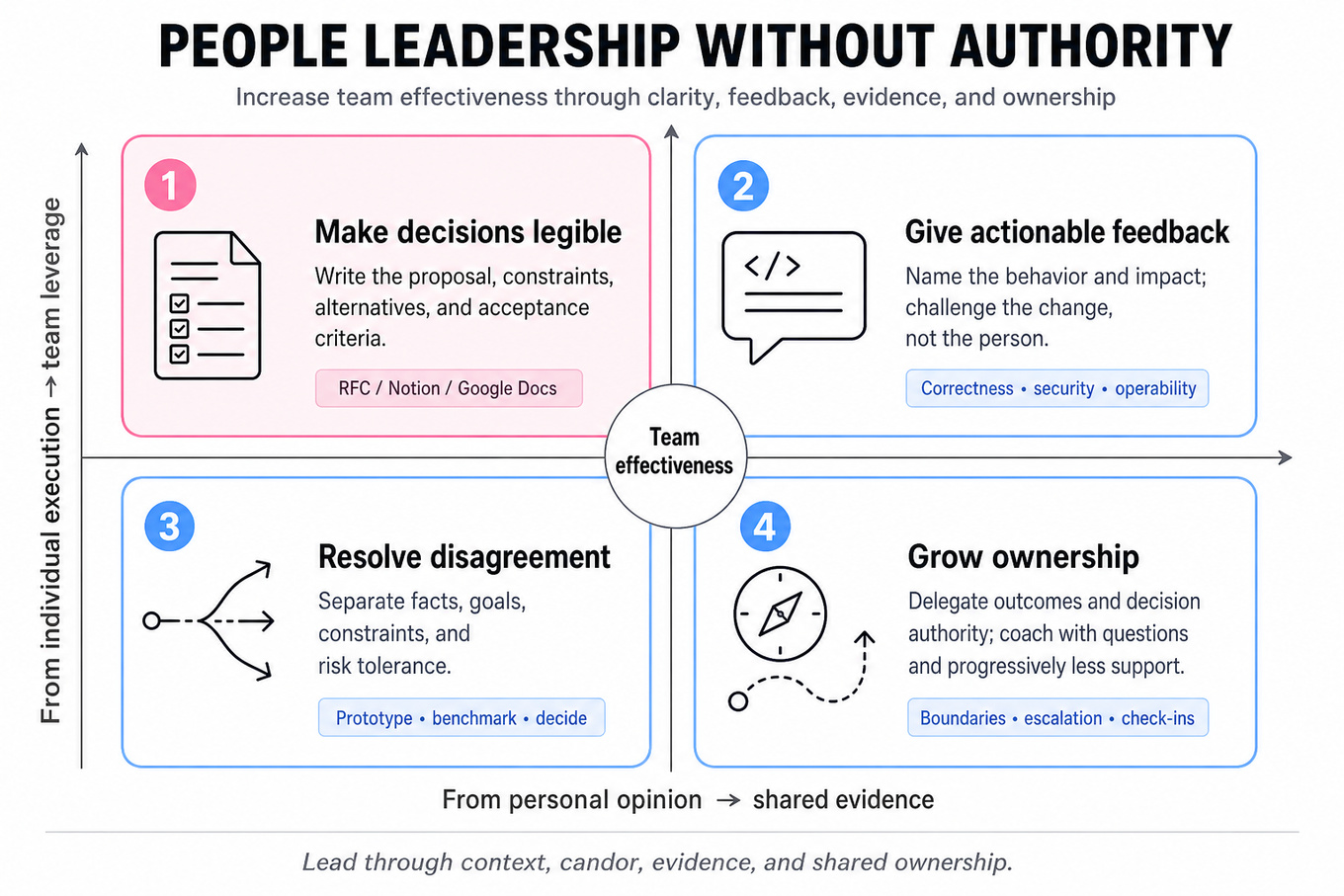
The interviewer is testing whether you can increase team effectiveness without formal authority: make technical decisions legible, give and receive actionable feedback, resolve disagreement, and help teammates grow. As a Software Engineer, the focus is not compensation, performance-rating processes, or organizational design; it is how your behavior affects code quality, delivery reliability, psychological safety, and operational ownership. Coinbase cares because high-risk financial systems require engineers who communicate clearly, challenge unsafe decisions, and support one another during ambiguity and incidents.
Core knowledge
-
Servant leadership means removing obstacles and improving the team’s ability to make sound decisions, not becoming the person who approves every pull request. Describe how you create leverage through context, delegation, standards, and coaching.
-
Technical influence without authority relies on a written proposal, explicit constraints, alternatives, and measurable acceptance criteria. A design document in
Google Docs,Notion, or an RFC repository scales better than repeated hallway conversations or positional arguments. -
Constructive feedback should be specific, timely, behavior-based, and connected to impact: “The retry loop hides the upstream failure and increased
p99latency,” rather than “You need to think more about reliability.” Ask for the other person’s perspective before prescribing a solution. -
Radical candor combines direct challenge with genuine care. In a code review, separate the person from the change, distinguish blocking correctness issues from preferences, and explain why a concern matters for security, operability, or maintainability.
-
Disagreement resolution starts by identifying whether the conflict concerns facts, goals, constraints, or risk tolerance. Write down competing options, gather evidence with a prototype or benchmark, assign a decision owner, and record the outcome rather than seeking endless consensus.
-
Delegation should transfer both responsibility and decision authority. Define the outcome, boundaries, interfaces, escalation conditions, and check-in points; avoid “delegating” implementation while retaining every meaningful decision yourself.
-
Mentoring is different from solving someone’s problem. Use questions, pairing, targeted examples, and progressively reduced support; evaluate improvement through observable outcomes such as independently leading a design review or debugging a production issue.
-
Psychological safety is compatible with high standards. Teams should be able to report a mistaken deploy, suspicious transaction behavior, or an unsafe design early, while still using blameless analysis and concrete corrective actions.
-
Incident leadership requires calm role separation: an incident commander coordinates, an investigator tests hypotheses, and a communications owner posts updates. During a
PagerDutyevent, prioritize mitigation and customer impact over proving who introduced the defect. -
Accountability means making commitments, surfacing risk early, and following through on corrective actions. A strong answer distinguishes an individual mistake from a system weakness such as unclear ownership, missing alerts, unsafe defaults, or an overloaded on-call rotation.
-
Inclusive technical discussion improves decision quality. Invite dissent before convergence, prevent the loudest voice from dominating, rotate presentation opportunities, and use written pre-reads so contributors do not need to improvise in a high-pressure meeting.
-
Growth feedback should connect a person’s goals to engineering opportunities: owning an API migration, improving the test strategy, or leading an operational review. Do not promise promotions or compensation outcomes; instead, clarify observable expectations and create opportunities to demonstrate them.
Worked example
Representative scenario: “Tell me about a time you disagreed with a teammate on a technical decision.” In the first 30 seconds, clarify the system context, the decision at stake, the constraints, each person’s concern, and the eventual customer or operational impact. Frame the answer around four pillars: shared goal, competing options, evidence-based decision, and relationship or team outcome. Explain that you would first restate the teammate’s argument to verify understanding, then compare options against reliability, latency, security, delivery time, and long-term ownership. A concrete tradeoff might be choosing a simpler synchronous path for an initial release instead of introducing an asynchronous Kafka workflow whose operational complexity the team could not yet support. State how you made the decision reversible where possible, documented the rationale, and invited a review after real production data. Close by explaining what changed in your own behavior, such as writing decision criteria before advocating for a preferred design. If you had more time, you would also describe how you checked whether the disagreement reflected a broader team concern or an unclear architectural principle.
A second angle
Representative scenario: “Tell me about a time you helped a teammate who was struggling.” The same leadership principles apply, but the central constraint is development rather than technical consensus. Start by separating observed behavior from assumptions, asking what is blocking the person, and agreeing on a specific outcome such as independently shipping a change or owning an incident follow-up. Use pairing, smaller milestones, and deliberate handoffs rather than taking over the work. Measure success by increased autonomy and confidence, not merely by finishing the immediate task.
Common pitfalls
Pitfall: Saying “I resolved the disagreement by choosing the best technical solution” skips the people dimension and often sounds like authority-based decision-making. Explain how you defined evaluation criteria, incorporated dissent, made ownership explicit, and preserved the working relationship.
Pitfall: Giving a long chronology with vague references such as “we discussed it a lot” makes your role difficult to assess. Use a compact structure—context, conflict, actions, result, lesson—and name the exact conversation, artifact, or behavior that changed the outcome.
Pitfall: Treating mentorship as answering questions or reviewing code more quickly is a weak answer. Show how you diagnosed the learning gap, calibrated support, transferred ownership, and verified that the teammate could handle a similar situation independently.
Connections
The interviewer may pivot to incident response, code review culture, technical decision records, on-call sustainability, or conflict management. Be ready to connect people leadership to measurable engineering outcomes such as escaped defects, review latency, deployment frequency, change-failure rate, and retention of operational knowledge.
Further reading
-
The Manager’s Path — Camille Fournier’s practical treatment of mentorship, feedback, and engineering leadership.
-
An Elegant Puzzle — Will Larson’s framework for engineering effectiveness, organizational constraints, and leadership leverage.
-
Accelerate — Research-backed engineering metrics connecting team practices with delivery and reliability outcomes.
Related concepts
- M7 Org Strategy And Execution
- M7 Architecture Review And Technical Strategy
- L7 Technical Leadership and Architecture Trade-offs
- Behavioral Ownership, Impact, And LeadershipBehavioral & Leadership
- Adobe senior engineer ownership and cross-team impact stories
- Behavioral Leadership And Stakeholder ManagementBehavioral & Leadership