Memory Allocator Design
Asked of: Software Engineer
Last updated
What's being tested
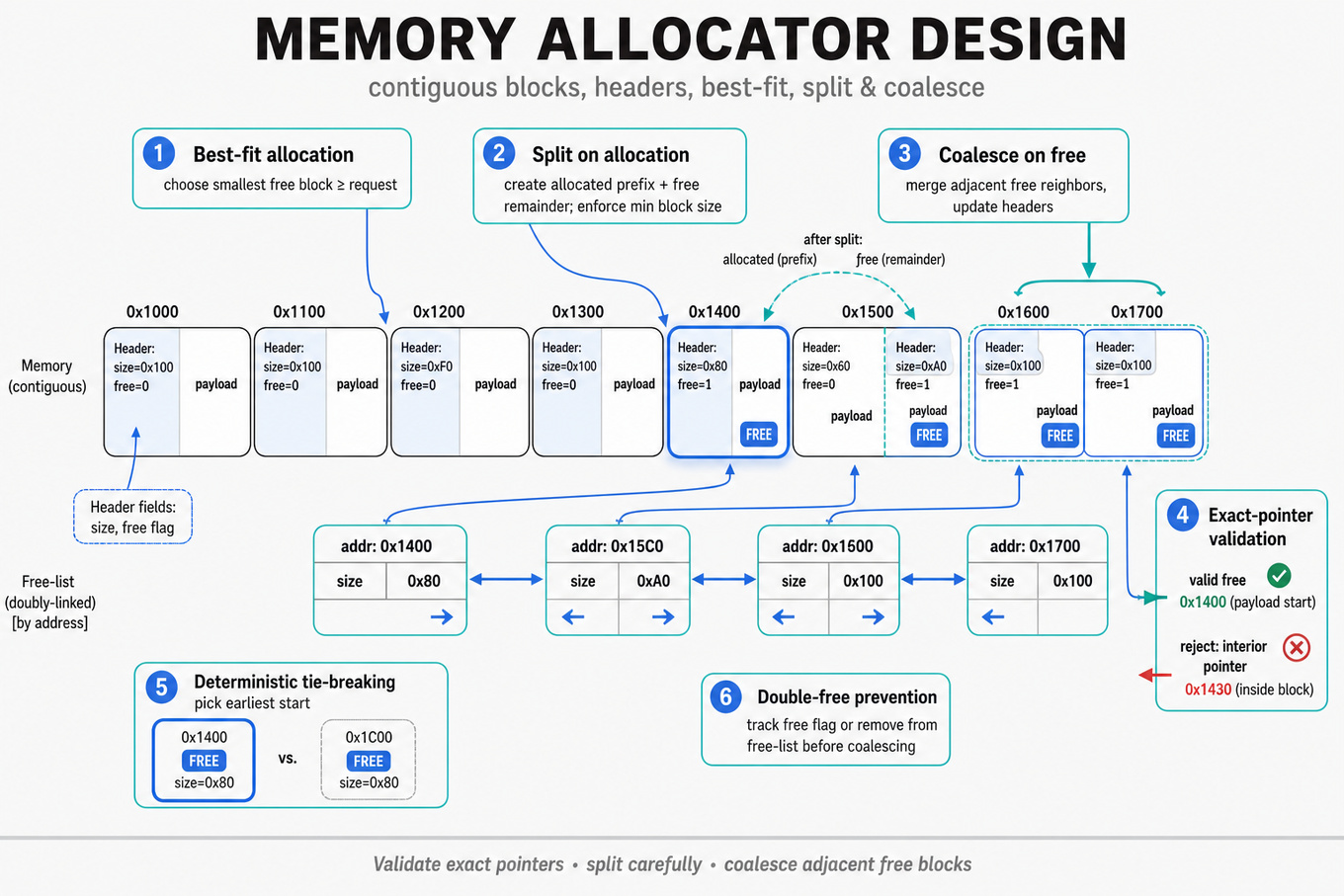
These problems test designing a contiguous memory allocator: managing a linear address space with best-fit allocation, splitting, and coalescing of free blocks. Interviewers probe data-structure choices, correctness for malloc/free semantics (including double-free detection and pointer validation), and deterministic tie-breaking under equal-fit scenarios.
Patterns & templates
-
Free-list as ordered list — maintain a list of (start, size, free) blocks; scan for best-fit in
O(b)time where b = number of blocks. -
Block header layout — store metadata (size, free flag) adjacent to block; use pointer arithmetic for successor/predecessor.
-
Split on allocation — when a free block > requested, carve prefix/suffix and update headers; watch minimum block size to avoid tiny fragments.
-
Coalesce on free — merge adjacent free neighbors by checking neighboring headers in
O(1)if doubly-linked,O(b)otherwise. -
Exact-pointer validation — accept frees only when pointer matches a block's payload start; reject interior or null frees deterministically.
-
Deterministic tie-breaking — prefer earliest-start or lowest-index block on equal sizes to make behavior testable and reproducible.
-
Optional optimizations — use segregated free lists or balanced tree (interval tree / ordered set) to reduce allocation/search to
O(log b)at space cost.
Common pitfalls
Pitfall: Returning an interior pointer or allowing frees of non-exact pointers — always validate pointer equals the block’s payload start.
Pitfall: Forgetting to prevent double-free — track a free flag or remove freed block from free-list before coalescing.
Pitfall: Splitting without enforcing minimum block/header size — leads to unusable tiny fragments and incorrect pointer arithmetic.
Practice these
the practice cards below cover the canonical variants — solve all of them and time yourself
Practice questions
- Implement a Simple Memory AllocatorOpenAI · Software Engineer · Onsite · medium
- Implement a Contiguous Memory Allocator with Primitive ListsOpenAI · Software Engineer · Technical Screen · hard
- Implement a memory allocator with malloc/freeOpenAI · Software Engineer · Technical Screen · medium
- Implement a Simulated Memory AllocatorOpenAI · Software Engineer · Technical Screen · medium
Related concepts
- C++ And Virtual Memory FundamentalsSoftware Engineering Fundamentals
- Mutable Data Structures And O(1) DesignCoding & Algorithms
- Linked Lists, Pointers, Caches, And In-Memory StoresCoding & Algorithms
- Linked Lists, Stacks, Caches, And Pointer TechniquesCoding & Algorithms
- Interval, Boundary, And Monotonic Stack AlgorithmsCoding & Algorithms
- Greedy, Heaps, And Scheduling OptimizationCoding & Algorithms