SQL Cohort, Retention, And Churn Analysis
Asked of: Data Scientist
Last updated
What's being tested
Demonstrates manipulation of SQL event-level logs to construct cohort analysis, compute retention and churn, and produce per-variant aggregates. Interviewer probes deduplication, time-windowing, correct cohort alignment, and clear assumptions about first-touch vs. triggered cohorts.
Patterns & templates
-
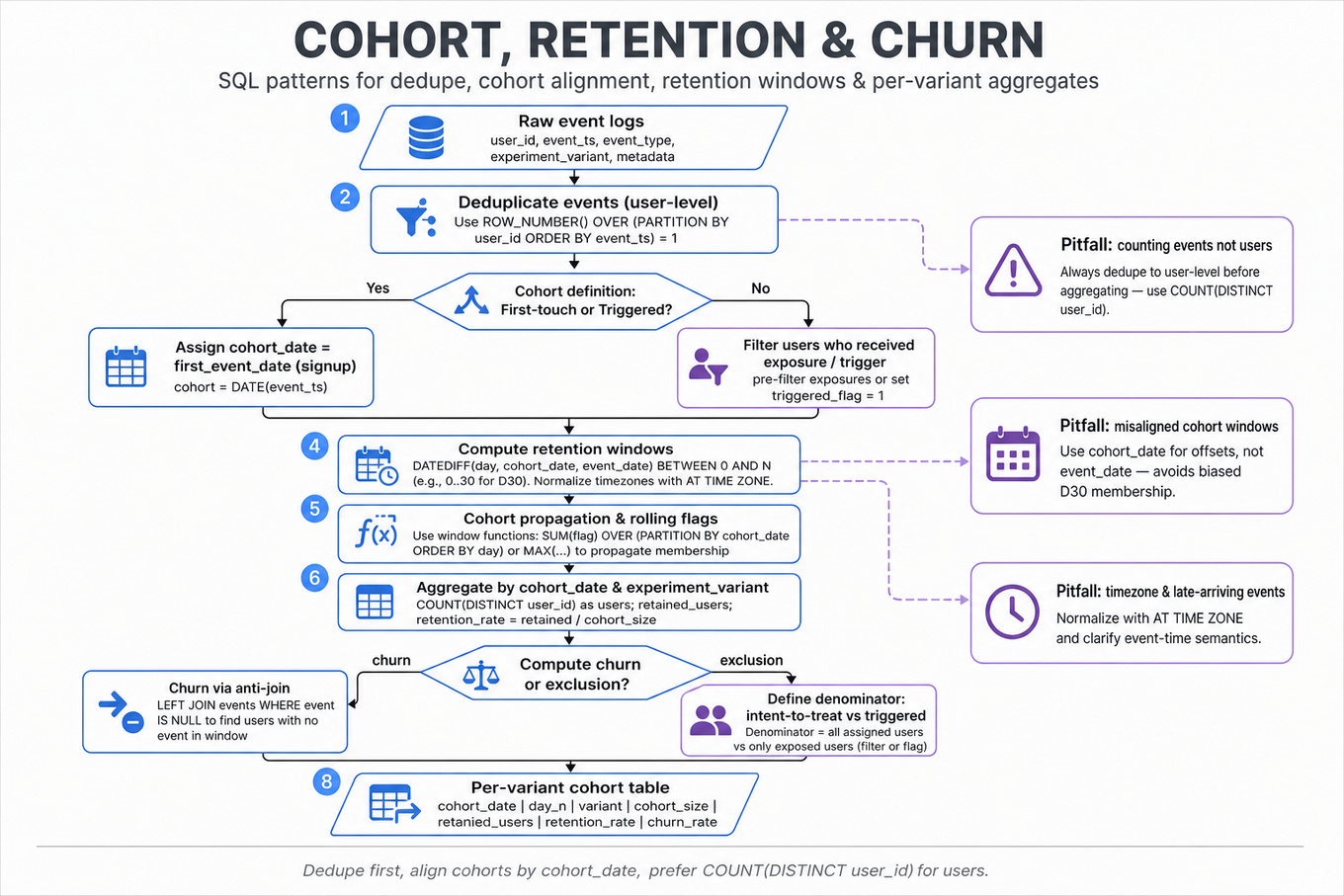
ROW_NUMBER()for deduplication — useROW_NUMBER() OVER (PARTITION BY user_id ORDER BY event_ts)to pick first/last event per user. -
Window functions for rolling/cohort flags —
SUM(...) OVER (PARTITION BY cohort ORDER BY day)orMAX(...)to propagate cohort membership. -
Date arithmetic for retention windows —
DATEDIFF(day, signup_date, event_date) BETWEEN 0 AND 30for D30 retention; watch timezone. -
COUNT(DISTINCT ...)for unique-user metrics; prefer approximate (hyperloglog) only for very large cardinalities. -
Anti-join / LEFT JOIN ... WHERE null to compute churn/exclusion (users who didn’t convert or perform event).
-
Intent-to-treat vs triggered — define the denominator: all assigned users vs. only those who received exposure; implement with pre-filtering or flags.
-
Aggregate by variant/date — group by
experiment_variant,cohort_dateand compute rates withSUM(events)/COUNT(users); includeNULL-handling.
Common pitfalls
Pitfall: Counting events instead of unique users — leads to inflated retention; always dedupe on user-level before aggregating.
Pitfall: Misaligned cohort windows (using event_date instead of signup_date) — yields wrong D30 membership and biased churn.
Pitfall: Ignoring late-arriving events or timezone differences — clarify event-time semantics and apply
AT TIME ZONEor consistent normalization.
Practice these
The practice cards below cover the canonical variants — solve all of them and time yourself.
Practice questions
- Write SQL for repeat churnOpenAI · Data Scientist · Technical Screen · hard
- Write SQL for post-trial conversion cohortsOpenAI · Data Scientist · Technical Screen · medium
- Write SQL to compute signup and retention liftOpenAI · Data Scientist · Technical Screen · medium
- Compute signup rate and retention from raw logsOpenAI · Data Scientist · Technical Screen · easy