What to expect
Prepare for Software Engineer interviews at Altinity by connecting technical fundamentals to memory ownership and analytical reliability. This guide gives you six focused practice questions, an illustrated design exercise and a study plan with concrete outputs. Use it to build answers you can explain and test, then adjust the emphasis to the actual team and assessment.
Altinity's official company resource provides background on production ClickHouse services and open-source data infrastructure. That context helps you ask better questions about users and product constraints. It does not establish a required interview language, a fixed sequence of rounds or a promised set of questions.
Explore six guide-only practice questions →
Build a role brief before you study
A useful starting question for this domain is how a team would detect and recover from an acknowledged analytical ingestion batch being retried after a connection failure. Write down who is affected, what they should be able to trust and which component owns the accepted state. This is an original practice scenario, not a description of Altinity's internal architecture.
Read the vacancy with three columns in your notes: a stated requirement, an example from your work that demonstrates it, and an uncertainty to ask about. Separate an explicit language or framework requirement from a tool you happen to prefer. If the role is mainly frontend, focus on state, accessibility and browser behavior; if it is infrastructure-oriented, bring deeper evidence about concurrency, failure recovery and operation under load.
Ask the recruiter which assessments apply, whether work is live or take-home, what tools are permitted and how seniority changes the expected depth. Make those answers change your preparation. A timed coding discussion calls for a different rehearsal from a project review or a collaborative debugging session.
Choose your first practice session
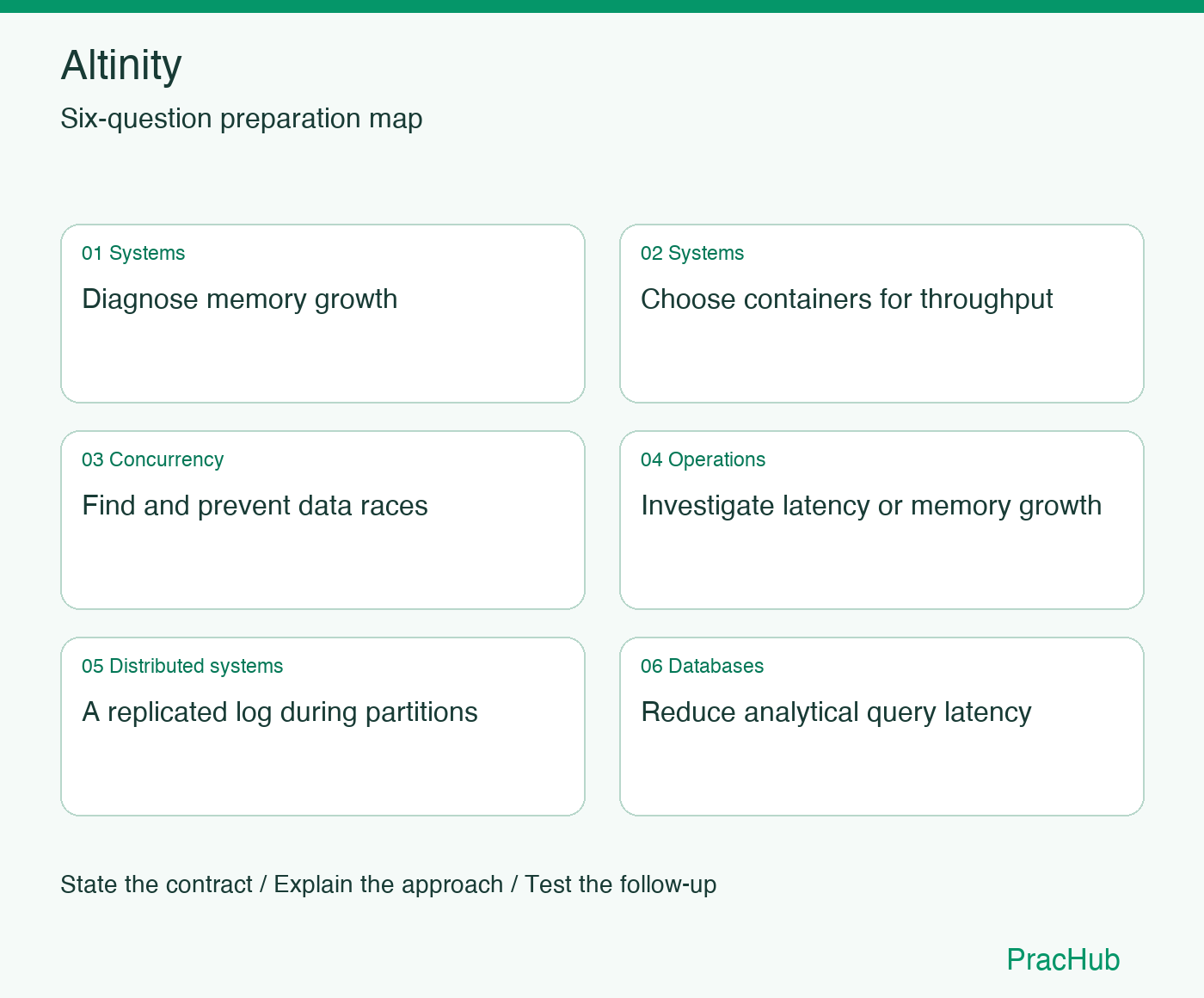
Begin with diagnose memory growth, choose containers for throughput, find and prevent data races. Read each prompt without its answer, state the contract aloud and attempt a solution before checking the approach. The follow-ups are designed to expose assumptions, so write the changed requirement before changing your implementation.
For a coding task, retain one small example with expected output. For a design task, draw the state owner and one failure boundary. For a project question, identify your own decision and the evidence behind it. These artifacts make gaps visible much faster than rereading an explanation you already recognize.
Guide-only practice question bank
These six practice topics are selected from the published third-party guide. PracHub supplies the clarified problem statements, solution approaches and follow-ups. Treat them as preparation material; their inclusion does not independently verify that this employer asked them.
Diagnose memory growth
Practice prompt: How would you manage allocations and prevent leaks in a long-running server?
Solution approach:
- Establish whether resident memory growth comes from a growing live set, an intentionally retained cache, fragmentation or temporary allocation bursts. Compare profiles at similar workloads rather than treating every rise in memory as a leak.
- In C++, use ownership and scoped resource management; in Go, examine retained references and goroutines that never exit. Garbage collection does not release objects still reachable through an unbounded map. Bound cache size, queue length and connection lifetime.
- Replay a steady workload and observe whether retained memory stabilizes after warm-up. Test cancellation and error paths, where buffers or workers may outlive their useful work. Keep a reproducer and a profile comparison as evidence for the fix.
Follow-up: How would you distinguish a retained-object leak from high allocation churn?
Choose containers for throughput
Practice prompt: Explain container tradeoffs for a high-throughput application.
Solution approach:
- List the required operations: append, lookup, ordered traversal, removal or stable references. A contiguous sequence can make scans efficient; a hash map supports expected fast lookup but adds hashing and memory overhead.
- Estimate retained bytes per entry, allocations and cache behavior. Reserve capacity when justified, but avoid allocating for an imagined peak. In C++, address iterator and reference invalidation when a container grows or erases elements.
- Benchmark realistic key distributions and object sizes. Include a hot-key case, a miss-heavy case and resizing. Explain which result would make you change representations; Big O alone does not predict every latency difference.
Follow-up: When would a sorted vector be preferable to a hash table?
Find and prevent data races
Practice prompt: How does your language handle concurrency, and what race risks remain?
Solution approach:
- Start with shared state and its invariant. Two goroutines incrementing a counter without synchronization can lose updates or race; protecting only the write while leaving reads unprotected is not sufficient.
- Choose a mutex, atomic operation or ownership through message passing according to the invariant. A thread-safe container does not make a read-then-write sequence atomic. State lock order and avoid holding a lock while waiting on a slow external dependency.
- Exercise the code under a race detector and representative concurrent tests. A clean test run only covers schedules that occurred. Include shutdown, cancellation and error handling to find workers blocked forever or accessing resources after cleanup.
Follow-up: How would you keep a multi-field state transition atomic?
Investigate latency or memory growth
Practice prompt: Diagnose a production performance problem without guessing the cause from one symptom.
Solution approach:
- Compare normal and affected periods, then separate queueing, computation, dependency waits and data volume. For memory, distinguish a growing live set from allocation churn or expected caching.
- Use profiles, traces and representative inputs to test a specific hypothesis. Avoid broad configuration changes that destroy evidence or move the bottleneck.
- Validate correctness and resource usage after the fix. Record workload assumptions and guard against recurrence with a signal tied to the original failure.
Follow-up: How would you investigate a problem that appears only under sustained load?
A replicated log during partitions
Practice prompt: Design a distributed log that preserves data integrity during a network partition.
Solution approach:
- Define what an acknowledgement promises: accepted by one node or durably replicated to a quorum. Assign sequence and partition ownership explicitly, and distinguish a client retry from a new append using an operation identifier.
- Prevent two leaders from independently accepting incompatible writes through a quorum-based protocol and fencing of stale leadership. If the required quorum is unreachable, reject or delay writes under this contract rather than claiming both unlimited availability and strong ordering.
- Test a leader failure before acknowledgement, a lost acknowledgement after commit and a partition that later heals. Consumers may replay records; define checkpointing and duplicate handling. Per-partition ordering does not automatically provide one global order across all producers.
Follow-up: What can a client safely infer when an append times out?
Reduce analytical query latency
Practice prompt: How would you reduce latency when querying a very large analytical dataset?
Solution approach:
- Capture the query, its parameters, scanned rows and bytes, CPU, memory and wait time. Compare plans and workloads before adjusting cluster size. One poorly selective query may read far more data than the caller expects.
- Match sorting and partitioning choices to actual filters and aggregation patterns. Pre-aggregation or materialized results can reduce repeated work but introduce freshness, storage and maintenance tradeoffs. Bound query concurrency so one heavy query cannot exhaust every worker.
- Compare results for correctness and measure cold and warm runs separately. Include skew, wider time ranges and concurrent ingestion. State whether the improvement comes from less scanned data, better parallelism or cached results rather than reporting a single unexplained timing.
Follow-up: How would you prevent a fast approximate result from being mistaken for an exact answer?
Worked example: ingestion retries and bounded memory
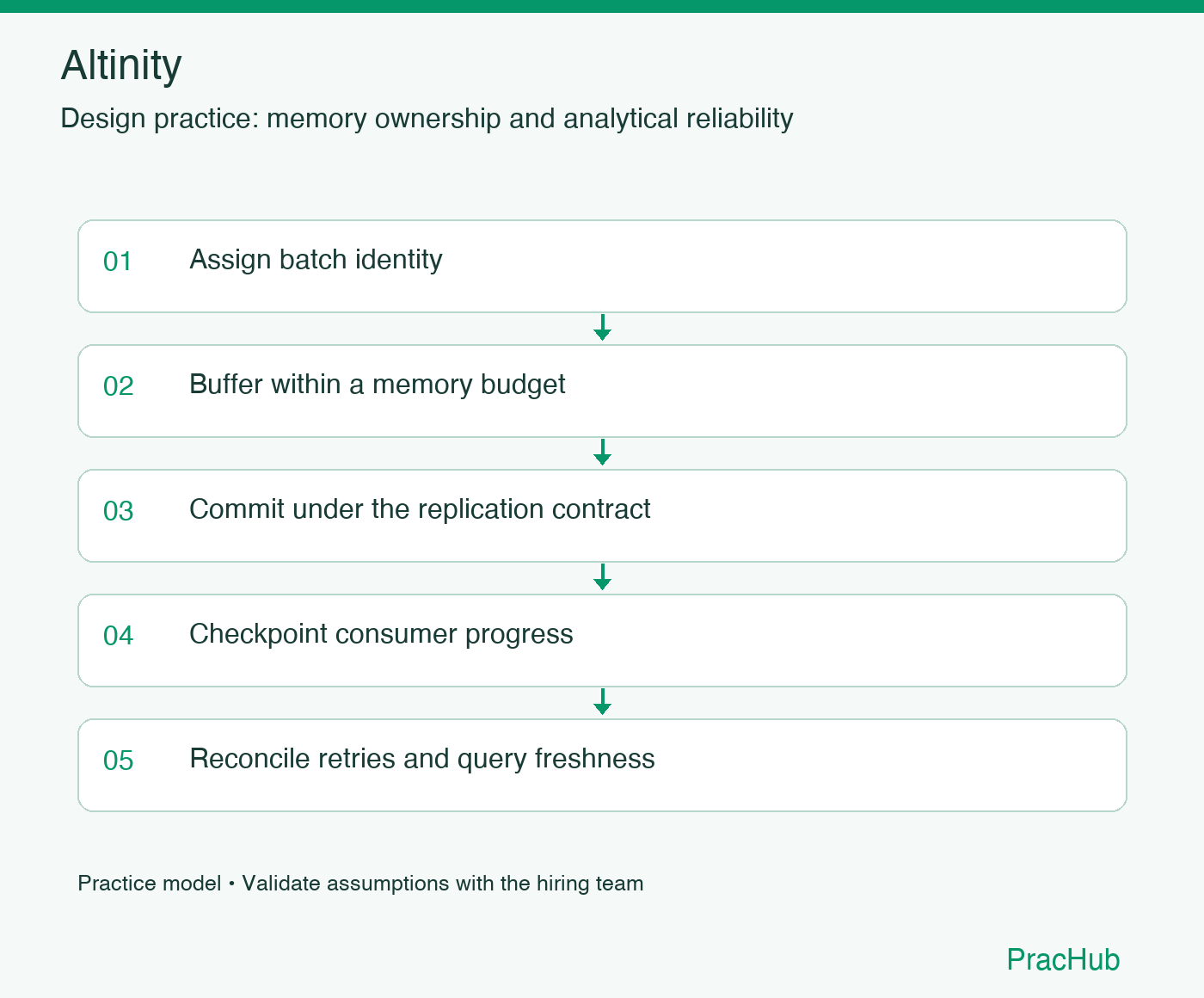
Consider an ingestion worker that sends analytical batches to a replicated store. A response is lost after a write may have committed, so the worker retries. Meanwhile incoming events accumulate faster than the store accepts them. This original exercise connects memory management, concurrency, log integrity and analytical query performance; it is not a description of Altinity's service architecture.
Separate a durable acknowledgment from a received request
State what acknowledgment promises before choosing a replication scheme. Receipt by one process, local persistence and persistence under a quorum contract are different events. A majority-quorum log generally needs the appropriate election and fencing rules as well as enough reachable members to accept a write safely. During a partition, promising progress on both sides can conflict with the chosen single-history contract.
Assign a stable batch identity before the first attempt and retain it across retries. The consumer checkpoint should advance only after the required acknowledgment. A timeout is an uncertain outcome: the batch may be committed even though the caller received no response. Reusing its identity allows a correctly designed deduplication mechanism to recognize the repeat. Do not describe all ClickHouse ingestion paths as exactly-once; the relevant table engine, settings and deduplication window need explicit verification.
Budget retained work in bytes
A queue limit measured only in batches is unreliable when batch sizes vary. As a hypothetical budget, allowing 128 queued batches of at most 2 MiB accounts for 256 MiB of payload. It excludes object overhead, decompression buffers, active requests and temporary copies. Include those allocations and operational headroom before setting a process memory limit.
When the budget is exhausted, choose an explicit behavior: block producers, spill to a bounded durable store or reject work so it can be retried upstream. An unbounded queue converts a downstream slowdown into an out-of-memory failure. Track queue bytes, oldest-item age, ingestion throughput and retry rate to distinguish temporary bursts from sustained overload.
Container selection matters at this boundary. A contiguous buffer can improve iteration locality, but growth may allocate and copy substantial memory. A linked structure avoids some moves while adding per-node overhead and poorer locality. Benchmark the actual ownership and access pattern, including peak retained memory; do not choose from asymptotic lookup cost alone.
Make one owner responsible for each checkpoint
Imagine two workers complete batches for the same partition out of order. Advancing the checkpoint to the later completion can skip unfinished earlier work. Track the highest contiguous completed position, or serialize checkpoint ownership for that partition. A mutex around an individual map access does not fix an incorrect checkpoint rule.
Use the language's race tooling on realistic concurrent tests. A clean run only describes the schedules exercised; inspect ownership and synchronization even when the detector reports nothing. Repeat a retry during shutdown, a worker crash after acknowledgment and a stale worker attempting to update a checkpoint.
Diagnose the query separately from the ingest path
For a slow analytical query, compare its plan and rows or bytes read before changing cluster size. Check whether filters can eliminate data, whether the sort key matches the access pattern and whether repeated aggregation justifies a maintained aggregate. Measure the cost of building and refreshing that aggregate as well as its query-time benefit.
Keep a before-and-after record: query and parameters, dataset shape, warm or cold cache conditions, concurrent workload, elapsed time and scanned bytes. A faster repeat with a warm cache is not evidence that a schema change helped. Ask what freshness, correctness and resource tradeoffs the interviewer wants before selecting an optimization.
Explain your reasoning in the interview
Make the first answer small and correct
Begin with the contract and a simple approach. Explain its cost and limitations, then improve the part that conflicts with a stated constraint. If you propose an optimization, preserve a test that demonstrates the original behavior. In a design discussion, a small system with a clear failure contract is easier to evaluate than a large diagram with unnamed responsibilities.
Handle a changed requirement explicitly
When the interviewer adds concurrency, a larger dataset or a failing dependency, pause and name the assumption that changed. Describe what remains correct and which boundary needs revision. Do not restart the entire answer unless the new requirement invalidates the original model. This makes adaptation visible and gives the interviewer a chance to correct your interpretation early.
Bring a project story with evidence
Prepare an example relevant to memory ownership and analytical reliability. Explain the constraint, your personal contribution, an alternative you considered and the outcome you verified. If you lack professional experience in this domain, use a course or personal project honestly and describe what extra controls production work would need. Never invent traffic numbers, savings or responsibility to make the story sound more senior.
A two-week preparation plan
This is a suggested schedule, not Altinity's interview timeline. Move effort toward the confirmed assessment and the topics where your first attempt exposed a gap.
| Session | Concrete output |
|---|---|
| Days 1–2 | A role brief and an attempted answer to diagnose memory growth. |
| Days 3–4 | A tested answer to choose containers for throughput, including one failure or boundary case. |
| Days 5–6 | Rehearse find and prevent data races and explain a changed requirement. |
| Days 7–8 | Complete investigate latency or memory growth and compare your reasoning with its checklist. |
| Days 9–10 | Work through a replicated log during partitions and reduce analytical query latency. |
| Days 11–12 | Annotate the design diagram with ownership, failure and recovery. |
| Days 13–14 | Run a mock, repair the weakest answer and prepare questions for the team. |
After each session, record what you could not explain without looking at the answer. Turn that uncertainty into a small test, diagram or documented example. Repeating a question is useful when the second attempt demonstrates a specific improvement, such as a clearer invariant or a previously missed edge case.
Questions to ask the team
Ask which user workflow needs the most attention, how the team knows a change is working and where engineers spend time diagnosing failures. For Altinity, use the discussion of memory ownership and analytical reliability to make the questions concrete: which system owns the truth, which views may lag and who handles discrepancies between them?
Also ask how code reviews, production support and onboarding work for this specific role. The answers help you assess the work and prepare relevant examples without assuming that every team at one company has the same stack or responsibilities.
Frequently asked questions
Are these confirmed Altinity interview questions?
The six topics are selected from a third-party company guide; the problem clarifications, solution approaches, diagrams and follow-ups are PracHub preparation material. The third-party listing is not independent confirmation that this team asks these questions. Use current recruiter instructions for the actual format.
Do I need to use the language shown in a reference?
Use the language required by the assessment, or your strongest suitable language when there is a choice. Reference documentation helps verify behavior; it does not prove the employer requires that language. Be ready to explain your data structures and test cases without relying on memorized syntax.
What if I have only a weekend?
Complete the first two selected questions, trace the design failure above and prepare one honest project story. Prefer a few answers you can defend over a wide list of topics you cannot explain. For more exercises, use the PracHub Software Engineer question bank.
Sources and further reading
- Altinity: company background — context on production ClickHouse services and open-source data infrastructure; use the actual vacancy to establish role requirements.
- Dataford: Altinity Software Engineer guide — source of the selected practice topics, with PracHub-authored explanations and follow-ups. Its company-question attribution has not been independently confirmed.
- Effective Go — Review channels, goroutines and synchronization alongside the current language specification.
- Go data race detector — Use the detector to exercise concurrent code; passing tests do not prove absence of races.
- Google SRE: monitoring distributed systems — Use latency, traffic, errors and saturation to structure operational diagnosis.
- Microsoft architecture patterns — Compare documented patterns and their tradeoffs instead of treating a pattern name as a complete design.
- ClickHouse query optimization — Study query plans and scanned data before tuning.