
This guide is for software engineers preparing for a SoFi interview, from new grad to senior. It walks through every stage of the loop, what each interviewer is actually scoring, the topics worth drilling, and how to turn "correct solution" into "strong hire" in a regulated fintech environment where judgment and communication carry real weight.
What to expect
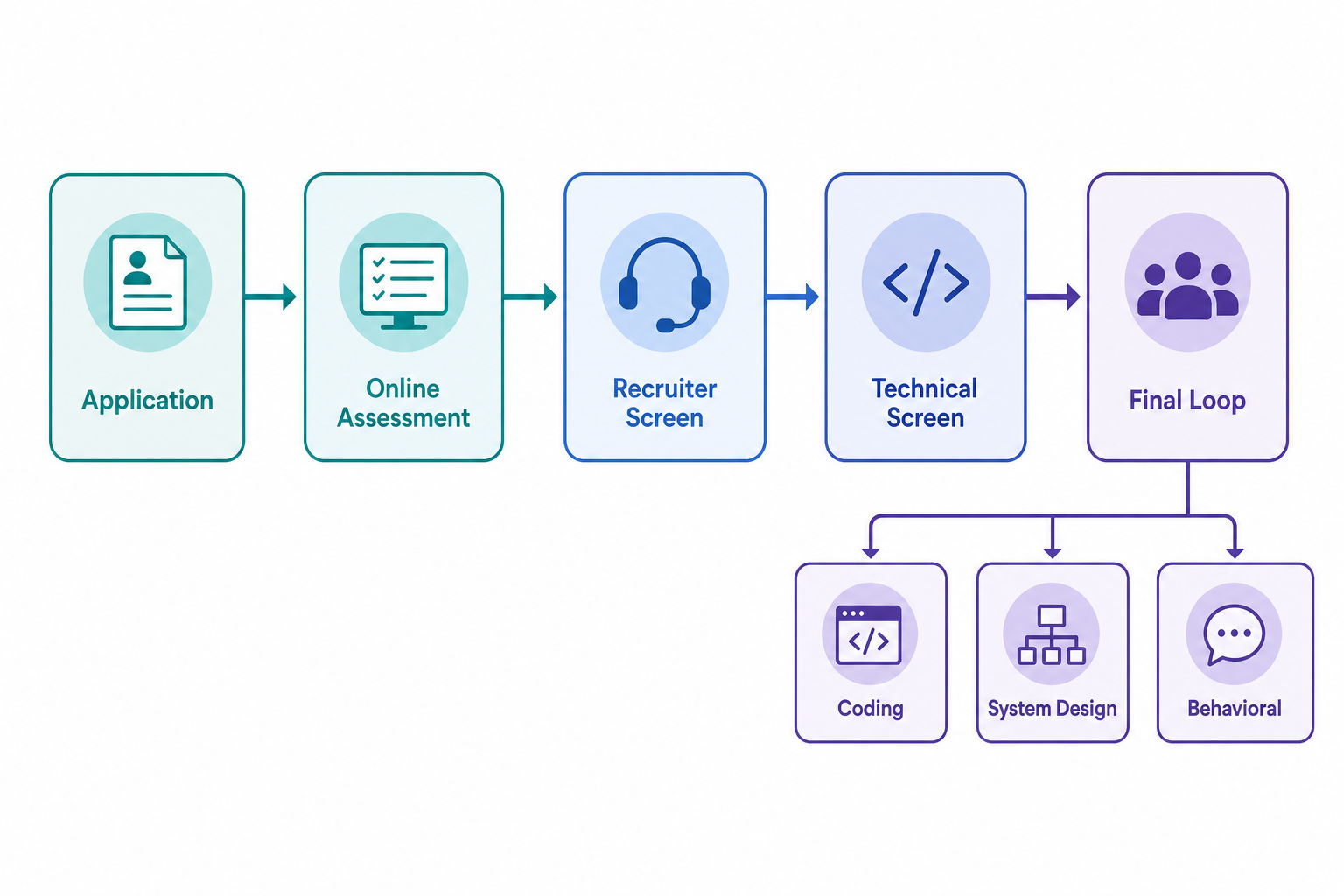
SoFi's software engineer interview is coding-heavy from the first technical round, but raw problem-solving alone won't carry you through. Interviewers consistently weigh how you communicate, how you handle edge cases, and whether you show the kind of accountability a fintech company cares about. A typical path looks like this:
- Application and resume review
- An online coding assessment (used for some roles, not all)
- A recruiter screen
- A live technical interview with an engineer
- A final loop of three to four interviews
For experienced candidates, the final loop usually adds a system design round and a hiring-manager or leadership conversation. New grads tend to see more weight on data structures and algorithms and less on design.
What sets SoFi apart is the pairing of classic algorithmic problem solving with close attention to values, judgment, and communication. Interviewers want more than a working solution. They look for whether you can explain tradeoffs, work through edge cases out loud, and bring the integrity and accountability expected when the product touches people's money.
The interview rounds at a glance
The exact lineup varies by team and level, so treat the table below as the common shape rather than a fixed script. Durations are typical ranges candidates report, not guarantees.
| Round | Typical length | Primary focus | Who usually sees it |
|---|---|---|---|
| Online assessment | ~60 min | Easy-to-medium DSA, correctness + speed | Some roles only (often new grad / high-volume) |
| Recruiter screen | ~30 min | Background, motivation, values fit, logistics | Everyone |
| Technical screen | ~60 min | Live coding, communication, edge cases | Everyone |
| Final loop coding | 45-60 min each | Deeper / medium-to-hard problems, consistency | Everyone |
| System design | 45-60 min | Service boundaries, scaling, tradeoffs | Mid-level and senior |
| Behavioral / hiring manager | 30-60 min | Judgment, collaboration, ownership | Everyone |
The rounds in detail
Online assessment or coding challenge
When SoFi uses an assessment for a role, it is typically a web-based coding test of around 60 minutes. Expect easy-to-medium algorithm questions in a familiar online-judge format, scored on correctness, speed, and core data-structure fluency. Some candidates report two medium problems; others see straightforward problems used mainly as an early filter. Treat it as a gate, not a place to be clever: get a correct, readable solution submitted, then optimize if time remains.
Recruiter screen
A roughly 30-minute call by phone or video. The recruiter checks your background, interest in SoFi, communication, logistics, and fit for the role. Knowing SoFi's values helps here, so come ready to explain why the company matches what you want next. A crisp two-minute summary of your background and one specific reason you're drawn to SoFi goes a long way.
Technical screen with an engineer
A live coding interview of about 60 minutes. Expect data structures and algorithms problems, with pressure to find an efficient solution while talking through your reasoning, edge cases, and tradeoffs. Some candidates report more than one coding question in a single hour, so pacing and clear communication matter as much as raw implementation. Browse the full question bank and our SoFi company page to calibrate the style and difficulty before you sit down.
Final onsite (or virtual onsite) loop
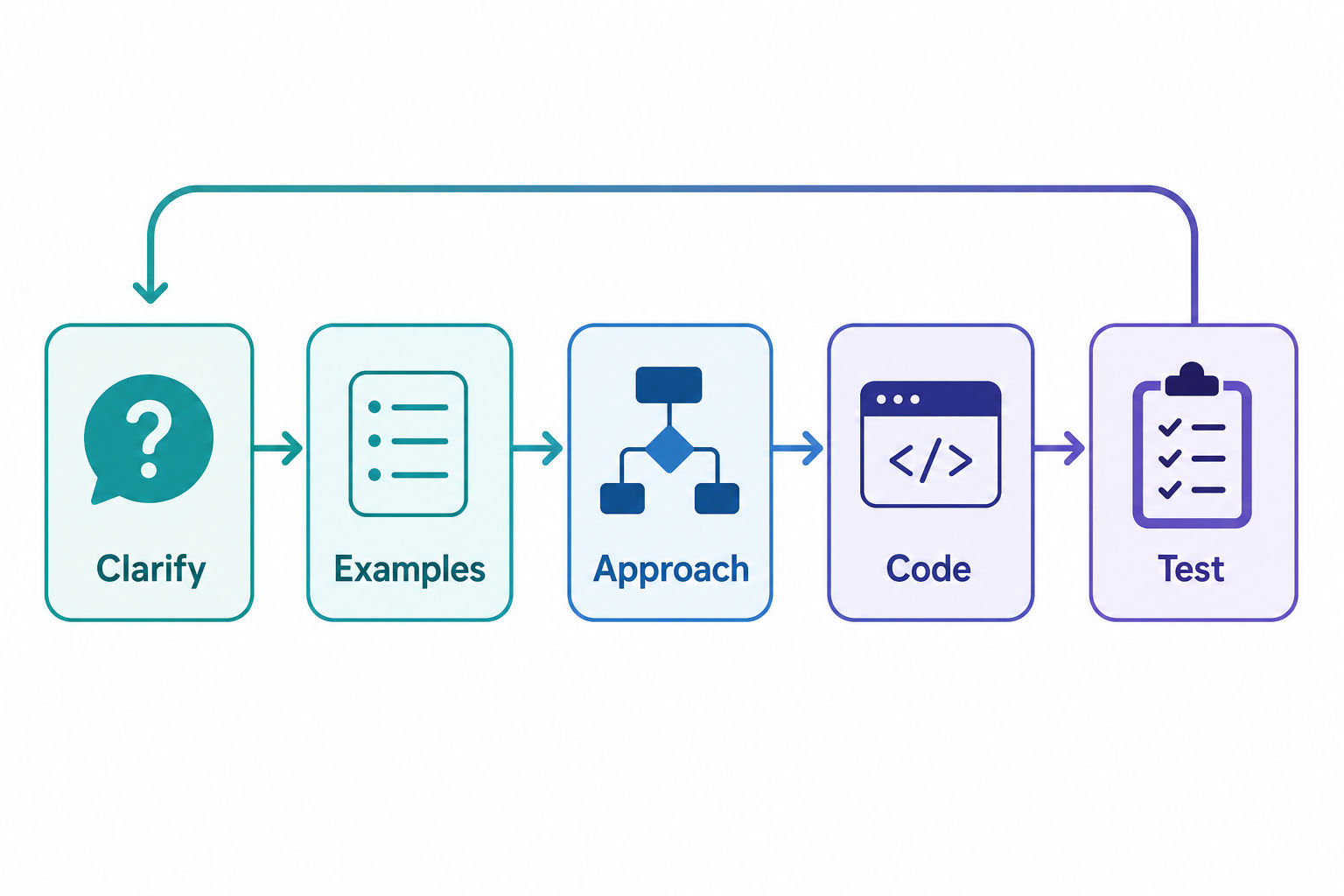
The final loop commonly includes three to four interviews, usually 45 to 60 minutes each. For software engineers, it often features one or more deeper coding rounds that test consistency, problem decomposition, and performance under pressure, sometimes at medium-to-hard difficulty. These later rounds can feel noticeably tougher than the initial screen, so build the stamina to solve a clean medium problem even when you're already tired.
System design
Experienced candidates should expect a dedicated 45- to 60-minute system design round in the final loop. It evaluates whether you can define service boundaries, reason about APIs and data flow, and discuss scaling, reliability, storage, and tradeoffs in a practical way. New grads are less likely to see this round; mid-level and senior candidates should plan for it.
A reliable structure: clarify requirements and scope, sketch the high-level components, define the data model and key APIs, then go deep on the one or two areas the interviewer pushes on (scaling, consistency, failure modes). For a clear walkthrough of that flow, this overview is a good primer:
Behavioral or hiring-manager round
This conversation usually runs 30 to 60 minutes and leans scenario-based rather than purely resume-driven. Expect questions about conflict with a manager, cross-functional collaboration, your first 30 to 60 days, or how you handle ambiguity and accountability. The goal is to gauge your maturity, teamwork, business judgment, and alignment with SoFi's mission. Structure answers with the STAR method (Situation, Task, Action, Result) so the interviewer can follow your reasoning without digging for it.
What they actually test
Data structures and algorithms are the core. Be comfortable with arrays, strings, hash maps, trees, graphs, and the common interview patterns, and expect to solve problems live under time pressure. Coding fluency, correctness, edge-case handling, and clean decomposition are all major evaluation criteria. Arriving at the answer silently isn't enough; how clearly you narrate your approach is part of the score.
For experienced hires, the bar widens beyond coding into system design and decision-making. You may need to design a service, explain how its components communicate, reason about scalability and persistence, and defend tradeoffs between speed, reliability, and complexity. Some teams also include SQL or occasional language-specific questions (for example, JavaScript), so the exact mix depends on the team. Browse the Software Engineer role page for the broader topic spread.
Behavioral and manager rounds test judgment and collaboration. Interviewers want evidence that you can work across engineering and business functions, make principled decisions, and connect technical choices to member outcomes in a setting where trust, correctness, and accountability genuinely matter.
One process note candidates have mentioned for the 2025-2026 cycle: some interviews may be recorded through a tool called BrightHire, used for interviewer note-taking rather than automated scoring, and this recording can often be declined before or during the interview. Treat the process as human-led, and decide in advance how you'd like to handle recording if it comes up.
Topics worth drilling
| Area | What to practice | Why it matters at SoFi |
|---|---|---|
| Arrays & strings | Two pointers, sliding window, hashing | The bread and butter of the screens |
| Hash maps & sets | Frequency counts, dedup, lookups | Fast, clean solutions interviewers expect |
| Trees & graphs | BFS/DFS, traversal, shortest path | Common in the deeper loop rounds |
| Sorting & searching | Binary search variants, custom comparators | Tests precision under time pressure |
| System design (senior) | APIs, data modeling, scaling, reliability | Core of the experienced-hire loop |
| SQL (some teams) | Joins, aggregation, window functions | Appears on data-adjacent teams |
You can drill all of these against real, company-tagged problems in the PracHub question bank.
How to prepare and stand out
- Practice coding out loud, not just on paper. SoFi's screens reward communication during problem solving, so narrate your assumptions, tradeoffs, and test cases as you code.
- Build stamina for multiple coding rounds. Many candidates face several technical interviews in a row, so train to solve medium problems cleanly even after an earlier screen or assessment.
- Learn SoFi's values before your recruiter call. Be ready to connect past decisions to accountability, integrity, principled judgment, learning, and member-focused thinking.
- Lean on high-correctness experience. Stories about preventing mistakes, handling risk, or balancing speed with reliability fit well with a fintech environment.
- For experienced roles, rehearse system design with concrete tradeoffs. Discuss service boundaries, reliability, persistence, APIs, and scaling in specific terms rather than vague architecture buzzwords.
- Bring cross-functional examples, not just coding wins. Show that you can align technical work with product and business outcomes, not just ship features in isolation.
- Decide how you'll handle recording in advance. If BrightHire recording comes up, knowing whether you're comfortable proceeding keeps you focused on the interview itself.
Example: turning a coding round into a strong signal
For instance, suppose you're asked to find the longest substring without repeating characters. A strong-hire version of that round isn't just a correct sliding-window solution. It sounds like: "Let me confirm the input can include any ASCII character. I'll use a sliding window with a hash map of last-seen indices, which gives O(n) time and O(k) space for the character set. Let me trace it on abcabcbb, then check the empty-string and single-character edge cases." Same algorithm, but the clarifying question, the stated complexity, and the explicit edge-case check are exactly the communication signals the rubric rewards.
Example: a behavioral answer that lands
Example answer to "Tell me about a time you balanced speed and correctness": "Situation: we were shipping a payments change under a deadline. Task: I owned the rollout. Action: rather than skip review to hit the date, I split the change behind a feature flag, shipped the safe path first, and added a reconciliation check before enabling the rest. Result: we hit the deadline on the visible feature with zero incorrect transactions." It's concrete, it shows ownership, and it ties a technical choice to a member-safe outcome.
How to Use This Page as a Prep Plan
Do not treat this as passive reading. Convert the ideas in this page into a short weekly loop: learn one idea, practice it under interview conditions, then write down what changed. That is the fastest way to turn advice into visible interview behavior.
| Prep area | What you need to prove | Practice artifact |
|---|---|---|
| Understand | Turn the prompt into a concrete goal. | Clarifying questions and success criteria. |
| Practice | Use realistic constraints and timed reps. | Worked examples with edge cases. |
| Explain | Make reasoning visible. | Tradeoffs, assumptions, and test strategy. |
| Improve | Review misses quickly. | A short feedback log and next action. |
For SoFi Software Engineer Interview Guide 2026, the strongest candidates usually do three things well: they make their assumptions explicit, they use concrete examples instead of vague claims, and they review mistakes quickly enough that the next practice rep is better than the last one.
FAQ
How hard is the SoFi software engineer interview?
The coding rounds tend to sit in the easy-to-medium range early and shift toward medium-to-hard in the final loop. Many candidates find the difficulty manageable if they've drilled core patterns and can communicate clearly; the harder part is staying clean across several back-to-back rounds.
Does SoFi ask system design questions?
Yes, for mid-level and senior candidates a dedicated system design round is common in the final loop. New grads are far less likely to see one. If you're applying to an experienced role, plan to rehearse end-to-end design with concrete tradeoffs.
What programming language should I use?
Use the language you're fastest and most accurate in for coding rounds; the interviewers care about your approach, not a specific language. Note that some teams include SQL or language-specific questions (for example, JavaScript), so check the role description for hints about the stack.
How should I prepare for the behavioral round?
Prepare several STAR-structured stories covering conflict, cross-functional work, ambiguity, and a time you balanced speed with reliability. Tie each one back to ownership and member outcomes, which fit SoFi's fintech context well.
What is BrightHire and do I have to be recorded?
BrightHire is a tool some interviewers use for note-taking, not automated scoring. Candidates have reported that recording can usually be declined before or during the interview. Decide your preference ahead of time so it doesn't distract you mid-round.
Where can I practice real SoFi-style questions?
Start with the PracHub question bank and filter by company and role, or read more company-specific guidance in Resources and the broader interview guide library.