This guide is for software engineers preparing for a TikTok (ByteDance) interview in 2026 - new grad through senior. It walks through the round-by-round structure, what each stage actually tests, the topics that show up most, and a concrete prep plan you can start today. Everything here is framed as guidance, not a promise: teams, levels, and locations vary, so treat the rounds below as a representative loop rather than a fixed script.
What to expect
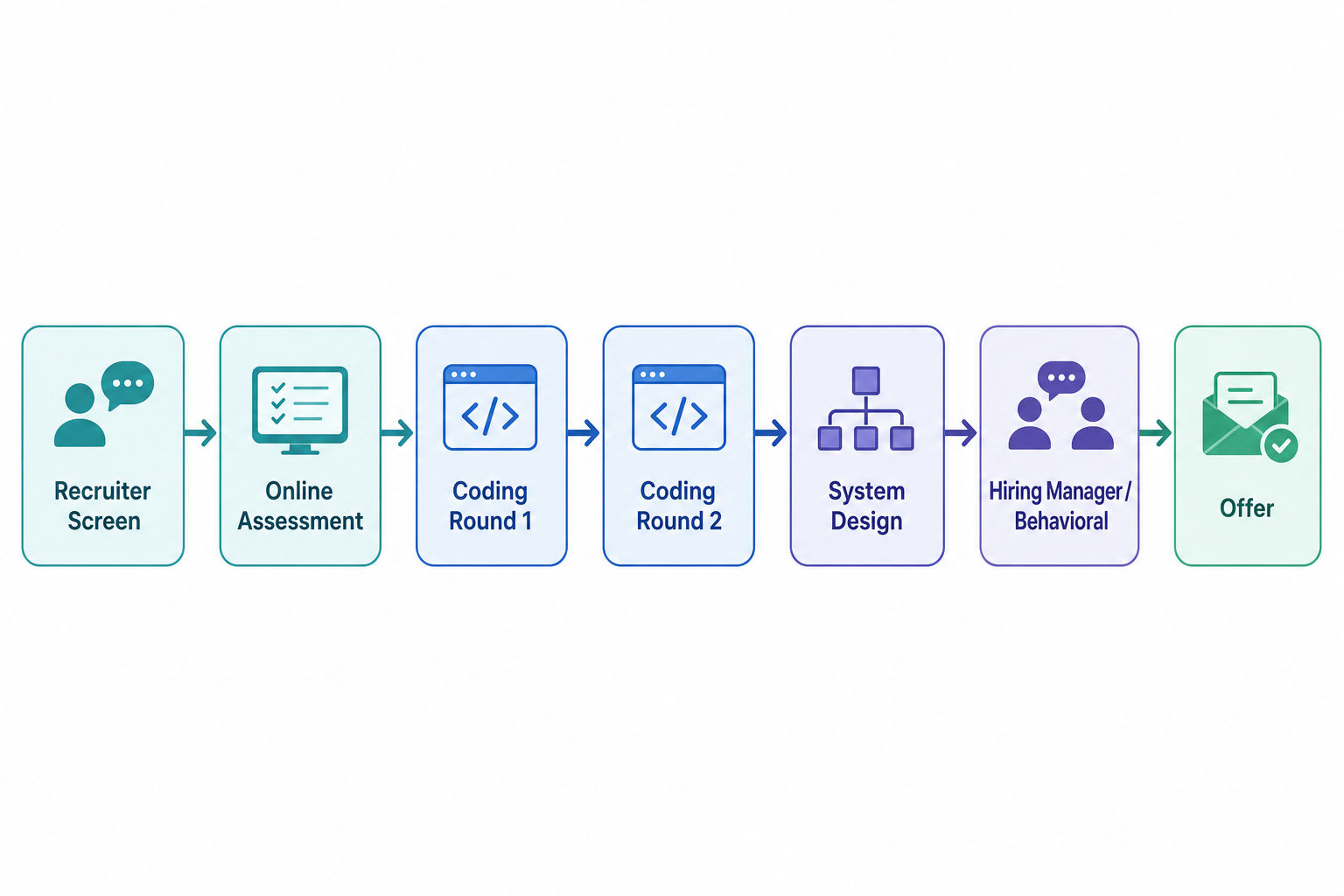
TikTok software engineer interviews in 2026 generally follow the broader ByteDance hiring process: a recruiter screen, an online assessment or initial coding step, several sequential technical rounds, and a final hiring manager or behavioral round. The most distinctive feature is the one-round-at-a-time structure. Instead of a single onsite loop where every interview happens on the same day, stages are often unlocked one by one, and you only advance after passing the previous round.
That structure changes how you should prepare. Each round is an independent bar to clear, so a strong coding round won't carry a weak system design round, and momentum can stall for weeks between stages. Plan for a process that can stretch across several weeks, and keep your skills warm the whole time.
Across the board, expect a coding-heavy process with a strong emphasis on implementation speed, edge-case handling, and clear communication under pressure. The bar is not just "solve the problem." TikTok consistently tests whether you can justify tradeoffs, validate your own code, and connect technical decisions to scale, reliability, and product impact. For mid-level and senior roles, system design leans toward large-scale consumer systems such as feeds, messaging, media delivery, and recommendation-adjacent infrastructure.
The interview rounds
The exact rounds vary by team, level, and location. A typical loop looks like the following.
| Round | Typical length | Primary focus | What clears the bar |
|---|---|---|---|
| Recruiter screen | ~25–45 min | Fit, motivation, logistics | Clear communication, genuine interest, role match |
| Online assessment | varies | Speed + correctness on DSA | Fast, correct solutions with good edge-case coverage |
| Coding round 1 | ~45–60 min | Live problem solving | Clean code under time pressure, complexity analysis |
| Coding round 2 | ~60 min | Deeper algorithms + follow-ups | Algorithmic depth, calm handling of constraints |
| Technical / domain | ~60 min | Project + role fundamentals | Real architectural understanding of your past work |
| System design | ~45–60 min | Large-scale design | Scalable, reliable design with reasoned tradeoffs |
| Hiring manager / behavioral | ~30–60 min | ByteStyle values | Ownership, candor, speed, learning under ambiguity |
Recruiter screen
A short call over phone or video. Expect a resume walkthrough plus questions about why TikTok or ByteDance, team and location fit, start date, work authorization, and compensation expectations. The recruiter is checking that your background matches the role and that you communicate clearly and show genuine interest. Treat it as a real round - a flat or evasive answer to "why TikTok" can stall an otherwise strong candidate.
Online assessment or initial coding screen
Often run on HackerRank or a similar platform, this step usually involves solving several data structure and algorithm problems, most around medium difficulty (some candidates get a harder question or an implementation-heavy task). It evaluates coding speed, correctness, complexity awareness, and your ability to handle edge cases with little scaffolding. There's rarely an interviewer to nudge you, so reading the constraints carefully and budgeting your time across problems matters as much as raw algorithm skill.
Technical coding round 1
A live coding round on a video call and shared editor. Expect one or two coding questions and to talk through your approach, code fluently, and debug in real time. Interviewers focus on whether you can produce a clean solution under pressure and clearly explain time and space complexity. The shared editor usually has no autocomplete or compiler help, so fluency in your chosen language's syntax is part of what's being measured.
Technical coding round 2
Usually deeper than the first coding interview. You may face one to three questions, often with stronger follow-ups and difficulty shifting toward medium-to-hard in later stages. Interviewers look for stronger algorithmic depth, cleaner handling of follow-up constraints, and steady communication while coding. A common pattern is a solvable base problem followed by a twist ("now the input is streaming," "now optimize for memory") to see how you adapt.
Technical or domain round
For some candidates - especially experienced hires and team-specific roles - there may be an additional technical round focused on domain knowledge and project depth rather than pure algorithm puzzles. This round often digs into your past systems, architecture choices, and fundamentals relevant to the team:
- Backend: caching, databases, APIs, concurrency, distributed systems.
- Frontend / mobile: rendering, lifecycle, performance, state management, client architecture.
System design round
Mid-level and senior candidates commonly get a system design interview, while new grads may instead see a lighter architecture discussion. You might be asked to design a messaging app, feed service, notification system, media-sharing platform, or another large-scale consumer feature in the TikTok product space. Interviewers evaluate scalability, API and storage design, reliability, latency tradeoffs, and whether you can make practical architecture decisions rather than recite a textbook diagram.
Hiring manager / behavioral round
A final round by video. Expect questions on ownership, disagreement, ambiguity, execution speed, failure, and feedback, plus "why TikTok." This is where alignment with ByteStyle (ByteDance's values) is tested most explicitly: interviewers want evidence that you are candid, pragmatic, collaborative, and able to move quickly in a high-growth environment.
What they test
Data structures and algorithms
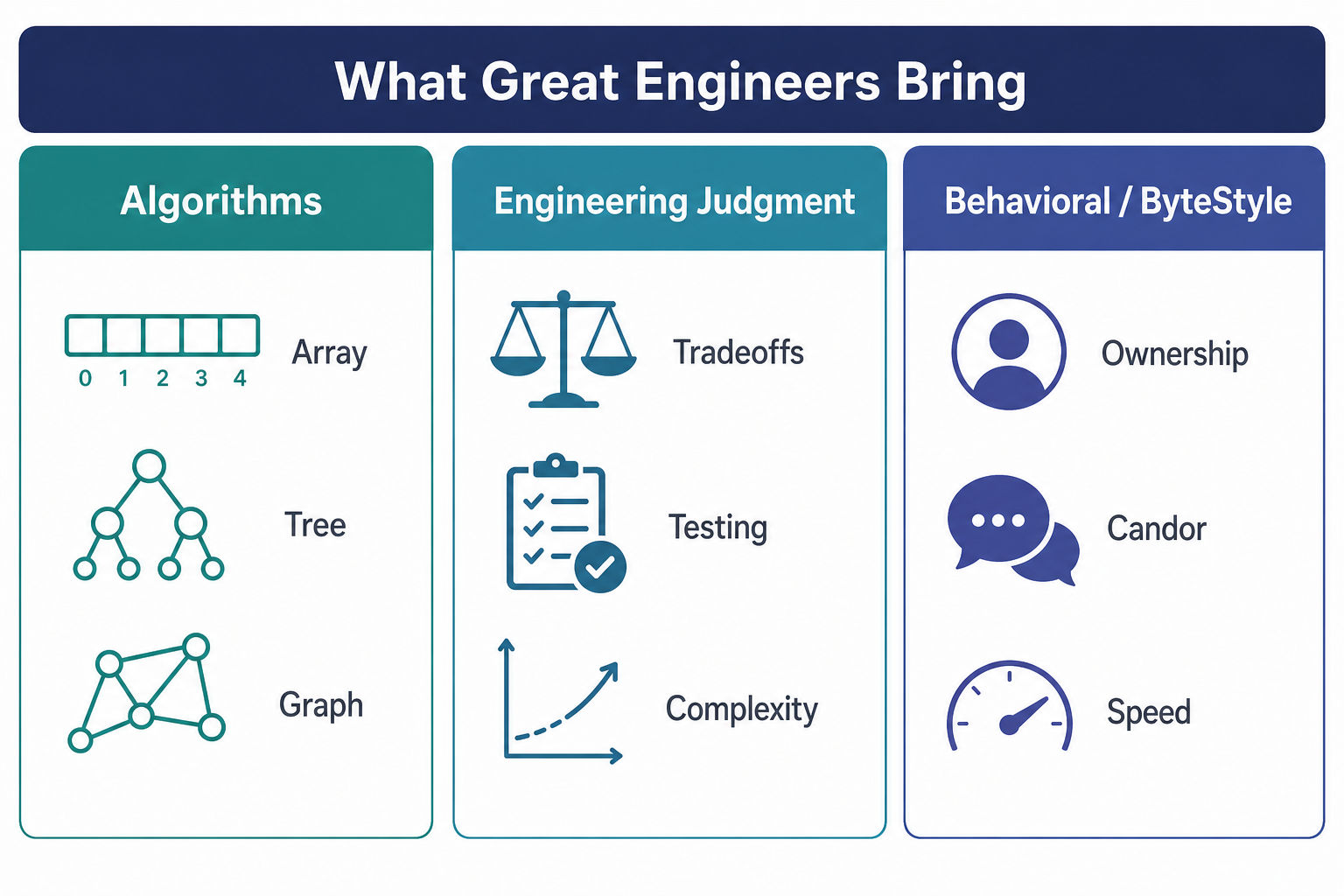
DSA remains the core of the SWE interview, but TikTok's style is distinctive: you are expected to code quickly in a plain shared editor or HackerRank-like environment, explain your reasoning as you go, and actively verify correctness rather than lean on an IDE. Common topics include:
- Arrays, strings, hash maps, linked lists, stacks, and queues
- Trees and graphs, including BFS and DFS
- Sliding window, two pointers, binary search, heaps, and intervals
- Dynamic programming
- Implementation-heavy and design-style coding tasks (for example, cache behavior), where correctness depends on careful state management and edge-case discipline
You can drill all of these against real, company-tagged problems in the PracHub question bank, and filter for TikTok-specific questions to mirror the difficulty and phrasing you'll likely see.
Engineering judgment
TikTok puts visible weight on judgment beyond raw problem solving. Be ready to discuss time and space complexity after every solution, describe or write your own test cases, and reason about tradeoffs out loud. Role-specific depth often comes up in follow-ups:
- Backend: distributed systems basics, Redis and caching, storage choices, API design, message queues, concurrency, and fault tolerance.
- Frontend / mobile: rendering, lifecycle, performance, networking, state management, and client-side architecture.
At mid-level and above, system design centers on real-time messaging, feeds, media upload and delivery, recommendation-style systems, and high-scale backend services where latency, reliability, and scale all matter.
Behavioral signals
TikTok assesses how you operate in fast-moving environments. ByteStyle values surface in questions about ownership, candor, pragmatism, learning speed, and cross-team collaboration. Expect to defend decisions with evidence, describe how you handled ambiguity or disagreement, and show that you can move fast without becoming careless.
How to prepare and stand out
The seven habits below map directly to what the rounds reward. Work them in order - the early ones (fluency, narration) pay off in every coding round.
- Practice in stripped-down editors. Drill in HackerRank-style environments, not just your local IDE. TikTok's process is heavily virtual and often uses plain shared editors with no autocomplete or compiler help.
- Narrate your tradeoffs. Say why you chose a hash map over sorting, why BFS fits better than DFS here, or why an optimization improves latency or memory. Thinking out loud is part of the evaluation, not a distraction from it.
- Write your own test cases. Proactively check edge conditions: empty input, duplicates, single-element cases, overflow risks, and (for design tasks) eviction behavior. Catching your own bug before the interviewer does is a strong signal.
- Know your resume at the architecture level. Be ready to explain database choices, caching strategy, API contracts, concurrency concerns, and failure modes - not just the features you shipped.
- Practice consumer-scale system design. Focus on problems close to TikTok's product surface: feeds, messaging, notifications, video and media delivery, and real-time systems. The PracHub system design questions are a good place to rehearse the API-and-storage walkthrough.
- Prepare ByteStyle-aligned stories. Map behavioral examples to themes like moving fast under ambiguity, being candid in disagreement, taking ownership, learning quickly, and staying pragmatic under pressure. Structure each one so the result is concrete.
- Sharpen role-specific fundamentals. If you're interviewing for a specialized team, review its core areas alongside DSA - Redis, APIs, and distributed systems for backend; lifecycle, rendering, and performance for frontend or mobile.
Example: narrating a coding round well
A strong candidate doesn't just write code silently. Example narration: "I'll use a hash map to store each value's index so lookups are O(1), which gets the whole thing to O(n) time and O(n) space. The alternative is sorting first, but that's O(n log n) and loses the original indices, so the map is the better fit here. Let me also check the empty array and single-element cases before I call it done." That running commentary - choice, tradeoff, complexity, edge cases - is exactly the signal interviewers are listening for.
Example: scoping a system design answer
When asked to "design a feed," a strong opener for instance is to lock down scope before drawing anything: "Let me confirm the requirements - roughly how many daily active users, read-heavy or write-heavy, do we need real-time freshness or is a few minutes of staleness fine, and is ranking in scope or out of scope?" Establishing constraints first shows judgment and keeps the rest of the design honest about its tradeoffs.
What good vs weak answers look like
| Dimension | Weak answer | Strong answer |
|---|---|---|
| Approach | Jumps straight to code | States the plan and complexity first |
| Communication | Codes in silence | Narrates choices and tradeoffs |
| Correctness | Says "looks right" and stops | Walks through edge cases and dry-runs an example |
| Follow-ups | Rewrites from scratch | Adapts the existing solution to the new constraint |
| System design | Lists components with no reasoning | Ties each choice to scale, latency, or reliability |
| Behavioral | Vague "we" stories | Specific "I did X, the result was Y" with evidence |
Takeaways
TikTok rewards engineers who are fast, correct, and clear - fluent coders who verify their own work, explain their reasoning, and connect decisions to real-world scale and product impact. Treat the round-by-round structure as a series of independent bars to clear, and prepare both the algorithmic depth and the ByteStyle behavioral stories that the later rounds reward. To round out your prep, browse more software engineer interview questions and other interview guides on PracHub.
How to Use This Page as a Prep Plan
Do not treat this as passive reading. Convert the ideas in this page into a short weekly loop: learn one idea, practice it under interview conditions, then write down what changed. That is the fastest way to turn advice into visible interview behavior.
| Prep area | What you need to prove | Practice artifact |
|---|---|---|
| Understand | Turn the prompt into a concrete goal. | Clarifying questions and success criteria. |
| Practice | Use realistic constraints and timed reps. | Worked examples with edge cases. |
| Explain | Make reasoning visible. | Tradeoffs, assumptions, and test strategy. |
| Improve | Review misses quickly. | A short feedback log and next action. |
For TikTok Software Engineer Interview Guide 2026, the strongest candidates usually do three things well: they make their assumptions explicit, they use concrete examples instead of vague claims, and they review mistakes quickly enough that the next practice rep is better than the last one.
FAQ
How long does the TikTok software engineer interview process take?
It varies by team and candidate, but the one-round-at-a-time structure means stages unlock sequentially rather than happening in a single onsite day. In practice that often stretches the process across several weeks, with gaps between rounds. Keep your coding skills warm throughout rather than cramming only before the first stage.
What coding difficulty should I expect?
Most problems sit around medium difficulty, with later rounds trending medium-to-hard and adding stronger follow-ups. The bigger differentiator is usually speed and clean edge-case handling in a plain editor, not exotic algorithms. Practicing under time pressure in a stripped-down environment matters more than chasing the rarest problem types.
Does TikTok ask system design questions for new grads?
New grads typically get a lighter architecture discussion rather than a full system design loop, while mid-level and senior candidates commonly face a dedicated 45–60 minute system design round. Regardless of level, being able to reason about scale, storage, and latency tradeoffs is a plus.
What is ByteStyle and how do I prepare for it?
ByteStyle refers to ByteDance's company values, which surface heavily in the behavioral round. Interviewers look for candor, ownership, pragmatism, fast learning, and the ability to operate under ambiguity. Prepare specific stories that show those traits with concrete results rather than rehearsing generic answers.
Should I use a specific programming language?
Use the language you're most fluent in, since the shared editor usually has no autocomplete or compiler help and syntax fluency is part of what's measured. Common choices include Python, Java, and C++. Pick one and drill it until you can write clean code without IDE assistance.
How can I practice realistic TikTok-style questions?
Use real, company-tagged problems and rehearse out loud in a plain editor. The PracHub question bank lets you filter for TikTok questions and software engineer questions, so you can mirror the difficulty, phrasing, and round structure described above.