This guide is for software engineers preparing for a Meta (Facebook) interview loop. It covers the 2026 process end to end: every round you'll face, exactly what each one tests, how the new AI-enabled coding round changes your prep, and a concrete plan for the weeks before your onsite. Read it once for the map, then come back to the round-by-round sections as you train.
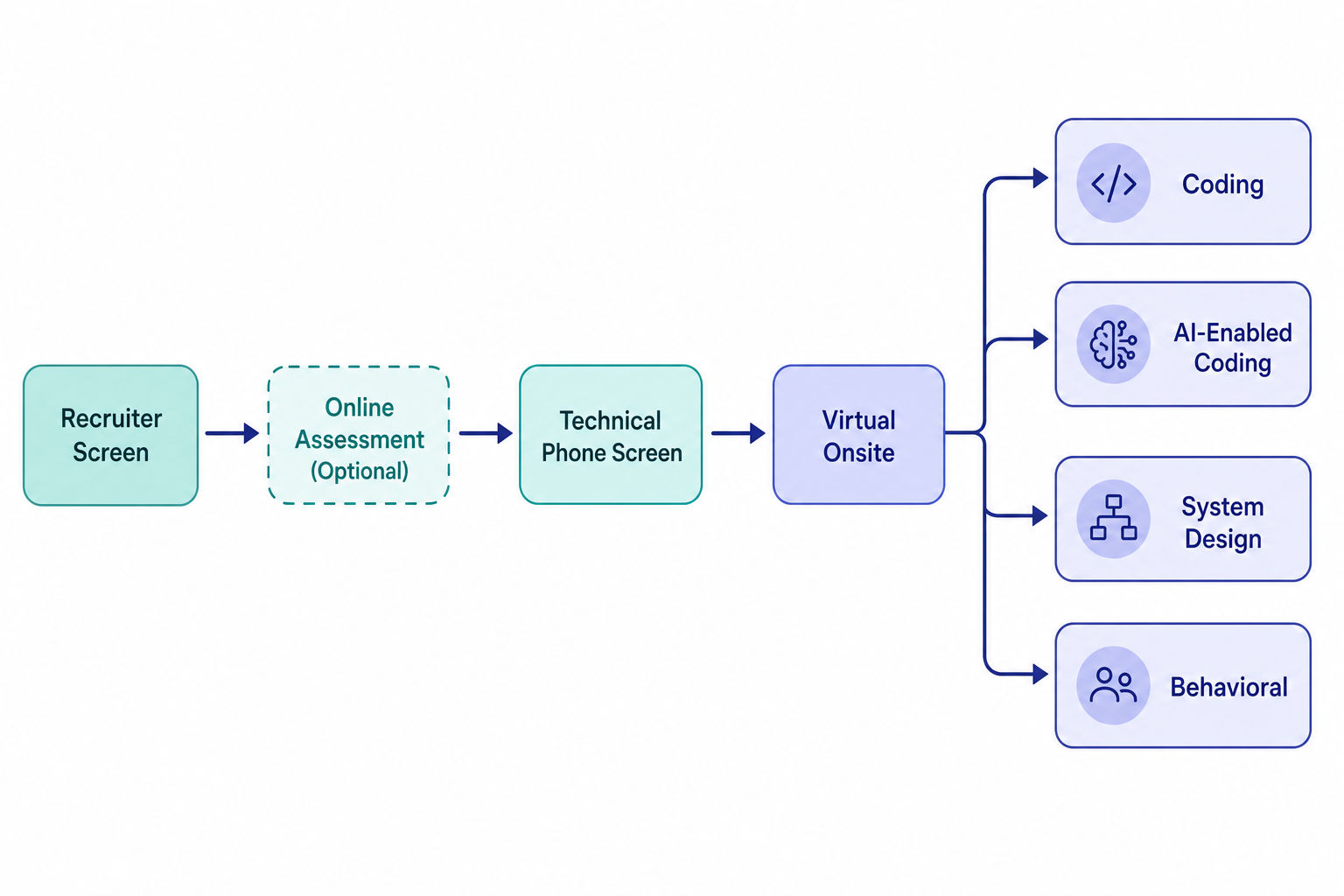
What to expect
Meta's 2026 Software Engineer loop is still built around fast, high-signal coding, but it now includes an AI-enabled coding round that many candidates encounter as a standard part of the process. The typical path is: a recruiter screen, sometimes an online assessment, then a technical phone screen, and finally a virtual onsite with four to five interviews. End to end, the process commonly runs a few weeks to a couple of months, with real variation by team and level.
What sets Meta apart is the combination of speed, communication, and ownership. You're expected to solve problems quickly, explain your reasoning clearly, and handle ambiguity without waiting for heavy guidance. In 2026, you also need to show good engineering judgment when AI tools are available, rather than leaning on them as a shortcut.
If you want to drill the exact question types below, PracHub has hundreds of real questions tagged for this role. Start with the Meta question set and the broader question bank.
The interview loop at a glance
The exact loop varies by team and level, so confirm the details with your recruiter. The table below summarizes what most candidates encounter.
| Round | Typical length | Primary focus | How to win it |
|---|---|---|---|
| Recruiter screen | 15–30 min | Background, level fit, logistics | Be clear on level, team interest, timeline |
| Online assessment (not always present) | ~60–90 min | Coding speed and correctness | Treat as an early filter, not the decision |
| Technical phone screen | ~45 min | 1–2 algorithm problems, communication | Narrate; dry-run when code can't be run |
| Coding (onsite) | ~45 min | 2 medium problems, clean code, speed | Pattern recognition, edge cases, complexity |
| AI-enabled coding (onsite) | ~60 min | Tool use, debugging, ownership | Validate AI output; explain tradeoffs |
| System / product design | ~45 min | Decomposition, scale, tradeoffs | Scope first, then architect |
| Behavioral | ~45 min | Ownership, conflict, impact | Stories with both people and engineering depth |
Interview rounds in detail
Recruiter screen
A short phone or video conversation. Expect questions about your background, level fit, team interests, motivation for Meta, timeline, and logistics such as location or work authorization. The goal is to confirm mutual fit before technical evaluation begins. Come with a crisp two-minute summary of your experience and one or two honest questions about the team or product area.
Online assessment or CodeSignal
This round doesn't appear in every Meta SWE process, but some candidates complete a timed online coding assessment before live interviews. These are typically multi-part problems that build on earlier steps and test coding speed, correctness, and working under time pressure. Treat it as an early screen, not the sole decision point - finishing every part cleanly matters more than clever micro-optimizations.
Technical phone screen
A live coding interview with an engineer, usually around 45 minutes. You'll typically solve one or two algorithmic problems at medium to medium-hard difficulty while explaining your approach, edge cases, and complexity. Code execution may be limited or unavailable, so dry-running matters - the interviewer is watching how you reason through correctness, not just whether the code compiles.
Traditional coding round
In the onsite loop, the standard coding round is usually 45 minutes of live implementation. Expect roughly two LeetCode-style problems, with emphasis on speed, clean code, edge-case handling, and complexity analysis. Interviewers want to see that you recognize common patterns quickly and recover calmly when you hit a bug.
AI-enabled coding round
This is the major 2026 change. It's typically a 60-minute onsite interview in a CoderPad-style environment with an AI assistant, a terminal, tests, and multiple files. The task is usually more production-like than a pure algorithm puzzle and may involve staged work: reading and understanding existing code, debugging, and practical implementation. Meta is evaluating whether you use AI thoughtfully - validating its output, explaining tradeoffs, and keeping ownership of the solution rather than blindly accepting generated code.
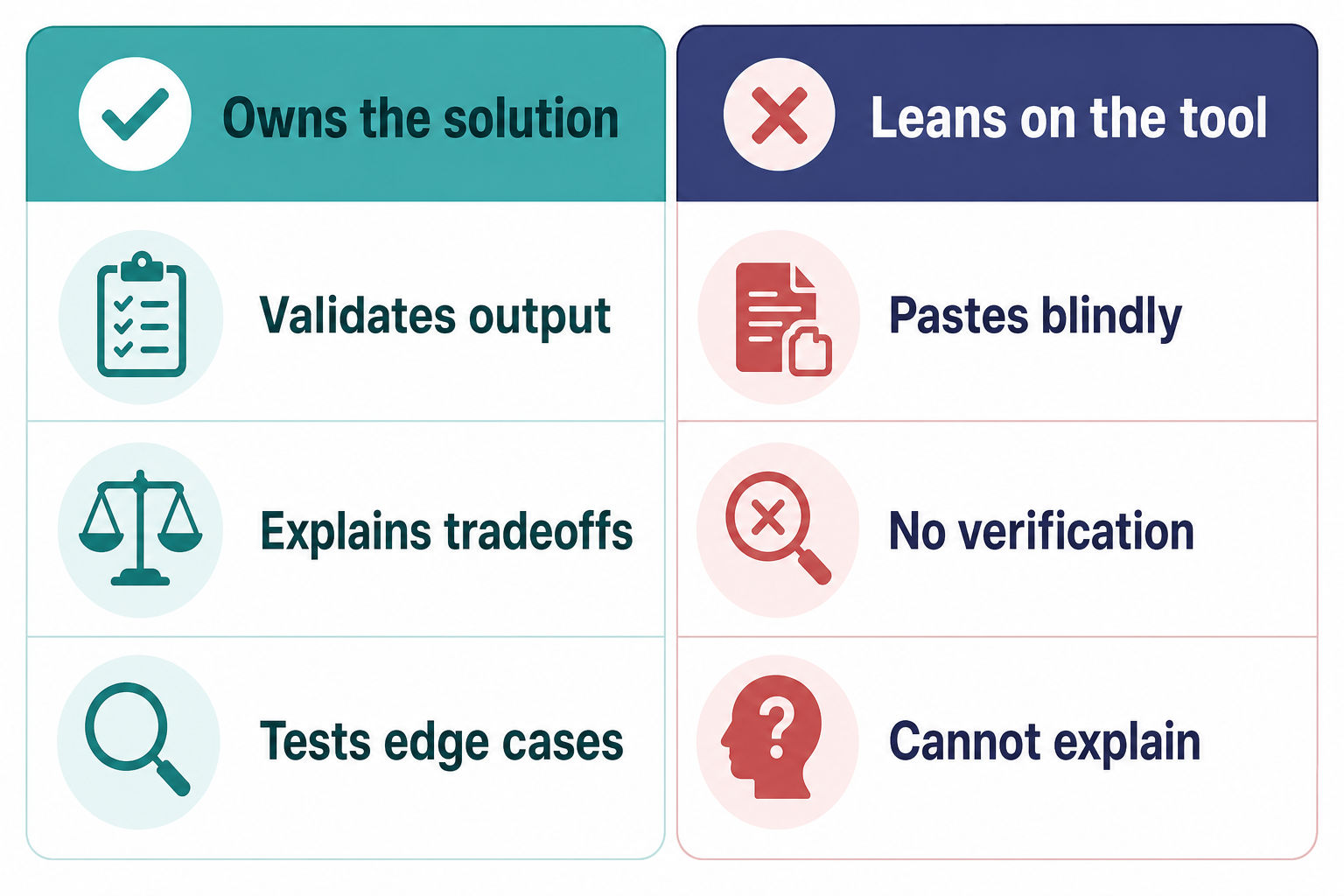
A practical mental model for this round: treat the AI like a fast but unreliable pair-programmer. Use it to scaffold structure, recall syntax, or surface a debugging idea, then read every line, run the tests, and be ready to say why the result is correct.
System or product design round
Usually about 45 minutes, discussion-based rather than code-heavy. You'll clarify requirements, state assumptions, decompose the system, and explain tradeoffs around APIs, data models, scale, reliability, and performance. For junior candidates, the conversation tends to stay closer to design fundamentals; senior candidates are judged more heavily on architecture depth and decision quality. Common prompts are product-shaped systems such as a news feed, a chat service, or media storage.
Behavioral round
Typically 45 minutes and more structured than a casual chat. Expect questions about ownership, conflict, feedback, failure, ambiguous situations, and why you want to work at Meta. Interviewers often drill into the technical details of your past projects, so your stories need both interpersonal and engineering substance.
What each area actually tests
Coding fluency is the foundation. Be ready for arrays, strings, trees, graphs, hash maps, sets, linked lists, stacks, queues, sorting, searching, and recursion. Graph and tree traversals such as BFS and DFS come up often. Dynamic programming can appear, but the stronger recurring emphasis is pattern recognition in medium-level problems and executing quickly under time pressure. In practice that means writing working code fast, talking through your logic, checking edge cases, and giving clean time and space complexity.
The AI-enabled round shifts part of the evaluation from raw DSA performance toward practical engineering judgment: breaking a larger problem into subproblems, using tools deliberately, debugging and verifying outputs, and explaining why a proposed solution is or isn't correct. Meta isn't testing whether you can get the AI to do the work - it's testing whether you stay accountable for correctness, design decisions, and tradeoffs while using AI as a tool.
Design centers on scalable architecture, system decomposition, API design, data modeling, reliability, and performance. Be comfortable scoping a product-oriented system and explaining how it behaves as traffic and data grow.
Behavioral evaluation ties directly to Meta's engineering culture: autonomy, ownership, execution speed, honesty about mistakes, and making progress in ambiguous situations.
A four-week prep plan
This is one workable structure, not a rule. Adjust to your timeline and current strengths.
| Week | Focus | Concrete actions |
|---|---|---|
| 1 | Patterns | Re-learn core patterns: two pointers, sliding window, BFS/DFS, hashing, heaps. Do timed mediums. |
| 2 | Speed & cleanliness | Solve two mediums in 45 minutes, out loud, writing tests by hand. Review every miss. |
| 3 | Design & AI round | Practice 3–4 design prompts with a scoping-first template; do mock AI-enabled tasks on real codebases. |
| 4 | Behavioral & mocks | Write 6–8 STAR stories; run full mock loops; rest before the onsite. |
Anchor your daily practice on real, role-tagged problems rather than random sets. The Meta question collection and the full question bank let you train on the patterns this loop actually rewards, and the software engineer role page groups questions by what hiring teams look for. For the design and behavioral rounds, the interview guide hub has companion walkthroughs.
How to stand out
- Confirm your loop. Ask your recruiter which version you'll face, especially whether the AI-enabled coding round replaces a traditional coding round at your level.
- Train for pace. Practice solving two medium problems in 45 minutes - Meta rewards speed nearly as much as correctness.
- Narrate continuously. State assumptions early and think out loud instead of going silent; Meta tends to reward direct, collaborative communication.
- Practice without a compiler. Dry-run your code by hand, since some live screens limit or disable running your solution.
- Use AI deliberately. In the AI-enabled round, reach for AI on targeted help - structure, syntax, or a debugging idea - then explicitly validate and critique what it gives you.
- Scope before you architect. In system design, don't jump straight to diagrams. Clarify scope, scale, constraints, and success metrics first.
- Build strong stories. Prepare behavioral examples around ownership in ambiguous situations, cross-functional collaboration, conflict, failure, and learning - each with technical depth and measurable impact.
Worked examples
These are illustrations of how to respond, not scripts to memorize.
Example coding narration. For a problem like "find the length of the longest substring without repeating characters," a strong opening is: "I'll use a sliding window with a hash set. I expand the right pointer, and when I see a duplicate I shrink from the left until the window is valid again. That's O(n) time and O(min(n, alphabet)) space. Edge cases: empty string returns 0, and an all-unique string returns its length." Then you write it, then you trace a small input by hand.
Example AI-round move. Suppose the assistant generates a function that passes the visible tests. A strong follow-up is: "It passes the provided cases, but it doesn't handle an empty input list - let me add a guard and a test for that, then confirm the time complexity is still linear." You caught a gap the tool missed and showed you own correctness.
Example STAR story (compressed). Situation: a flaky deploy pipeline blocked the team weekly. Task: I owned making releases reliable. Action: I instrumented the failures, found a race in the migration step, and added a pre-deploy gate. Result: releases stopped breaking and we shipped on a predictable cadence. Notice it has a concrete problem, your specific actions, and a measurable outcome.
How to Use This Page as a Prep Plan
Do not treat this as passive reading. Convert the ideas in this page into a short weekly loop: learn one idea, practice it under interview conditions, then write down what changed. That is the fastest way to turn advice into visible interview behavior.
| Prep area | What you need to prove | Practice artifact |
|---|---|---|
| Understand | Turn the prompt into a concrete goal. | Clarifying questions and success criteria. |
| Practice | Use realistic constraints and timed reps. | Worked examples with edge cases. |
| Explain | Make reasoning visible. | Tradeoffs, assumptions, and test strategy. |
| Improve | Review misses quickly. | A short feedback log and next action. |
For Meta Software Engineer Interview Guide 2026, the strongest candidates usually do three things well: they make their assumptions explicit, they use concrete examples instead of vague claims, and they review mistakes quickly enough that the next practice rep is better than the last one.
FAQ
How long does the Meta software engineer interview process take?
It varies by team and level, but candidates commonly see a few weeks to roughly two months from recruiter screen to decision. Scheduling availability and team demand drive most of the variance, so ask your recruiter for a realistic timeline up front.
Is the AI-enabled coding round replacing the traditional coding round?
For some candidates it's an additional round; for others it may stand in for a traditional coding interview. There's no single universal answer, so confirm your exact loop with your recruiter rather than assuming.
What programming language should I use?
Use the language you're fastest and most fluent in - most candidates pick Python, Java, C++, or JavaScript. The interview rewards clean, correct code written quickly, not a specific language. Pick one and practice until your syntax is automatic.
How hard are the coding questions?
Expect mostly medium-difficulty, LeetCode-style problems, sometimes medium-hard. The bar is less about exotic algorithms and more about recognizing common patterns fast, coding cleanly, handling edge cases, and analyzing complexity correctly.
Do I need to be perfect to pass?
No. Interviewers care about how you reason, communicate, and recover from mistakes. A calm correction after a bug often reads better than a silent, flawless solution. Show your thinking and stay collaborative.
Where can I practice realistic Meta questions?
PracHub's Meta question collection and the full question bank contain real, role-tagged questions with in-depth solutions, which lets you train on the exact patterns this loop tends to test.