What this guide covers
This is a practical, current map of the Google Software Engineer hiring loop for 2026: what each round actually tests, the topics that show up most, and how interviewers separate a strong loop from a weak one. It's written for candidates targeting SWE / SWE II and early-career pipelines, with notes for senior levels where the bar shifts. Pair it with PracHub's bank of Google interview questions and the broader software engineer question set to drill the patterns below.
How the process is structured
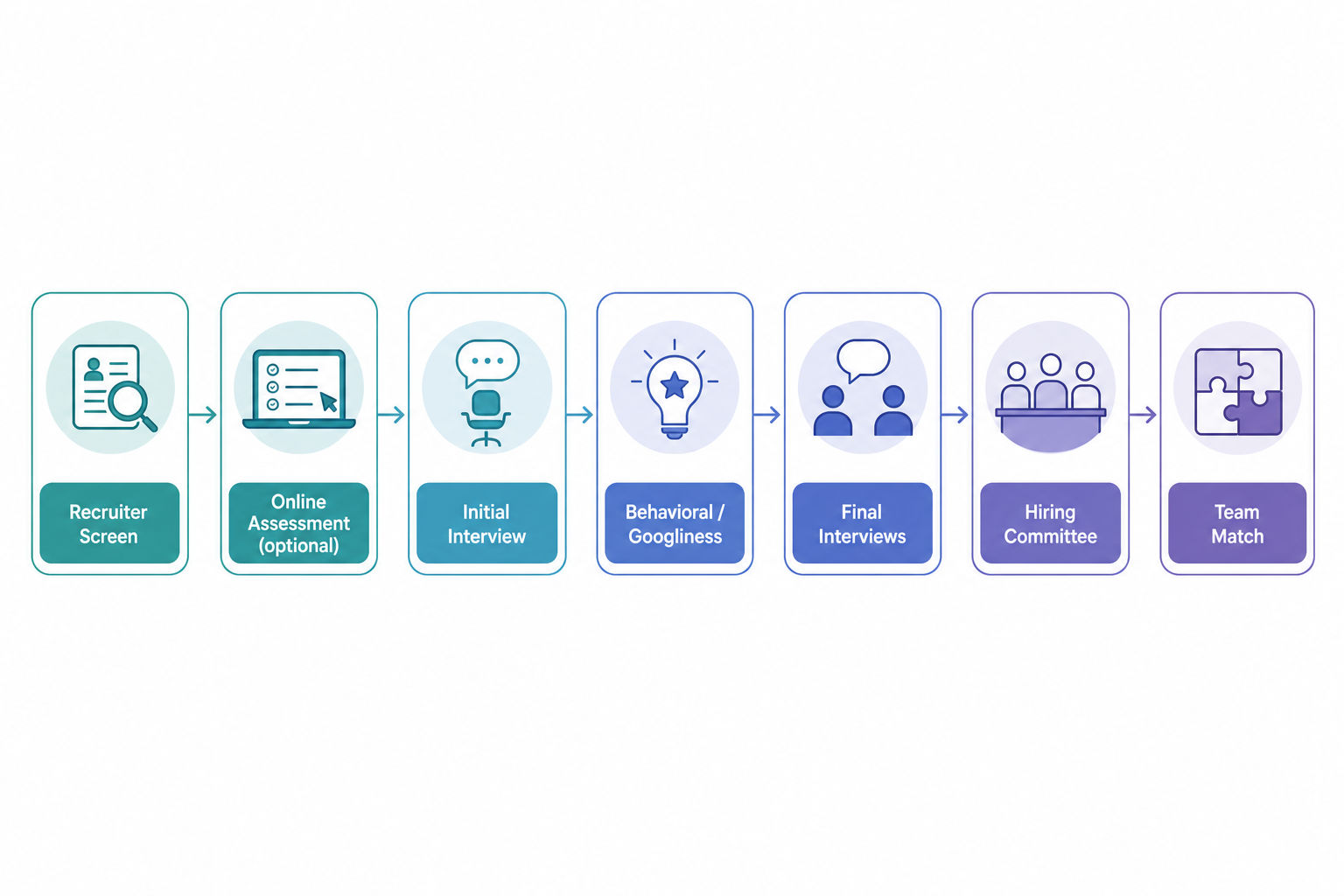
Google's loop still centers on live problem solving, but the shape has streamlined for many early-career pipelines. A typical path runs: recruiter screen, an optional online assessment, an initial interview stage, a final interview stage, hiring committee, then team match. For some early-career and SWE II roles, Google has moved toward a two-stage structure with roughly four interviews total after the recruiter screen, rather than the older single onsite loop.
Treat any specific round count as typical rather than guaranteed. The number and naming of rounds vary by level, region, and pipeline. What's consistent is the emphasis on collaborative coding over memorized answers: you solve problems in a shared doc or lightweight browser editor without full IDE support, explain your thinking continuously, adapt as the interviewer changes constraints, and demonstrate "Googliness & Leadership" alongside raw technical skill.
The rounds, one by one
Recruiter screen
A 20-30 minute phone or video call. You'll cover your background, role fit, motivation, recent projects, and logistics such as level, location, work authorization, or graduation timing. The recruiter is confirming that your experience matches the pipeline and that you're ready to start the loop. Come with a crisp two-minute summary of your most relevant project and a clear answer to "why Google, why now."
Online assessment (not universal)
Common in new grad, intern, and some early-career pipelines, but not used for every candidate. It typically runs 60-90 minutes and consists of timed coding problems that test raw fluency with data structures and algorithms. Expect medium-to-hard questions where correctness, edge-case handling, and speed all matter at once.
Initial technical interview
Usually around 45 minutes, sometimes 60. Expect one main coding problem plus follow-ups in a shared document or collaborative editor, with continuous narration of your reasoning. Interviewers focus on your approach, algorithm choices, code accuracy, complexity analysis, and how well you respond to hints and shifting constraints.
Googliness & Leadership / behavioral
Often a dedicated round of about 45 minutes, though in some early-career flows it's woven into another interview. Expect questions about conflict, ambiguity, influence, failure, tradeoffs, and teamwork. Google is looking for humility, ownership, reflection, and collaboration: how you work with others and handle uncertainty without ego. Weak answers here can sink an otherwise strong loop.
Final technical interviews
In the streamlined early-career flow, this stage often includes two 45-minute coding interviews. More traditional loops may include three to four final interviews depending on level, and higher-level candidates can also face system design. These rounds test whether you can tackle unfamiliar problems more independently, optimize past a first-pass solution, reason about tradeoffs, and perform consistently across topics.
Hiring committee
No live interview here. Google reviews the full packet of interviewer feedback to check consistency, calibrate level, and decide whether the evidence supports a hire. Strong, consistent performance across rounds tends to carry more weight than a single standout answer paired with a weak one.
Team match
Passing the loop often isn't the final step. Many candidates still need to match with a team, a stage that can take days or weeks and usually involves conversations with hiring managers about domain fit, past work, interests, and product or infrastructure needs. Timing can depend on hiring availability even after a successful loop.
What each round is really testing
Different rounds reward different things. This rubric maps the round to the signal interviewers are scoring and what a strong showing looks like.
| Round | Primary signal | What "strong" looks like |
|---|---|---|
| Recruiter screen | Fit & readiness | Clear motivation, accurate level/logistics, concise project summary |
| Online assessment | Raw DSA fluency | Correct, fast, edge-case-clean solutions under time pressure |
| Initial coding | Problem-solving process | Clarifies first, picks a sound approach, narrates, analyzes complexity |
| Behavioral | Collaboration & ownership | Specific stories, reflection, humility, influence without authority |
| Final coding | Depth & consistency | Optimizes past first pass, handles follow-ups, steady across topics |
| System design (senior) | Architecture judgment | Reasons about tradeoffs in storage, caching, partitioning, reliability |
Topics that show up most
Data structures and algorithms
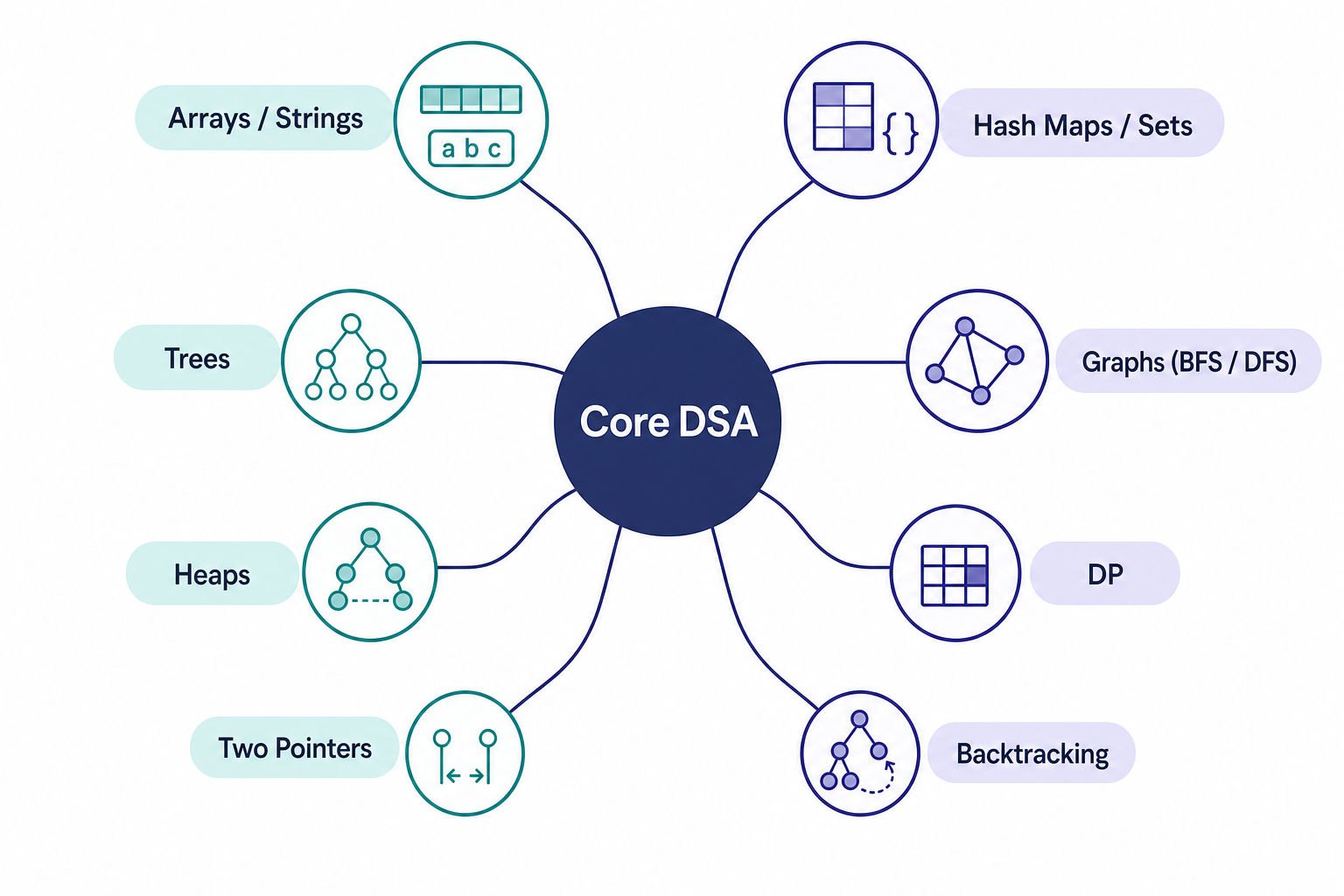
This is the core of the SWE assessment. Be fluent with:
- Arrays, strings, hash maps, sets, linked lists, stacks, queues
- Trees, graphs, heaps
- Recursion and backtracking
- Sorting and searching
- Sliding window and two pointers
- Greedy methods, dynamic programming, and union-find
- Matrix and grid problems
Graph-heavy questions appear often, so be especially ready for DFS, BFS, shortest-path reasoning, connectivity, traversal state management, and graph-based follow-ups. Many candidates over-drill arrays and under-drill graphs, then get caught flat-footed.
The coding bar
Reaching a correct answer isn't enough. Interviewers want to see you:
- Ask clarifying questions and state your assumptions before coding
- Choose a reasonable first approach, then improve it as constraints change
- Write clean code in one language you know well
- Handle edge cases and think in test cases
- Analyze time and space complexity out loud
Because many interviews happen in a shared doc or simple browser tool, you also need to write bug-light code without autocomplete, compilation, or syntax highlighting. Practicing in a plain editor is the single highest-leverage adjustment most candidates skip.
Behavioral signals
These matter more than many candidates expect. Google looks for collaboration, intellectual humility, ownership, comfort with ambiguity, inclusiveness, and leadership without authority. Prepare specific examples where you resolved conflict, influenced a direction, handled unclear requirements, supported teammates, or learned from failure. Structure them with a method like STAR so the interviewer can follow the situation, your specific actions, and the measurable result.
System design (higher levels)
At higher levels, and especially for senior roles, expect system design questions covering APIs, storage, caching, partitioning, reliability, observability, consistency, and scalability tradeoffs. The signal is judgment under ambiguity: you're scored on how you reason about tradeoffs, not on reciting a single "correct" architecture.
A worked example of the coding signal
To make the difference concrete, here's how the same problem reads to an interviewer depending on approach.
Example problem: "Given a 2D grid of 1s (land) and 0s (water), count the number of islands."
Example of a weak start: jumping straight into nested loops and a flood-fill without saying what you're doing, then getting tangled in visited-state bugs and going quiet.
Example of a strong start: "Let me confirm a few things. Is the grid guaranteed non-empty? Are diagonals considered connected, or only up/down/left/right? Can I mutate the grid to mark visited cells, or should I keep a separate visited set?" Then: "I'll treat this as connected components. I'll scan each cell; when I hit unvisited land I'll run a BFS or DFS to sink the whole island, counting one per launch. Time is O(rows × cols) since each cell is visited once; space is O(rows × cols) in the worst case for the stack or queue." Then you code it, narrate edge cases (single cell, all water, all land), and dry-run one small input.
The code is similar in both cases. The hire signal comes from the clarifying questions, the stated complexity, and the continuous narration. You can drill this exact muscle on PracHub's coding interview questions.
How to stand out
- Practice in a plain editor. Code in a doc or minimal browser tool, since Google interviews often strip away IDE conveniences and syntax support.
- Clarify before you code. Start every technical answer by pinning down inputs, constraints, edge cases, and expected output.
- Narrate continuously. Talk through your reasoning, especially when comparing a brute-force approach with an optimized one.
- Drill graphs. Don't stop at tree and array patterns; Google SWE interviews often lean graph-heavy.
- Build real behavioral stories. Have concrete examples around ambiguity, conflict, cross-functional influence, failure, and learning.
- Expect follow-ups. After you solve the first version, the interviewer will often change constraints or ask for a streaming, queryable, or more scalable variant. Practice adapting on the spot.
- Do your own thinking. Google's recent guidance is explicit that using AI assistance during interviews is disqualifying. Interviewers want your original reasoning, not rehearsed scripts.
A four-week prep sketch
This is a flexible scaffold, not a prescription. Compress or stretch it to fit your timeline.
| Week | Focus | Concrete goal |
|---|---|---|
| 1 | Foundations | Re-implement core structures from scratch; solve easy/medium arrays, strings, hash maps |
| 2 | Graphs & trees | BFS/DFS, shortest paths, connectivity, tree traversals and recursion |
| 3 | Hard patterns | DP, backtracking, sliding window, union-find; time yourself in a plain editor |
| 4 | Mock & behavioral | Full mock loops with narration; write 6-8 behavioral stories in STAR form |
How to Use This Page as a Prep Plan
Do not treat this as passive reading. Convert the ideas in this page into a short weekly loop: learn one idea, practice it under interview conditions, then write down what changed. That is the fastest way to turn advice into visible interview behavior.
| Prep area | What you need to prove | Practice artifact |
|---|---|---|
| Understand | Turn the prompt into a concrete goal. | Clarifying questions and success criteria. |
| Practice | Use realistic constraints and timed reps. | Worked examples with edge cases. |
| Explain | Make reasoning visible. | Tradeoffs, assumptions, and test strategy. |
| Improve | Review misses quickly. | A short feedback log and next action. |
For Google Software Engineer Interview Guide 2026, the strongest candidates usually do three things well: they make their assumptions explicit, they use concrete examples instead of vague claims, and they review mistakes quickly enough that the next practice rep is better than the last one.
Video Walkthrough
Scortier walks through the Google Software Engineer loop first-hand. It is one candidate's account rather than an official spec, so treat the round order as indicative.
FAQ
How many interview rounds does Google have for software engineers?
It varies by level and pipeline. Many early-career flows have streamlined to roughly four interviews after the recruiter screen (often a couple of coding rounds plus a behavioral round), while more traditional loops run three to four final interviews. Treat any single number as typical, not guaranteed, and confirm with your recruiter.
Does Google ask system design questions for entry-level roles?
Usually not for new grad or junior roles, where the focus is data structures and algorithms plus behavioral signals. System design becomes a standard part of the loop at higher and senior levels, covering APIs, storage, caching, partitioning, reliability, and scalability tradeoffs.
What programming language should I use in a Google interview?
Use the one language you know best. Interviewers care about clean, correct, well-reasoned code, not which language it's in. Pick something with strong standard-library support for common structures so you spend your time on the problem, not on boilerplate.
How important is the behavioral (Googliness) round?
More important than many candidates assume. Google weighs collaboration, humility, ownership, and comfort with ambiguity alongside coding ability, and a weak behavioral round can drag down an otherwise strong loop. Prepare specific, reflective stories rather than generic talking points.
Can I use AI tools during a Google interview?
No. Google's recent guidance is explicit that using AI assistance during interviews is disqualifying. Interviewers are evaluating your own reasoning in real time, so the safe and expected approach is to solve and narrate independently.
How long does the whole process take?
It ranges widely. The interview loop itself can move quickly, but stages like hiring committee and especially team match can add days or weeks, and timing depends on team availability even after you pass. Ask your recruiter for current timelines for your specific pipeline.