
This guide is for software engineers preparing for an Amazon SDE loop in 2026 - new grads through SDE II and above. You'll get a stage-by-stage map of the process, the round types you'll face, what each one actually tests, the Leadership Principles that decide close calls, and a concrete plan for behavioral and technical prep.
The single thing most candidates underestimate: at Amazon, behavioral performance is graded with the same rigor as your code. Strong algorithms with weak Leadership Principles stories is a common way to get a no-hire.
What to expect
Amazon's 2026 Software Engineer interview evaluates two things at once: technical execution and alignment with Amazon's Leadership Principles. Strong coding alone is rarely enough. Behavioral questions appear in nearly every stage, and interviewers tend to probe for metrics, tradeoffs, ownership, judgment, and your specific contribution rather than what your team did.
The process is fairly standardized, though the exact shape depends on the level and team. Entry-level loops lean more heavily toward coding and behavioral evaluation, while experienced roles (SDE II and above) add more design depth. Many candidates begin with an online assessment that goes beyond pure coding before reaching the final loop.
The interview process
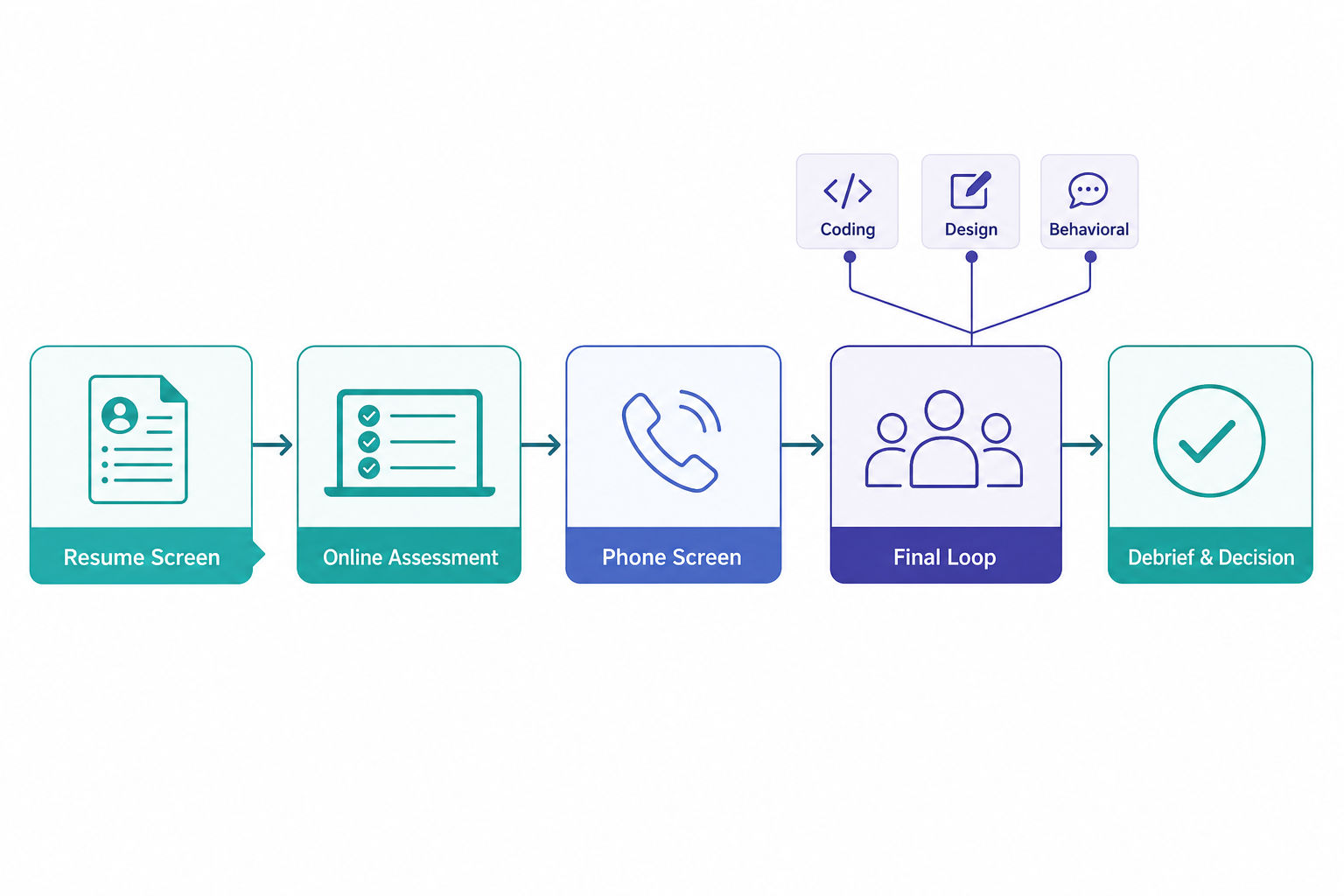
The journey from application to decision typically moves through these stages:
- Resume screen - A recruiter and hiring team review your background for level fit, relevant technical stack, domain relevance, and evidence of impact. Make scope, ownership, and outcomes obvious; this is what determines whether you advance.
- Online assessment (OA) - For many roles the OA is the first real screen. It commonly includes one to two coding problems and often adds work-style/work-simulation questions; some assessments include a lightweight system-thinking component. It evaluates coding correctness and efficiency alongside how well your working style fits Amazon.
- Recruiter or phone screen - Usually a 30–60 minute call covering your resume, past projects, motivation, and Leadership Principles examples. Some candidates also get a coding problem or technical discussion. This checks role fit, communication, and baseline technical depth.
- Final loop - Typically 3–5 interviews of ~45–60 minutes each, usually as a virtual onsite. The loop is a mix of round types (described below), and behavioral questions are embedded throughout rather than confined to one round.
- Debrief and decision - The panel meets to compare evidence, weigh strengths and concerns, and decide on outcome and level. Results are often communicated within a few business days, though scheduling can stretch the overall timeline. Outcomes can include an offer, a different level than you applied for, team matching, a hold, or a rejection.
Treat timelines and exact round counts as typical rather than guaranteed - they vary by team, level, and location.
Round types in the loop
The final loop draws from several interview types. Not every loop includes all of them, and several skills are often tested within a single round. Here's how they compare and what each one is really looking for.
| Round | Format | What it tests | Most relevant for |
|---|---|---|---|
| Coding / algorithms | Live coding, 1–2 problems | Data structures, correctness, edge cases, complexity reasoning | All levels |
| Low-level / OO design | Model + implement a subsystem | Abstractions, extensibility, testing, production judgment | All levels |
| System design | Whiteboard / shared doc discussion | Scaling, reliability, data modeling, tradeoffs | SDE II and above |
| Behavioral / LP | Story-driven conversation | Ownership, judgment, impact, Leadership Principles | All levels |
| Bar Raiser | Behavioral, technical, or mixed | Whether you meet/exceed the hiring bar; depth and consistency | All levels |
Coding / algorithms
A live coding round focused on data structures, algorithms, clean implementation, debugging, and complexity analysis. Expect medium-to-hard problems involving trees, graphs, hashing, recursion, heaps, dynamic programming, and traversal. Interviewers watch how you clarify requirements, handle edge cases, and explain tradeoffs - not just whether you reach a correct answer. Practice on real prompts in the Amazon question bank so the patterns feel familiar under time pressure.
Low-level / object-oriented design
This round pairs implementation with design thinking. You may be asked to model a small class hierarchy, API, or subsystem, then implement or extend part of it while discussing abstractions, maintainability, testing, and edge cases. The goal is code that is both correct and extensible, with production-minded judgment.
System design
Most common for experienced hires (SDE II and above). You'll typically design a scalable service or feature and discuss architecture, throughput, latency, reliability, data modeling, caching, consistency, and failure handling. Interviewers care less about memorized buzzwords and more about whether you make sensible tradeoffs under realistic constraints.
Behavioral / Leadership Principles
Behavioral evaluation runs across the whole loop, and one round is often weighted toward it. Expect multiple questions about ownership, customer focus, conflict, failure, disagreement, raising standards, and delivering under constraints. Amazon wants detailed stories with your specific actions, the reasoning behind them, and measurable outcomes.
Bar Raiser
The Bar Raiser is typically one of the loop interviews rather than a separate stage - a trained interviewer from outside the hiring team who assesses whether you meet or exceed Amazon's hiring bar. The conversation may be behavioral, technical, or mixed, but it usually goes deeper and probes harder than other rounds, with particular attention to judgment, standards, and consistency.
What they test
Coding and fundamentals
The core remains data structures, algorithms, and practical engineering judgment. Be ready for arrays, strings, hash maps, linked lists, stacks, queues, trees, graphs, recursion, backtracking, sorting, searching, greedy methods, heaps, and dynamic programming. Recognizing a pattern isn't enough - you need to write clean, executable code, reason about edge cases, and explain time and space complexity accurately.
Design judgment
Design rounds reward grounded engineering over textbook answers:
- Low-level design: object-oriented modeling, abstraction, API choices, extensibility, testing strategy, refactoring, and implementation tradeoffs.
- System design: service decomposition, scaling, availability, consistency, caching, sharding, load balancing, asynchronous processing, message queues, observability, and failure recovery.
In both, connect your choices back to customer needs and operational realities rather than reciting components.
Leadership Principles
Behavioral performance carries as much weight as technical skill. Amazon's principles that frequently surface include Customer Obsession, Ownership, Dive Deep, Have Backbone; Disagree and Commit, Insist on the Highest Standards, Deliver Results, Are Right, A Lot, and Frugality. Your stories should show concrete impact, sound judgment, willingness to challenge decisions respectfully, and the ability to learn from failure. Interviewers push for detail, so vague, team-attributed answers tend to underperform.
The table below maps a few of the most commonly probed principles to the signal interviewers are listening for and a typical opening prompt.
| Leadership Principle | What a strong story signals | Example prompt you might hear |
|---|---|---|
| Customer Obsession | You started from the customer's need, not the tech | "Tell me about a time you went out of your way for a customer." |
| Ownership | You acted beyond your assigned scope and owned the outcome | "Describe a time you took on something outside your role." |
| Dive Deep | You found root cause with data, not assumptions | "Walk me through a hard bug you debugged end to end." |
| Have Backbone; Disagree and Commit | You pushed back respectfully, then committed fully | "When did you disagree with your manager? What happened?" |
| Deliver Results | You shipped under constraints and can quantify the result | "Tell me about a deadline you had to fight to meet." |
| Insist on the Highest Standards | You raised the bar even when 'good enough' was available | "Give an example of when you weren't satisfied with the status quo." |
Answering behavioral questions: STAR with your fingerprints on it
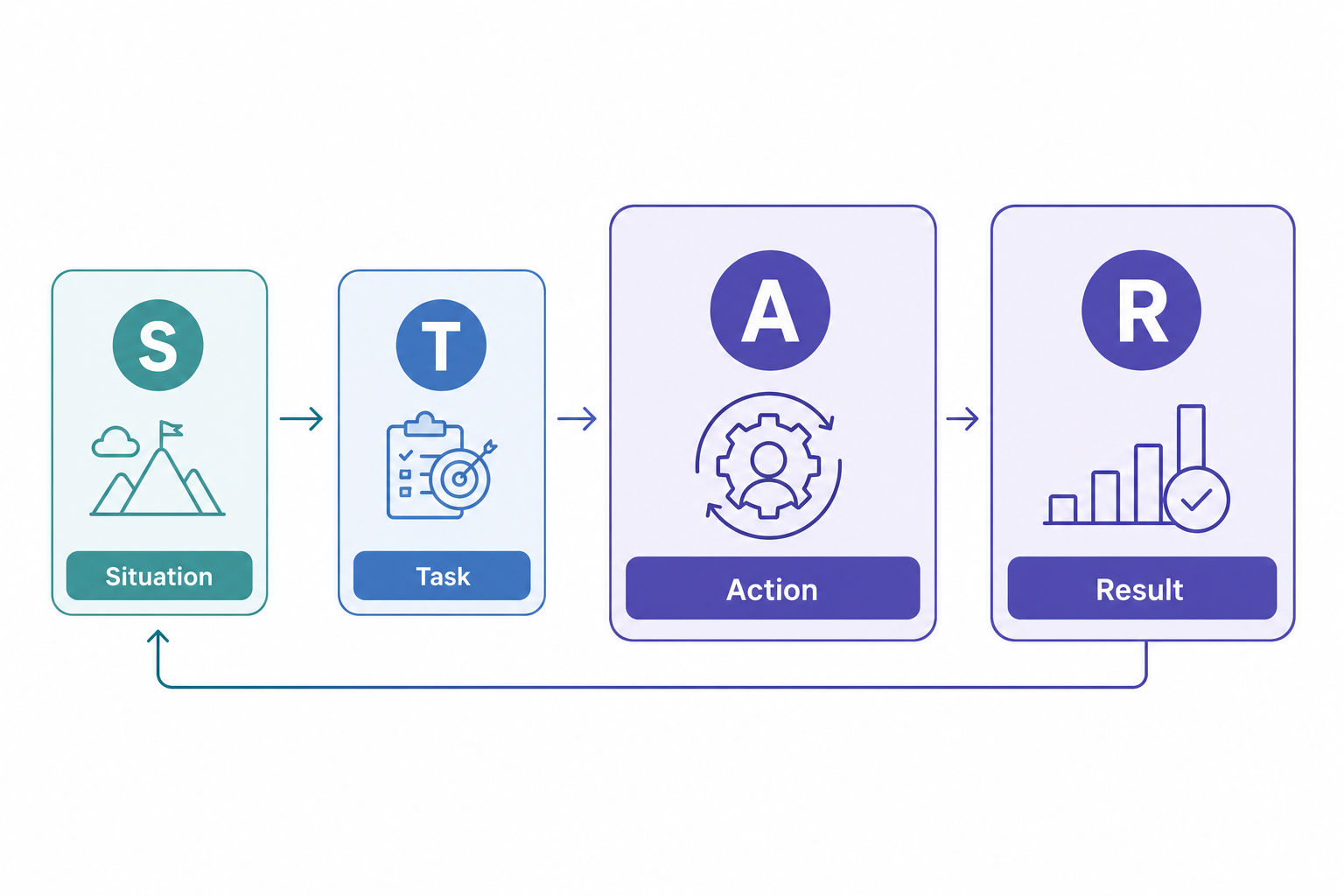
Amazon expects structured stories, and the STAR framework (Situation, Task, Action, Result) is the cleanest way to deliver them. The trap is spending too long on Situation and Task and running out of time before the Action and Result - which is where your judgment and impact actually live. Aim for a brief setup, then most of your airtime on what you did and what changed because of it.
Example answer (Ownership), abbreviated:
Situation: Our checkout service started timing out for a subset of users during peak hours. Task: It wasn't formally my area, but no one was tracking it down, so I picked it up. Action: I traced the latency to an N+1 query, added a batched fetch and a short-lived cache, and wrote a load test to confirm the fix before rollout. Result: P99 latency for that path dropped substantially and the timeout reports stopped. I documented the pattern so the team caught two similar issues later.
Note how the Action and Result carry the weight, the contribution is "I" not "we," and the outcome is concrete without inventing a precise statistic. If you don't have a hard number, describe the direction and magnitude honestly ("dropped substantially," "cut the on-call pages roughly in half") rather than fabricating one.
How to prepare and stand out
- Prepare Leadership Principles stories as seriously as coding. Have specific examples ready for failure, conflict, ownership, customer impact, ambiguity, raising standards, and disagreeing with a manager or stakeholder.
- Make every behavioral answer evidence-based. State the scope, your exact role, the alternatives you weighed, the tradeoff you chose, and the measurable result.
- Clarify before you code. Ask about input assumptions, constraints, edge cases, expected scale, and error handling instead of jumping straight into implementation.
- Write runnable code, not pseudocode. Amazon evaluates correctness and readability, so use clear naming, handle edge cases, and talk through tests as you go.
- Treat the OA as broader than a coding screen. Prepare for coding and work-style components rather than assuming it's just algorithm questions.
- Practice mixed rounds. Amazon commonly blends behavioral, coding, and design within a session; smooth transitions between storytelling and technical reasoning make you look interview-ready.
- Prepare for follow-ups. Interviewers often ask why you chose a path, what failed, what you'd change now, and how you knew a decision was right - so your examples and designs need real depth.
A four-week prep sketch
This is one sensible way to structure prep, not a rule. Adjust to your timeline and weak spots.
| Week | Coding | Behavioral / LP | Design |
|---|---|---|---|
| 1 | Arrays, strings, hashing, two pointers | Draft 6–8 STAR stories | - |
| 2 | Trees, graphs, recursion, heaps | Map stories to specific principles | Low-level design basics |
| 3 | DP, backtracking, mixed mediums | Practice out loud, tighten Action/Result | System design fundamentals (SDE II+) |
| 4 | Timed mocks, weak-area cleanup | Mock behavioral with follow-ups | Mock design round |
Build your story set early and reuse it. A well-prepared engineer often has a small library of 6–10 experiences that can each be reframed to answer several different principles.
Where to practice
- Drill real prompts from the full PracHub question bank to cover breadth across topics.
- Filter to Amazon-specific questions to match the flavor of problems and behavioral themes you'll see.
- Browse questions by role at Software Engineer to calibrate difficulty to your target level.
- Explore more company guides and prep resources in the interview guide library.
How to Use This Page as a Prep Plan
Do not treat this as passive reading. Convert the ideas in this page into a short weekly loop: learn one idea, practice it under interview conditions, then write down what changed. That is the fastest way to turn advice into visible interview behavior.
| Prep area | What you need to prove | Practice artifact |
|---|---|---|
| Understand | Turn the prompt into a concrete goal. | Clarifying questions and success criteria. |
| Practice | Use realistic constraints and timed reps. | Worked examples with edge cases. |
| Explain | Make reasoning visible. | Tradeoffs, assumptions, and test strategy. |
| Improve | Review misses quickly. | A short feedback log and next action. |
For Amazon Software Engineer Interview Guide 2026, the strongest candidates usually do three things well: they make their assumptions explicit, they use concrete examples instead of vague claims, and they review mistakes quickly enough that the next practice rep is better than the last one.
Video Walkthrough
Scortier walks through the Amazon Software Engineer loop first-hand. It is one candidate's account rather than an official spec, so treat the round order as indicative.
FAQ
How many rounds are in the Amazon SDE final loop?
The final loop is typically 3–5 interviews of about 45–60 minutes each, often as a virtual onsite. The exact count varies by level, team, and location, so treat it as typical rather than fixed.
How important are the Leadership Principles for software engineers?
Very. Behavioral evaluation runs through the entire loop and is graded with the same seriousness as your technical rounds. Strong coding paired with vague, team-attributed behavioral answers is a common reason for a no-hire decision.
What is the Bar Raiser and how do I prepare for it?
The Bar Raiser is a trained interviewer from outside the hiring team who checks whether you meet or exceed Amazon's hiring bar. You can't tell in advance which interview it is, so prepare every round to your highest standard - deep, specific stories and well-reasoned technical answers that hold up under hard follow-ups.
Do I need system design experience for an entry-level SDE role?
Usually not at the same depth. System design weighs most heavily for SDE II and above. New grads should still understand basic low-level and object-oriented design, but the loop will lean more toward coding and behavioral evaluation.
What should I do if I don't have a precise metric for a STAR result?
Describe the direction and rough magnitude honestly - "cut the failure rate substantially," "reduced on-call load noticeably" - rather than inventing a number. Interviewers probe deep, and a fabricated statistic that falls apart under follow-up does more damage than an honest qualitative result.
How is the SDE II interview different from new-grad?
SDE II loops add more design depth (especially system design) and expect richer behavioral stories that demonstrate scope, ambiguity, and influence over others. The coding bar stays high, but the differentiator shifts toward judgment, design tradeoffs, and ownership at a larger scale.