Who this guide is for
This is a practical walkthrough of the Akuna Capital Software Engineer loop for anyone interviewing for a C++, Python, backend, or full-stack role at the firm. You'll get the typical shape of each round, what interviewers actually weight, track-specific prep, and concrete examples of how to narrate your thinking. The loop is less standardized than a big-tech pipeline, so treat the rounds below as the common pattern rather than a fixed script.
What to expect
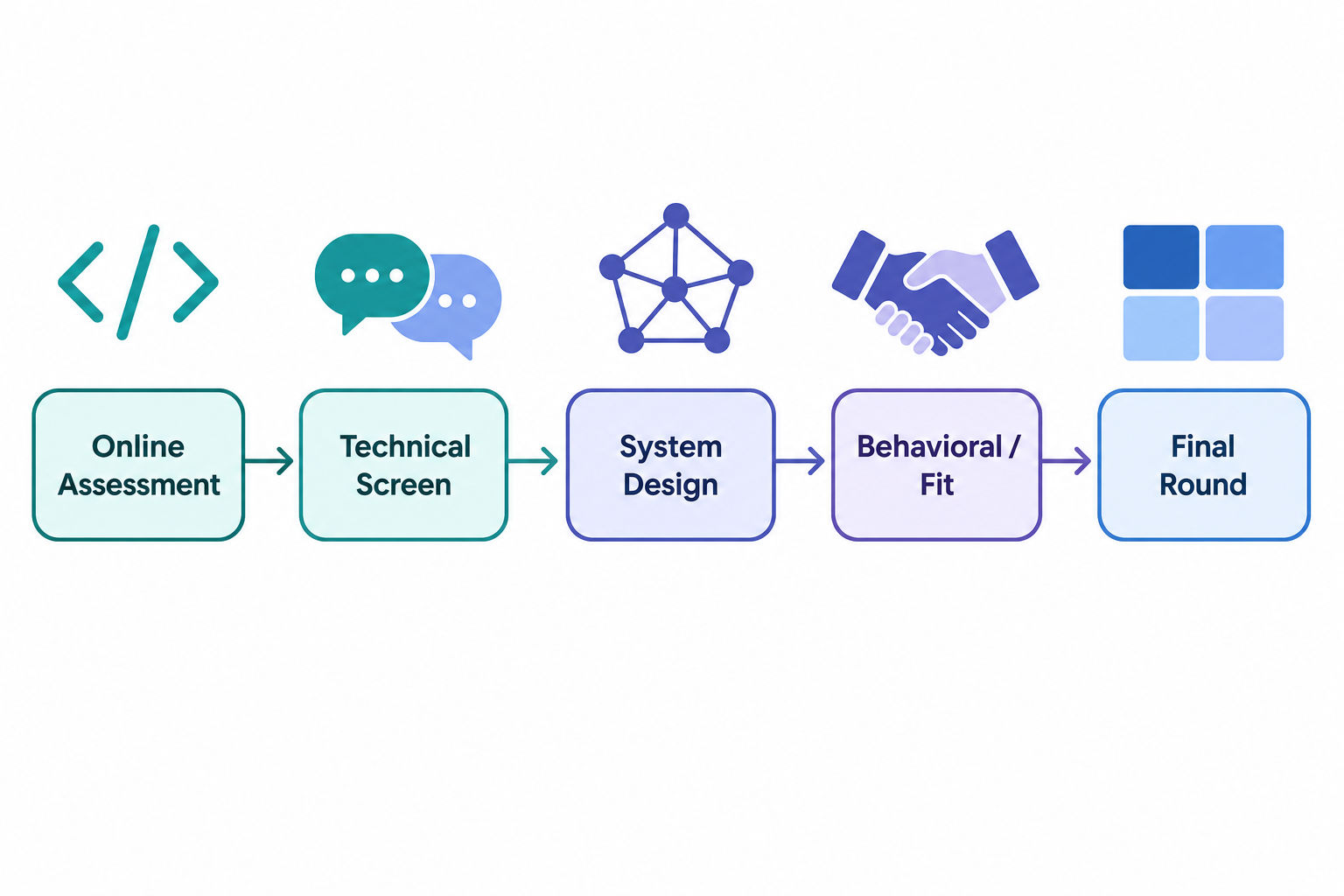
Akuna builds technology for trading, so the loop skews toward practicality. The recurring test is whether you can write correct, performance-aware code under realistic constraints, not whether you can land a polished algorithm trick. Most candidates move through three broad phases: an online assessment, one or more technical interviews, and a final round that may bundle coding, system design, and behavioral conversations.
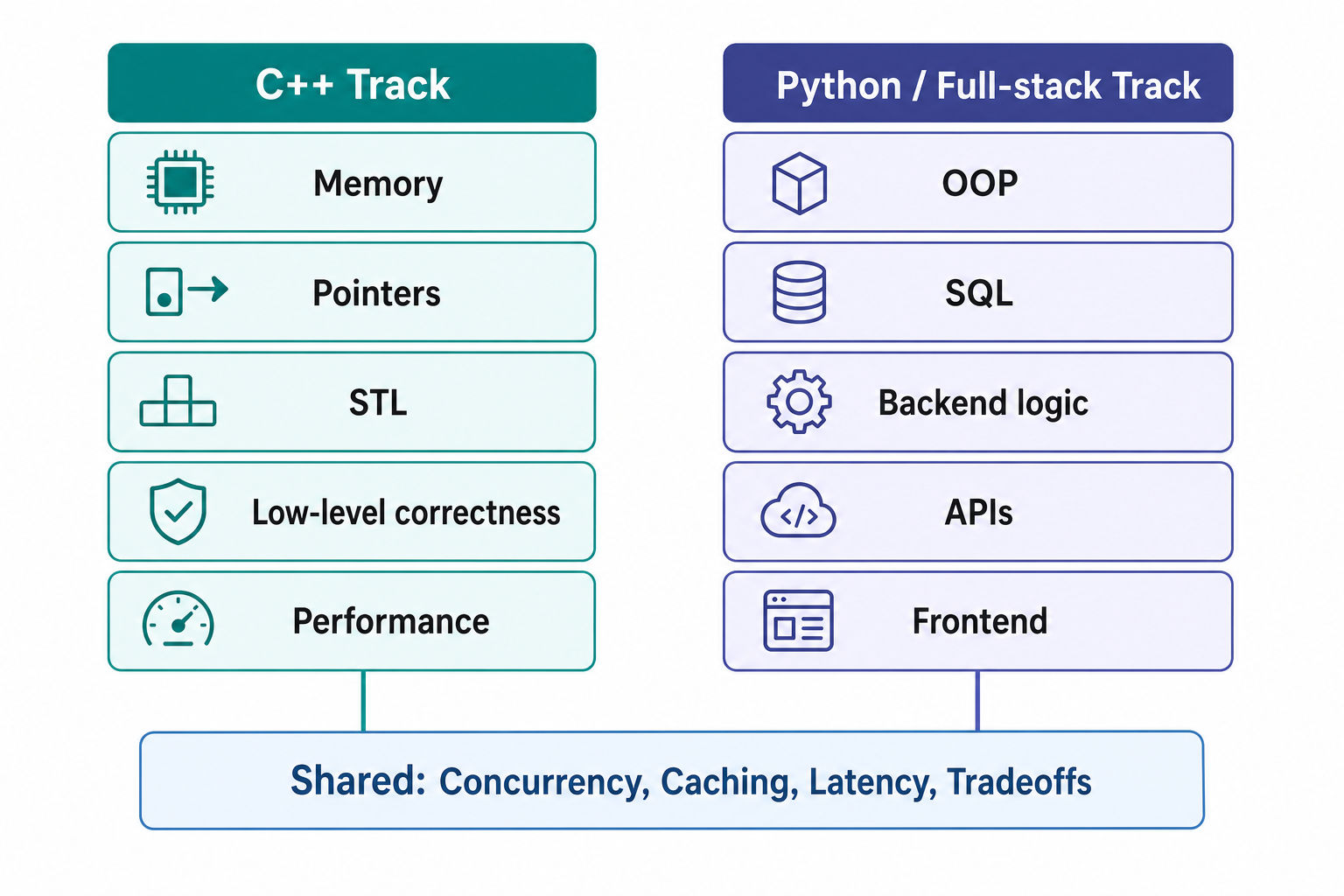
Format shifts by team, language track, and level. The clearest split is by track:
- C++ candidates tend to face lower-level, performance-focused questions.
- Python, backend, and full-stack candidates more often see SQL, OOP, and implementation tasks that resemble real feature work.
Because the exact path varies, read the round descriptions below as the typical structure, then pressure-test them against any recruiter call notes you get.
Interview rounds
Online assessment
Usually the first step, commonly running somewhere from about 45 minutes to a couple of hours. It is often HackerRank-style, but the content varies a lot by team. Some candidates report several shorter coding problems; others get one long implementation task with detailed requirements. This round mainly checks coding fluency, correctness under time pressure, and your ability to write solid code in the target language.
What helps here: read the full spec before writing anything, handle the stated edge cases explicitly, and leave time to test rather than racing to a first submission.
Technical screen or live coding
A 30 to 45 minute technical interview with an engineer in a shared editor or pair-coding setup. Depending on the team, you may solve one or more coding problems, walk through your resume, or answer language-specific questions. Interviewers generally look for:
- A clear problem-solving process and steady communication while coding
- Clean, readable implementation
- Awareness of time and space complexity and edge cases
System design
For many full-time and mid-level roles, Akuna includes a dedicated system design discussion, often around 45 to 60 minutes, either ahead of or within the final round. It tends to focus on practical engineering tradeoffs - scalability, reliability, and latency - rather than abstract architecture buzzwords. Common themes include caching, rate limiting, distributed-systems basics, and designing services that hold up under load. Given the domain, expect prompts where throughput and correctness both matter, such as high-volume data or exchange-style components.
Behavioral or fit interview
A behavioral or hiring-manager conversation is frequently part of the process, either as a standalone round of about 30 minutes or folded into the final loop. It evaluates how you communicate, how you collaborate, why you want Akuna specifically, and whether you operate well in a fast-moving environment. Be ready to talk through projects, teamwork, conflict, ownership, and your interest in trading- or finance-driven engineering.
Final round or onsite
The final stage often runs roughly 90 minutes to 3 hours and may stack several interviews back-to-back. In many cases it is a multi-panel loop spanning technical coding, system design, and fit conversations in one sitting; some teams hold the final in person. This round tests sustained technical depth, adaptability across interview styles, and whether you stay clear and composed through a longer evaluation.
Round-by-round cheat sheet
| Round | Typical length | Primary focus | What to do well |
|---|---|---|---|
| Online assessment | ~45 min to 2 hrs | Coding fluency, correctness under time | Parse the spec fully, cover stated edge cases, leave time to test |
| Technical screen | 30 to 45 min | Problem-solving, clean code, communication | Think out loud, state complexity, handle edge cases before optimizing |
| System design | 45 to 60 min | Practical tradeoffs, latency, reliability | Clarify requirements, reason about throughput, justify each choice |
| Behavioral / fit | ~30 min | Communication, ownership, motivation | Use STAR, have a sharp "why Akuna," show fast-feedback mindset |
| Final / onsite | ~90 min to 3 hrs | Sustained depth across formats | Stay composed, switch gears cleanly, keep narrating reasoning |
What they test
Akuna emphasizes practical software engineering fundamentals, with a strong focus on correctness, efficiency, and implementation quality. Data structures and algorithms matter, but rarely in isolation. Interviewers often care just as much about whether you can:
- Translate messy requirements into working code
- Reason through edge cases and debug under pressure
- Explain tradeoffs clearly
Complexity analysis counts, but it usually comes after getting the solution right.
The depth becomes more specialized by track:
- C++ roles: expect deeper questions on pointers, memory management, the STL, low-level correctness, and performance-sensitive code.
- Python, backend, or full-stack roles: expect Python OOP, SQL, backend service logic, and sometimes frontend or React-related implementation.
Across tracks, Akuna also values systems thinking - concurrency, throughput and latency tradeoffs, caching, load balancing, fault tolerance, API design, and distributed-systems basics all surface. Because the firm builds technology for trading, be ready for scenarios where performance and correctness matter together.
How to stand out
- Match prep to the exact team and language track. For C++, go deep on memory, pointers, the STL, and performance. For Python or full-stack, review OOP, SQL, and practical service or UI implementation.
- Practice longer, requirement-heavy tasks, not only short LeetCode problems. The assessments tend to reward candidates who read specs quickly and implement accurately without losing structure.
- Narrate your decisions as you code. Interviewers care about how you reason through tradeoffs, test cases, and complexity, not just whether you eventually reach a working answer.
- Write production-quality code. Clear naming, sensible structure, and explicit edge-case handling so the solution looks like something a team could build on.
- Be ready to discuss performance even in a standard SWE interview. Explain how design choices affect latency, throughput, and resource usage.
- Have a sharp answer for "why Akuna" and "why trading-tech." Connect your interests to high-impact, fast-feedback, performance-critical systems rather than a generic finance answer.
- Rehearse switching gears across coding, design, and behavioral topics, since the final rounds can shift formats quickly.
Example: narrating a coding problem
It helps to make your process audible. For instance, on a typical implementation task you might say:
"I'll restate the requirements first, then handle the empty and single-element cases. My initial pass is O(n^2) for clarity; once it's correct I'll swap in a hash map to get O(n). Let me add a quick test for duplicates before I optimize."
That sequence - restate, cover edge cases, get it correct, then optimize and re-test - is exactly the discipline interviewers reward at a performance-focused firm.
Example: a "why Akuna" answer
Avoid generic finance lines. For instance:
"I want to work where code quality has an immediate, measurable impact. Trading systems give that fast feedback loop, and I enjoy problems where correctness and latency both matter at the same time, like designing a component that has to stay fast under heavy load."
A 2-week prep sketch
You can adapt this depending on how much time you have before the loop.
- Days 1 to 4: Drill core data structures and algorithms in your target language. If you're on the C++ track, fold in STL and memory questions now.
- Days 5 to 8: Practice longer, spec-heavy implementation tasks end to end. Time yourself, then review for edge cases you missed.
- Days 9 to 11: Run system design reps on caching, rate limiting, and high-throughput services. Practice clarifying requirements out loud.
- Days 12 to 14: Prepare behavioral stories in STAR form, sharpen "why Akuna," and do at least one mixed mock that switches between coding and design.
Mix in real interview questions as you go. You can pull Akuna-specific reps from the Akuna Capital question bank, browse role-specific patterns on the software engineer track, and use the full PracHub question bank for broader coverage. For structure across formats, the interview guide hub and the rest of our resources cover system design and behavioral prep.
How to Use This Page as a Prep Plan
Do not treat this as passive reading. Convert the ideas in this page into a short weekly loop: learn one idea, practice it under interview conditions, then write down what changed. That is the fastest way to turn advice into visible interview behavior.
| Prep area | What you need to prove | Practice artifact |
|---|---|---|
| Understand | Turn the prompt into a concrete goal. | Clarifying questions and success criteria. |
| Practice | Use realistic constraints and timed reps. | Worked examples with edge cases. |
| Explain | Make reasoning visible. | Tradeoffs, assumptions, and test strategy. |
| Improve | Review misses quickly. | A short feedback log and next action. |
For Akuna Capital Software Engineer Interview Guide 2026, the strongest candidates usually do three things well: they make their assumptions explicit, they use concrete examples instead of vague claims, and they review mistakes quickly enough that the next practice rep is better than the last one.
FAQ
Does Akuna Capital ask LeetCode-style questions?
Algorithm and data-structure skills do come up, but the loop leans toward practical, requirement-heavy implementation rather than pure puzzle-solving. Many candidates find that being fluent with longer spec-driven tasks matters as much as memorizing patterns. Practice both, and prioritize correctness and clean code over clever tricks.
Is the interview different for C++ versus Python roles?
Yes. C++ candidates tend to get deeper low-level questions on memory, pointers, the STL, and performance. Python, backend, and full-stack candidates more often see OOP, SQL, and service or UI implementation. Both tracks still touch shared systems topics like concurrency, caching, and latency tradeoffs, so prepare to the track you're applying for.
How hard is the Akuna Capital online assessment?
It varies by team. Some candidates report multiple shorter coding problems; others get one long implementation task with detailed requirements. The common challenge is reading the spec quickly and writing correct code under time pressure. Budget time to test before you submit instead of optimizing prematurely.
Should I prepare system design even for a coding-heavy role?
For many full-time and mid-level roles, yes. System design discussions often appear, focused on practical tradeoffs like scalability, reliability, and latency rather than buzzwords. Reviewing caching, rate limiting, and high-throughput service design is worth it even if your primary strength is coding.
How should I answer "why Akuna" or "why trading-tech"?
Tie your answer to high-impact, fast-feedback, performance-critical engineering rather than finance in the abstract. A common pitfall is giving a generic "I like finance" response. Connect it to the kind of work you actually enjoy, such as systems where correctness and latency both matter.