Who this guide is for
You're interviewing for a Data Scientist role at CVS Health and want to know what to actually prepare. This guide breaks down the typical loop, what each round tests, and how to prep for the parts that matter most: live SQL, applied statistics and experimentation, and translating messy healthcare and retail problems into measurable analytics. It's built for candidates who'd rather drill the right things than guess.
CVS Health is a large, multi-business company: pharmacy, retail, Aetna (insurance), and Caremark (pharmacy benefits). The bar shifts by team, so treat this as the common pattern and confirm specifics with your recruiter.
What to expect
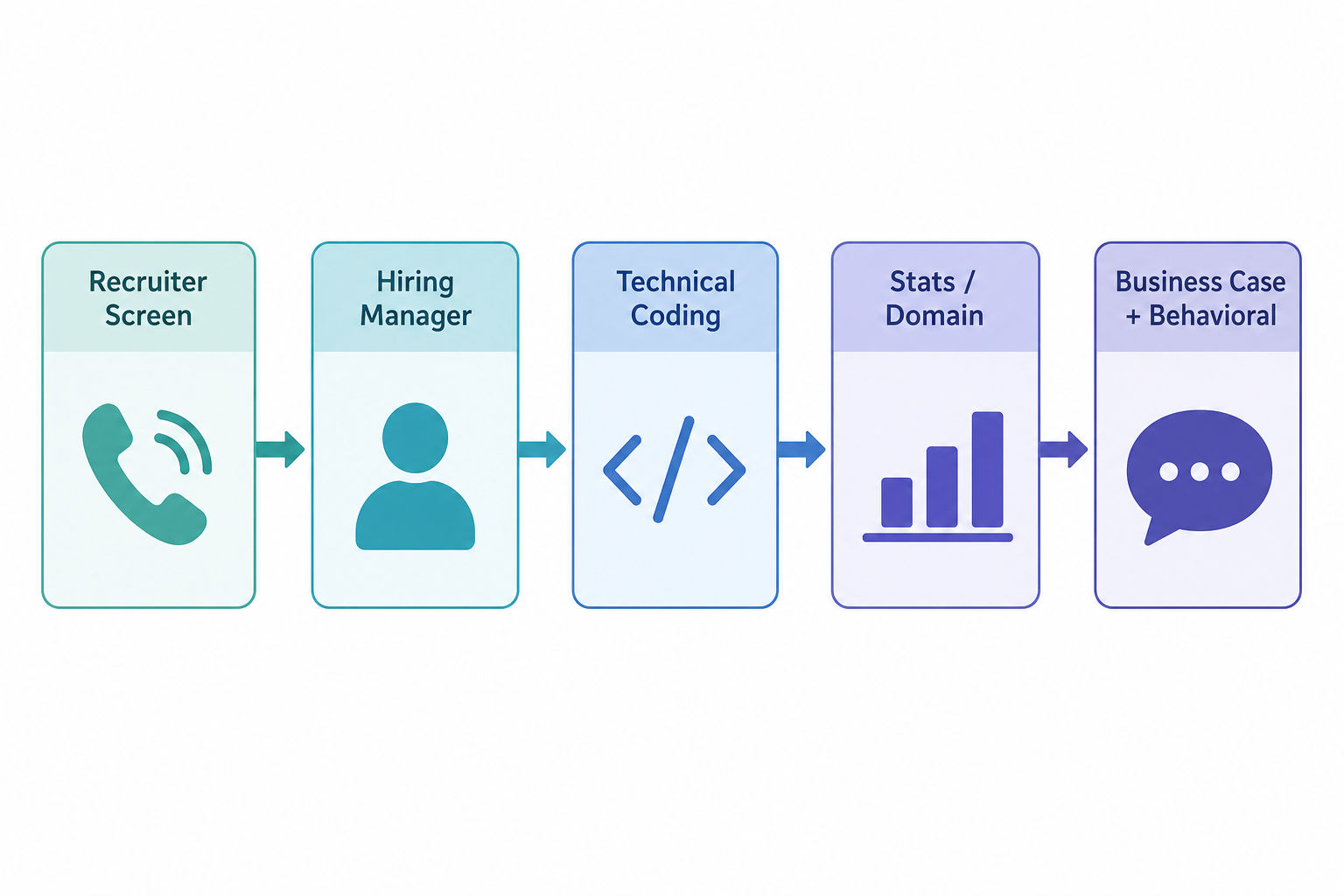
CVS Health's Data Scientist interview is usually a 3- to 5-round loop, though the exact structure depends heavily on the team. A role tied to pharmacy analytics, Aetna, Caremark, personalization, pricing, or assortment optimization can shift the balance between coding, statistics, business cases, and domain depth. A common arc is a recruiter screen, a hiring manager conversation, one or two technical rounds, and a business or behavioral final discussion.
What stands out is how practical the evaluation tends to be. The emphasis is usually on SQL and Python execution, experimentation and statistical judgment, and your ability to connect analysis to healthcare, retail, or insurance outcomes rather than reciting ML theory. Be prepared, too, for some process variability and occasionally slow communication across teams, so confirm your timeline expectations with the recruiter early.
The interview rounds
Recruiter screen
A short (roughly 20- to 30-minute) phone or video conversation covering resume fit, interest in CVS Health, compensation expectations, work authorization, and location preferences. Expect straightforward questions about your background and whether you've worked in healthcare, retail, insurance, or analytics settings. This round is mostly about alignment and logistics, not technical depth.
Hiring manager interview
A 30- to 45-minute conversation, usually with the manager or a senior manager. The focus is on how deeply you understand your prior work, how you frame business problems, and how well you communicate with stakeholders in ambiguous environments. Be ready to walk through past models, experiments, forecasting work, or analytics projects and explain why your experience fits the team.
Technical coding round
Often 45 to 60 minutes in a live shared editor (such as CoderPad). This round tests SQL fluency, Python/Pandas problem solving, and your ability to reason aloud under time pressure. Expect fast-moving SQL questions involving joins, aggregations, CTEs, window functions, and query debugging, sometimes alongside Python data wrangling or basic statistical interpretation. You can drill this format on the Data Scientist question bank.
Second technical or domain round
Typically 30 to 60 minutes, often led by a senior or lead data scientist. The goal is to evaluate statistical maturity, machine learning judgment, and your ability to turn business needs into analytical formulations. Depending on the team, this can include causal inference, experimentation, model selection, feature design, performance interpretation, or optimization concepts for pricing- and assortment-focused roles.
Business case or product analytics round
Usually 30 to 45 minutes and more conversational than coding-heavy. You'll likely be asked to structure an ambiguous, CVS-relevant problem: choose the right metrics, identify the data you'd need, and explain how you'd measure impact. Common themes include medication adherence, fraud detection, forecasting, personalization, member outcomes, and store or merchandising decisions.
Behavioral or final panel
Usually 30 to 60 minutes, sometimes a single interview and sometimes a panel. Interviewers assess collaboration style, ownership, leadership, and alignment with CVS Health's mission and values. Expect questions about stakeholder influence, conflict resolution, working with messy data, prioritizing competing needs, and why healthcare impact matters to you.
Round-by-round summary
| Round | Length (approx.) | Format | Primary signal |
|---|---|---|---|
| Recruiter screen | 20-30 min | Phone/video | Fit, motivation, logistics |
| Hiring manager | 30-45 min | Conversation | Business framing, communication |
| Technical coding | 45-60 min | Live editor | SQL + Python fluency |
| Stats / domain | 30-60 min | Conversation + whiteboard | Statistical & modeling judgment |
| Business case | 30-45 min | Discussion | Metric choice, problem structuring |
| Behavioral / panel | 30-60 min | 1:1 or panel | Collaboration, ownership, values |
Note: not every candidate sees all six; teams combine or drop rounds. Confirm the exact loop with your recruiter.
What they test
CVS Health tends to test applied data science rather than abstract puzzle solving. The four areas below show up across nearly every loop.
SQL and Python
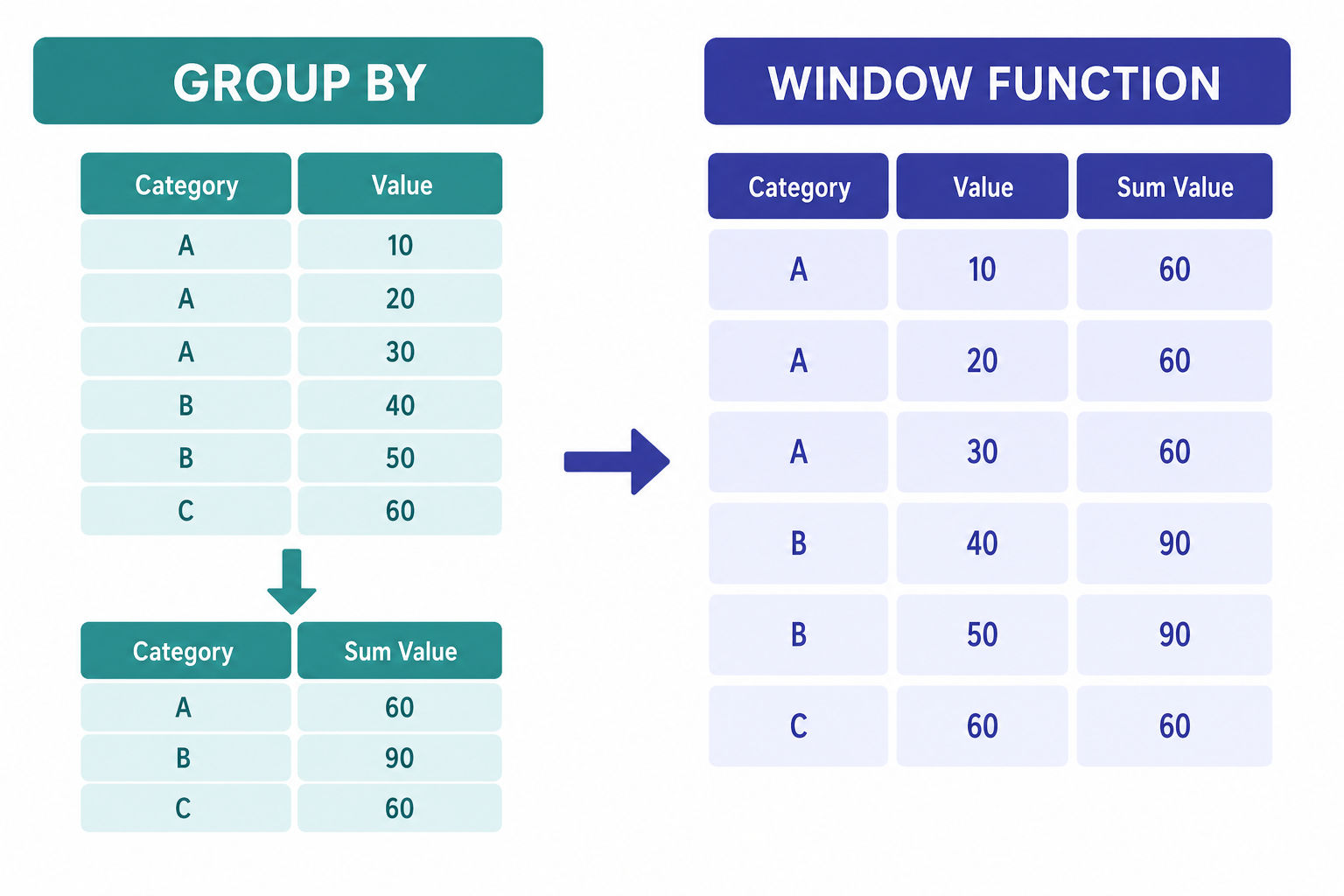
SQL is one of the most consistent themes, and you should expect to write production-style analytical queries quickly. Be comfortable with joins, group-bys, aggregations, CTEs, window functions, and debugging incomplete or incorrect queries. For Python, focus on practical coding and Pandas-based data manipulation rather than only algorithm drills. Some teams split SQL and Python into separate interviews, so prepare for both even if the job description emphasizes one.
For instance, a common window-function task is "rank each member's pharmacy fills by date and flag the most recent one":
SELECT
 member_id,
 fill_date,
 drug_name,
 ROW_NUMBER() OVER (
 PARTITION BY member_id
 ORDER BY fill_date DESC
 ) AS recency_rank
FROM prescription_fills;
-- recency_rank = 1 is each member's latest fill
That single pattern - PARTITION BY ... ORDER BY ... - covers a large share of analytical SQL questions. Drill it until it's automatic.
Statistics and experimentation
CVS often probes whether you can make sound decisions in business and healthcare contexts. Be ready for hypothesis testing, confidence intervals, regression basics, sampling logic, the bias-variance trade-off, and interpreting significance correctly. A/B testing comes up often, especially metric choice, test design, statistical power, and explaining trade-offs in plain language. Because many healthcare and operational decisions can't rely on clean randomized experiments, causal inference also matters - be ready to mention approaches like difference-in-differences or propensity matching when randomization isn't possible.
Modeling judgment
For more modeling-heavy teams, expect discussion of model selection, feature engineering, evaluation metrics, overfitting control, and output interpretation. The strongest signal is usually practical judgment: choosing solutions that are interpretable, operationally useful, and safe in a high-stakes setting, not flashy algorithms. In a regulated healthcare environment, "why this model" and "how would clinicians trust it" often matter more than squeezing out the last point of accuracy.
Domain translation
A major differentiator is whether you can take an ambiguous problem - improving medication adherence, reducing fraud, optimizing assortment, personalizing outreach - and turn it into a measurable analytical plan. For some teams (pricing, merchandising, assortment science), optimization concepts can matter nearly as much as classic ML; you may need to discuss objective functions, constraints, trade-offs, and how to scale decisions across many products or stores. The consistent through-line is choosing sensible metrics and communicating recommendations clearly to business, clinical, or operational partners.
How to stand out
- Know the specific business unit. A pharmacy analytics team, an Aetna team, and an assortment optimization team can each weigh very different skills. Tailor your prep accordingly.
- Make live SQL automatic. Drill window functions, CTEs, joins, and debugging until they feel fast under time pressure. These rounds often reward speed and clarity, not just eventual correctness.
- Narrate your reasoning while coding. Interviewers commonly evaluate how you surface trade-offs and assumptions as much as whether you finish the exercise.
- Prepare one or two healthcare case frameworks. Be able to define the business goal, ask for the right data, choose outcome metrics, and explain how you'd measure impact on patients, members, or operations.
- Lead with practical modeling judgment. Favor solutions that are interpretable, operationally useful, and safe in high-stakes contexts over the most sophisticated algorithm.
- Bring concrete behavioral stories. Have examples ready on ambiguity, messy data, stakeholder conflict, and cross-functional influence; these come up often in manager and final rounds.
- Confirm each round's format in advance. Because processes vary across teams and communication can be inconsistent, asking whether a round is SQL-heavy, Python-heavy, or domain-focused gives you a real edge.
Do this, not that
| Do | Don't |
|---|---|
| Clarify the business goal before writing any query or model | Jump straight to a complex algorithm |
| State assumptions out loud as you code | Code silently and reveal logic only at the end |
| Pick a metric and defend why it fits the decision | List five metrics with no recommendation |
| Choose interpretable, deployable models for clinical/ops use | Over-index on accuracy at the cost of trust |
| Tie the answer back to patient, member, or store impact | Stop at "the model has 0.9 AUC" |
| Ask whether a round is SQL- or Python-focused | Assume the format and prep only one skill |
A worked example: medication adherence
A business-case round might open with something like "How would you help improve medication adherence?" Here is how a strong candidate could structure it.
Example answer:
- Clarify the goal. Is adherence defined by Proportion of Days Covered (PDC) over a refill window? Which member population and which drug classes? What's the intervention budget?
- Frame the metric. Target a measurable outcome (e.g., share of members above an adherence threshold), and a guardrail (e.g., not increasing call-center cost per saved member).
- Identify data. Fill history, gaps between refills, plan type, demographics, prior outreach, and clinical flags.
- Choose an approach. A model to predict who's at risk of falling out of adherence, then target outreach there - and, critically, an experiment (randomized outreach where ethical/feasible) to measure causal lift, not just correlation.
- Measure impact. Compare adherence and downstream outcomes between treated and control groups; report effect size with a confidence interval, not just a point estimate.
The point isn't a perfect answer. It's showing you can move from a vague prompt to a measurable, defensible plan and name where causal inference replaces a clean A/B test.
How to prepare
- Drill real analytical SQL. Window functions, CTEs, and multi-join debugging on dataset-style problems. Work through the PracHub question bank and filter to SQL and data science problems.
- Practice talking through stats. Be able to explain p-values, power, confidence intervals, and A/B test design in plain language, as if to a non-technical stakeholder.
- Study CVS-specific interviews. Read what other candidates report for similar roles in the CVS Health interview pages and across the Data Scientist guides.
- Compare with peer companies. The retail/health/insurance data science bar overlaps with companies like the Capital One and Amazon data science loops, useful for calibrating breadth.
- Browse more guides. See the full set of company-specific interview guides to benchmark formats.
How to Use This Page as a Prep Plan
Do not treat this as passive reading. Convert the ideas in this page into a short weekly loop: learn one idea, practice it under interview conditions, then write down what changed. That is the fastest way to turn advice into visible interview behavior.
| Prep area | What you need to prove | Practice artifact |
|---|---|---|
| Metric framing | Define the unit, window, and denominator. | One clear metric contract. |
| SQL execution | Use readable CTEs and test row counts. | A query with checks after each join. |
| Statistics | Connect methods to decision risk. | Assumptions, confidence, and caveats. |
| Communication | Turn findings into a recommendation. | One concise business interpretation. |
For CVS Health Data Scientist Interview Guide 2026, the strongest candidates usually do three things well: they make their assumptions explicit, they use concrete examples instead of vague claims, and they review mistakes quickly enough that the next practice rep is better than the last one.
FAQ
How many rounds is the CVS Health Data Scientist interview?
Usually 3 to 5 rounds: a recruiter screen, a hiring manager conversation, one or two technical rounds (SQL/Python and stats/modeling), and a business-case or behavioral final. The exact count varies by team, so confirm with your recruiter.
Is the CVS Health Data Scientist interview more SQL or Python?
SQL is the most consistent theme: expect production-style analytical queries with joins, CTEs, and window functions. Python (especially Pandas) shows up too, and some teams split them into separate rounds. Prepare for both even if the job description leans one way.
Does CVS Health ask LeetCode-style algorithm questions?
Less than pure-tech companies. The coding emphasis is applied: SQL fluency and practical Python data manipulation rather than heavy data-structures-and-algorithms drilling. Brush up on core Python, but prioritize analytical SQL.
What domain knowledge helps for a CVS Health data science interview?
Familiarity with healthcare, pharmacy, retail, or insurance analytics is a plus (think medication adherence, fraud detection, forecasting, personalization, and assortment or pricing decisions). You don't need to be a clinician, but being able to translate these into metrics and experiments stands out.
How important is A/B testing and causal inference?
Very. Metric choice, test design, power, and reading results correctly come up often. Because many healthcare and operational decisions can't be cleanly randomized, be ready to discuss causal-inference approaches for when an A/B test isn't feasible.
How should I prepare for the business case round?
Practice structuring ambiguous prompts: clarify the goal, define a primary metric and a guardrail, list the data you'd need, choose an approach, and explain how you'd measure impact. Prepare one or two healthcare-flavored frameworks so you're not improvising the structure live.