What this guide covers
This is a practical preparation guide for the Google Data Scientist interview in 2026. It's written for candidates targeting product-analytics, experimentation, or research-leaning DS roles, and it walks through the full loop: what each round tests, how the bar is calibrated, the topics to over-prepare, and concrete answer frameworks you can rehearse. Use it alongside real, structured practice questions - reading about the loop is no substitute for working problems out loud.
Google evaluates a Data Scientist on far more than modeling or coding. The loop tests statistics, experimentation, product metrics, analytical judgment, communication, and how you reason through ambiguity. The fastest way to fail is to be a strong coder who can't define a metric or defend an experiment design.
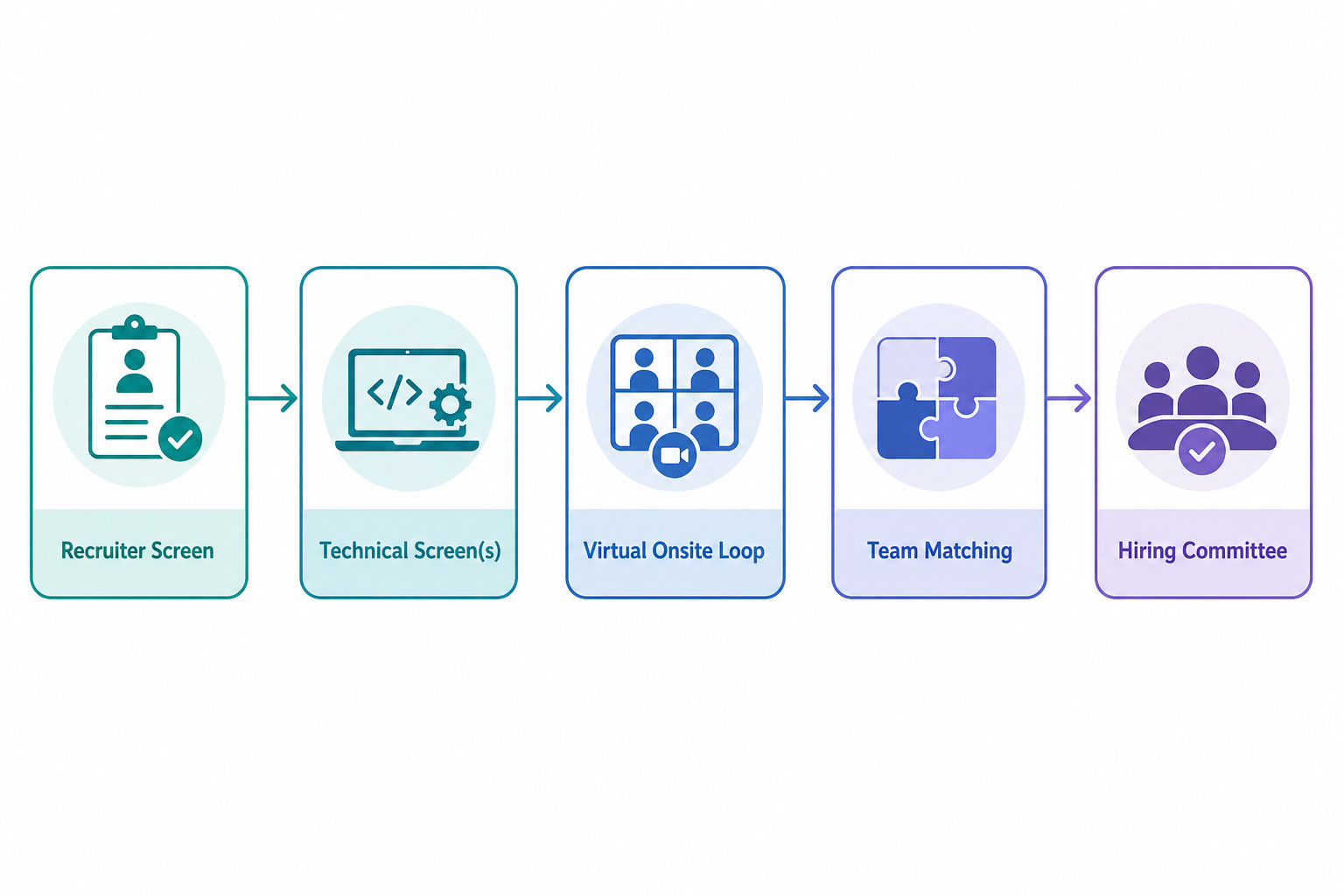
The interview process at a glance
The process is role-shaped rather than rigidly standardized. A product-analytics candidate tends to see more metrics and experiment design; a research-leaning candidate gets deeper modeling discussion. Clearing the interview bar is not always the final step either - team matching and internal approvals can extend the timeline by weeks.
| Stage | Typical length | Primary signal | How to prepare |
|---|---|---|---|
| Recruiter screen | ~20-30 min | Role fit, motivation, communication | Crisp "why Google / why DS" story; clarify your track (product vs. ML vs. research) |
| Technical screen(s) | ~45 min each | Stats fundamentals, reasoning under uncertainty | Probability, hypothesis testing, talking through messy problems aloud |
| Virtual onsite loop | 4-5 rounds, ~45 min each | Depth + range across DS competencies | Mixed prep: stats, coding, product sense, ML, behavioral |
| Team matching | Varies | Fit with a specific team's domain | Be specific about the problems you want to own |
| Hiring committee | Not candidate-facing | Signal consistency across the loop | Nothing to do directly - strong, consistent rounds drive it |
Recruiter screen
A short phone or video conversation, commonly 20-30 minutes. Expect a resume walkthrough, "why Google" and "why Data Science," and discussion of team interests, location, work authorization, and logistics. This round mainly checks role fit and communication, and it clarifies whether your background aligns more with product analytics, experimentation, ML, or research-focused DS work. Treat it as the moment to position your track - it shapes who interviews you.
Technical screen(s)
The first technical screen is usually about 45 minutes over video with a data scientist, and it often leans toward statistics, probability, and analytical reasoning rather than pure coding. You'll typically solve problems live while narrating your thinking, so interviewers can read your statistical fundamentals, reasoning under uncertainty, and clarity through a messy problem.
A second screen is common but not guaranteed. When it happens, it tends to add Python, SQL, product analytics, experiment design, or an applied business case, depending on the role. Here you're judged on coding fluency, data manipulation, structured problem solving, and your ability to turn an ambiguous business question into a concrete analytical plan.
Virtual onsite loop
The onsite is typically a virtual loop of four to five interviews, most often around 45 minutes each and commonly conducted over Google Meet. Across the loop, expect a mix of:
- Statistics and experimentation
- Coding and data manipulation (Python, SQL)
- Product sense and metrics
- Machine learning
- Behavioral
The loop is designed to measure both depth and range: technical rigor, product judgment, communication, collaboration, and comfort with ambiguity. A single weak round can sink an otherwise strong packet, so range matters as much as any one peak skill.
Team matching and hiring committee
Passing the interview bar usually leads to a few steps that are less about raw interview performance:
- Team matching - conversations with hiring managers or teams focused on whether your background fits a specific team's domain and style of DS work. Being clear about the problems you want to solve and where your strengths lie helps you land well.
- Hiring committee - in many cases a committee reviews your packet for signal consistency, strength across competencies, and overall fit against Google's hiring bar. This is typically not candidate-facing, and its exact sequencing relative to team matching can vary.
What they test, and how to prepare
Statistics and experimentation (the core)
This is the area to over-prepare. Be ready for probability rules, conditional probability, expected value, distributions, confidence intervals, hypothesis testing, p-values, Type I and Type II error, sampling bias, bootstrapping, and causal reasoning.
Experiment design matters most of all. Expect to define primary and guardrail metrics, reason about power and sample size, spot confounders, discuss instrumentation and logging risks, and explain the difference between statistical and practical significance.
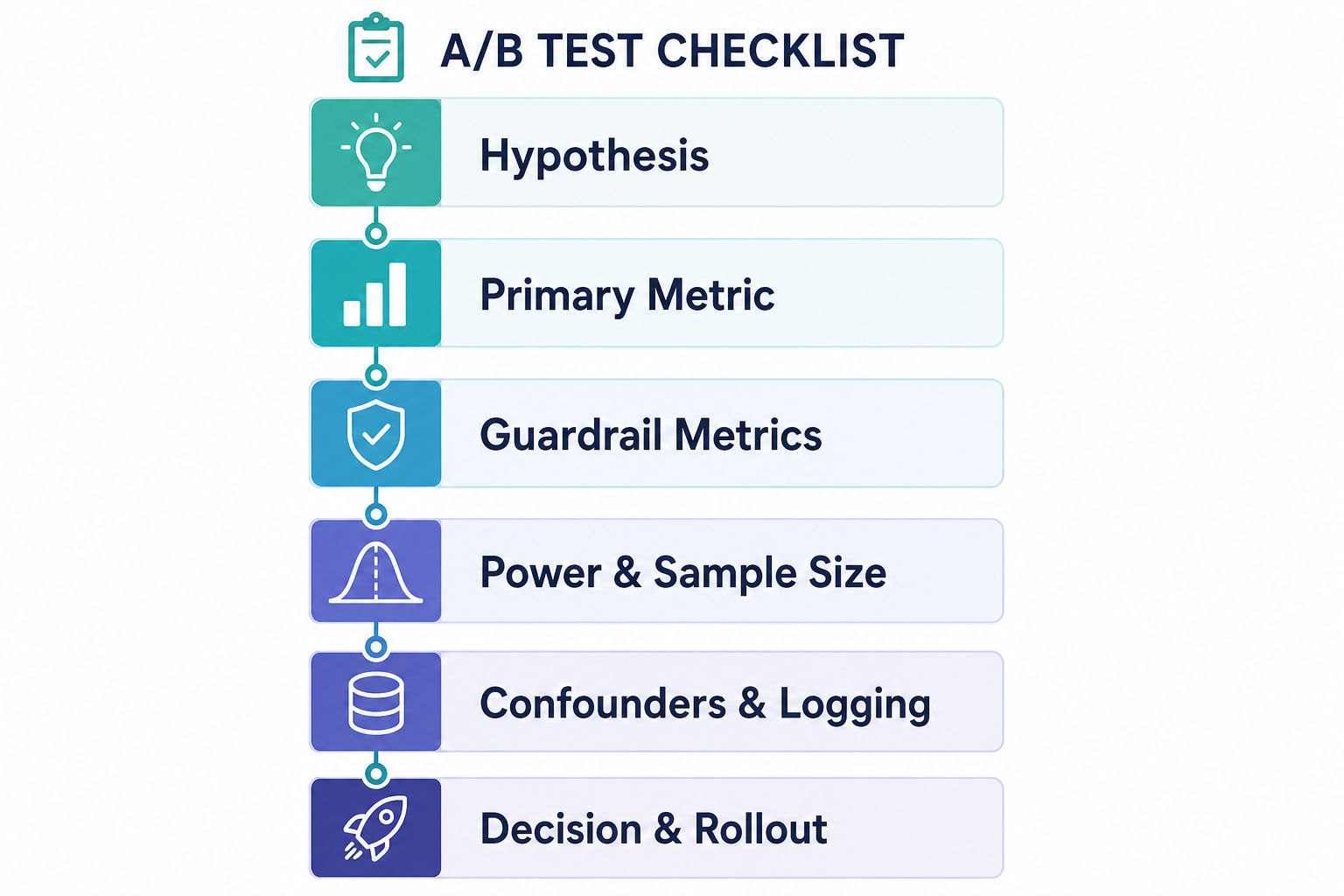
Example A/B test answer skeleton. When asked "How would you test a new ranking change?", structure it: state the hypothesis, name the primary metric and why, add guardrail metrics (latency, complaints, revenue) to catch harm, estimate the sample size needed for the effect you care about, list confounders and logging risks, then decide how you'd read a result and roll out. Walking this path out loud signals far more than reciting a p-value definition.
Product analytics
Google wants to see whether you can turn a vague product question into a measurable framework. That means defining the goal, identifying the user behavior that matters, choosing success metrics, diagnosing metric movement, segmenting results intelligently, and recommending next steps. Be comfortable with funnels, retention, engagement, launch impact, UX changes, and how to investigate a KPI drop after a release.
Example metric-drop framework. For "Daily active users dropped 8% week-over-week, what do you do?", don't jump to a cause. Scope it first: is it real or an instrumentation bug? Then segment - by platform, country, new vs. returning, app version - to localize the drop. Form hypotheses (a release, a holiday, a logging change, a competitor event), then check each against the segmented data before recommending action. The structure is the answer; the specific cause is secondary.
Coding (Python and SQL)
Coding is usually practical rather than deeply algorithmic, and it can appear in dedicated rounds or inside other interviews. Expect to write clean functions over tabular or log-like data, manipulate arrays or text, and solve SQL problems involving joins, grouping, ranking, top-N, and filtering. Correctness, clarity, and edge-case handling generally count for more than clever tricks.
A reliable way to build this fluency is repetition on realistic prompts. Work a set of SQL and Python data questions until window functions, aggregations, and group-wise ranking feel automatic - these recur across many DS loops, not just Google's.
Machine learning
ML shows up, but usually tied to judgment rather than theory alone. Know when to use supervised vs. unsupervised methods, how to weigh regression and classification tradeoffs, and how to evaluate models with precision, recall, ROC-style tradeoffs, clustering quality, and feature choices. Interviewers often push on why you chose a method, what alternatives you considered, and how you'd validate that a model is actually useful for the product problem.
If your target is a more ML-heavy track, the related Google Machine Learning Engineer guide goes deeper on modeling and systems expectations.
Your resume and behavioral signal
Your past work matters more than many candidates expect. Interviewers frequently dig into ownership, data-quality challenges, design tradeoffs, stakeholder communication, impact measurement, and what you'd do differently in hindsight. Throughout, they're checking whether you can explain technical choices simply, stay rigorous without overcomplicating, and connect analysis to decisions.
How to stand out
| Do | Don't |
|---|---|
| Go deeper on stats and experimentation than standard prep | Treat A/B testing as a single memorized definition |
| Structure product answers explicitly (goal -> metric -> guardrails -> segments) | Guess at a cause before scoping and segmenting |
| Narrate your reasoning so interviewers can follow it | Code silently and reveal only the final answer |
| Be precise about exactly what you owned on past projects | Use "we" so much that your contribution disappears |
| Show low-ego, collaborative judgment in behavioral rounds | Frame every story as a solo heroics narrative |
| Tailor prep to your DS track (product vs. ML vs. research) | Prepare one generic profile for every team |
A few of these deserve detail:
- Treat SQL and Python as cross-round skills, not isolated topics - coding and data manipulation can surface inside broader analytics or product interviews.
- Be precise about your role on past projects. Expect probing on exactly what you owned, why you chose a method, what data issues you faced, and how your work changed a product or business decision.
- Show low-ego judgment in behavioral rounds. Strong answers highlight collaboration with PMs, engineers, analysts, or researchers, especially where you influenced without authority or changed course based on data.
- Don't use AI assistance during live interviews. Google's published 2026 candidate guidance is explicit that using AI tools during interviews can lead to disqualification. Practice with AI beforehand; go in clean on the day.
A 3-week prep skeleton
This is one example cadence, not a guarantee - adjust to your starting point.
| Week | Focus | Daily habit |
|---|---|---|
| 1 | Statistics and probability fundamentals | Solve 2-3 stats problems out loud; review one experimentation concept |
| 2 | Experiment design + product sense | Run one full A/B framework and one metric-diagnosis framework per day |
| 3 | Coding fluency + behavioral + mocks | Mixed SQL/Python sets; write 4-5 STAR stories; do 2-3 mock loops |
Spread practice across topics rather than cramming one area - the loop rewards range, and the weakest round often decides the outcome. Pull from the full PracHub question bank and Google's company page to keep prompts realistic.
How to Use This Page as a Prep Plan
Do not treat this as passive reading. Convert the ideas in this page into a short weekly loop: learn one idea, practice it under interview conditions, then write down what changed. That is the fastest way to turn advice into visible interview behavior.
| Prep area | What you need to prove | Practice artifact |
|---|---|---|
| Metric framing | Define the unit, window, and denominator. | One clear metric contract. |
| SQL execution | Use readable CTEs and test row counts. | A query with checks after each join. |
| Statistics | Connect methods to decision risk. | Assumptions, confidence, and caveats. |
| Communication | Turn findings into a recommendation. | One concise business interpretation. |
For Google Data Scientist Interview Guide 2026, the strongest candidates usually do three things well: they make their assumptions explicit, they use concrete examples instead of vague claims, and they review mistakes quickly enough that the next practice rep is better than the last one.
Video Walkthrough
Chaitanya Data walks through the Google Data Scientist loop first-hand. It is one candidate's account rather than an official spec, so treat the round order as indicative.
FAQ
How hard is the Google Data Scientist interview compared to other companies?
It's widely considered one of the more demanding DS loops, mainly because it tests breadth - statistics, experimentation, product sense, coding, and ML in a single loop - rather than depth in one area. Many candidates underestimate the experimentation and product-metric components and over-index on coding. Comparing notes across the Amazon and Microsoft DS guides can help you see what's Google-specific versus standard for the field.
How long does the whole process take?
It varies a lot. After the screens and onsite, team matching and hiring committee can add weeks, especially if you're matching to a specific team. Plan for a process measured in weeks rather than days, and don't read a quiet stretch as a rejection.
Do I need a PhD to get hired?
No. Google hires data scientists from a range of backgrounds. What the loop actually checks is rigorous statistical reasoning, product judgment, and the ability to connect analysis to decisions. A strong, well-explained track record can matter more than a specific credential.
How much coding should I expect?
Enough to demonstrate fluency, but it's usually practical rather than algorithm-heavy. Expect clean data manipulation in Python and solid SQL (joins, grouping, window functions, top-N) rather than competitive-programming puzzles. Correctness, clarity, and edge cases count more than clever tricks.
Can I use AI tools to help during the live interview?
No. Google's 2026 candidate guidance states that using AI assistance during interviews can lead to disqualification. Use AI to practice and pressure-test your reasoning beforehand, but treat the live rounds as unaided.
What single area should I prioritize if I'm short on time?
Statistics and experimentation. It's the core competency the loop is built around, it shows up in multiple rounds, and it's where many otherwise-strong candidates are weakest. Make sure you can run a full A/B design and a metric-diagnosis framework cleanly from memory.