What this guide covers
This is a practical walkthrough of the Google Product Manager interview for candidates who already understand the basics and want to know how Google evaluates PMs, round by round. You'll get the loop structure, what each interviewer is actually scoring, the five signals that decide the outcome, worked examples of how to open each question type, and a preparation plan you can run in the weeks before your loop. The goal is to help you show structured judgment under ambiguity, which is what Google's PM bar rewards most.
This guide is written for first-time and experienced PM candidates targeting roles from APM through senior PM. It pairs well with the broader PracHub interview guides and the live Google interview questions in the question bank.
What to expect
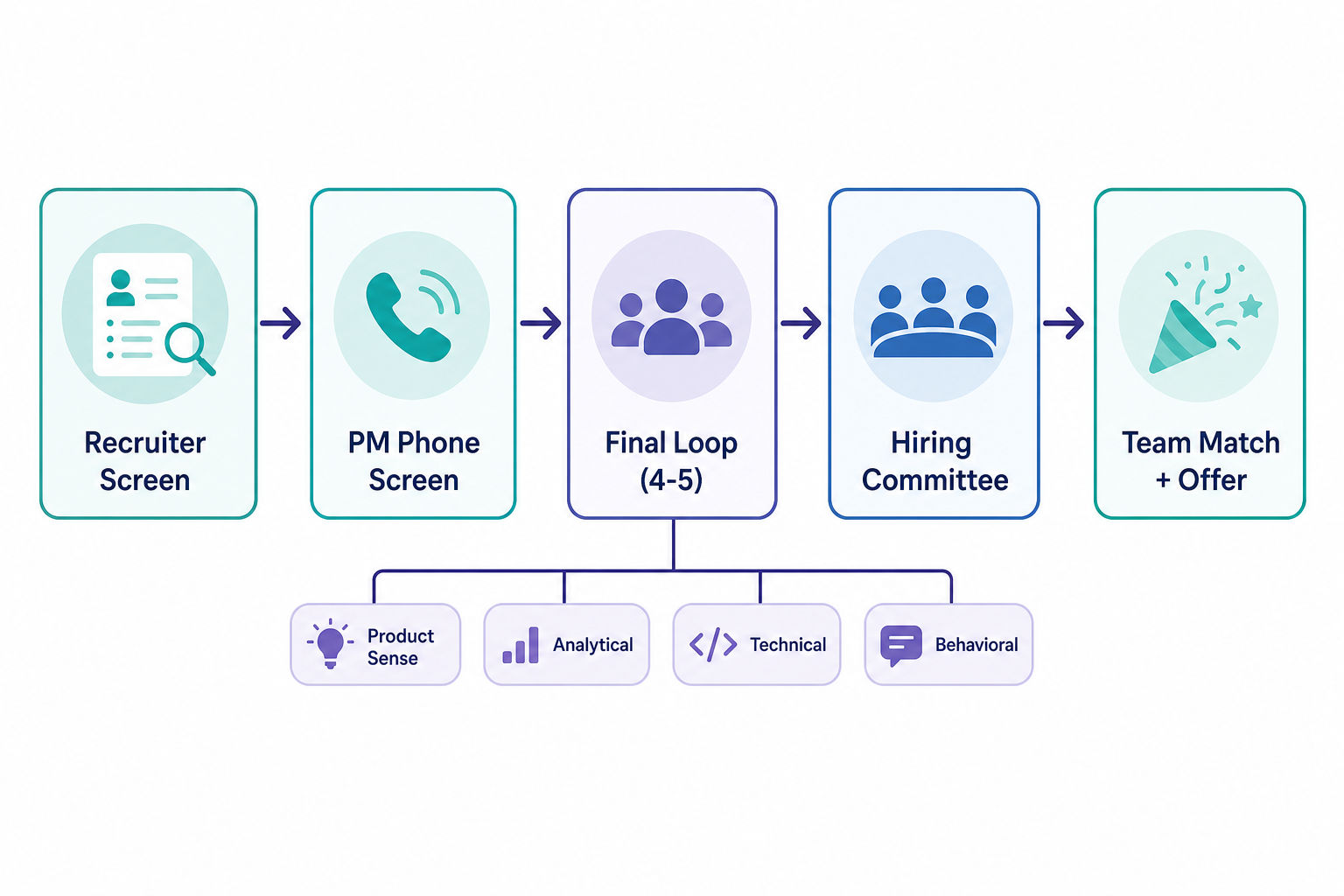
Google's Product Manager interview is a structured, competency-based process that often runs several weeks end to end. Most of that calendar time comes from internal steps like hiring committee review and team matching, not from the interviews themselves. The usual flow is:
- Recruiter screen
- PM phone screen (sometimes one to two screens, depending on team and level)
- Final loop of 4 to 5 interviews
Many final loops are still conducted virtually, and some roles add an online culture or values assessment before the interviews begin.
What stands out about Google is how explicitly it separates the signals it measures. You are not evaluated on a single notion of "overall PM fit." Different rounds probe different dimensions, and interviewers care a great deal about how you structure ambiguity, justify trade-offs, and stay anchored in user value.
Interview rounds
The exact round names, count, and sequencing vary by team and level, but a typical Google PM loop covers the areas below.
Recruiter screen
A short phone or video conversation with a recruiter, usually around 30 minutes. Expect a resume walkthrough, questions about why Google and why this role, and a discussion of your background, target level, and logistics. The recruiter is checking baseline fit: communication, motivation, and whether your experience matches the role.
PM phone screen
A screening interview with a Product Manager, typically around 45 minutes. It tests baseline PM judgment through product design, product improvement, metrics, estimation, and trade-off questions. Google looks for structured thinking, user focus, clear communication, and the ability to reason through an open-ended problem without getting lost.
Product design / product sense
In the final loop you will often face two separate product-focused interviews, typically around 45 minutes each. These are live, case-style discussions. You might be asked to design a product, improve an existing Google product, define a target user segment, or prioritize features under constraints. Interviewers assess user empathy, problem framing, prioritization, creativity, product vision, and how well you defend trade-offs.
Analytical / execution / strategy
A case-style interview focused on metrics, diagnosis, and strategic reasoning, typically around 45 minutes. You might be asked to explain a metric drop, define a north-star metric, size a market, judge whether a launch succeeded, or reason through the limits of an experiment. The round tests analytical clarity, KPI selection, prioritization, growth logic, and your ability to reason carefully with incomplete data.
Technical / system design
A PM-oriented technical discussion, typically around 45 minutes - not a coding interview. You might reason about architecture, APIs, databases, client-server behavior, scalability, reliability, or feasibility trade-offs for a product idea. Google wants to see that you can partner effectively with engineering, understand technical constraints, and make product decisions shaped by system realities. For infrastructure, cloud, ads, or AI-heavy teams, this discussion can go deeper.
Behavioral / leadership ("Googlyness")
A structured behavioral interview, typically around 45 minutes. Expect questions about conflict, failed launches, influencing cross-functional partners, handling ambiguity, hard prioritization calls, and leadership without authority. The evaluation focuses on collaboration, judgment, resilience, stakeholder management, and whether you communicate with clarity and humility.
Hiring committee, team match, and offer
After the interviews, your packet goes through internal review rather than another candidate-facing round. Google uses this step to calibrate level, confirm consistency across interviewer feedback, and decide whether you meet its PM bar. In some cases you clear the interviews before being matched to a specific team, which can extend the timeline by days or weeks.
Round-by-round signal map
Each interviewer is scoring a primary dimension. Knowing the target of the round lets you spend your 45 minutes on what counts.
| Round | Primary signal | What good looks like | Common failure |
|---|---|---|---|
| Recruiter screen | Baseline fit & motivation | Clear "why Google," accurate level framing, tight resume story | Rambling background, no specific reason for the role |
| PM phone screen | General PM judgment | Structured open, user focus, sensible prioritization | Jumping to solutions before scoping |
| Product sense | Framing & user empathy | Named user segment, prioritized pains, defensible feature pick | Feature list with no segmentation or goal |
| Analytical / execution | Metric reasoning | North-star + counter-metric, MECE diagnosis, experiment caveats | Vanity metrics, no counter-metric, hand-waving the data |
| Technical / system design | Engineering partnership | Reasons about APIs, data flow, latency, feasibility trade-offs | Buzzwords, can't connect tech choices to product impact |
| Behavioral ("Googlyness") | Collaboration & judgment | Specific STAR stories, owns mistakes, influence without authority | Vague stories, blames others, no measurable result |
What they test
Across the loop, Google PM interviews most consistently test five areas.
- Product sense - Segment users, identify pain points, frame the problem clearly, prioritize features, compare options, and articulate a longer-term vision. Questions tend to reward candidates who clarify the user, goal, constraints, platform, and success criteria before jumping to solutions.
- Analytical reasoning - Select north-star metrics and counter-metrics, diagnose funnel or retention issues, reason about experiments, and handle estimation or probability-style questions with structure. The analytical bar is high.
- Strategy and execution - Decide what to build next, whether to launch, and how to prioritize across competing opportunities, while accounting for market dynamics, competition, ecosystem effects, and monetization.
- Technical fluency - Discuss client-server architecture, APIs, databases, reliability, scalability, and latency, and reason about trade-offs between speed, quality, complexity, and feasibility. You won't write code, but you should sound like a PM who can genuinely partner with engineers rather than recite buzzwords.
- Cross-functional leadership - Influence without authority, manage stakeholders, and navigate ambiguity and conflict.
A 2026 theme: AI/ML literacy
Even when a role is not explicitly AI-focused, be ready to discuss when machine learning is the right tool versus a simpler rules-based approach, how AI changes the user experience, and the trade-offs it introduces around quality, latency, safety, trust, and operational complexity.
Across every round, Google tends to value structured thinking over polished perfection. Clear assumptions, logical frameworks, and defensible trade-offs matter more than landing on a single "correct" answer.
How to answer each question type
These are reusable openings. The point isn't to memorize a script - it's to make your structure visible in the first 60 seconds so the interviewer can follow your reasoning.
Product design / product sense
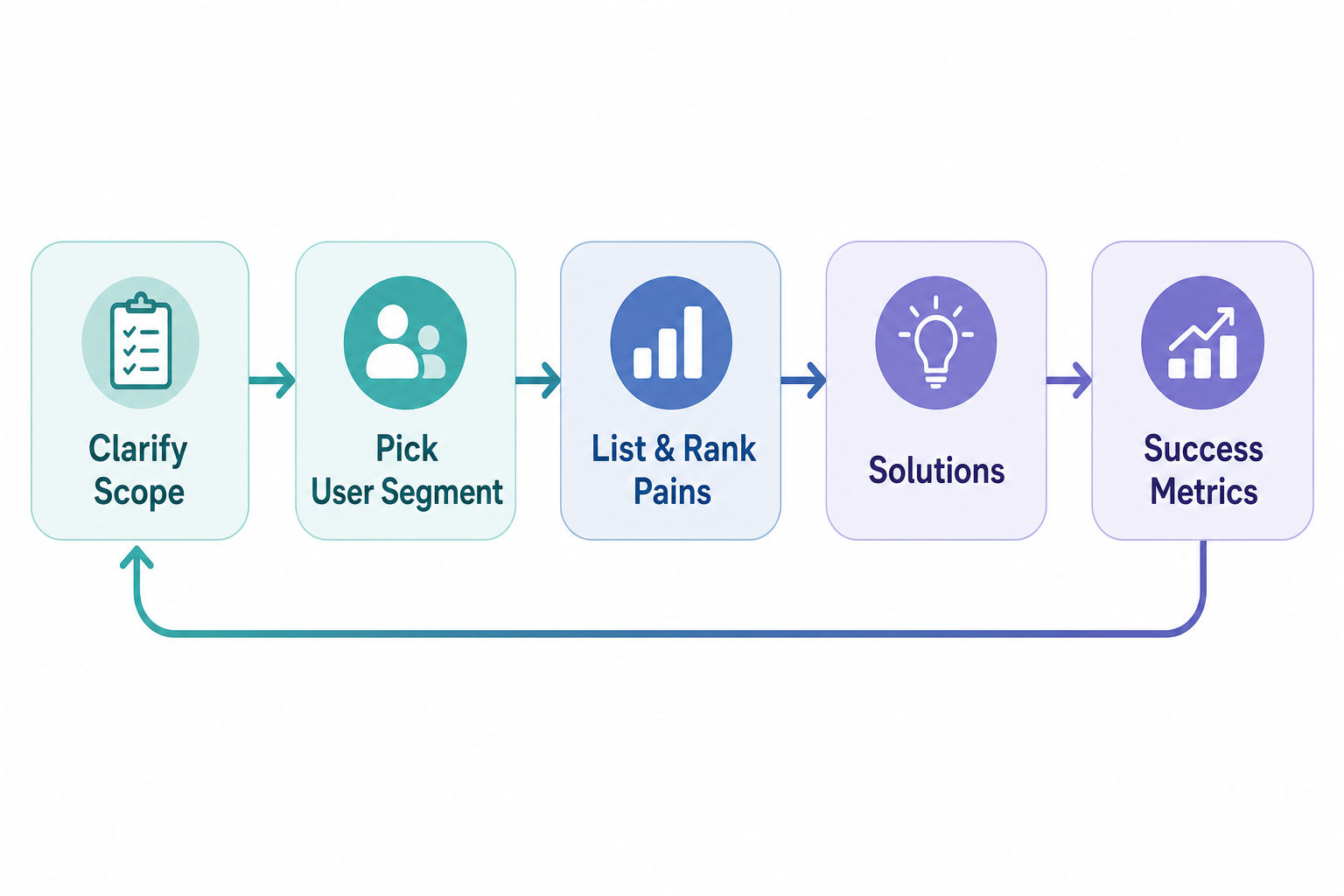
Open by scoping, then commit to a user. A structured open beats a clever idea.
Example opening: "Before I design, let me clarify a few things - are we optimizing for engagement, growth, or revenue, and is there a platform or geography constraint? I'll assume we're improving daily engagement for mobile users in mature markets unless you'd steer me elsewhere. I'll pick a primary user segment, list their top pains, prioritize one, then propose solutions and how I'd measure success."
Then narrate: segment, pains (ranked), the pain you'll solve and why, two or three solution directions, the one you'd ship first, and the metric that would prove it worked. End with a risk or counter-metric so you don't look one-sided.
Analytical / metric-drop
When a metric drops, resist guessing. Split the problem.
Example structure: "First I'd confirm the metric is real and not an instrumentation or logging bug. Then I'd segment the drop - is it one platform, one country, one cohort, or a specific app version? I'd separate internal causes (a recent launch, an experiment, a pricing change) from external ones (seasonality, a competitor move, a holiday). For instance, if the drop is isolated to Android users on the latest release, that points to a regression rather than a market shift, and I'd validate before recommending anything."
Estimation / market sizing
State your approach, pick a population, apply assumptions out loud, and sanity-check the order of magnitude. The number matters less than whether your assumptions are explicit and reasonable.
Behavioral ("Googlyness")
Use STAR and pick stories with measurable outcomes. Influence-without-authority and "a time you were wrong" are near-certain themes.
| Weak answer | Strong answer | |
|---|---|---|
| Conflict | "We disagreed and eventually agreed." | Names the stakes, the data you brought, how you found common ground, the outcome |
| Failure | "A launch underperformed." | What you misjudged, what you changed, what you'd do differently now |
| Influence | "I convinced engineering." | The specific lever (user data, a prototype, a shared goal) and the measurable result |
How to prepare and stand out
- Clarify before you solve. Open product and strategy answers by pinning down the user, goal, platform, geography, and constraints before proposing anything.
- Make your structure visible. Especially for product design and metrics questions, narrate your framework so the interviewer can follow your reasoning in real time.
- Anchor on user value. Tie every recommendation back to the user, not just business impact or technical elegance.
- Name trade-offs explicitly. Say what you would prioritize, what you would defer, and why that choice fits Google's scale.
- Show metric fluency repeatedly. In more than one round, define success metrics and counter-metrics and explain how you would know your decision worked.
- Form opinions on Google products. Come ready with a point of view on major Google products and concrete improvements, backed by clear user segmentation and measurable goals.
- Speak engineering credibly. In technical discussions, explain architecture and constraints clearly enough that you sound like a PM who can lead alongside engineers on scalability, latency, reliability, and AI-related decisions.
A four-week prep plan
| Week | Focus | What to do |
|---|---|---|
| 1 | Diagnose | Take 2-3 timed mock questions across product sense, metrics, and behavioral; find your weakest signal |
| 2 | Product & strategy | Drill product design and prioritization; write opinions on 4-5 Google products with metrics |
| 3 | Analytical & technical | Practice metric-drop diagnosis, north-star selection, and PM-level system design |
| 4 | Behavioral & polish | Build 6-8 STAR stories, run full timed loops, tighten your openings |
Use the PracHub question bank to pull real product, metric, and behavioral prompts, and review the Product Manager track for role-specific patterns. For more company-specific loops, browse other interview guides.
Takeaways
Google's PM loop is deliberately compartmentalized: each round targets a distinct signal, so practice across all of them rather than over-indexing on product sense alone. The timeline is often dominated by hiring committee and team-match steps, so build in patience after the interviews end. Above all, win on clarity - well-structured reasoning, explicit assumptions, and defensible trade-offs consistently outweigh a single clever answer.
How to Use This Page as a Prep Plan
Do not treat this as passive reading. Convert the ideas in this page into a short weekly loop: learn one idea, practice it under interview conditions, then write down what changed. That is the fastest way to turn advice into visible interview behavior.
| Prep area | What you need to prove | Practice artifact |
|---|---|---|
| Problem | Name the user, pain, and current workaround. | One crisp problem statement. |
| Success | Define primary and guardrail metrics. | Metric tree with instrumentation notes. |
| Solution | Compare options before choosing. | Tradeoff table with risks. |
| Execution | Plan rollout, learning, and rollback. | Experiment or launch checklist. |
For Google Product Manager Interview Guide 2026, the strongest candidates usually do three things well: they make their assumptions explicit, they use concrete examples instead of vague claims, and they review mistakes quickly enough that the next practice rep is better than the last one.
Video Walkthrough
Michael Yitayew walks through the Google Product Manager loop first-hand. It is one candidate's account rather than an official spec, so treat the round order as indicative.
FAQ
How long is the Google PM interview process?
It commonly runs several weeks from recruiter screen to offer. Much of that time is internal - hiring committee review and team matching - rather than the interviews themselves, which usually cluster into one final loop day. Timelines vary widely by team, level, and how quickly team match happens.
How many interview rounds are there?
Most candidates see a recruiter screen, one or two PM phone screens, and a final loop of 4 to 5 interviews covering product sense, analytical/execution, a PM-level technical discussion, and behavioral. The exact mix and naming vary by team and level.
Do Google PMs need to code?
No. The technical round is a discussion about architecture, APIs, data, latency, and feasibility trade-offs, not a coding test. You should be able to reason about technical constraints and partner credibly with engineers, but you won't write or run code.
What is the most important thing Google evaluates in PM interviews?
Structured thinking under ambiguity. Across rounds, Google rewards candidates who clarify scope, segment users, make assumptions explicit, and defend trade-offs over those who reach a clever answer without a visible framework.
What frameworks should I use for product sense questions?
Any framework that forces you to scope first, commit to a user segment, prioritize pains, then propose and measure solutions. The specific acronym matters less than narrating it clearly. Avoid forcing a memorized template onto a question it doesn't fit.
How should I prepare for the behavioral "Googlyness" round?
Build a set of STAR stories with measurable outcomes that cover conflict, a failure you owned, influencing without authority, and navigating ambiguity. Practice telling each in about two minutes, and be ready to go a layer deeper when the interviewer probes.
