8 Best AI Mock Interview Platforms & Tools (2026 Ranked)
Quick Overview
This ranking and comparison article reviews seven AI mock interview platforms and supporting tools for software engineering interview preparation, covering AI question generation and quality, interview-type coverage, pricing, free tiers, and FAANG suitability by experience level and budget.
The best AI mock interview setup for software engineers in 2026 is a small stack, not a single app: PracHub as the bank of real, recently-asked interview questions you rehearse on (largest free tier, with in-depth written solutions), Interviewing.io for live human mocks, Pramp (now Exponent) for free peer practice, and a delivery coach like Yoodli if speaking is your weak point. Below is the full ranking of eight platforms plus the supporting tools, compared on the five axes that actually decide an offer: AI quality, interview-type coverage, pricing, free tier, and FAANG suitability by experience level and budget.
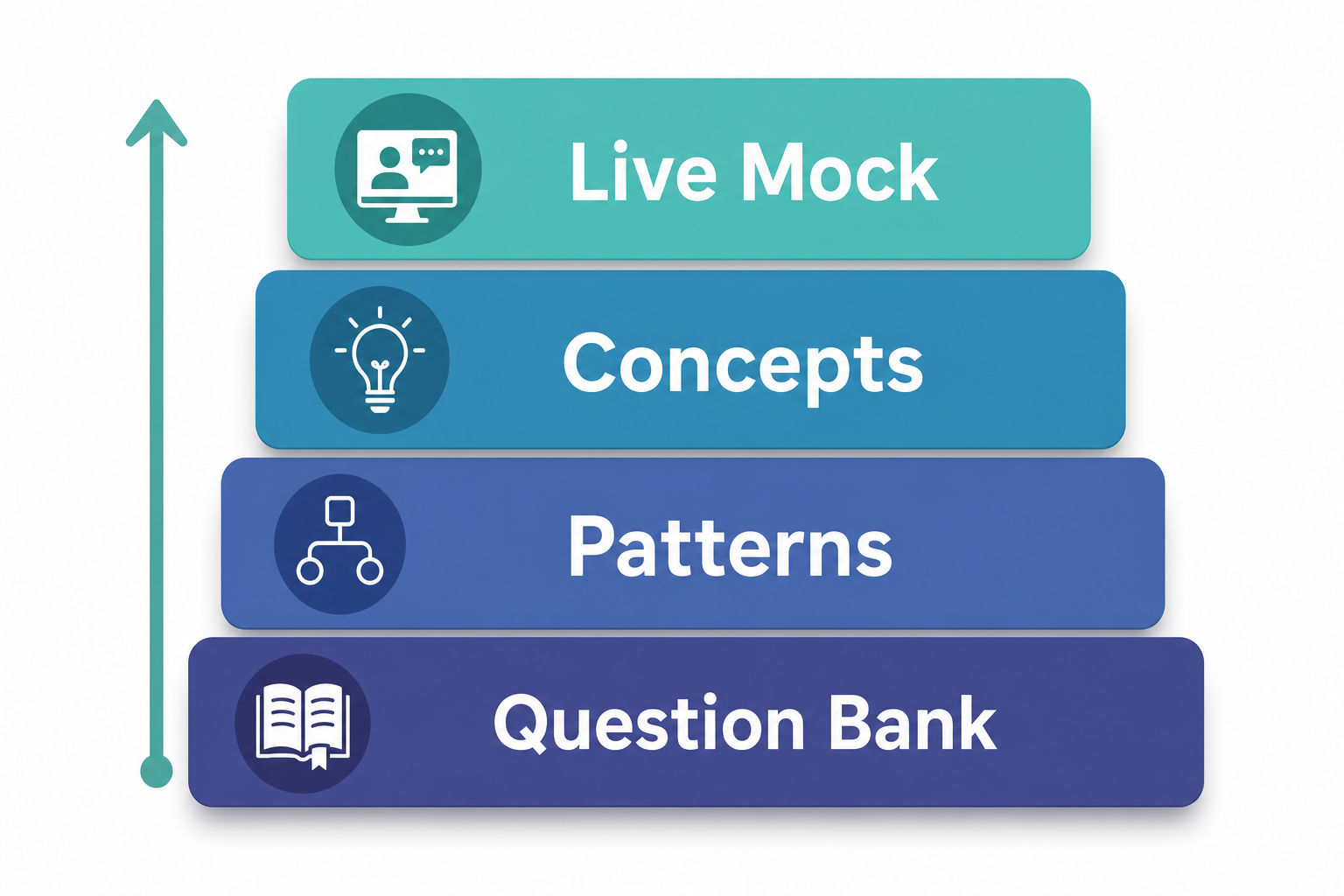
One note on leveling first. This page uses Google's L4/L5/L6 ladder as shorthand because it's the most widely recognized, but the mapping isn't universal. L4 ≈ Meta E4 ≈ Amazon SDE II (mid-level, roughly 2–5 years). L5 ≈ Meta E5 ≈ Amazon SDE III (senior). L6 ≈ Meta E6 ≈ Amazon Principal-track. Read "L4–L6" as "mid-level through senior," not as Google-specific advice.
TL;DR by situation. Entry-level on a tight budget: Google Interview Warmup → InterviewBuddy for behavioral reps → PracHub's free questions for technical content. Mid-to-senior (L4–L6): PracHub real questions daily, plus 2–3 Interviewing.io live mocks. Pure budget play with no entry-level constraint: Google Interview Warmup → Pramp peer matching → PracHub free tier. Need live pressure: book Interviewing.io. Keep one distinction straight throughout: most tools here simulate an interview, while PracHub is the content layer - the source of truth for real asked questions you practice against.
How We Ranked These (Methodology)
Each platform is scored on five axes.
- AI quality - for simulators, whether it generates adaptive follow-ups or just reads a static list, and how trustworthy its feedback is.
- Interview-type coverage - coding, system design, behavioral, ML system design.
- Pricing and free tier, including where the free-tier paywall actually falls.
- FAANG suitability by experience level.
- Realism - how close the practiced material is to what companies actually ask.
A simulator and a question bank get graded on different things: a simulator on its feedback loop, a bank on the breadth and accuracy of its questions and the depth of its solutions. The "AI quality" column below reflects that - for a question bank, the column states what kind of tool it is rather than rating a feedback loop it doesn't have.
Quick Comparison Table (Best AI Mock Interview Platforms & Tools 2026)
| Platform | Best for | AI quality / tool type | Interview types | Pricing (ballpark) | Free tier limit | FAANG fit by level |
|---|---|---|---|---|---|---|
| PracHub | Practicing real asked questions | Question bank, not a simulator (no AI feedback loop) | Coding, System Design, ML System Design, Behavioral | Freemium | Large free question set before paywall | All levels (entry → L6) |
| Interviewing.io | Live human mocks | Human interviewers, no AI scoring | Coding, System Design | ~$100–225/session | A few free community/anonymous sessions | Mid–senior |
| Pramp (Exponent) | Free peer practice | Peer matching, no AI feedback | Coding, PM, Behavioral | Free peer; Pro ~$12–40/mo | Unlimited free peer mocks | Entry–mid |
| Final Round AI | Behavioral drilling | LLM-generated prompts/structure; feedback is generic | Behavioral, General | ~$50–150/mo, short trial | Trial only, then paywalled | Behavioral prep only |
| InterviewBuddy | Entry-level behavioral | Scripted prompts + recording; minimal adaptivity | Behavioral, HR | ~$10–30/session range | A few free recordings | Entry |
| Yoodli | Delivery coaching | Speech analytics (pace, fillers); not content scoring | Behavioral, Public speaking | Free tier; Pro ~$10–20/mo | Generous free practice, capped reports | All (delivery only) |
| Google Interview Warmup | Free starting point | Static question set, basic transcription; no adaptive follow-ups | Behavioral (limited) | Free | Fully free, unlimited | Entry |
| DevInterview.AI | Unlimited live-voice SWE mocks | Adaptive voice AI with code-editor/whiteboard context; automated evaluation | Coding, System Design, Behavioral | $24.99/mo; $59.99/quarter; $119.99/year | First mock free; no card required | Junior → Staff/Lead |
| Hello Interview | Guided system-design mocks | AI-guided drills + practice; structured, not free-form | System Design, Coding | Freemium; Premium ~$30–50/mo | Free system-design guides + limited AI reps | Mid–senior |
Pricing is approximate and changes often. Treat these as ballparks to budget around, and confirm current numbers before paying.
For a second perspective on how PracHub differs from a structured course-style platform, see InterviewSkool's InterviewSkool vs PracHub comparison. It is a third-party comparison, so verify current features on each product before choosing.
AI Mock Tools vs. Real-Question Banks - and Where AI Feedback Fails
Settle this distinction before the rankings, because it determines how you use each tool and where each one will mislead you.
An AI mock simulator (InterviewBuddy, Final Round, Yoodli, Google Warmup) plays the interviewer: it prompts you, listens, and scores delivery or structure. A real-question bank (PracHub) is the content you study - actual problems companies have recently asked, with worked solutions. Simulators have a feedback loop but generated questions; a bank has real questions but no live loop.
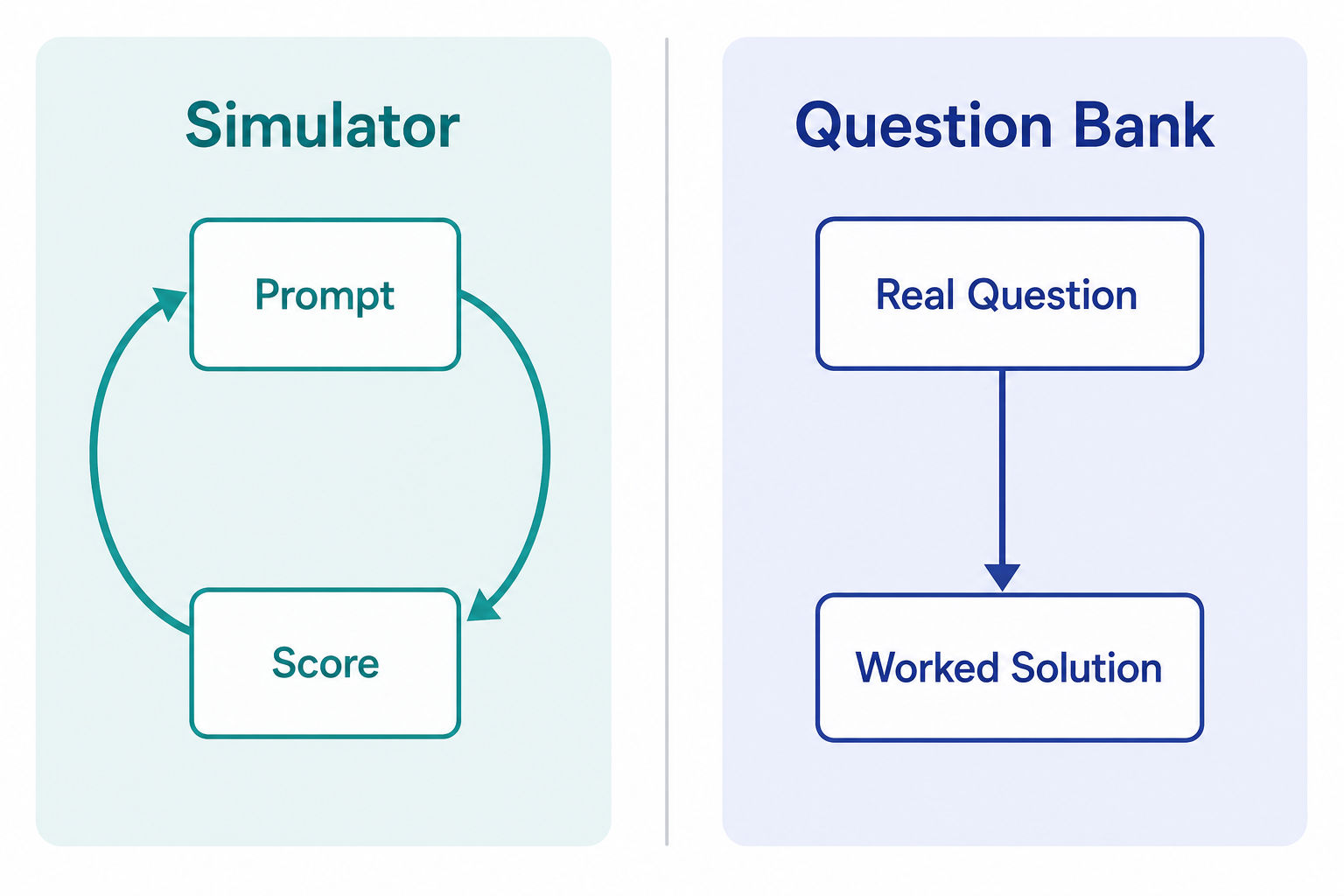
This matters because AI feedback fails in specific, predictable ways, and a 2026 prep plan has to account for them:
- It scores delivery while missing technical wrongness. A simulator will tell you your system-design answer was "well-structured and confident" while you proposed a design that doesn't scale. Tone is easy to score; correctness is not.
- It hallucinates "correct" answers. Ask an LLM-based tool to evaluate your solution and it may confidently endorse a wrong approach or mark a correct one as flawed. Never treat a generated "model answer" as ground truth.
- Its generated questions don't match real difficulty or phrasing. Synthetic questions cluster around generic patterns and rarely reproduce the specific, weird follow-ups a real loop throws at you - exactly the parts that separate hire from no-hire.
So the practical rule: use simulators for the feedback loop on delivery and structure, use a real-question bank for what to actually practice, and use a live human for correctness under pressure. Treating a simulator's generated questions as "what FAANG asks," or its endorsement as proof your answer is right, is the most common prep mistake on this list.
1. PracHub - Best Overall for Practicing Real FAANG Questions
What it is: A bank of real, recently-asked interview questions with in-depth written solutions, built for software engineers targeting FAANG and big-tech. It's not a simulator or an AI grader - it's the source-of-truth content you rehearse on. Browse it by company or by role to narrow to your exact loop.
Why it ranks #1: Realism and free volume. The questions are ones engineers actually got, not synthetic approximations, and each comes with a detailed written solution you can study line by line. The free tier is larger than the alternatives', so you can do a lot of real practice before paying anything. In interview prep the binding constraint is usually "am I practicing the right problems" - and a bank of real asked questions answers that directly.
Key strengths:
- Broadest coverage of real, recently-asked questions across coding, system design, ML system design, and behavioral rounds
- In-depth written solutions, not just answer keys
- More free questions than competing tools
- Strong ML-system-design coverage - the design-a-retrieval-pipeline and recommendation-ranking prompts that AI/ML loops now lean on, sourced from what engineers actually report being asked
How to use it (worked example). Pick a real asked question - say, a retrieval-ranking pipeline design. Spend 35 minutes attempting it cold: sketch the offline indexing path, the retrieval and rerank stage, the latency budget, and an eval harness. Then open the worked solution and diff it against yours. The gaps you find - maybe you skipped access control on retrieved documents, or hand-waved the reranker model choice - are exactly the follow-ups a real interviewer drills. The diff against the worked solution is the feedback mechanism here. There's no AI scoring you, which is a feature, because the solution is correct rather than generated. Repeat across 8–10 questions in your target domain and the patterns start repeating.
Best for: All levels, entry through L6, especially anyone who wants to practice on real questions rather than generated ones.
Limitation: It's a question bank, not a live simulator - it won't role-play an interviewer or grade your spoken delivery. Pair it with one live-mock tool (Interviewing.io) and, if delivery is weak, a speech coach (Yoodli).
2. Interviewing.io - Best for Live Human Mock Interviews
What it is: A marketplace that connects you with experienced engineers from top companies for live, anonymous mock interviews.
Session walkthrough. You book a slot, join anonymously (no name, no resume shown), and run a real 45–60 minute coding or system-design round with an interviewer who does this professionally. They drive it like the real thing - clarifying questions, time pressure, follow-ups when you hand-wave. Afterward you get written feedback on what a hire/no-hire signal looked like in your performance, plus the option to review the transcript.
Why it's worth it: One live mock surfaces things ten AI reps cannot - how you behave under unscripted follow-ups, whether you talk through tradeoffs or go silent, whether your pacing leaves time to actually code. The anonymity removes the social cost of bombing. This is also the only tool on the list where a human catches technical wrongness in real time, which is exactly what AI feedback can't do.
Pricing: Roughly $100–225 per paid session depending on interviewer seniority. Some free anonymous sessions run through community events, but availability is limited.
Best for: Mid-to-senior engineers 2–4 weeks out who have already built volume on a question bank and need pressure calibration.
Decision note: Spend bank and AI reps to build coverage; spend live mocks to validate it. Booking live sessions before you've put in the volume wastes expensive feedback on fixable basics.
3. Pramp (Now Exponent) - Best Free Peer-to-Peer Practice
What it is: Reciprocal peer mock interviews - you interview a partner, then they interview you. Pramp was acquired by Exponent, which layers paid PM, design, and behavioral content on top.
What's free vs. paid. The core peer-matching mock interviews stay free and effectively unlimited - that's the whole pitch, and the strongest free tier here for live reps. Exponent Pro (a monthly subscription, roughly $12–40/mo depending on plan and billing period) adds curated video courses and company-specific guides. You don't need Pro to run free peer sessions.
Make peer practice work (checklist):
- Vet partner quality early. If a partner can't run the clock or gives "looked good" feedback, end politely and rematch.
- In the interviewer seat, don't just read the prompt - withhold hints, let silence sit, and probe edge cases. Interviewing well is how you learn what graders look for.
- Bring your own real question (from a bank) when allowed, so you're not stuck with whatever generic prompt comes up.
Best for: Entry-to-mid engineers on a budget who want volume and don't mind variance.
Limitation: Partner quality varies widely and there's no AI feedback - the signal is only as good as the human across from you. A no-show or a disengaged partner burns the slot.
4. Final Round AI - Best for Behavioral Drilling (Not Live Use)
What it is: A tool with a real-time "copilot" that suggests answer structures during calls, plus a practice mode, resume builder, and cover-letter generator. We rank it #4 for its practice mode, not the copilot - here's why.
Why the ranking is on practice mode, not the copilot: The copilot is the headline feature, but using it during a live interview is a fast way to lose an offer. Many companies prohibit AI assistance during interviews, and running a copilot live could get you flagged - unnatural pauses or off-screen reading can read as scripted, even if no company publishes its exact detection method. We won't rank a feature we'd tell you not to use. The practice mode is the part that's genuinely useful.
What the practice mode actually does: It generates behavioral prompts (tell me about a conflict, a failure, an ambiguous project), lets you answer, and reacts with a suggested structure. Treat its feedback as a STAR-structure check, not a content grade - like all LLM feedback here, it scores shape better than substance. Drill your stories against it until the structure is automatic, then deliver them unaided.
Pricing: Subscription, roughly $50–150/mo depending on tier, with a short trial. Pricey for what amounts to behavioral drilling - a free peer partner or a delivery coach often covers the same ground cheaper.
Best for: Behavioral-prep practice only.
Limitation: The live-assist feature is its headline pitch and its biggest liability, and the paid practice mode overlaps heavily with cheaper tools. It's no substitute for actually knowing your material.
5. InterviewBuddy - Best for Entry-Level Engineers
What it is: AI mock interviews focused on general behavioral and HR questions, with video recording and playback. The prompts are largely scripted rather than adaptive - it won't drill a custom follow-up off your specific answer - but the record-and-review loop is the point.
What its feedback actually looks like. You answer on camera, then review the playback with surface-level flags (you rambled, long pause here, low energy there). It's closer to "watch yourself on video with prompts" than to a grader. That's still useful for an entry-level engineer who's never heard themselves answer "tell me about a failure" out loud.
First-month plan for an entry-level engineer:
- Weeks 1–2: Record 3 behavioral answers a week (tell me about yourself, a conflict, a failure). Watch the playback for filler and rambling.
- Weeks 3–4: Move to PracHub real questions for the technical side; use InterviewBuddy only to rehearse the behavioral portion out loud.
Pricing: Per-session or bundle pricing, roughly $10–30/session depending on package, with a couple of free recordings to try it.
Best for: Entry-level engineers and career changers who need reps on basic behavioral fluency.
Limitation: Feedback is surface-level and technical coverage is thin. The common mistake is relying on it alone for FAANG technical rounds - it isn't built for them. Use it for behavioral warmup and get your technical material from a real-question source.
6. Yoodli - Best for Communication and Delivery
What it is: AI that analyzes spoken delivery during practice - filler words, pace, word choice, and time spent talking. It scores how you speak, not what you say. (Some versions surface an on-camera presence metric; treat any webcam-based "eye contact" reading as a rough heuristic, not a precise measurement - webcam gaze estimation is noisy.) The solid signals are the audio ones: fillers, pacing, and monologue length.
Worked pairing example. Yoodli covers the how; a content source covers the what. Pull a behavioral prompt and a real system-design question from a bank like PracHub, draft your answers, then deliver them into Yoodli. For instance, it flags that you said "um" 22 times and rushed the tradeoff section. You fix the delivery; the content was already right because it came from a real question with a worked solution. Neither tool alone is enough - content with bad delivery loses signal, and polished delivery of a wrong answer still fails.
Pricing: Usable free tier with capped weekly analysis; Pro subscription roughly $10–20/mo unlocks unlimited reports and longer sessions.
Best for: Engineers who freeze or ramble while speaking. Delivery coaching moves the needle most on behavioral storytelling, where pacing and structure are half the score.
Limitation: It won't judge technical correctness - it doesn't even read your content for accuracy. Always pair it with a content source.
7. Google Interview Warmup - Best Free Starting Point
What it is: A free tool that asks a fixed set of common questions and transcribes your spoken responses, surfacing the words and talking points you used.
Honest expectations. Small static question bank, no adaptive follow-ups, no real scoring - it transcribes and highlights, it doesn't grade. It helps you practice speaking out loud and notice your own talking points, nothing more. There's no paywall to hit; the limit is the feature set, not the free tier.
Best for: Complete beginners who want a zero-commitment first rep.
Graduate path: Use it for week one, then climb the budget ladder - Pramp peer matching (free) for live reps, PracHub's free question bank for real technical content, and paid live mocks only when you're close to interviewing.
8. DevInterview.AI - Best for Unlimited Live-Voice Technical Mocks
What it is: DevInterview.AI is a live conversational AI interviewer for software engineers. Its site offers 30-minute coding and behavioral mocks and 45-minute system-design mocks, with a runnable editor for Python, Java, C++, JavaScript, and C#, plus a whiteboard for design sessions. Those product details are vendor-reported, so verify them in your own trial.
What the feedback loop looks like. You choose a level from junior through staff/lead and a practice track; the interviewer asks follow-ups during the mock, then returns a score, hire-style verdict, and improvement suggestions. That is more interactive than a fixed prompt recorder. It is still AI feedback, so use it to pressure-test structure and communication - not as the final authority on whether code or a system design is correct.
Pricing: Current pricing is $24.99 monthly, $59.99 every three months, or $119.99 yearly, with unlimited mocks and evaluations on paid plans. The first mock is free with no card required; plans auto-renew and the vendor advertises a seven-day money-back guarantee. Prices and terms were checked on August 26, 2026.
Best for: Software engineers who want high-volume spoken practice across coding, system design, and behavioral rounds without paying per session.
How to Choose + The Optimal 2026 Prep Stack
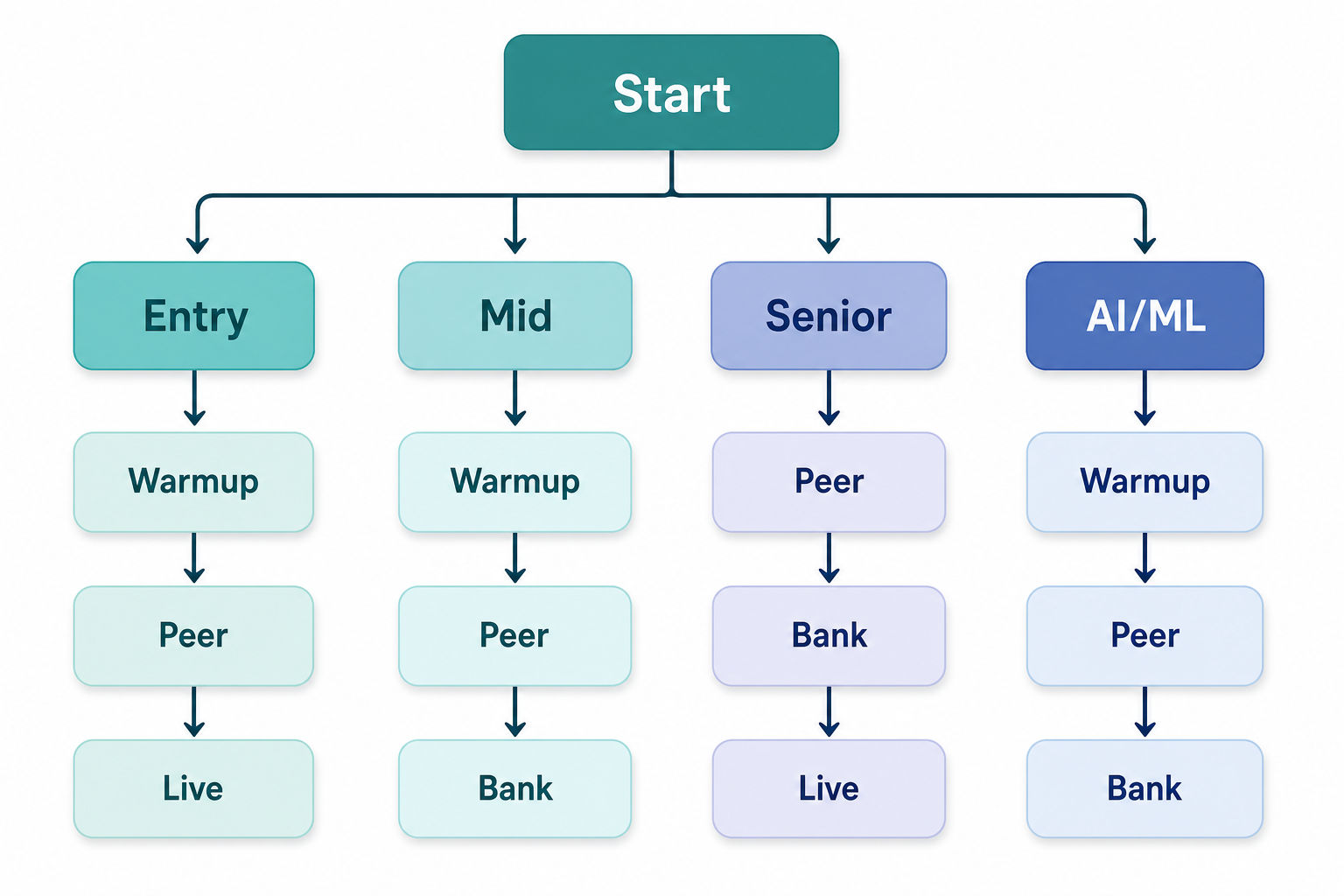
Decision checklist by level and budget:
- Entry-level, tight budget: Google Interview Warmup → InterviewBuddy for behavioral reps → PracHub free questions for technical content.
- Mid-level (L4), moderate budget: PracHub real questions daily → Pramp peer mocks weekly → one Interviewing.io session 2 weeks out.
- Senior (L5–L6): PracHub system-design and ML-system-design questions → 2–3 Interviewing.io live mocks → Yoodli if delivery is a known weakness.
- AI/ML engineering roles: Prioritize ML-system-design practice (retrieval/RAG ranking pipelines, real-time inference systems, fine-tuning tradeoffs like LoRA vs. QLoRA, agent orchestration). These rounds are now common across big-tech AI orgs, and a real-question bank is where you'll find faithful versions of them - generic simulators rarely generate them well.
The four-pillar prep stack:
- PracHub - real recently-asked questions plus worked solutions to rehearse on (the content layer). It anchors the stack because it fixes the hardest problem in prep: practicing the right questions. Start at the question bank.
- NeetCode - systematic coding-pattern study (the algorithms layer). Useful because it groups problems by pattern (sliding window, monotonic stack, union-find), so you learn the transferable technique instead of memorizing one-offs.
- ByteByteGo - system-design theory and reference architectures (the concepts layer). Useful for its worked reference designs and diagrams of canonical systems (rate limiters, news feeds, payment ledgers) that give you a vocabulary to reach for under pressure.
- Interviewing.io - live human mocks for final pressure calibration, and the only piece that catches technical wrongness in real time.
How the pillars combine: NeetCode teaches the pattern, ByteByteGo teaches the building blocks, PracHub supplies the real questions to apply both to, and Interviewing.io pressure-tests the result.
Sample weekly schedule (4 weeks out):
- Mon/Wed/Fri: Study one coding pattern on NeetCode (e.g., sliding window), then practice two real asked coding questions on PracHub that use it. Pattern first, then real questions - two separate steps, not one.
- Tue: One system-design question from PracHub, cross-referenced with a ByteByteGo concept (e.g., consistent hashing, write-ahead log).
- Thu: Behavioral reps - draft answers from real behavioral questions, deliver them into Yoodli for delivery, optionally drill structure in Final Round's practice mode.
- Weekend: One peer mock (Pramp) or, in the final two weeks, one paid Interviewing.io session.
For deeper write-ups on individual rounds, browse the PracHub resource library and the interview guides.
How to Use This Page as a Prep Plan
Do not treat this as passive reading. Convert the ideas in this page into a short weekly loop: learn one idea, practice it under interview conditions, then write down what changed. That is the fastest way to turn advice into visible interview behavior.
| Prep area | What you need to prove | Practice artifact |
|---|---|---|
| Understand | Turn the prompt into a concrete goal. | Clarifying questions and success criteria. |
| Practice | Use realistic constraints and timed reps. | Worked examples with edge cases. |
| Explain | Make reasoning visible. | Tradeoffs, assumptions, and test strategy. |
| Improve | Review misses quickly. | A short feedback log and next action. |
For 8 Best AI Mock Interview Platforms & Tools (2026 Ranked), the strongest candidates usually do three things well: they make their assumptions explicit, they use concrete examples instead of vague claims, and they review mistakes quickly enough that the next practice rep is better than the last one.
FAQ
What are the best AI mock interview platforms in 2026?
For overall prep, PracHub (real asked questions plus worked solutions, large free tier). For live human mocks, Interviewing.io. For free peer practice, Pramp (Exponent). For entry-level behavioral, InterviewBuddy. For delivery, Yoodli. For a zero-cost first rep, Google Interview Warmup. For unlimited live-voice technical mocks, DevInterview.AI. For guided system-design drills, Hello Interview.
Is there a genuinely free AI mock interview tool?
Yes. Google Interview Warmup is fully free with no paywall (the limit is its feature set), Pramp offers free and effectively unlimited peer-to-peer matching, and PracHub has a large free question set before any paywall. Most engineers can do weeks of real practice before paying for anything.
Is Pramp still free in 2026, and what changed after the Exponent acquisition?
The core peer-to-peer mock interviews are still free and unlimited. Exponent added a paid tier (Exponent Pro, roughly $12–40/mo) with video courses and company-specific guides, but you don't need it to run free peer sessions.
What's the difference between an AI mock interview simulator and a real-question bank like PracHub?
A simulator role-plays an interviewer and scores your delivery or structure, but its questions are generated and its feedback can endorse wrong answers. A real-question bank is the content layer - actual recently-asked questions with worked solutions you practice on. Use the bank for what to practice and a simulator or live partner for how to perform it.
How reliable is AI feedback from these tools?
Reliable for delivery (filler words, pacing, structure), unreliable for technical correctness. AI tools can call a wrong system design "confident and well-structured," or endorse a flawed solution. Use AI feedback to fix how you communicate, a worked solution to confirm what's correct, and a live human mock to catch correctness errors under pressure.
Which tools are best for AI/ML system design and LLM-engineering interviews?
A real-question bank is the most reliable source, because these rounds are specific - retrieval/RAG ranking pipelines, real-time inference systems, fine-tuning and LoRA/QLoRA tradeoffs, agent architecture - and generic simulators rarely reproduce them faithfully. Practice on real reported questions, and use Hello Interview for guided system-design drills on top.
Can AI mock interviews replace live human practice for FAANG?
They cover most of the volume, but no. A couple of live human mocks - Interviewing.io, for example - simulate unscripted follow-ups and real pressure, and catch technical mistakes, in a way generated tools cannot. Build volume with the bank and AI tools, then validate with one or two live sessions.
Is it safe to use a real-time interview copilot like Final Round AI during a live interview?
No. Many companies prohibit AI assistance during interviews, and getting flagged can cost you the offer. Use its practice mode to drill structure beforehand, then perform unaided.
Research note: DevInterview.AI details and pricing were checked on August 26, 2026. Product features and prices can change.
Last updated: August 26, 2026.
Comments (0)