Above and Beyond for a Customer: Engineering Interview Answers That Show Durable Impact
Quick Overview
Prepare an engineering customer-impact answer with a justified responsibility boundary, verified rescue, durable improvement evidence, honest metrics, and useful follow-ups.
An “above and beyond for a customer” engineering interview answer needs a reason for the extra effort and evidence of what changed. Working longer describes effort. It does not explain whether the customer recovered, whether your choice was proportionate, or whether the next customer faced the same problem.
Choose a real experience where you understood a concrete need, made a bounded decision outside the initial assignment, verified the immediate result and improved what happened afterward. A modest intervention with traceable evidence can produce a clearer answer than an ambitious rescue whose outcome you cannot establish.
The evidence map and rehearsal questions below are original preparation tools, not an employer scoring rubric. They help you organize your own experience without inventing a polished personal story. Begin with Resolve a Customer Problem: identify the customer's blocked task before deciding which technical details belong in the answer.

Distinguish public principles from a promised interview question
As an official company example, Amazon's Leadership Principles connect Customer Obsession with customer trust and Ownership with long-term value beyond an individual team. Its interview-loop preparation page lists behavioral questions and the STAR method among preparation topics. Those statements support preparing evidence about decisions and outcomes; they do not disclose a universal answer score or promise this exact prompt.
A separate official example is GitLab's Results for Customers value, which prioritizes customer success. Its public discussion also distinguishes customer value from automatically agreeing to every request. These are GitLab's stated values, not a requirement that every employer evaluates customer stories identically.
For candidate-reported context, a Hello Interview community timeline associates this prompt family with several employers. Treat those entries as reports with limited context. They do not independently establish a current process, interview frequency or the standard applied to your application.
The practical inference for preparation is narrower: expect to explain why your intervention helped a customer and why its costs were justified. Prepare those facts whether the interviewer asks about customer focus, ownership, an unexpected problem or work beyond your formal remit. Follow the actual wording rather than forcing every question into one rehearsed story.
Select a story with a real responsibility boundary
Start by naming the customer and the task they could not complete. A paying organization, an individual user or an internal team can all have a concrete need, but an internal-user example may need clarification if the interviewer specifically asks about an external customer. Explain the relationship rather than silently changing the question.
Next, separate your normal assignment from the extension. Investigating a ticket assigned to you might be ordinary work. Discovering that the issue crossed services, assembling the missing evidence, coordinating a reviewed workaround and remaining responsible through customer confirmation can establish what you added. Use only actions that actually happened.
Choose a story you can defend under follow-up. You should know what first revealed the problem, what you personally checked, which owner joined, what alternative you considered and how the outcome was observed. If you remember only that everyone appreciated your effort, gather more facts or choose another example.
Extra effort need not mean unlimited availability. An engineer can contribute by making an ambiguous issue reproducible, translating its effect into a clear priority decision or creating a handoff that prevents repeated investigation. The answer should show the customer benefit of that effort, not merely celebrate having taken on more work.
Map immediate rescue and durable improvement separately
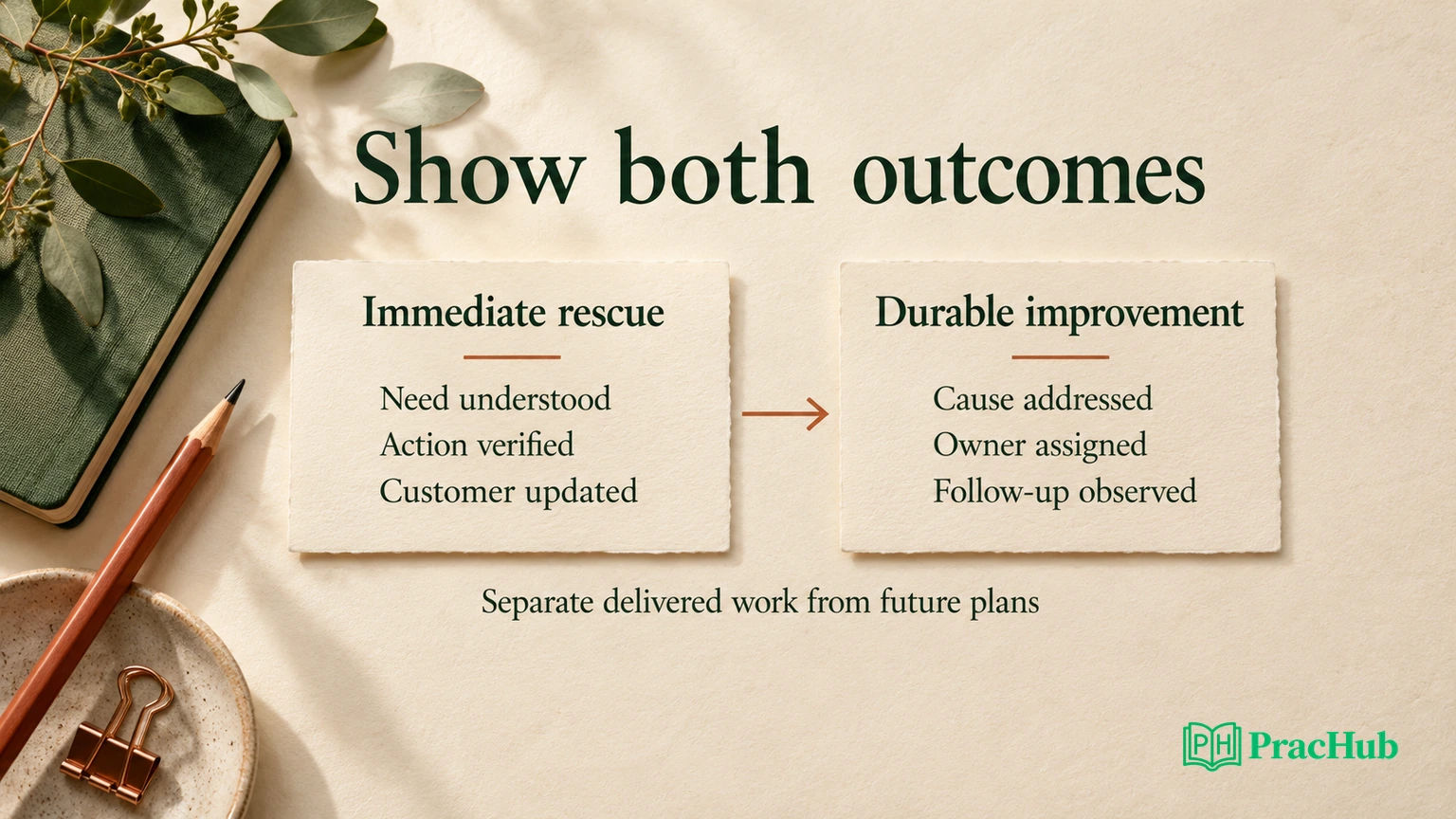
Before rehearsing, divide your evidence into two outcomes. Immediate rescue answers whether the customer could resume the blocked task. Durable improvement answers what changed in the product, operating process or ownership so the same class of problem became less likely or easier to handle.
A closed ticket does not automatically prove either outcome. It may indicate an administrative state change, an accepted workaround or a fully verified repair. Name what was checked and by whom. Likewise, creating a follow-up issue is a commitment to investigate, not evidence that a permanent improvement has shipped.
| Evidence to recover from your real experience | Immediate rescue | Durable improvement |
|---|---|---|
| Customer need | The blocked operation, affected workflow and practical deadline. | The recurring failure mode or repeated support burden. |
| Your contribution | Diagnosis, coordination or a reviewed mitigation you actually delivered. | A prevention, validation or handoff change you actually completed. |
| Verification | Customer confirmation, reconciled output or another direct completion check. | A regression check, adoption record or later observation with a stated period. |
| Ownership | Who communicated status and confirmed recovery. | Who maintains the change after you leave the incident. |
| Remaining uncertainty | What the workaround did not resolve. | What is still proposed, unmeasured or outside your observation window. |
Use this map to locate missing evidence, not to manufacture a complete-looking result. A story can honestly end with a verified workaround and an assigned permanent fix still in progress. That may be the best account available, but describe its durable contribution as a handoff or accepted plan rather than a completed prevention.
Build the answer around the decision you made
Use STAR as an organizing structure if it suits the interview, then give the action section enough detail to expose your judgment. The situation establishes the customer's problem. The task establishes your original responsibility. The action explains the extension and the choice between alternatives. The result reports observed changes and limits.
Make the decision visible before listing implementation details. Explain why simply routing the issue elsewhere would not have met the customer's need, or why immediately building a custom feature would have been disproportionate. Connect the chosen intervention to the deadline, risk and available ownership that existed at the time.
Use first-person verbs for your own work and name collaborators' contributions separately. Reproducing the failure, proposing a mitigation and checking its output are different from approving a production change or writing the final fix. Clear credit makes follow-ups easier because each claim has an identifiable owner.
Finish the main answer with the immediate outcome and the durable work that actually reached completion. Then state one limitation or lesson that affected how you handled the next case. You do not need to attach every available detail to the opening answer; retain the technical evidence for questions that require it.
Work through a customer export problem without inventing a history
The following is an original hypothetical teaching case, not a candidate account or an experience to claim as your own. A customer needs a data export for a business workflow. The export job reports success, but the resulting file omits records. The engineer's initial assignment is to identify why the customer sees incomplete output.
A useful analysis first asks what “complete” means: the intended date range, eligibility filters, source records and cutoff time. Comparing only file size would not establish correctness. The engineer would need a reconciliation between the requested record set and exported identifiers before claiming that a replacement file solved the problem.
The immediate choice might be a reviewed rerun with corrected parameters, a scoped backfill, or an explanation that the request includes records excluded by the documented contract. The appropriate action depends on the evidence. An evidence-based answer would explain the option actually chosen in the candidate's real experience and why the other options were rejected.
For durable improvement, distinguish a useful ticket from a delivered change. A proposal to make missing records visible is future work. An implemented reconciliation check with an owner is a concrete artifact. Evidence that a later export used the check is an additional observation. None of those statements establishes a retention increase or elimination of all export failures.
This walkthrough shows what information to recover from a genuine incident: the requested outcome, the validation method, the approved intervention and the post-recovery change. It supplies no fictional success metric to memorize. Your real example may involve access, integration failures or confusing errors instead; its evidence should still follow the customer's task through resolution.
Explain the trade-off behind the extra effort
The interviewer can reasonably ask what you deferred. Describe the original commitment, who helped reprioritize it and what limited the intervention. If you could handle the problem within existing ownership, say so. If another team needed to approve a change, explain how you obtained that decision and kept the customer informed.
A customer's requested implementation may differ from the need. A request for a permanent exception could reflect an urgent workflow that a supported configuration already handles. Explain how you checked that possibility rather than assuming every request deserved custom code. Protecting a reliable shared service can itself serve customers when paired with a workable alternative.
Also explain when you stopped. A temporary rerun or backfill process should have an expiration condition or a handoff to ongoing ownership when appropriate. If the solution depended indefinitely on your manual intervention, acknowledge that maintenance cost. The durable improvement might be removing that dependency rather than adding a larger technical feature.
Avoid portraying other teams as obstacles to your heroism. Constraints such as release ownership, data access and competing customer needs shaped the decision. Explain how you worked within those constraints and what you escalated, rather than implying that helping one customer justified ignoring everyone else.
Prepare follow-ups that test the evidence chain
Ask a rehearsal partner to challenge one claim at a time. Why was the action beyond your original responsibility? What did the customer actually need? Which observation changed your diagnosis? What did you personally deliver? These questions test specificity rather than fluency.
Then challenge the result. How did you know the customer was unblocked? What happened after the handoff? Was the prevention deployed or only proposed? Who maintained it? If you cannot answer, narrow the original claim so the account remains accurate. More confident wording cannot repair missing observation.
Finally, challenge the trade-off. Would you make the same choice for a smaller customer? What work waited? What would you do differently with more time? A useful response explains the decision criteria and available facts, including uncertainty. It does not invent an alternative outcome you never observed.
Report impact when the numbers are incomplete
Use metrics when they are available and meaningful. Define what was measured, the comparison and the observation period. A reduction in repeat tickets needs a stable counting rule; fewer tickets might reflect changed reporting. A faster recovery needs comparable cases before it can support a broad improvement claim.
You can still provide evidence without a percentage. A verified export, a documented customer confirmation, an adopted troubleshooting step or a merged regression check can support a bounded result. Explain what each artifact establishes and what it does not. Do not substitute praise for evidence of technical correctness or attribute an entire renewal to one intervention without support.
For early-career experience, customer-facing coursework, volunteer systems or an internal tool may provide a real example. Identify the setting and scale honestly. If no experience fits the question, say that and offer the closest relevant case; do not present the hypothetical export analysis as something you personally delivered.
Rehearse with five customer-focused engineering prompts
These verified PracHub records vary the customer problem, responsibility boundary and reuse question. Their company associations describe the records; they do not establish your employer's interview format. Practice with facts from your own work and adjust the answer to each prompt's scope.
| Practice question | Evidence to prepare |
|---|---|
| Resolve a Customer Problem | Customer need, safe mitigation, confirmation and prevention. |
| Explain Customer-Focused Technical Work and AI Verification | Technical validation and personal contribution when AI or optimization is involved. |
| Demonstrate Customer-Centric Judgment About AI | Alternatives and material risks behind a customer-facing AI decision. |
| Describe Work Beyond Your Formal Responsibilities | The responsibility boundary, priority agreement and sustainable handoff. |
| Build a Solution That Benefits Teams Beyond Your Own | Adoption and maintenance evidence for a solution that benefits other teams. |
Start with Resolve a Customer Problem and fill the two-outcome evidence map using one real incident. Rehearse a concise answer, then have a partner probe its weakest link. Revise the claim to match what you know rather than adding a more dramatic ending.
Sources and Further Reading
- Amazon: Leadership Principles — official Customer Obsession and Ownership statements.
- Amazon: Interview loop — official behavioral and STAR preparation topics.
- GitLab Handbook: Values — official Results for Customers discussion.
- Hello Interview community question timeline — candidate-reported prompt context.
Comments (0)