Adaface Coding Assessment Guide: MCQs, Coding Questions, and Proctoring
Quick Overview
Adaface coding assessments can combine scenario-based MCQs, code tracing, role-specific questions, and hands-on coding. This candidate guide explains how test formats vary, what proctoring settings may record, how automated scorecards are used, and how to manage time with a five-step strategy. Prepare ethically with PracHub using real interview questions, written solutions, and targeted coding practice.
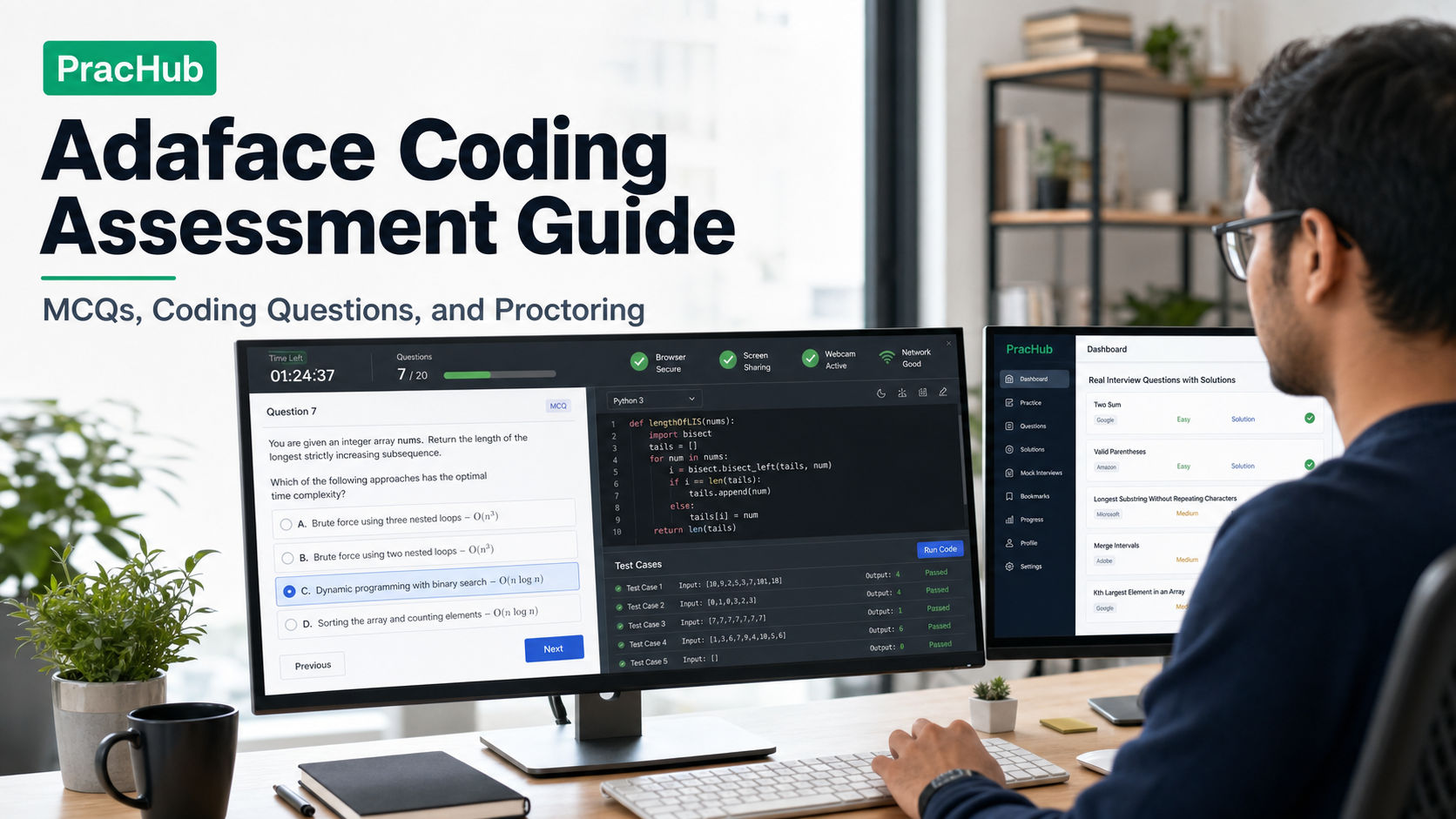
An Adaface invite can say "coding assessment" even when coding is only part of the test. Depending on the employer, you may also face scenario-based MCQs, code tracing, debugging, technical aptitude, framework questions, or role-specific topics.
The safest preparation is not to memorize leaked questions. It is to understand the test structure, practice switching between short technical decisions and working code, and follow every proctoring instruction exactly.
If your assessment is already scheduled, start with real interview questions with written solutions and targeted coding and algorithms practice on PracHub. Use your invitation's skills list to decide what to practice first.
Quick Verdict
Expect a customized screening test, not one universal Adaface exam. Adaface offers ready-to-use and employer-customized assessments. Its public software engineering examples commonly combine scenario-based MCQs with a hands-on coding question, but the exact duration, topics, question count, language options, and proctoring settings can vary.
Read the invitation and assessment overview before starting. Those screens are more authoritative than any generic guide, including this one.
What Is an Adaface Coding Assessment?
Adaface is a pre-employment assessment platform used by companies to screen candidates before later interviews. Its programming tests emphasize practical skills such as code analysis, debugging, adding functionality, algorithms, data structures, frameworks, and software engineering fundamentals.
Many ready-to-use programming tests shown in Adaface's public library run for roughly 30 to 50 minutes and combine several MCQs with one coding question. Employers can customize both content and difficulty, so do not assume your test will match a public sample.
| Component | What It May Test | Best Preparation |
|---|---|---|
| Scenario MCQs | Applied judgment, language behavior, frameworks, databases, security, testing | Read the full scenario and eliminate answers that fail a stated constraint |
| Code-tracing MCQs | Output, bugs, complexity, edge cases, language semantics | Trace state changes and test the smallest counterexample |
| Coding questions | Correctness, problem solving, debugging, maintainability | Build a correct baseline, test it, then optimize |
| Role-specific sections | Frontend, backend, cloud, SQL, aptitude, or other required skills | Follow the skills named in the invitation or job description |
What Adaface MCQs Look Like
Adaface describes many of its technical questions as scenario-based or code-tracing MCQs rather than trivia. A question may show code, an incident, a design choice, or a requirement and ask you to identify the best outcome or decision.
Options and question order may be randomized. That makes concept-level preparation more useful than remembering a particular answer position. Read every qualifier such as best, most secure, or lowest complexity before choosing.
A practical MCQ method
First identify what the question is actually optimizing. Then remove choices that violate correctness or a stated requirement. Compare the remaining options using a concrete example. If the interface allows review flags, mark a close call and return after protecting time for coding.
What the Coding Questions May Test
Public Adaface programming tests often include a built-in code editor and one hands-on coding task alongside MCQs. The platform says its editor supports popular programming languages and includes language documentation.
The task may test an algorithm, debugging, data manipulation, or practical implementation. Start by restating the input, output, constraints, and failure cases. Write the simplest correct solution you can test, then improve complexity only when the baseline is stable.
Use a two-pass coding strategy
Pass one is correctness. Handle the examples, empty or minimal input, duplicates, boundaries, and invalid assumptions. Pass two is quality. Improve complexity, remove repeated work, clarify names, and retest after every meaningful change.
How Adaface Proctoring Works
Adaface offers several proctoring controls, but an employer chooses which ones to enable. Official product pages describe web activity logging, full-screen monitoring, screen sharing, webcam capture, IP reporting, plagiarism detection, copy-paste controls, and optional secure or AI-detection tools.
Web proctoring can record tab or window changes. Screen proctoring may ask you to share the entire screen and can capture activity for the employer's scorecard. Webcam and full-screen settings can also record compliance events. IP proctoring can report network location and changes.
Do not try to work around these controls. Close unrelated applications, silence notifications, connect power, test your webcam and permissions, and use only resources the employer explicitly allows. If a permission, accessibility, or technical issue prevents you from testing normally, contact the recruiter before beginning when possible.
A Five-Step Assessment Game Plan
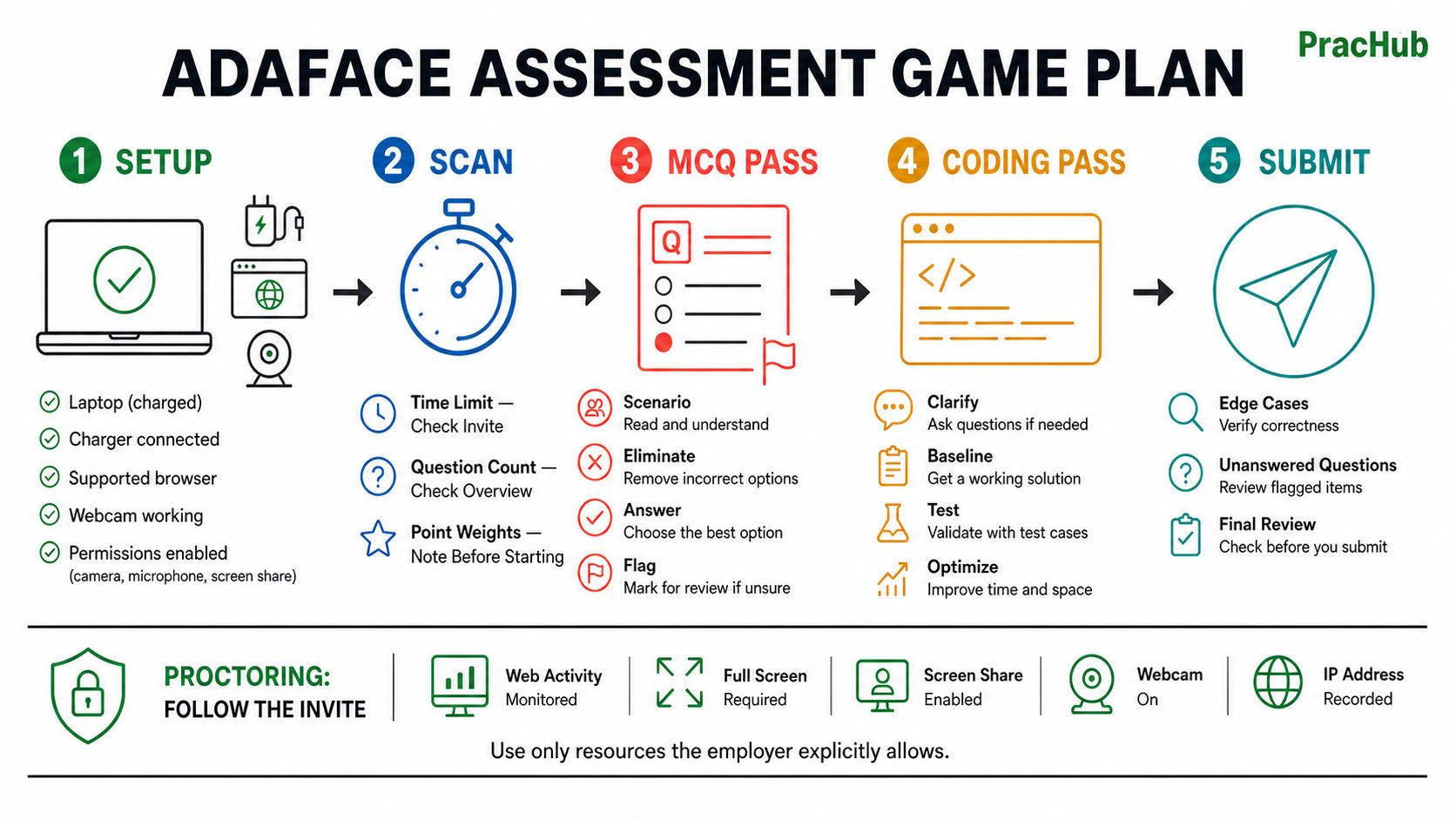
1. Set up before the timer
Use a stable computer, supported browser, charger, reliable network, and quiet workspace. Read the rules and complete device checks before clicking the final start button.
2. Scan the assessment
Note the total time, number of sections, question weights, navigation rules, and whether you can revisit answers. Build your plan from the actual overview rather than a remembered format.
3. Protect time for coding
Answer clear MCQs efficiently and flag uncertain ones if allowed. Do not spend ten minutes debating one low-value option while leaving a coding question untouched.
4. Get code working early
A correct baseline gives you something to test and improve. Run small cases, inspect failures, and save or execute regularly instead of writing the entire solution in one untested pass.
5. Use the final minutes deliberately
Check unanswered items, boundary cases, accidental debug output, function signatures, and submission status. Avoid a large rewrite unless you have a clear failing case and enough time to retest.
How Scores and Reports Are Used
Adaface says candidates are scored automatically and employers receive a detailed scorecard with overall status, skill-level breakdowns, question-level information, and benchmarks. Recruiters can set or interpret their own screening threshold, so there is no universal passing score for every company.
The platform itself describes assessments as an elimination or screening tool rather than the final hiring decision. A strong result usually earns the next conversation; it does not replace technical interviews, system design, or behavioral evaluation.
Common Mistakes to Avoid
Candidates lose time by treating every MCQ as a research project, starting optimization before achieving correctness, ignoring the assessment overview, or discovering webcam and screen-share problems after the timer begins.
Another mistake is practicing only algorithm puzzles when the test targets a language, framework, SQL, debugging, or technical aptitude. Map your preparation to the job description and invite.
A Focused 5-Day Prep Plan
Day 1: Extract every tested skill from the invite and job description. Complete one untimed diagnostic on PracHub.
Days 2-3: Practice short code-tracing and scenario questions, then complete two timed coding problems in your preferred language. Review every wrong assumption, not just the final answer.
Day 4: Run a mixed mock that forces you to switch between MCQs and coding. Practice stopping, flagging, and returning instead of getting stuck.
Day 5: Test your device and permissions, complete one light review, and stop early enough to protect focus for the real assessment.
Frequently Asked Questions
How long is an Adaface coding assessment?
It varies. Many public ready-to-use programming tests are around 30 to 50 minutes, while custom assessments can differ. Use the duration shown in your invitation.
Does every Adaface test include a coding question?
No. The question mix depends on the role and employer configuration. Many software engineering tests combine MCQs and coding, but some assessments emphasize other skills.
Can I switch tabs during the test?
Assume no unless the employer explicitly allows it. Adaface web proctoring can log tab and window changes, and screen proctoring can record activity outside the assessment.
Can I take an official Adaface practice test?
Adaface's public test pages say full candidate practice tests are not currently offered, although sample questions are available. Use the samples to understand style, then practice the underlying skills elsewhere.
Prepare with PracHub
PracHub helps you prepare for the skills behind the assessment, not leaked copies of one test. Practice real interview questions with written solutions, focus on coding and algorithms, and use company-specific interview prep to understand what may follow the screening stage.
Start with one mixed session today: ten short technical questions, one timed coding problem, and a review of every missed edge case. That is a stronger signal builder than memorizing an answer list.
Related Resources
Adaface coding tests Adaface platform features Adaface proctoring features Adaface software engineering test Adaface sample coding questions
Related Articles
Code Review Interview Guide: How to Find Bugs and Explain Trade-Offs
Code review interview guide: learn how to find bugs, propose tests, prioritize feedback, and explain technical trade-offs with a practical example.
Parakeet AI Review 2026: Pay-Per-Interview Copilot vs Real Preparation
Parakeet AI review 2026: examine credits, live copilot features, privacy and detection risks, then compare pay-per-interview help with real prep.
Palantir Decomposition Interview Guide: How to Structure Ambiguous Problems
Palantir Decomposition Interview guide: learn a six-step framework for ambiguous problems, trade-offs, MVPs, practice examples, and common mistakes.
InterviewReady vs ByteByteGo: Which System Design Course Is Better in 2026?
InterviewReady vs ByteByteGo in 2026: compare pricing, curriculum, visual learning, practice features, and which system design course fits you.
Comments (0)