Palantir Decomposition Interview Guide: How to Structure Ambiguous Problems
Quick Overview
Prepare for Palantir's Decomposition Interview with a six-step framework for clarifying ambiguous problems, mapping stakeholders and data, prioritizing an MVP, testing trade-offs, and adapting to new constraints. Includes a worked example, pacing guide, common mistakes, and a PracHub practice workflow.
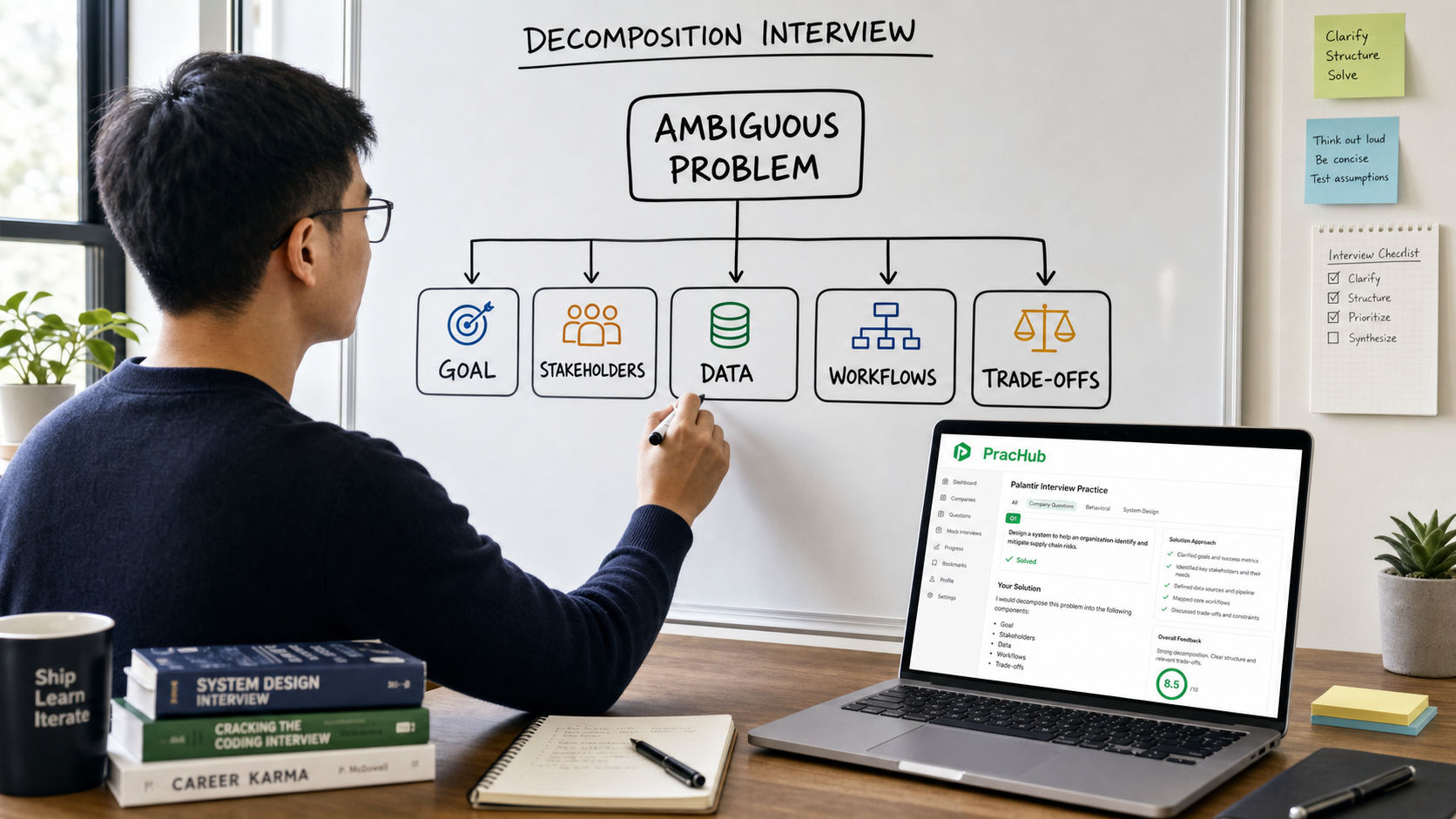
A Palantir decomposition interview can feel uncomfortable for a simple reason: the prompt is supposed to be incomplete. You are not being asked to recall a standard architecture. You are being asked to turn a messy real-world situation into a problem a team could actually solve.
The strongest candidates do not rush toward a dashboard, database, or algorithm. They clarify the outcome, identify the people affected, expose assumptions, map the data and workflows, and then choose a practical first version. Before your interview, use PracHub's company-specific interview prep to practice explaining that reasoning against real company questions.
Quick Answer: What Is the Palantir Decomposition Interview?
The Palantir decomposition interview is an open-ended problem-solving round in which you break an ambiguous operational or product challenge into smaller, solvable parts. It tests how you discover requirements, organize complexity, prioritize a workable solution, discuss trade-offs, and adapt when the interviewer changes a constraint.
Palantir says its interview formats are personalized by role and candidate. Its official preparation pages emphasize open-ended technical challenges, multiple possible solutions, thoughtful trade-offs, clarifying questions, and delivering a functioning idea before expanding it. Recent candidate accounts commonly describe a dedicated Decomposition round, but your recruiter or interview invitation is the source of truth for the exact format and timing.
What the Interviewer Is Actually Evaluating
This round sits between product thinking, system design, and structured problem solving. It may involve data and technology, but writing code is usually not the main point. The interviewer wants to see whether you can create order without pretending the ambiguity does not exist.
| Signal | What It Looks Like in Your Answer |
|---|---|
| Problem framing | You define the outcome before proposing features. |
| Requirement discovery | You ask focused questions about users, constraints, scale, and success. |
| Decomposition | You separate stakeholders, data, workflows, decisions, and risks. |
| Prioritization | You choose an MVP instead of trying to solve everything at once. |
| Trade-off judgment | You compare options and explain why one fits the current goal. |
| Collaboration | You make your assumptions visible and use interviewer feedback. |
Palantir's own guide to open-ended questions makes the standard clear: perfect solutions are often unattainable, so candidates should articulate alternatives while still arriving at a concrete approach.
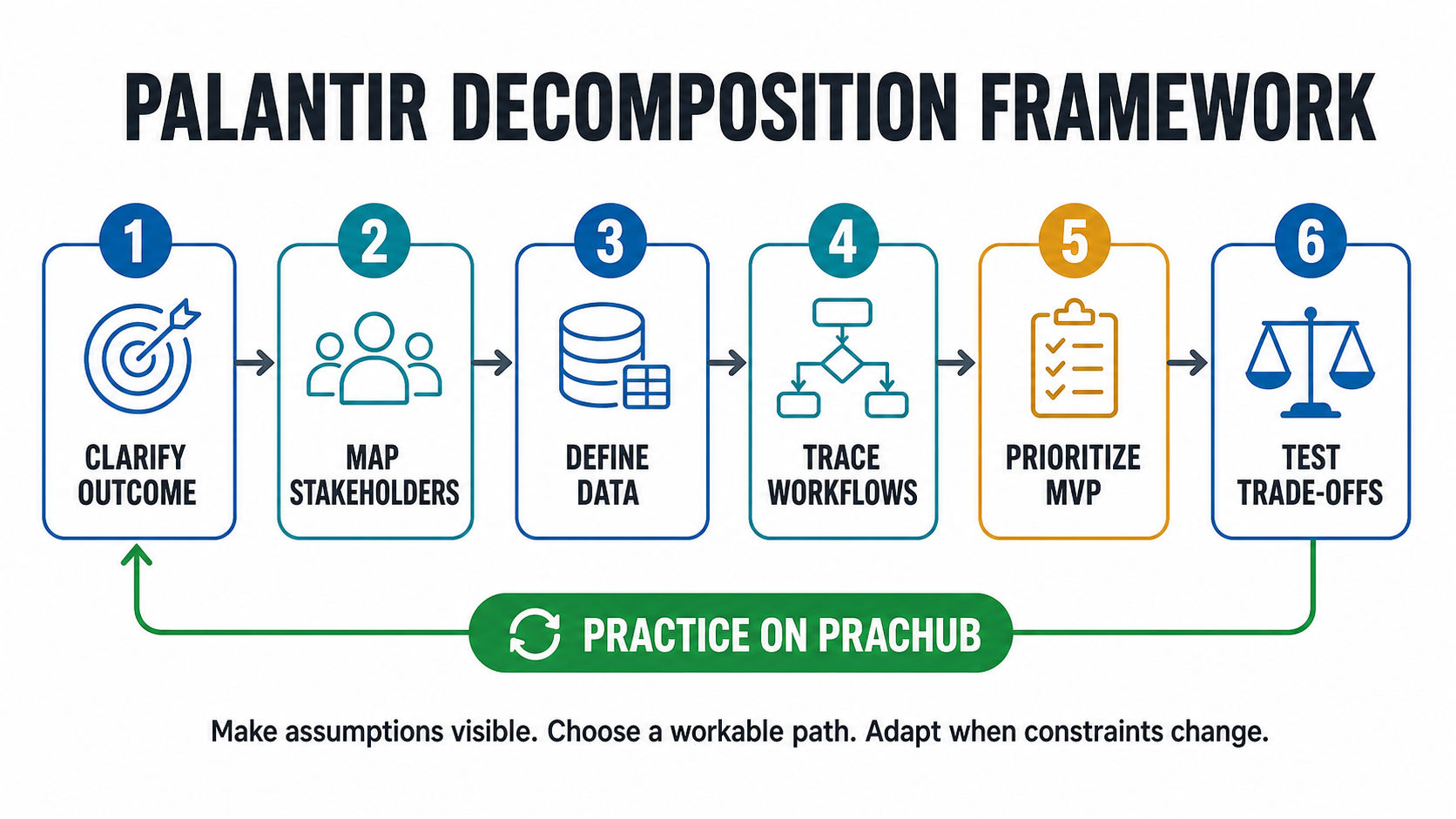
A Six-Step Palantir Decomposition Framework
1. Clarify the Outcome
Restate the problem in one sentence, then define success. Ask what must improve, who cares about the result, what time horizon matters, and which constraints cannot be violated. "Build a tool for hospitals" is not an outcome; "reduce critical supply shortages without slowing clinical work" is.
2. Map the Stakeholders
Identify the people who create data, make decisions, perform the workflow, and receive the outcome. Their incentives may conflict. A procurement team may optimize cost, while clinicians prioritize immediate availability and administrators require auditability.
3. Define the Data
Name the core entities and relationships before selecting technology. For a supply problem, that might include item, location, inventory event, usage event, purchase order, vendor, delivery, and alert. Then ask which sources are delayed, incomplete, duplicated, or sensitive.
4. Trace the Current Workflow
Walk through what happens today from trigger to decision to action. Find the delay, manual handoff, missing information, or ownership gap. This keeps your answer grounded in the actual bottleneck instead of turning into a generic architecture discussion.
5. Prioritize a Workable MVP
Choose the smallest intervention that improves the target outcome. State what is included now, what is deferred, and why. Palantir explicitly advises candidates to deliver a functioning idea first and expand it afterward, so a focused MVP is stronger than an unbounded feature catalog.
6. Test Trade-Offs and Failure Modes
Pressure-test the design. What happens when data arrives late, permissions differ, a user ignores an alert, or the scale increases tenfold? Compare at least one alternative and explain the cost of your choice. Then invite the interviewer to change a constraint and adapt your plan aloud.
Worked Practice Example: Prevent Hospital Supply Shortages
Imagine the prompt is: "A regional hospital network frequently runs out of critical supplies. Design a better way to manage the problem." This is a practice scenario, not a claimed Palantir interview question.
Start with the outcome. Reduce preventable stockouts of critical items while preserving clinical speed and safety. Clarify which supplies are critical, how shortages are measured, and whether the first release covers one hospital or the entire network.
Map the operation. Clinicians consume supplies, inventory teams count them, procurement places orders, vendors deliver them, and hospital leaders monitor risk. Data may come from point-of-use systems, inventory scans, purchase orders, and delivery records.
Choose the first version. Create a risk score from current inventory, recent usage, lead time, and open orders. Route high-risk items to an inventory coordinator with evidence and a recommended action. Keep a human approval step for expensive or regulated items.
Discuss the hard choices. A sensitive alert catches more shortages but creates noise. Real-time ingestion improves freshness but increases integration effort. Automatic ordering is fast but may be unsafe when data quality is poor. A strong answer chooses one path, states the assumption behind it, and explains what evidence would trigger a change.
How to Structure the Conversation
Do not treat the following timing as a rigid Palantir rubric. Use it as a pacing tool for a roughly hour-long practice session, then follow the instructions in your actual invitation.
| Practice Time | Your Focus | Useful Output |
|---|---|---|
| 0-8 minutes | Clarify the outcome and constraints | One-sentence goal and success metrics |
| 8-18 minutes | Map stakeholders and current workflow | Actors, handoffs, and bottleneck |
| 18-30 minutes | Define data and system boundaries | Core entities, sources, and ownership |
| 30-43 minutes | Propose and prioritize the MVP | Concrete workflow and architecture |
| 43-55 minutes | Test trade-offs and failure modes | Alternatives, risks, and mitigations |
| Final minutes | Summarize and adapt | Decision, assumptions, and next step |
Common Mistakes to Avoid
Jumping into technology too early creates a polished solution to an undefined problem. Asking endless questions is not better. Clarify the variables that change your decision, state reasonable assumptions, and move forward.
Do not list every possible feature or hide your uncertainty. Pick an MVP, explain what you left out, and think aloud. Palantir's official guidance encourages candidates to discuss their approach, ask clarifying questions, and engage with the interviewer.
How to Practice on PracHub
Start with an unseen prompt from PracHub's real interview questions with written solutions. Give yourself five minutes to build the goal, stakeholder, data, workflow, MVP, and trade-off structure before speaking.
Record a 45-minute answer, check whether each technology choice traces to a need or constraint, and compare your reasoning with the written solution. Repeat with one changed assumption. Add system design questions for architecture depth and behavioral and leadership practice for the hiring-manager portion of the loop.
FAQ
Is the Palantir decomposition interview a system design interview?
Not exactly. Both involve requirements, architecture, and trade-offs, but Decomposition usually begins with a broader operational problem. You may need to model stakeholders, workflows, data, priorities, and product decisions before discussing technical components.
Do I need to code during the decomposition round?
Recent candidate descriptions generally focus on structured reasoning rather than implementation, but Palantir personalizes interview formats. Confirm expectations with your recruiter and prepare to express technical details clearly if the conversation moves toward APIs, data models, or algorithms.
How many clarifying questions should I ask?
Ask questions that materially change the solution: desired outcome, users, constraints, scale, data quality, and risk. Once the important variables are clear, state remaining assumptions and proceed. The goal is not to eliminate ambiguity; it is to manage it responsibly.
What is the best way to prepare?
Practice unfamiliar, real-world prompts aloud. Use the same six-step framework each time, force yourself to choose an MVP, and ask a partner to change a constraint halfway through. Review the official Palantir interview guidance and use PracHub for company-specific repetitions.
Final Takeaway
The Palantir decomposition interview rewards candidates who can turn uncertainty into a sequence of defensible decisions. Clarify the outcome, map the operation, choose a practical first version, and adapt without losing the thread.
Do not prepare by memorizing one perfect answer. Prepare by building a repeatable reasoning habit. Start with PracHub's company interview prep, attempt new prompts without notes, and use written solutions to find where your structure or judgment breaks down.
Comments (0)