AI Agent Memory System Design Interview: Working State, Long-Term Retrieval, and Forgetting
Quick Overview
A practical 2026 guide to AI agent memory system design interview, with question rubrics, technical trade-offs, failure analysis, PracHub practice, and a seven-day preparation plan.
AI Agent Memory System Design Interview: Working State, Long-Term Retrieval, and Forgetting
Quick answer: Separate working state, durable user memory, and external knowledge before choosing a database. Explain what is stored, why it is stored, who may retrieve it, how stale information is corrected, how users delete it, and how memory affects latency and cost. Retrieval quality is only one part of the design.
Use the PracHub interview question bank to rehearse the same explanation with timed coding, debugging, and design practice. PracHub records are practice material, not leaked questions or a prediction of your exact interview.

What interviewers actually test
Agent memory is the state an AI application carries across or within tasks to make future decisions. A production design needs more than embeddings: it needs schemas, provenance, scope, retention, permissions, conflict resolution, retrieval policy, and a safe, verifiable forgetting path in production.
The differentiating skill is designing memory that is useful, scoped, inspectable, fresh, and removable. An interview-ready answer turns that idea into a checkable contract: state the user or system goal, identify the component that owns each decision, name one invariant, and show the metric or test that would expose a failure.
A four-part answer framework
Use this structure for AI agent memory system design interview without forcing every question into the same architecture. Start with the smallest design that meets the requirement, then add complexity only when a stated constraint requires it.
| Part | What to explain | Evidence that makes it credible |
|---|---|---|
| Requirement | User, task, inputs, outputs, and success condition | One explicit assumption and one excluded scope |
| Mechanism | Memory tiers, provenance, retrieval, privacy, and deletion | A data flow, state transition, API contract, or invariant |
| Evidence | How you test or compare the design | Baseline, metric, failure slice, or trace |
| Recovery | What happens when the design is wrong or a dependency fails | Safe fallback, user-visible status, and next action |
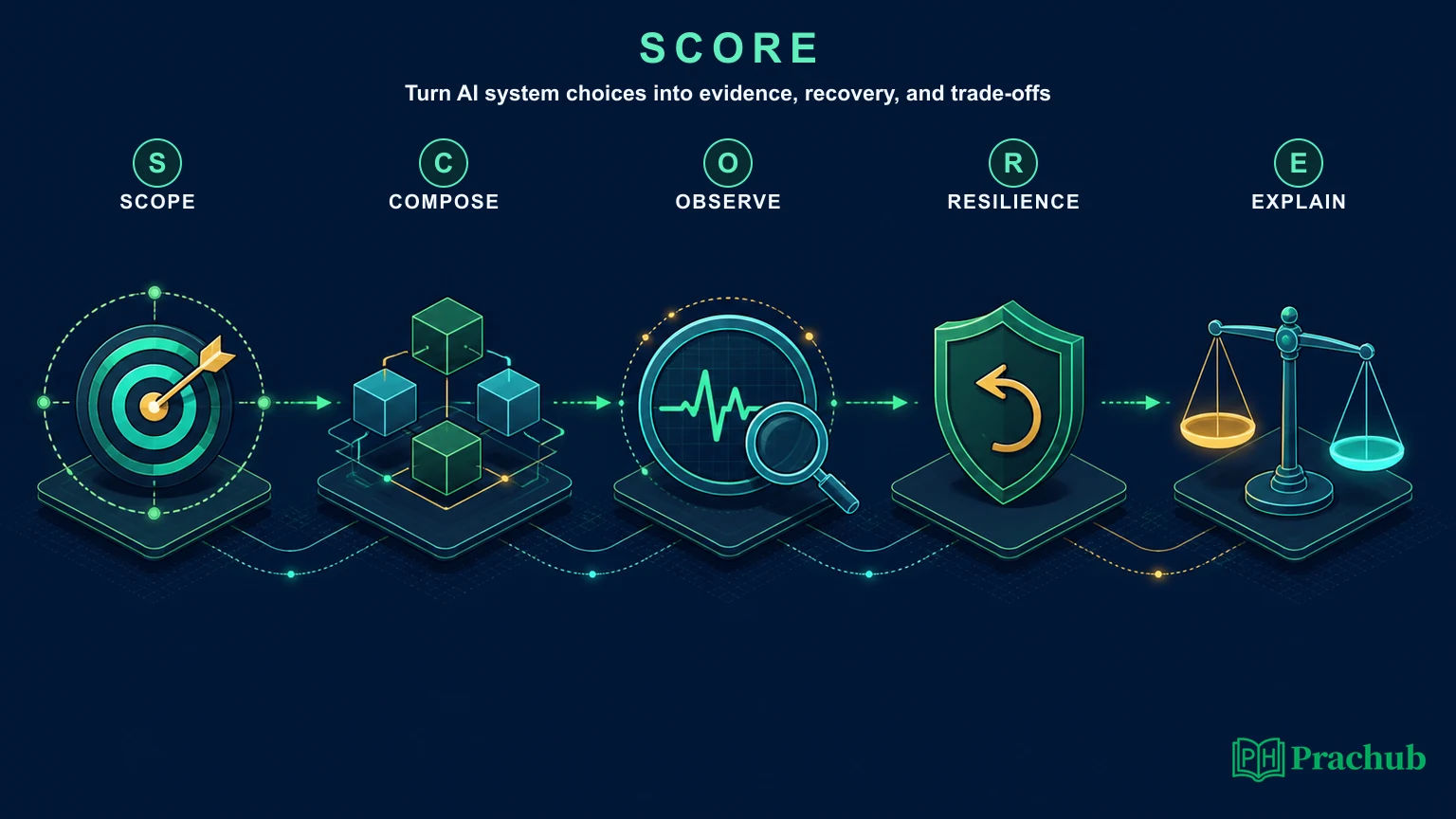
AI Agent Memory System Design Interview: questions and strong-answer signals
The AI agent memory system design interview questions below each target a decision that can be tested. Avoid listing components without explaining ownership, failure behavior, and evidence.
1. What memory tiers would you define for an AI agent?
Separate turn-local working state, durable task state, user-approved preferences, and external knowledge. Each tier needs an owner, schema, access policy, retention rule, and retrieval path; chat history alone is not a memory architecture.
What interviewers listen for: Show why different state types require different storage and deletion semantics. Name one trade-off or condition that would change your recommendation.
2. When should memory be structured instead of embedded?
Use structured storage for permissions, preferences, identifiers, workflow status, and facts that need exact filters or updates. Use semantic retrieval for meaning-based recall, then preserve source identity and apply structured authorization before returning results.
What interviewers listen for: Choose the representation from access and correctness requirements, not fashion. Name one trade-off or condition that would change your recommendation.
3. How should the system decide what to remember?
Use an explicit write policy based on utility, user expectation, sensitivity, confidence, and retention. High-impact or inferred memories may require confirmation, while transient observations should expire instead of silently becoming durable profile data.
What interviewers listen for: Describe a deny path and who can correct the write decision. Name one trade-off or condition that would change your recommendation.
4. How would you retrieve and rank memories?
Filter by tenant, user, scope, time, and permissions before semantic ranking. Combine recency, relevance, confidence, and source authority, then return a bounded set with provenance so the model can distinguish memory from current instructions.
What interviewers listen for: Prevent cross-tenant retrieval and explain how ranking handles conflicting items. Name one trade-off or condition that would change your recommendation.
5. How do you resolve stale or contradictory memories?
Keep provenance and timestamps, prefer authoritative current sources, detect conflicts, and expose correction or deletion to the user. Do not overwrite history blindly when the contradiction itself may be operationally useful.
What interviewers listen for: Define a resolution rule and a safe behavior when confidence remains low. Name one trade-off or condition that would change your recommendation.
6. How would you implement forgetting and privacy controls?
Support inspection, correction, scoped deletion, retention expiry, and deletion propagation through indexes, caches, and derived artifacts. Audit access without storing unnecessary sensitive content in logs.
What interviewers listen for: Treat deletion as a system workflow with verifiable completion. Name one trade-off or condition that would change your recommendation.
7. How would you evaluate whether memory helps?
Compare task outcomes with and without memory on representative scenarios. Measure retrieval precision, stale-memory rate, correction rate, latency, cost, and privacy violations, then inspect failures by memory type and user cohort.
What interviewers listen for: Show that more remembered context is not automatically better. Name one trade-off or condition that would change your recommendation.
8. What is a dangerous memory failure mode?
A plausible but stale memory can silently override current intent or expose another user's data. Contain the issue by disabling the affected retrieval path, preserving traces, correcting the data, and adding regression cases for scope and freshness.
What interviewers listen for: Cover detection, containment, user communication, and prevention. Name one trade-off or condition that would change your recommendation.
A worked interview drill
Use this question as a timed drill: How should the system decide what to remember?
First pass, two minutes: for AI agent memory system design interview, state the requirement, your recommendation, and the main reason. Do not start by naming products. The interviewer should understand what the system or candidate must accomplish and which constraint drives the choice.
Second pass, five minutes: draw the data or control flow behind memory tiers, provenance, retrieval, privacy, and deletion. Label the component that owns validation, authorization, state, and recovery. Add one invariant that must remain true even if a model, tool, or dependency returns a plausible but incorrect result.
Interviewer challenge: in the AI agent memory system design interview scenario, assume the first dependency times out, the cost doubles, or the input violates an important assumption. Revise the design without discarding the original goal. Explain whether you retry, degrade, ask for clarification, require approval, or stop.
Evidence check: Describe a deny path and who can correct the write decision. Add one metric or test that could prove your first recommendation wrong, then name the condition that would make you choose a simpler design. This final step turns a memorized answer into engineering judgment and gives the interviewer a concrete path for follow-up questions.
How to prepare for this topic
Choose two questions from the list and answer each at three depths: a 30-second summary, a two-minute design, and a ten-minute whiteboard discussion. For each answer, draw the boundary implied by memory tiers, provenance, retrieval, privacy, and deletion, then add one failure case and one measurement that could disprove your first idea.
Bring one project or incident that demonstrates designing memory that is useful, scoped, inspectable, fresh, and removable. Write down the original requirement, your exact contribution, the trade-off you made, the evidence you collected, and what changed afterward. For company-specific interviews, keep official information, candidate reports, and your own inference clearly separated; the current invitation remains the source of truth.
Use the five linked PracHub records below as timed work samples for memory tiers, provenance, retrieval, privacy, and deletion. Explain the invariant before coding, test an edge case before polishing, and state the operational or complexity cost of the final choice.
Practice with PracHub questions
These question-bank records are practice material, not predictions of your exact interview or assessment. Use the complete linked title in the first column to open the question and written solution.
| PracHub question | Practice focus | Why it helps |
|---|---|---|
| How to Prepare for AI-Assisted Coding Interviews | AI-assisted coding | Practice decomposing a task, using an allowed assistant narrowly, and validating every change. |
| Validate AI-Generated Code Safely | verification and security | Builds the habit of checking behavior, data handling, permissions, and failure modes. |
| Describe an Analysis Where You Used AI Responsibly | judgment and ownership | Rehearses a truthful explanation of assistance, review, limits, and measurable outcome. |
| Design RAG Evaluation and Debugging | evaluation and retrieval | Connects model behavior to test sets, traces, slices, and a repeatable debugging loop. |
| Explain Your Technical Focus and Responsible Use of AI | communication and scope | Helps you explain technical choices without overstating tools, outcomes, or certainty. |
A seven-day preparation plan
| Day | Focus | What to do |
|---|---|---|
| Day 1 | Map the search intent | Write a one-paragraph answer to AI agent memory system design interview, including the audience, scope, and one assumption. |
| Day 2 | Master the core system | Draw memory tiers, provenance, retrieval, privacy, and deletion and label ownership, data flow, and one invariant. |
| Day 3 | Answer questions 1-4 | Give each answer in two minutes, then add a failure case and a trade-off. |
| Day 4 | Answer questions 5-8 | Add a metric, test, or trace that could prove each recommendation wrong. |
| Day 5 | Build a project story | Rehearse one example with your contribution, evidence, limitation, and what changed after measurement. |
| Day 6 | Run a timed simulation | Complete one software engineer practice set and review assumptions, tests, permissions, and skipped edge cases. |
| Day 7 | Final review | Confirm logistics and permitted tools, then review the five weakest answers without adding a new framework. |
Frequently asked questions
Is agent memory the same as chat history?
No. Chat history is one possible source of context. Memory is a deliberate data product with selection, scope, retention, and retrieval rules.
Should all memories be embedded?
No. Structured preferences, permissions, counters, and current workflow state may belong in relational or key-value storage. Use semantic retrieval where meaning-based lookup is actually needed.
How do you prevent stale memory?
Store timestamps and provenance, apply expiration or review rules, detect conflicts, and let authoritative current data override inferred memory.
What is a good privacy answer?
Explain consent, access scope, retention, user inspection, correction, deletion, auditability, and prevention of cross-tenant retrieval.
How do you measure memory quality?
Measure task success with and without memory, retrieval precision, stale-memory rate, correction rate, latency, cost, and privacy-policy violations by slice.
What a strong answer sounds like
A strong AI agent memory system design interview answer is specific enough to challenge. The interviewer should be able to point to the requirement, the owner of each decision, the evidence supporting the choice, and the condition that triggers a fallback or redesign. If any of those pieces are missing, the answer is probably still at the buzzword level.
Final takeaway
Prepare for AI agent memory system design interview by making every answer inspectable: define the requirement, show the mechanism, provide evidence, and design the recovery path. The linked PracHub questions let you rehearse that discipline under time pressure while the role description and interview instructions control the exact format.
Sources and Further Reading
- Anthropic: Effective context engineering
- Anthropic: Building effective agents
- NIST Privacy Framework
- OWASP Top 10 for LLM Applications
Research note: This draft was checked on August 31, 2026. Employer processes, platform features, documentation, and model behavior can change; the reader's current instructions remain the source of truth.
Comments (0)