AI Fluency Interview Questions 2026: Prompting, Verification, Judgment, and Recovery
Quick Overview
A practical guide to AI fluency interview questions, strong-answer signals, live work samples, verification habits, and responsible recovery in 2026.
AI fluency interviews assess more than model names or prompt templates. Prepare to show when AI is useful, how you provide context, verify output, recover from failure, and remain accountable.
In 2026, an AI fluency interview—sometimes a GenAI fluency round—may appear as a behavioral question, case, review, or AI-permitted live task. Formats vary, so treat the invitation and interviewer instructions as authoritative.
This guide covers questions about how you work with AI—not AI-led interviews or LLM and generative AI theory.
Use the PracHub interview question library to practice the underlying technical and behavioral skills before adding an AI-assisted workflow. The goal is to make your judgment visible, not to let a tool hide gaps you cannot explain.
For permitted coding rounds, see the AI-assisted coding interview guide.
Quick answer: what AI fluency means in an interview
AI fluency is the ability to collaborate with AI effectively, efficiently, ethically, and safely while keeping human responsibility clear. It includes choosing the right task, describing the goal and constraints, evaluating the output, and deciding what may be used or shared.
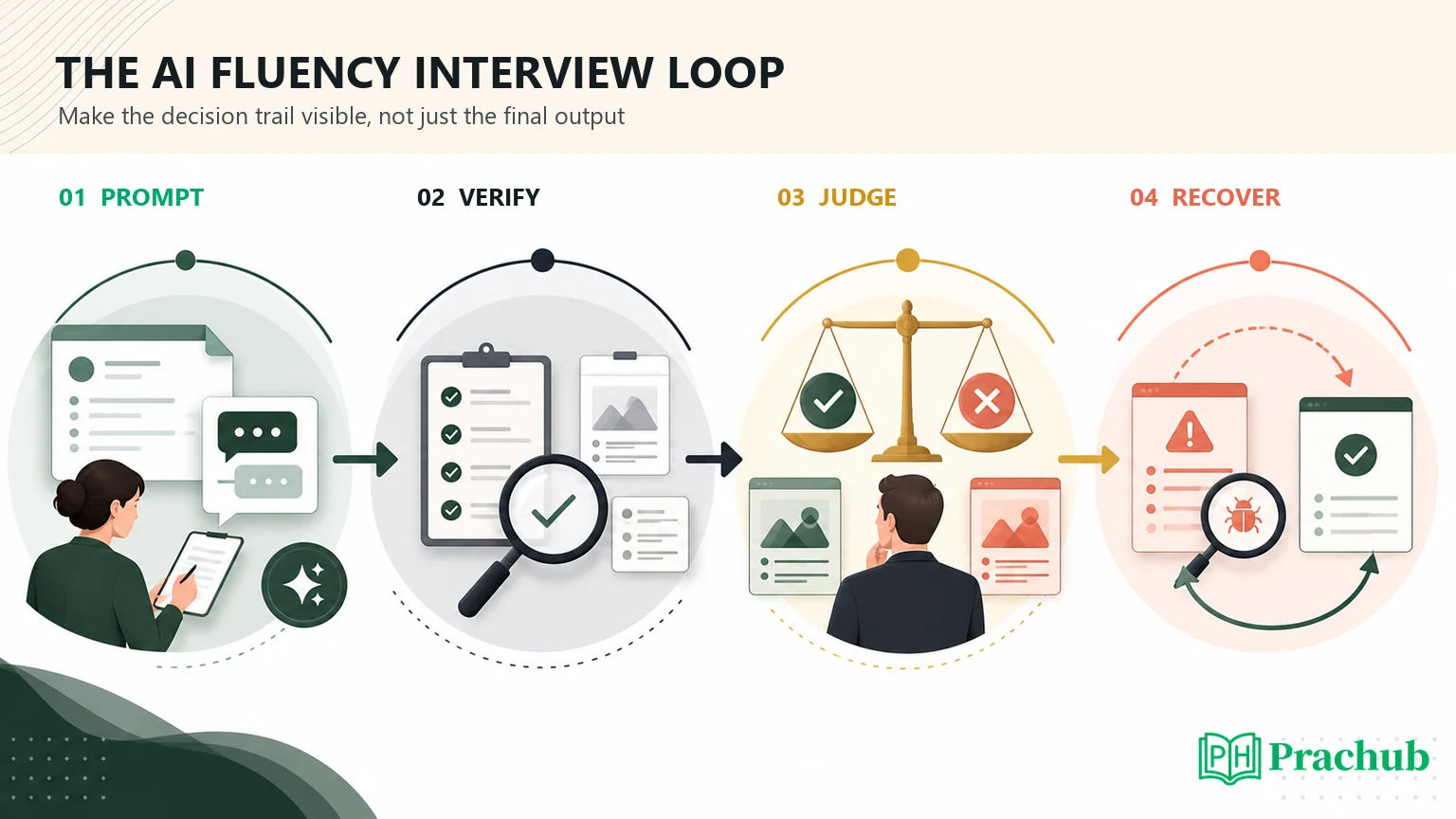
Anthropic's AI Fluency course organizes the skill into Delegation, Description, Discernment, and Diligence. Drawing on the 4Ds and Anthropic's Description-Discernment loop, PracHub uses four practical interview signals. This is a synthesis, not Anthropic's official taxonomy:
- Prompting: framing a useful request with context, constraints, and a definition of success.
- Verification: testing claims, code, calculations, citations, and edge cases instead of trusting fluent output.
- Judgment: deciding what to delegate, what to keep human-led, and how much checking the stakes require.
- Recovery: diagnosing a bad result, changing the approach, and containing any downstream impact.
Prompting is only one part of the story. A polished output is weak evidence if you cannot explain why it is correct, what could be wrong, or how you would handle a failure.
What interviewers are trying to measure
Interviewers want evidence that you can use an imperfect tool without surrendering engineering, product, or professional judgment.
HackerRank's June 15, 2026 technical-hiring article similarly distinguishes mere tool use from the judgment required to direct, evaluate, and improve AI-generated work.
| Signal | Strong evidence | Common red flag |
|---|---|---|
| Task framing | Separates the real decision from the work AI can accelerate | Gives the whole problem to the model without defining success |
| Prompting | Supplies relevant context, constraints, examples, and output format | Relies on vague instructions or memorized prompt tricks |
| Verification | Uses tests and independent evidence matched to the risk | Says “I always double-check” without describing how |
| Judgment | Names privacy, security, accuracy, and accountability boundaries | Uses AI everywhere because it is faster |
| Recovery | Finds the failure mode, limits impact, corrects it, and improves the process | Repeats the same prompt or quietly patches the final answer |
The NIST AI Risk Management Framework similarly emphasizes defining the use case, evaluating performance, and managing risk.
The 12 questions below are PracHub-created practice prompts synthesized from the cited frameworks; they are not a verified question set from any employer.
Prompting interview questions
1. How would you turn an ambiguous task into a useful AI prompt?
A strong answer begins before the prompt. Restate the outcome, identify missing information, choose the subtask AI should handle, then provide context, constraints, examples, and the expected output shape.
Also name what you would exclude: sensitive data, credentials, restricted code, and unsupported assumptions.
2. Tell me about a first prompt that produced a poor result. What did you change?
Choose a real example and diagnose the miss: a vague objective, missing schema, absent domain context, or too many bundled decisions. Describe the smallest useful change and how you evaluated the next result.
Show iteration based on evidence: “the output violated two acceptance criteria, so I added those constraints and a counterexample.”
3. How do you provide enough context without overwhelming the model?
Include information that can change the answer: goal, audience, current state, hard constraints, evidence, and a definition of done. Remove irrelevant history. For a complex task, request a plan and add context only where it exposes a gap.
OpenAI Academy's prompting guidance likewise recommends clear instructions and iterative refinement.
Verification interview questions
4. How do you verify an AI answer in a domain you do not know well?
Decompose the output into checkable claims, identify the highest-risk ones, and triangulate them with primary documentation, an experiment, an authoritative dataset, or a qualified reviewer. State what remains uncertain.
Match verification to the consequences. A rephrased note may need a quick review; a security control or production migration needs stronger evidence and possibly independent approval.
5. AI-generated code passes the provided tests. What do you inspect before using it?
Passing visible tests is a starting point. Review assumptions, error handling, security, data-loss risk, concurrency, complexity, dependencies, and maintainability. Add boundary and adversarial tests rather than asking the model to judge its own code.
In a live interview, narrate this review so the checks and ownership are visible.
6. How would you evaluate an AI workflow before scaling it?
Define a baseline, representative cases, failure categories, quality metrics, latency and cost constraints, and human-review policy. Include rare failures and decide what result would block launch.
NIST's AI RMF Core says testing, evaluation, verification, and validation processes should be objective, repeatable, or scalable, documented, and applied before deployment and regularly in operation—not treated as a one-time confidence check.
Judgment interview questions
7. What work would you not delegate to AI?
Discuss decision rights instead of saying “never use AI for important work.” AI may organize evidence or generate alternatives while irreversible decisions, sensitive access, legal commitments, and high-impact approvals remain under accountable human control.
Good judgment adapts to the employer's tools, data classification, review process, and risk tolerance.
8. When is a slower manual approach better than an AI-assisted one?
A manual approach can be better when the task is small, setup and verification cost exceed the benefit, output must be deterministic, data cannot leave an approved system, or failure cannot be detected reliably.
If the task becomes repetitive and checks can be automated, the decision may change.
9. When should you disclose that AI helped produce the work?
Start with company policy, client expectations, assessment rules, and AI's material contribution. Disclose when required and whenever provenance affects trust, review, licensing, privacy, or accountability.
In an interview, ask whether AI is allowed before using it. Permission for one round or tool does not automatically apply to another.
Recovery interview questions
10. The model keeps producing the same wrong answer. What do you do?
Stop repeating the prompt. Recheck inputs, isolate the failing step, reduce the task, add a counterexample, switch tools if permitted, or complete the critical portion manually. Preserve a known-good state first.
The recovery signal is control, not persistence with a failing approach.
11. You discover an AI-assisted error after sharing the result. How do you respond?
Contain the impact first. Identify who consumed the result, correct the record, notify the owner, and preserve evidence of the cause. Then add a test, review gate, data check, or narrower boundary.
Own the decision to use the output and explain how recurrence became less likely.
12. What would you do if the AI tool became unavailable during a live task?
Continue from your own problem model. Restate requirements, preserve useful artifacts, prioritize a smaller complete solution, and perform available checks manually. Report a genuine platform failure instead of hiding it.
For interview preparation, treat the ability to continue without AI as a fluency signal.
A strong answer framework
Use Task, Choice, Check, Recovery, Result to keep answers concrete:
- Task: What outcome, constraint, and risk were you responsible for?
- Choice: Why did you use AI for this part, and what stayed human-led?
- Check: What tests, sources, reviewers, or acceptance criteria verified the output?
- Recovery: What failed or remained uncertain, and how did you respond?
- Result: What improved, what did you learn, and what process changed afterward?
Hypothetical model answer: “I used an approved assistant to draft a parser from a schema and malformed examples. A reconciliation test caught dropped duplicate records. I narrowed the prompt, added property-based tests, and reviewed the final diff. We shipped without missing records and made reconciliation a standard gate.”
That answer is stronger than a list of tools because it shows delegation, prompting, verification, recovery, and ownership in one story.
What a live AI-fluency exercise may look like
When AI is permitted, you may improve unfamiliar code, analyze a document, critique generated output, or solve a role-relevant case. Prepare for behaviors that transfer across tools:
Some platforms make the process reviewable. For non-coding work, CoderPad's AI Fluency environment records prompts, responses, edits, and comments, then supports playback for reviewers. That is one vendor's format, not a universal standard.
- Clarify the goal and allowed resources before opening the assistant.
- State your plan and define what a correct result must satisfy.
- Keep prompts small enough that you can evaluate each change.
- Inspect diffs, sources, calculations, and tests yourself.
- Explain why you accept, reject, or revise each important suggestion.
- Recover visibly when the model, tool, or your own assumption fails.
Keep enough notes to explain what the model contributed and what you personally verified.
Practice with AI fluency questions from PracHub
These PracHub question-bank records train the same underlying skills. They are practice material, not predictions of your exact assessment or interview.
| PracHub question | Practice focus | Why it helps |
|---|---|---|
| How to prepare for AI-assisted coding interviews? | Workflow and communication | Practice making AI use visible without giving up technical ownership. |
| Validate AI-Generated Code Safely | Verification and testing | Build a concrete review sequence beyond visible test cases. |
| Describe an Analysis Where You Used AI Responsibly | Behavioral evidence | Turn responsible AI use into a specific, accountable story. |
| Design RAG Evaluation and Debugging | Evals and failure analysis | Explain metrics, error categories, and recovery for an AI system. |
| Explain Your Technical Focus and Responsible Use of AI | Judgment and boundaries | Connect tool use to engineering priorities, policy, and impact. |
A seven-day preparation plan
| Day | Focus | What to do |
|---|---|---|
| Day 1 | Inventory | List three real AI-assisted tasks, including one that failed. |
| Day 2 | Prompting | Rebuild one prompt from objective, context, constraints, and success criteria. |
| Day 3 | Verification | Create a risk-based checklist for claims, code, data, and citations. |
| Day 4 | Judgment | Write boundaries for sensitive data, high-impact decisions, and disclosure. |
| Day 5 | Recovery | Practice diagnosing a repeated wrong answer and switching to a manual path. |
| Day 6 | Work sample | Complete one timed task while narrating prompts, checks, and decisions. |
| Day 7 | Story review | Rehearse two 90-second examples using Task, Choice, Check, Recovery, Result. |
Frequently asked questions
Are AI fluency interview questions only for AI engineers?
No. The task should match the role, but the core judgment transfers across software engineering, product, data, operations, and design. LinkedIn has identified AI literacy as a fast-growing skill across multiple job functions.
How is AI fluency different from prompt engineering?
Prompt engineering focuses on describing a task so a model can respond usefully. AI fluency is broader: it also covers whether AI should be used, how the output is verified, which decisions remain human-owned, and how you recover when the workflow fails.
How should I answer “How do you use AI in your work?”
Use one real example: state the task, why AI was appropriate, what you delegated, how you verified the result, and the outcome. Include what stayed human-owned and one failure you corrected. Avoid turning the answer into a tool inventory.
What if I have limited professional AI experience?
Use an honest academic, personal, or side-project example with real constraints and checks. Do not invent workplace impact. You can also explain how you would evaluate a proposed use case before relying on it.
Can I use AI during the interview?
Only when the written rules or the interviewer for that specific round explicitly permit it. If they conflict or are unclear, pause and ask before using AI. Confirm which tools and data are allowed, and follow disclosure requirements. Practicing AI fluency does not authorize hidden assistance in an interview designed to be completed independently.
Final takeaway
The strongest AI fluency interview answers make four things visible: a purposeful prompt, a verification method, a judgment boundary, and a recovery path. They show that AI can increase your leverage without becoming the source of your confidence or accountability.
Practice the underlying decisions with PracHub questions, then rehearse one success and one failure story until you can explain exactly what the tool did, what you checked, and what you owned.
Sources and Further Reading
- Anthropic AI Fluency: Framework and Foundations
- Anthropic AI Fluency 4D Framework
- Anthropic Description-Discernment Loop
- OpenAI Academy prompting guidance
- NIST AI Risk Management Framework
- NIST AI RMF Core: Govern, Map, Measure, and Manage
- NIST Generative AI Profile
- HackerRank on AI fluency in technical hiring
- CoderPad AI Fluency environment
- LinkedIn Skills on the Rise 2025
Research note: This guide was checked on August 30, 2026. Interview formats, permitted tools, and employer policies can change; follow the instructions for your specific role and round.
Comments (0)