AQR Quantitative Research Intern Interview 2027: Statistics, Python, and Finance
Quick Overview
An evidence-backed guide to AQR's 2027 Research Summer Analyst interview, covering statistics, Python, finance, research judgment, preparation, and what AQR has not officially confirmed.
The hardest part of preparing for an AQR quantitative research internship is not choosing between statistics, Python, and finance. It is showing that you can connect all three into a defensible research decision. A strong candidate can form a hypothesis, clean and analyze data, test a model, challenge the result, and explain why the finding might matter to a portfolio.
This guide explains what AQR officially confirms for its 2027 Research Summer Analyst role, what recent candidate reports suggest, and what remains unknown. If you want to start practicing before your interview details arrive, use PracHub's quantitative interview questions for probability, markets, and coding and statistics and math interview questions to identify the gaps that need the most work.

Quick answer: what should you prepare for?
Prepare for an interview that tests whether you can reason statistically, code cleanly in Python, understand financial data, and communicate research judgment. AQR does not publish a fixed 2027 interview sequence, so treat any exact round count or question list as candidate-reported rather than guaranteed.
| Evidence level | What we know | How to use it |
|---|---|---|
| Official | The role requires statistical and economic research, financial-data analysis, programming, and strategy implementation. Python is preferred. | Make these the core of your preparation. |
| Candidate-reported | Recent reports mention coding, probability and statistics, research discussions, and a mix of technical and behavioral interviews. | Use these reports to shape practice, not to predict an exact loop. |
| Not publicly fixed | Exact interview count, order, coding platform, time limits, and scoring thresholds. | Follow your recruiter email and invitation as the source of truth. |
What AQR officially confirms for the 2027 internship
AQR lists the position as 2027 Research Summer Analyst. The work includes studying markets and academic theory, analyzing market data, improving trading strategies, and helping with portfolio construction. Interns collaborate with researchers and portfolio managers rather than working on isolated textbook exercises.
The official job description emphasizes three responsibilities: performing statistical and economic research on financial data, developing proprietary quantitative investment strategies, and helping portfolio managers implement those strategies. This makes the interview closer to a research workflow than a pure coding contest.
AQR also asks for programming ability and names Python as the preferred language. Strong quantitative problem-solving, curiosity, communication, attention to detail, and a results-oriented mindset are all explicit qualifications. Those softer requirements matter because a correct model that cannot be explained, challenged, or implemented is not yet useful research.
The current Greenwich internship page says applications run from June 30 through mid-August, with interviews throughout September. It describes a ten-week program from early June through mid-August and more than 40 hours of Quanta Academy learning. Recruiting dates can change, so verify the year-specific posting and messages sent to you.
What current candidate reports suggest
AQR does not publish a universal interview script. Recent candidate discussions nevertheless provide useful directional evidence when they are labeled carefully.
A July 2026 Reddit post described upcoming virtual research interviews, including one conversation associated with machine learning and another research interview. An October 2025 candidate described a superday with several interviews and said the recruiter had mentioned both technical and behavioral evaluation. These are individual reports, not official guarantees.
Candidate submissions collected by Wall Street Oasis have mentioned online coding, probability, Python, maximum likelihood estimation, ordinary least squares, regression assumptions, and research-project discussion. The reports span different years and roles, so the durable takeaway is the skill mix, not the exact sequence.
Your invitation should override every public report. If it specifies a coding platform, presentation, case, or technical topic, prepare for that format first. Do not waste time reverse-engineering a rumored cutoff when the role itself tells you that statistical research, Python, financial reasoning, and communication are central.
Statistics: prepare to derive, diagnose, and explain
Statistics preparation should go beyond memorizing definitions. Interviewers can learn more from how you test assumptions and interpret uncertainty than from hearing a polished definition of a p-value.
Estimation, regression, and uncertainty
Be ready to work through conditional probability, expectation, variance, covariance, Bayes' rule, sampling, and common distributions. For regression, know what OLS is optimizing, what its assumptions buy you, how multicollinearity affects estimates, and why statistical significance is not the same as economic usefulness.
Practice answering in layers. Start with the mathematical statement, translate it into plain English, then explain how you would diagnose the issue in data. For example, if two predictors are highly correlated, discuss coefficient instability, standard errors, out-of-sample behavior, and whether the model still serves the research goal.
Time series, validation, and false discoveries
Financial observations are not automatically independent and identically distributed. Review autocorrelation, non-stationarity, volatility, regime shifts, and the difference between cross-sectional and time-series tests. Know why randomly shuffling a time series can leak future information.
A credible backtest needs a realistic information set, transaction costs, sensible turnover, and an out-of-sample plan. If you try many signals, discuss multiple testing and selection bias. A good answer acknowledges that a strong historical result can still be a product of data mining.
Python: write research-quality code
For this role, Python is not just a syntax quiz. AQR explicitly prefers Python because research requires turning raw financial data into reliable evidence.
Data manipulation and numerical reasoning
Practice NumPy and pandas operations that appear in real analysis: joins, group-by operations, rolling windows, missing values, ranking, normalization, and date alignment. Be able to explain when vectorization helps and when a clear loop is easier to verify.
Suppose you receive daily returns for thousands of securities. You may need to align dates, prevent look-ahead bias, compute a cross-sectional signal, form portfolios, and report performance. Talk through data shapes, assumptions, edge cases, and runtime before writing code.
Correctness before cleverness
Interview code should make its invariants visible. Use descriptive names, separate transformation from evaluation, and test the empty, duplicated, missing, and boundary cases. If you optimize, state the bottleneck you are removing rather than reaching for complexity prematurely.
For a research role, also explain reproducibility. What input data did the function use? How would you seed randomness? What would you log? How would you detect that a library default or data revision changed the result? These questions separate a one-off notebook from dependable research code.
Finance: connect models to portfolios and risk
You do not need to recite an entire finance textbook to show investment judgment. You do need enough vocabulary to connect a statistical result to returns, risk, trading costs, and implementation.
Review returns, compounding, volatility, Sharpe ratio, drawdown, correlation, beta, diversification, and basic portfolio optimization. Understand that a high expected return is incomplete without its uncertainty, capacity, turnover, and correlation with the rest of the portfolio.
AQR's published research and datasets make factor investing especially useful context. Its work on value and momentum shows how researchers compare signals across markets and study their common structure. Read this material to understand the questions a systematic investor asks, not to memorize one paper as an interview answer.
When discussing a signal, cover four questions: Why might it exist? Is it measurable without leakage? Does it survive realistic costs? What could make it disappear? That framework demonstrates financial reasoning even when you have not worked in investing before.
Research judgment matters more than memorized formulas
The strongest answers move through a complete chain: hypothesis, data, model, validation, and economic interpretation. Each step creates a chance to find a false assumption before money or engineering time is committed.
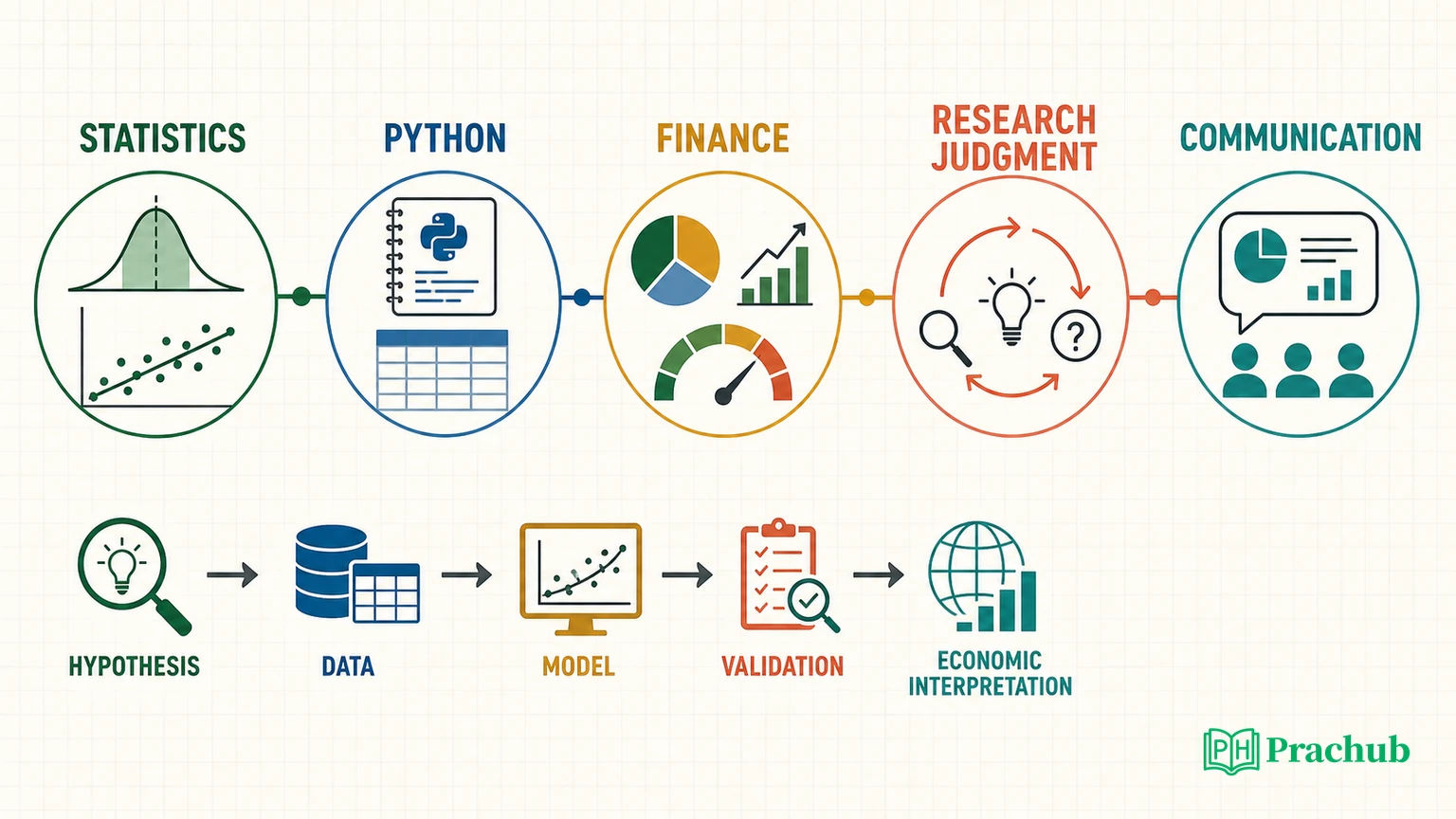
Start by defining the prediction target and when it becomes observable. Then inventory the data available at that time, establish a simple baseline, and choose metrics that match the decision. Validate across time periods or regimes, not only a convenient random split.
Finally, explain the result economically. A model can predict accurately yet be untradeable because of turnover, latency, market impact, or unstable exposure. Conversely, a modest signal may be valuable if it is diversified, persistent, and cheap to implement.
Expect follow-ups that stress your reasoning: What would change your conclusion? Which assumption is most fragile? How would the result behave in a crisis? What experiment would you run next? A thoughtful limitation is stronger than false certainty.
Practice with AQR-relevant questions from PracHub
These PracHub question-bank records build skills relevant to quantitative research. They are practice material, not predictions of your exact AQR interview. Each full title in the first column opens the question and written solution.
| PracHub question | Practice focus | Why it helps |
|---|---|---|
| Solve probability and expectation problems | Conditional probability, expectation, and distributions | Trains concise mathematical reasoning and assumption checks. |
| Explain multicollinearity and OLS assumptions | Regression diagnostics and interpretation | Connects statistical assumptions to model reliability. |
| Perform no-intercept linear regression from two datasets | Python, numerical implementation, and testing | Tests whether you can translate a model into correct code. |
| Describe a quantitative market model you built | Finance, validation, and research decisions | Builds a clear project narrative with defensible trade-offs. |
| Explain a research project in depth | Research ownership and communication | Prepares you for deep follow-ups on assumptions and results. |
A seven-day AQR interview preparation plan
| Day | Focus | What to do |
|---|---|---|
| Day 1 | Diagnose | Attempt one probability set, one regression explanation, and one Python data task without notes. Record gaps. |
| Day 2 | Statistics | Review probability, expectation, covariance, regression assumptions, and validation. Explain each aloud. |
| Day 3 | Python | Complete a timed pandas or NumPy exercise, then add edge cases and discuss complexity. |
| Day 4 | Finance | Review returns, risk, factors, portfolio construction, costs, and common backtest failures. |
| Day 5 | Research deep dive | Prepare one project from hypothesis through data, model, validation, limitations, and next experiment. |
| Day 6 | Mixed mock | Combine a probability problem, a Python task, and a research discussion under time pressure. |
| Day 7 | Final review | Recheck logistics, role details, and recruiter instructions. Review errors rather than cramming new topics. |
Frequently asked questions
What is the AQR quantitative research intern interview process for 2027?
AQR has not published a fixed sequence for every 2027 candidate. Its official materials establish the role's statistics, economics, Python, financial-data, strategy, and communication requirements. Candidate reports mention coding and several technical or behavioral conversations, but the number and order can vary.
How much Python should I know for an AQR research interview?
Be comfortable writing correct Python for data manipulation, numerical analysis, and small algorithms. Practice pandas and NumPy, but also show testing, complexity awareness, date alignment, missing-data handling, and reproducibility. Clear research code matters more than obscure language trivia.
How advanced should my statistics preparation be?
Prioritize probability, expectation, variance, covariance, estimation, regression, hypothesis testing, and validation. For each concept, be able to derive a result, state assumptions, diagnose violations, and explain the practical consequence. Time-series and multiple-testing awareness are especially useful for financial research.
Do I need prior finance experience?
The official posting emphasizes quantitative problem-solving and programming, not a required finance degree. Still, learn enough about returns, risk, diversification, factors, costs, and portfolio construction to explain why a statistical result could matter and what could prevent implementation.
What should I discuss in a research-project deep dive?
Explain the question, data, baseline, method, validation, result, and limitation in that order. State what you personally owned and what evidence changed your mind. Finish with the next experiment you would run. Interviewers can then evaluate both technical depth and intellectual honesty.
Final takeaway
The best preparation for an AQR quantitative research intern interview is a repeated, end-to-end research loop. Practice statistics until you can challenge assumptions, Python until you can produce trustworthy analysis, and finance until you can connect results to portfolios and risk.
Use PracHub to attempt relevant questions before opening the solutions, then turn every miss into a specific review task. You are not trying to predict one secret interview script. You are building the statistical, computational, and research judgment that the official role actually requires.
Sources and Further Reading
- AQR: 2027 Research Summer Analyst
- AQR: Greenwich Internships
- AQR: Careers and Quanta Academy
- AQR: Data Sets
- AQR research: Value and Momentum Everywhere
- Current candidate discussion: AQR research interviews, July 2026
- Candidate discussion: AQR superday format, October 2025
Research note: This guide was checked on August 25, 2026. AQR may change application dates, interview stages, platforms, or role requirements. Your current posting, recruiter messages, and assessment invitation are the source of truth.
Related Articles
IBM Data Scientist Intern OA 2027: Coding, MCQs, Preferred Languages, and the 7-Day Deadline
Prepare for the IBM Data Scientist Intern OA 2027: coding, MCQs, preferred languages, the reported 7-day deadline, privacy, and what comes next.
Citadel Securities Quant Research OA 2027: Coding, Math, and Resume Screening
Citadel Securities Quant Research OA 2027 guide to coding, probability, statistics, CoderPad, resume screening, and what comes after the first round.
Data Science Resume Examples: Projects, Metrics, and Technical Impact That Earn Interviews
See data science resume examples that show projects, model metrics, business impact, SQL, experimentation, and technical ownership that earn interviews.
Dataford Review 2026: Are 19,000+ Interview Questions Worth $29 a Month?
Dataford review 2026: assess 19,000+ interview questions, AI mocks, $29 monthly pricing, limitations, and the best PracHub alternative before subscribing.
Comments (0)