IBM Data Scientist Intern OA 2027: Coding, MCQs, Preferred Languages, and the 7-Day Deadline
Quick Overview
A current, evidence-backed guide to the IBM Data Scientist Intern OA 2027, including reported coding and MCQ content, language-choice guidance, the seven-day expiry, privacy, and a focused preparation plan.
The IBM Data Scientist Intern OA 2027 is best treated as a timed, role-specific screen rather than a standard two-question LeetCode test. IBM officially says coding assessments may contain multiple-choice questions or coding challenges. A current August 2026 candidate invitation for the Data Scientist internship adds more detail: MCQs and/or coding, a preference for languages named in the job posting, a recommendation to finish quickly, and a link that expires after seven days.Those invitation details are candidate-reported, not a universal IBM policy. Your own email controls the deadline, permitted languages, provider, timer, and monitoring rules. The safest plan is to prepare Python or another listed language, SQL, data-science fundamentals, and reliable coding rather than betting on one rumored question set.Start with the current IBM Data Scientist questions on PracHub. They cover the coding, SQL, statistics, machine-learning, and analytical reasoning that can remain useful even when the exact assessment format changes.
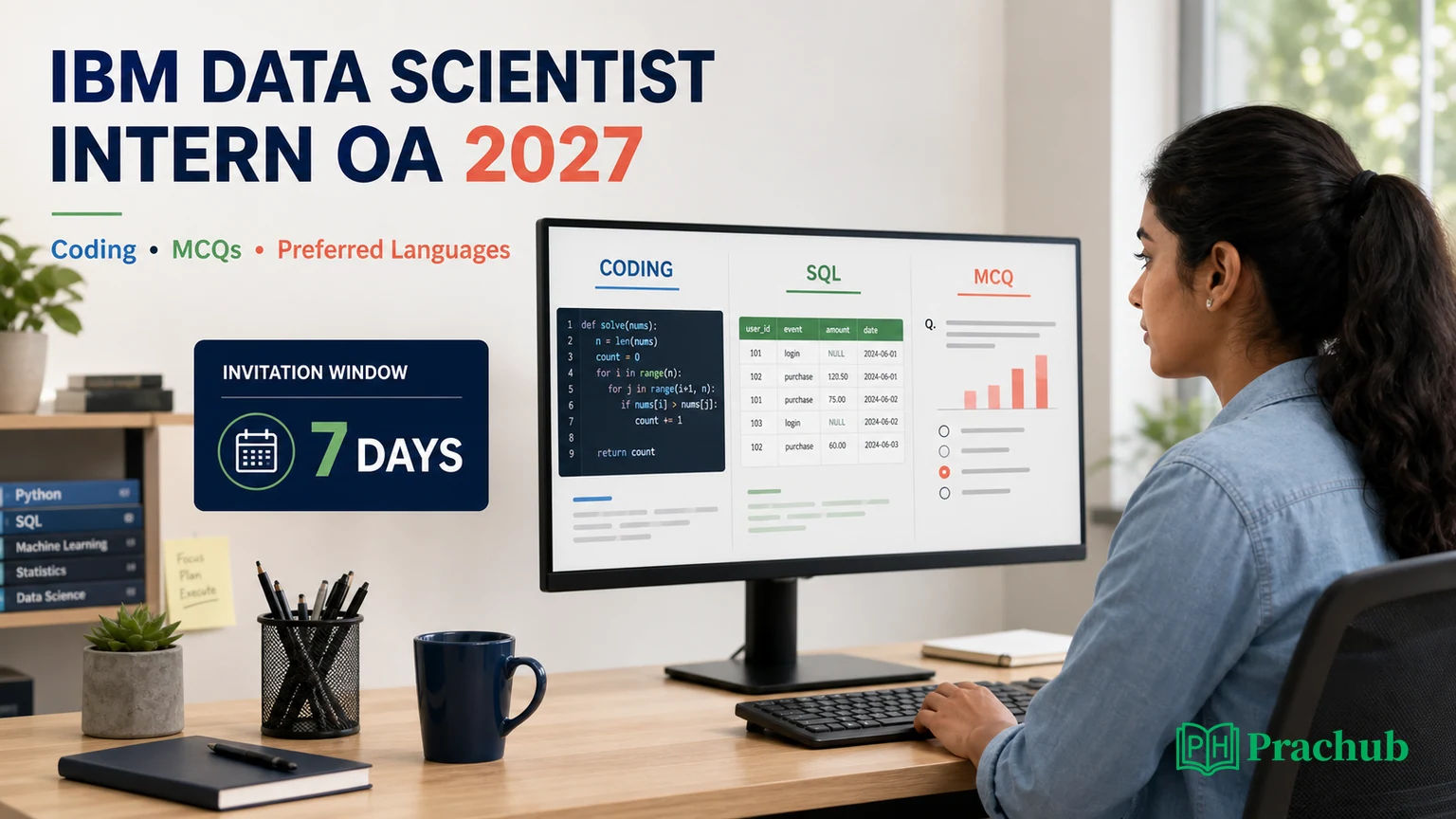
IBM Data Scientist Intern OA 2027: the quick answer
Confirmed by IBM: the company may use multiple-choice questions or coding challenges depending on the role. Reported for this 2027 Data Scientist recruiting wave: the invitation may combine MCQs with a coding interface, encourage languages listed in the job posting, prioritize candidates who use those preferred languages, recommend completion within three days, and expire after seven days.Neither IBM's general careers page nor the current candidate evidence establishes one guaranteed question count, difficulty, cutoff, or next-round timeline. A public Sample IBM Data Scientist test exists on HackerRank, but it is explicitly a sample and should be used to understand possible skill categories, not to predict the live assessment.
| Detail | Evidence level | Preparation decision |
|---|---|---|
| Coding challenges and/or MCQs | Official IBM guidance plus current invitation report | Prepare implementation and short conceptual questions. |
| Job-posting languages may be preferred | Current candidate-reported invitation | Use a listed language you can execute reliably. |
| Complete in one timed session | Current candidate-reported invitation | Do a full uninterrupted simulation first. |
| Ideally finish within three days; link expires after seven | Current candidate-reported invitation | Plan backward from the timestamp in your own email. |
| Exact sections, count, and difficulty | Not publicly confirmed for every 2027 candidate | Do not prepare around a single anecdote. |
What IBM officially confirms
IBM's Application Steps and FAQs says a coding assessment may contain a set of multiple-choice questions or coding challenges, depending on the role. IBM also says the length of the wider application process varies with the position, applicant response time, application volume, and other factors, so it does not publish one overall response timeline.The same page recommends practicing technical assessments and explains that interview questions vary by role and experience level. It also draws a clear line around AI use: candidates may use AI for preparation and learning, but IBM prohibits using it to complete assessments, technical tests, coding challenges, or live interviews.That official guidance matters because it prevents two common mistakes. First, seeing “coding assessment” does not prove the test is coding-only. Second, another IBM candidate's section count or platform cannot override the instructions sent for your role and location.What current Data Scientist candidates reportIn an August 18, 2026 discussion, a candidate reproduced an invitation for “Intern Data Scientist 2027 - AI & Data Analytics.” The message described multiple-choice questions and/or a coding interface. It encouraged use of languages mentioned in the job posting and said applicants using preferred languages would be prioritized for later selection, while still allowing another available language if necessary.The same invitation reportedly recommended completing the test as soon as possible, ideally within three days, and said the link would expire after seven days. It also described a timed, single-session assessment whose timer could not be paused after starting.A separate August 2026 IBM employment thread contains a report of a Data Scientist test labeled “IBM US - Advanced - Data Science” with one advanced coding question and one advanced SQL question. That is useful evidence for preparation, but it remains one reported variant. It does not prove every intern receives those exact sections or difficulty labels.What the public IBM Data Scientist sample can and cannot tell youHackerRank hosts a public test titled Sample IBM Data Scientist. Its visible sections include Python, machine learning, SQL, and multiple-choice questions. The page also shows that individual questions can restrict the available language list.The sample is evidence of the skill mix IBM has demonstrated publicly, not the blueprint for your 2027 OA. Its displayed duration and question count should not be carried into a live invitation. Use it to practice moving between code, data reasoning, queries, and concise conceptual answers.The most transferable categories are Python data handling, SQL aggregation and joins, probability and statistics, machine-learning evaluation, and one clean algorithmic implementation. If your invitation exposes a different set of sections, follow it.How to choose a preferred programming languageThe current invitation wording makes language choice more consequential than usual: it reportedly says applicants using preferred languages may receive priority in later selection. At the same time, it allows candidates to use another available language when they are not comfortable with a preferred option.Do not choose a language solely because it appears first in the posting. Choose the preferred language in which you can write, debug, and test correct code under time pressure. For the current role description, Python, SQL, and R are relevant; Python is especially practical when the assessment spans general coding and data-science work. But a shaky Python solution is not automatically better than a correct solution in another permitted language.Use this decision rule:If you are fluent in a preferred language, use it.
- If two preferred languages are equally strong, choose the one that best matches the section, such as Python for data manipulation.
- If you are materially weaker in every preferred language, use the strongest enabled language and focus on correctness.
- Never assume a language is available until the assessment shows it. HackerRank notes that the hiring company controls the languages enabled for each question.
How to prepare for coding, SQL, and MCQs
For coding, prioritize dependable fundamentals: arrays, strings, hash maps, sets, sorting, parsing, and complexity. Practice translating a word problem into explicit state changes, then test empty input, one item, duplicates, already-sorted data, negative values, and maximum-size constraints. Hidden tests usually punish incomplete assumptions more than plain code.For SQL, review filtering, NULL behavior, joins, aggregation, conditional counts, dates, and window functions. Define the output grain before typing: is each row a user, model, day, segment, or experiment? Then test whether a one-to-many join introduces duplicates.For MCQs, learn concepts as decisions rather than definitions. Be able to explain when accuracy fails on an imbalanced dataset, why data leakage inflates validation performance, how train/validation/test splits differ, what regularization changes, when precision matters more than recall, and why correlation does not establish causality.Also review Python behavior that appears in short conceptual items: mutable versus immutable objects, list and dictionary operations, set membership, comprehensions, sorting keys, exception handling, and the time complexity of common containers.The seven-day deadline is an expiry, not a study planIf your email matches the current report, the link expires seven days after receipt and IBM would prefer an earlier attempt. Do not turn all seven days into preparation and leave no recovery time. Time zones, browser updates, illness, school commitments, or a technical problem can erase the final window.Record the exact expiration timestamp from your invitation. Schedule the attempt at least 24 hours before it, test the system early, and keep the recruiting contact available. If the invitation contains an “ideally within three days” recommendation, treat it as a reason to make a focused plan, not a reason to start unprepared five minutes after receiving the email.
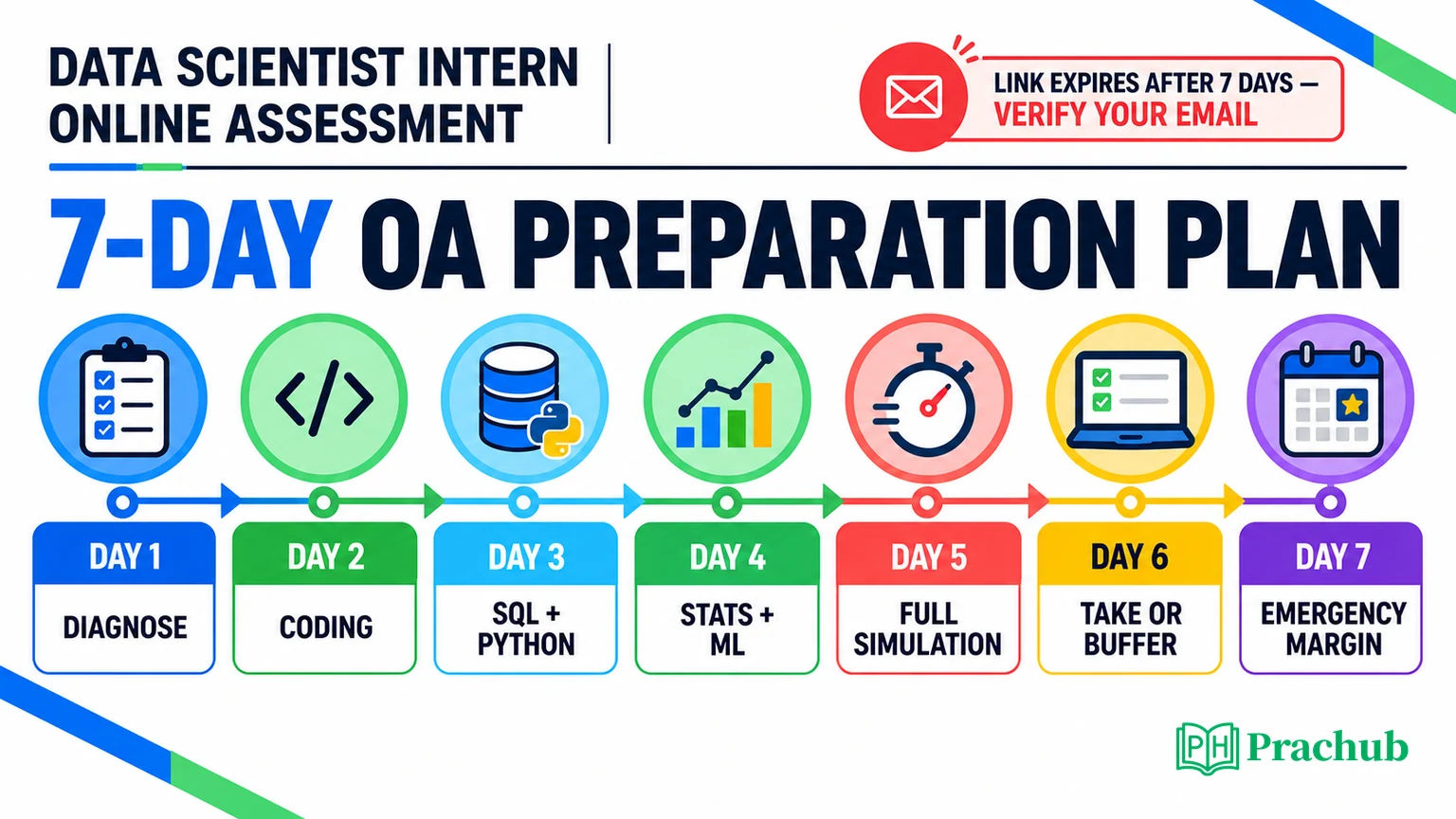
| Day | Focus and action |
|---|---|
| Day 1 | Diagnose coding, SQL, and statistics; record the exact deadline and permitted languages. |
| Day 2 | Practice arrays, maps, sorting, parsing, and hidden-edge-case checks. |
| Day 3 | Drill SQL joins, aggregation, NULLs, windows, and Python data transformations. |
| Day 4 | Review leakage, metrics, sampling, regression, and experiment interpretation. |
| Day 5 | Complete one mixed, timed simulation and retest every mistake. |
| Day 6 | Take the assessment when rested, or use one focused buffer day. |
| Day 7 | Keep as emergency margin; report documented technical issues before expiry. |
Practice with IBM Data Scientist questions from PracHub
These PracHub question-bank records train relevant skills. They are not predictions of your exact IBM assessment, and the stored interview round may differ from your current OA.
| PracHub question | Practice focus |
|---|---|
| Find minimum operations to make array sorted | Arrays |
| Write SQL to compute max and min marks | SQL |
| Design a lead-scoring model | Machine learning |
| How do you detect and fix multicollinearity? | Statistics |
| Estimate free-trial conversion probability | Probability |
Privacy, monitoring, and permitted tools
IBM's Talent Acquisition Privacy Notice, effective February 2, 2026, says IBM may store code created in a coding assessment and one or more webcam photos of a candidate completing exercises. Video-enabled assessments may also result in stored recordings.
This does not tell you that every Data Scientist OA uses the same monitoring configuration. Read the consent screen and instructions for your specific test. Close unneeded applications, use only permitted references, and do not use AI or outside help during the assessment. IBM's current application guidance explicitly prohibits AI use to complete technical tests or coding challenges.
What happens after the IBM Data Scientist OA?
IBM does not publish one response-time guarantee. Its careers FAQ says the overall selection timeline depends on the role, candidate response time, application volume, and other factors. The candidate portal and status emails are the best sources for your application.
Current discussions suggest some Data Scientist candidates receive a separate competency assessment after coding, while others wait for recruiter review. A competency stage may include recorded responses or work-preference items, but that sequence is not confirmed for every location or team. Continue preparing one concise project walkthrough and several behavioral examples while you wait.
Frequently asked questions
Does every IBM Data Scientist applicant receive the OA?
IBM has not publicly confirmed that this assessment is automatic for every applicant. Candidate timing and status reports vary. Receiving an invite means IBM wants an assessment for that application, but it does not by itself prove that a recruiter reviewed the resume or that the candidate passed a resume screen.
Is the IBM Data Scientist OA on HackerRank?
IBM has a public Sample Data Scientist test on HackerRank, and current candidates sometimes report HackerRank invitations. That does not guarantee the provider for every 2027 Data Scientist role. Use the domain and instructions in your invitation as the authority.
Will the assessment include Python, SQL, machine learning, or MCQs?
All four are plausible preparation areas. The public sample visibly covers Python, data science or machine learning, SQL, and MCQs, while current invitations describe MCQs and/or coding. The live mix can vary, so do not assume all four sections will appear.
Should I use Python if IBM lists it as preferred?
Use Python when it is enabled, preferred for the role, and you can implement accurately under time pressure. If another enabled language is much stronger, the current invitation reportedly permits it. Correct, tested code remains more defensible than choosing Python only for signaling and failing the task.
Can IBM extend the seven-day deadline?
The current report says the link expires after seven days, but extension rules are not publicly guaranteed. If illness, an accommodation need, or a documented platform issue affects you, contact the assessment or recruiting support listed in the invitation before expiry. Do not wait until the final hour.
Final takeaway
The strongest preparation for the IBM Data Scientist Intern OA 2027 is broad enough to survive format variation and focused enough to finish before the deadline. Practice clean coding, SQL, Python, statistics, and machine-learning decisions; choose a preferred language only when you can use it reliably; and reserve time for one uninterrupted simulation.Your invitation remains the source of truth. Once its logistics are clear, use the IBM Data Scientist question bank to turn the remaining preparation window into targeted practice rather than rumor chasing.
Sources and Further Reading
-
HackerRank candidate guidance on enabled programming languages
-
Current mirror of the Intern Data Scientist 2027 - AI & Data Analytics job posting
-
August 2026 candidate report reproducing the Data Scientist OA invitation
-
August 2026 IBM employment discussion with a Data Scientist assessment report
-
Current IBM competency-assessment discussion involving a Data Scientist applicant
Research note: This guide was checked on August 29, 2026. IBM can change assessment sections, language preferences, deadlines, providers, and next steps by role, location, and recruiting cycle.
Related Articles
AQR Quantitative Research Intern Interview 2027: Statistics, Python, and Finance
Prepare for AQR's 2027 Research Summer Analyst interview with statistics, Python, finance, research cases, and evidence-backed process notes.
Citadel Securities Quant Research OA 2027: Coding, Math, and Resume Screening
Citadel Securities Quant Research OA 2027 guide to coding, probability, statistics, CoderPad, resume screening, and what comes after the first round.
Data Science Resume Examples: Projects, Metrics, and Technical Impact That Earn Interviews
See data science resume examples that show projects, model metrics, business impact, SQL, experimentation, and technical ownership that earn interviews.
Dataford Review 2026: Are 19,000+ Interview Questions Worth $29 a Month?
Dataford review 2026: assess 19,000+ interview questions, AI mocks, $29 monthly pricing, limitations, and the best PracHub alternative before subscribing.
Comments (0)