Citadel Securities Quant Research OA 2027: Coding, Math, and Resume Screening
Quick Overview
An evidence-backed guide to the Citadel Securities Quant Research 2027 online screen, coding and math expectations, resume review, and later interview stages.
A strong score is not the same thing as a completed Citadel Securities Quant Research application. That distinction matters in the 2027 recruiting cycle, because candidates often use “OA” to describe several different online steps: a coding assignment, a CoderPad interview, a technical screen, or an early filter before team review.
Citadel Securities does publish a Quantitative Research interview process, but it does not publish one universal 2027 question count, timer, platform, or cutoff. The official first round is a 45- to 60-minute remote interview covering programming, data structures and algorithms, problem solving, technical interests, projects, and behavioral fit. Recent candidate reports add probability, statistics, machine learning, and research-depth questions, but the mix varies by team.
Start with Citadel Data Scientist questions on PracHub. Use them as a diagnostic across coding, probability, statistics, simulation, and research judgment rather than trying to memorize one rumored assessment.

Prepare for a mixed evaluation: executable code, quantitative reasoning, research depth, and evidence on your application.
Citadel Securities Quant Research OA 2027: Quick Answer
Prepare for coding and math, but do not assume a standardized OA. Citadel Securities officially describes a live remote first round using CoderPad, not a permanent HackerRank-style specification. The interview focuses on programming ability, algorithms, problem solving, and communication. Later interviews may go much deeper into probability, statistics, machine learning, research, and the technical work on your resume.
The “resume screening” part is also real, although there is no public formula. The current Quantitative Researcher intern application asks for a resume, undergraduate GPA, two preferred interview languages, academic or technical links, and openness to adjacent roles. Citadel Securities also says hiring managers review team fit after technical rounds and may share a candidate’s resume with other teams when there is a potential match.
| Question | Best current answer | Evidence level |
|---|---|---|
| Is there one fixed 2027 OA? | No public universal format is confirmed. Some candidates call an online coding or first technical step the OA. | Official process plus candidate terminology |
| Is coding tested? | Yes. The official first round assesses programming, data structures, algorithms, and problem solving in a shared editor. | Official |
| Is math tested? | Probability and statistics are core role requirements; candidate reports also mention linear algebra, ML, and open-ended research questions. | Official requirements plus reports |
| Does a strong technical result guarantee progress? | No. Resume evidence, role fit, team interest, location, and hiring capacity can still matter. | Official final-review process and application fields |
Is the Citadel Securities QR Screen Really an OA?
The safest answer is: sometimes candidates call it that, but your invitation controls the format. Citadel Securities’ official Quantitative Research guide describes a four-step process beginning with a remote video interview. Before that interview, candidates receive a CoderPad link. The company does not describe a universal standalone OA on that page.
Current reports are not perfectly consistent. A May 2026 candidate described coding during a first QR interview alongside an ML discussion. A May 2026 Glassdoor report described several interviews spanning past research, statistics, deep learning, and games. Another 2025 report mentioned an online screen before probability and linear-algebra-heavy interviews. These differences suggest team, seniority, region, and recruiting route affect what “online assessment” means.
Do not import the Citadel SWE HackerRank format into QR preparation. Software engineering, quantitative trading, quantitative research, and quantitative research engineering can share some tools, but they evaluate different work. The exact company matters too: Citadel and Citadel Securities are separate businesses, even though the official QR process says interviewing can expose a candidate to opportunities at both.
What the Official First Round Tests
Coding and algorithmic problem solving
The official first round lasts 45 to 60 minutes and uses video plus CoderPad. Citadel Securities names programming skills, data structures and algorithms, and problem solving. Python and C++ are core languages, although the company says other languages are welcome.
Expect to explain the approach before or while writing code. A strong solution is not only correct on a sample. It identifies the right data structure, states time and space complexity, handles edge cases, and remains readable while the interviewer introduces a follow-up. Recent QR candidates have specifically asked whether coding is traditional DSA or ML implementation, which is a useful reminder to prepare both clean algorithms and research-adjacent code.
Projects, technical interests, and motivation
The same first round can include questions about internships, school projects, technical interests, and why Citadel Securities. This is not filler before the “real” technical section. A project discussion tests whether you can form a hypothesis, work with imperfect data, justify validation, recognize leakage, and explain what changed because of your work.
Prepare one research project at three depths: a 45-second overview, a five-minute technical walkthrough, and a deeper discussion of assumptions, failed experiments, and implementation trade-offs. If the interviewer changes an assumption, reason from the model instead of defending the original answer at all costs.
How Much Math and Machine Learning Should You Prepare?
Citadel Securities’ candidate FAQ emphasizes probability, statistics, data analysis, predictive modeling, and programming. The current intern role also names machine learning, time-series analysis, pattern recognition, and NLP as examples of relevant quantitative depth. That is a broader target than rapid mental arithmetic alone.
Build fluency in conditional probability, Bayes’ rule, expectation, variance, covariance, common distributions, order statistics, estimation, hypothesis testing, regression, and linear algebra. You should be able to derive a result, sanity-check it, and explain which assumptions make it valid. For ML, review bias and variance, regularization, cross-validation, leakage, calibration, feature stability, non-stationarity, and how you would reject an attractive but fragile backtest.
Finance knowledge helps when it sharpens the model, but vocabulary is not a substitute for reasoning. You may be asked about signals, pricing, or time series; define the target, information set, prediction horizon, and costs before proposing a model. Citadel Securities explicitly says it can teach finance, while expecting robust statistical intuition from candidates.
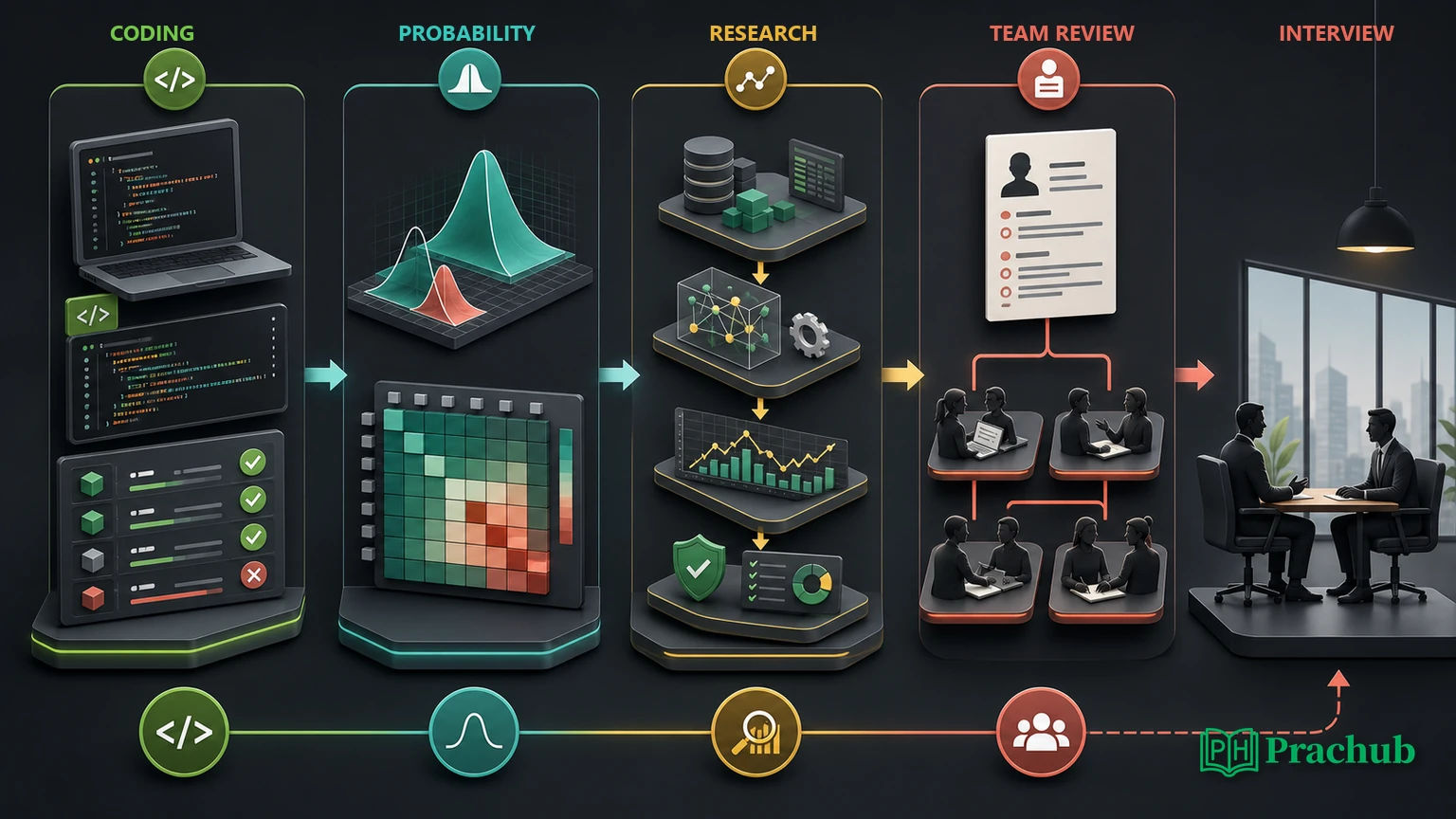
A balanced QR preparation map: code reliably, reason quantitatively, defend research choices, and make the resume easy to route to a team.
Why Resume Screening Still Matters After the Technical Step
A high score answers one narrow question: can you perform on that assessment? It does not automatically answer whether your background matches a particular research team. Citadel Securities’ current application requests undergraduate GPA, preferred coding languages, technical links, timing, location flexibility, and interest in related roles such as Machine Learning Researcher or Quantitative Developer.
The official interview guide also describes a final review in which hiring managers determine fit for specific teams. If multiple teams are interested, recruiting helps determine the best match. The company separately says it prefers to interview for one role at a time but may share a resume with prospective teams when it sees a fit.
That means your application should make the research signal obvious. Lead bullets with the question you investigated, the data or system scale, the method, and the measured result. Include a link only when it strengthens the evidence. A small, reproducible project with clear validation is more useful than a long list of libraries with no research decision behind them.
What Strong Performance Looks Like
For coding, narrate the model, choose a defensible complexity target, and test the riskiest edge case. If you are stuck, state what you know and use hints productively; Citadel Securities explicitly encourages candidates to ask clarifying questions and iterate.
For probability and statistics, define random variables and assumptions before calculating. Check a simple boundary or limiting case. For research questions, separate in-sample fit from out-of-sample evidence, mention leakage and selection bias, and name the result that would invalidate your hypothesis.
For resume discussions, distinguish what you personally owned from what the team delivered. Explain one failure honestly: what looked promising, what evidence changed your mind, and how the research or engineering process improved afterward. That combination shows precision and resilience without turning the answer into a rehearsed success story.
Practice with Citadel Questions from PracHub
These question-bank records are not predictions of an exact 2027 assessment. They form a balanced diagnostic for the capabilities Citadel Securities publicly values: coding, probability, statistics, simulation, and applied research judgment.
| PracHub question | Practice focus | Why it helps |
|---|---|---|
| Sort a Nearly Sorted Array | Heaps, constraints, and complexity | Tests whether you exploit structure instead of defaulting to a general sort. |
| Implement Lazy Unique-Merge Generator for Sorted Streams | Python iterators, streaming, and edge cases | Builds clean implementation and data-processing reasoning in a bounded-memory setting. |
| Solve Probability and Expectation Problems | Conditioning, distributions, and optimal stopping | Trains exact setup, derivation, and sanity checks across several probability models. |
| Analyze Correlations and Generate Gaussians | Correlation matrices and simulation | Connects statistical constraints to a practical random-sampling implementation. |
| Evaluate Alternative Data for an Investment Pitch | Leakage, robustness, and research communication | Practices deciding whether an apparent signal is usable instead of merely interesting. |
A Seven-Day Preparation Plan
| Day | Focus | What to do |
|---|---|---|
| Day 1 | Diagnostic | Complete one coding problem and three probability questions under a single timer. Record recognition, implementation, and explanation gaps. |
| Day 2 | Algorithms | Review heaps, hashing, sorting, graphs, and dynamic programming. Explain complexity before coding. |
| Day 3 | Probability and statistics | Practice conditioning, expectation, covariance, distributions, regression assumptions, and one derivation aloud. |
| Day 4 | ML and research judgment | Audit one model for leakage, validation design, instability, and the evidence needed to reject it. |
| Day 5 | Project deep dive | Prepare overview, technical, and failure-mode versions of your strongest research project. |
| Day 6 | Mixed mock | Run a 60-minute CoderPad-style mock: behavior, one algorithm, quantitative follow-ups, and testing. |
| Day 7 | Application and logistics | Review resume evidence, technical links, preferred language, invitation rules, camera, and setup. Do not cram new topics. |
What Comes After the First Screen?
Citadel Securities says the QR process typically takes four to five weeks. After the remote first round, the second round is usually onsite and contains three to five 60-minute interviews that combine technical and behavioral evaluation. The company says it generally communicates next steps within two weeks after that round.
Recent candidate reports describe wider variation, including field-specific technical questions, deep dives into prior research, probability, linear algebra, statistics, deep learning, and games. Some candidates report more interviews when several teams are interested. Treat those reports as a range, not a guaranteed sequence.
If you have a competing deadline, tell recruiting early. Citadel Securities explicitly asks candidates to be transparent and says it will try to accommodate deadlines. Continue other applications while waiting; silence is not a reliable interpretation of your score or team fit.
Common Preparation Mistakes
- Preparing only LeetCode: coding matters, but QR interviews can probe probability, statistics, ML, and research choices.
- Preparing only theory: a correct derivation does not replace executable, testable code in the official first round.
- Memorizing interview reports: current reports repeatedly show team and interviewer variation.
- Ignoring the resume after receiving an invite: projects, technical interests, and team fit remain part of the published process.
Frequently Asked Questions
Does every Citadel Securities Quant Research candidate receive an OA?
Citadel Securities does not publicly state that every QR applicant receives one standardized OA. Its official process begins with a remote CoderPad interview, while candidate terminology and preliminary steps vary. Follow the exact email attached to your application.
Is the Citadel Securities QR screen coding or math?
Prepare for both. Coding and algorithms are official first-round focus areas. Probability, statistics, predictive modeling, and programming are official role requirements, and recent interviews also report ML and research questions.
Do I need C++?
Python and C++ are core languages at Citadel Securities, but the official guide welcomes other languages. The current application asks for two preferred interview languages. Choose the language in which you can reason, implement, test, and discuss performance most confidently.
Can a perfect coding result still lead to rejection?
Yes. No official source promises that technical performance alone guarantees another round. The published process includes project and behavioral evaluation, team-fit review, and resume sharing across prospective teams.
How important is GPA?
The current US Quantitative Researcher PhD Intern application explicitly asks for undergraduate GPA, so it is an application input. Citadel Securities does not publish a universal GPA cutoff or weighting. Strong research, coding, statistical depth, and clear evidence of impact remain important.
How long does the process take?
Citadel Securities says the full QR process typically takes four to five weeks and may be accelerated for competing deadlines. Candidate timelines can be shorter, longer, or team dependent.
Final Takeaway
The best preparation for the Citadel Securities Quant Research OA 2027 is not an attempt to predict one exact test. Build a portfolio of evidence: correct code under a timer, rigorous probability and statistics, defensible research decisions, and a resume that makes your role fit easy to understand.
Use Citadel Data Scientist questions to run the mixed diagnostic first. Then spend your limited preparation time on the gap it actually exposes, whether that is algorithms, quantitative derivation, model validation, or explaining your research clearly.
Sources and Further Reading
- Citadel Securities: Our Quantitative Research Interview Process
- Citadel Securities: Candidate FAQs for Quantitative Research
- Citadel Securities: Quantitative Researcher – PhD Intern (US)
- Citadel Securities: Quantitative Research Careers
- Current candidate discussion: Citadel QR internship interviews
- Current candidate discussion: GQS QR intern first round
Research note: This guide was checked on August 24, 2026. Interview formats can vary by role, team, location, and recruiting cycle; your invitation remains the source of truth.
Related Articles
IBM Data Scientist Intern OA 2027: Coding, MCQs, Preferred Languages, and the 7-Day Deadline
Prepare for the IBM Data Scientist Intern OA 2027: coding, MCQs, preferred languages, the reported 7-day deadline, privacy, and what comes next.
AQR Quantitative Research Intern Interview 2027: Statistics, Python, and Finance
Prepare for AQR's 2027 Research Summer Analyst interview with statistics, Python, finance, research cases, and evidence-backed process notes.
Data Science Resume Examples: Projects, Metrics, and Technical Impact That Earn Interviews
See data science resume examples that show projects, model metrics, business impact, SQL, experimentation, and technical ownership that earn interviews.
Dataford Review 2026: Are 19,000+ Interview Questions Worth $29 a Month?
Dataford review 2026: assess 19,000+ interview questions, AI mocks, $29 monthly pricing, limitations, and the best PracHub alternative before subscribing.
Comments (0)