B2B Product Manager Interview Questions: Balance Buyers, Users, and Enterprise Demands
Quick Overview
Balance buying, administration and daily use in a bounded enterprise product pilot.
B2B Product Manager interview questions test whether you can build something an organization will buy, deploy, and keep using. Those are different decisions made by different people. A useful answer identifies each decision maker, translates requests into underlying needs, and explains what a bounded enterprise pilot must establish before a larger commitment.
Start with PracHub's Gathering and validating user needs before writing product requirements. Then use the original FieldNote case below to practice a deal-blocking request. The product, customer, constraints, and proposed pilot are fictional editorial inputs. No real customer interview, procurement result, candidate report, or employer hiring process is claimed.
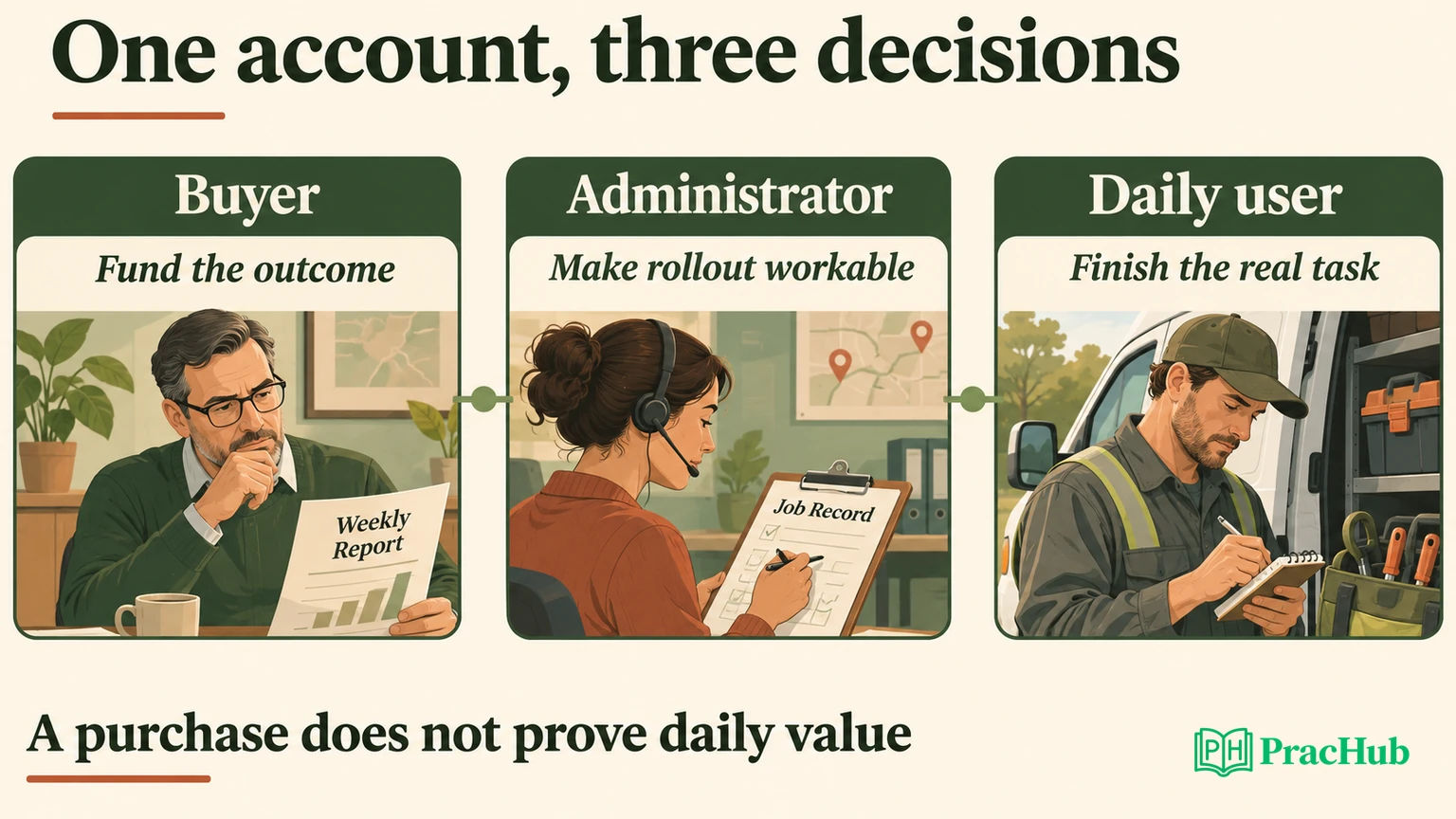
Who buys, who deploys, and who uses the product?
Suppose FieldNote helps regional maintenance companies turn completed service visits into usable job reports. A prospective customer's operations director controls the budget. Dispatch administrators configure jobs and resolve exceptions. Technicians complete reports between visits, sometimes with unreliable connectivity. A purchase can succeed while daily use fails.
Ask who can approve the purchase, who can block deployment, and who experiences the product's main task. Security, procurement, support, and finance may also matter, but naming departments is insufficient. Identify the concrete decision each participant controls and the evidence they require.
The director wants reliable visibility into completed work. Administrators want consistent records without repeatedly correcting them. Technicians want to finish reporting without losing notes or delaying their next visit. The reporting workflow can put those needs in conflict: adding mandatory fields may please the buyer while causing technicians to defer reports until details are forgotten.
| Participant | Decision or job | Evidence still needed |
|---|---|---|
| Operations director, buyer | Fund deployment and justify continuing spend | Reports are usable for the operating decision, with a credible support burden. |
| Dispatch administrator | Configure the workflow and handle exceptions | A report can be corrected and traced without duplicate entry. |
| Technician, daily user | Finish an accurate visit record in working conditions | The task survives interruptions and does not depend on a supervisor completing it later. |
| Deployment partners | Permit and support the rollout | Applicable access, data-handling, integration, and operational requirements are understood. |
Treat this map as a plan for gathering evidence. It does not establish what real technicians want merely because the scenario sounds plausible.
How should you interpret a deal-blocking request?
The director says FieldNote needs a weekly report in the customer's exact spreadsheet layout before the purchase can proceed. Sales asks engineering to build a special export immediately. Clarify whether the layout is genuinely required for purchase, an existing promise, a preference, or a workaround for a different problem.
Ask to observe the decision the spreadsheet supports. Which fields are read, by whom, and what happens next? Perhaps the director compares outstanding exceptions across regions. Perhaps finance imports selected fields. These explanations imply different requirements, owners, and failure consequences; the file layout alone does not reveal them.
GitLab's official Customer Issues Prioritization Framework distinguishes sales blockers, retention risks, and committed follow-up work. It also treats those signals as planning inputs rather than an automatic roadmap order. That is GitLab's documented practice, not a universal enterprise interview rubric.
Apply the distinction carefully in FieldNote. Confirm the customer's actual dependency with sales and the buyer, record any existing commitment, and ask whether an acceptable alternative exists. Do not dismiss commercial urgency, but do not silently convert an unvalidated request into a promised release date.
Would you configure, generalize, or build a customer fork?
Compare three delivery choices against the buyer's underlying decision. A manually prepared export may answer the pilot's learning question with limited engineering work. A configurable export could serve a repeated reporting need. A customer-specific code path may satisfy the exact layout quickly while creating testing and maintenance obligations.
The right choice depends on the product direction and the problem's recurrence. Interview other relevant accounts and inspect existing requests before calling the need common. Ten sales mentions copied from one underlying account are not ten independent customers. Conversely, a requirement can be strategically important even before many customers request it.
For this case, propose a bounded export prototype with explicit field definitions and a named operator. Test whether it supports the buyer's decision and whether administrators can reconcile it. Delay a broad configuration builder until you know which variation customers actually need. Do not let a temporary manual service become an undisclosed permanent product dependency.
State the cost of the customer fork beyond initial delivery. Someone must own changes to the customer's template, permissions, failed exports, regression checks, documentation, and support. If the business deliberately chooses that service model, make the choice explicit. An explicit exception gives the team a support obligation it can plan for.
What should the pilot prove before rollout?
The pilot should test the purchase-and-use hypothesis, not merely demonstrate a feature. Here the hypothesis is that technicians can produce usable visit records, administrators can handle exceptions, and the buyer can make the intended weekly operating decision without an unsustainable manual service.
The UK Government's official alpha-phase guidance describes testing ideas and risky assumptions before committing to a service. It supplies a useful learning principle, not an enterprise sales methodology or a prescribed pilot duration.
Define the pilot's boundaries with the customer and delivery partners: participating region, eligible visit types, people, reporting cycle, handling of connectivity loss, support availability, and excluded workflows. A small office demonstration cannot establish that the workflow survives a technician's actual route.
Before starting, agree which evidence leads to expansion, revision, or stopping. Set thresholds using the customer's current workflow and the consequences of errors. Do not invent a universal adoption percentage or assume that a signed pilot automatically establishes a scalable rollout.
Which evidence belongs in the exit decision?
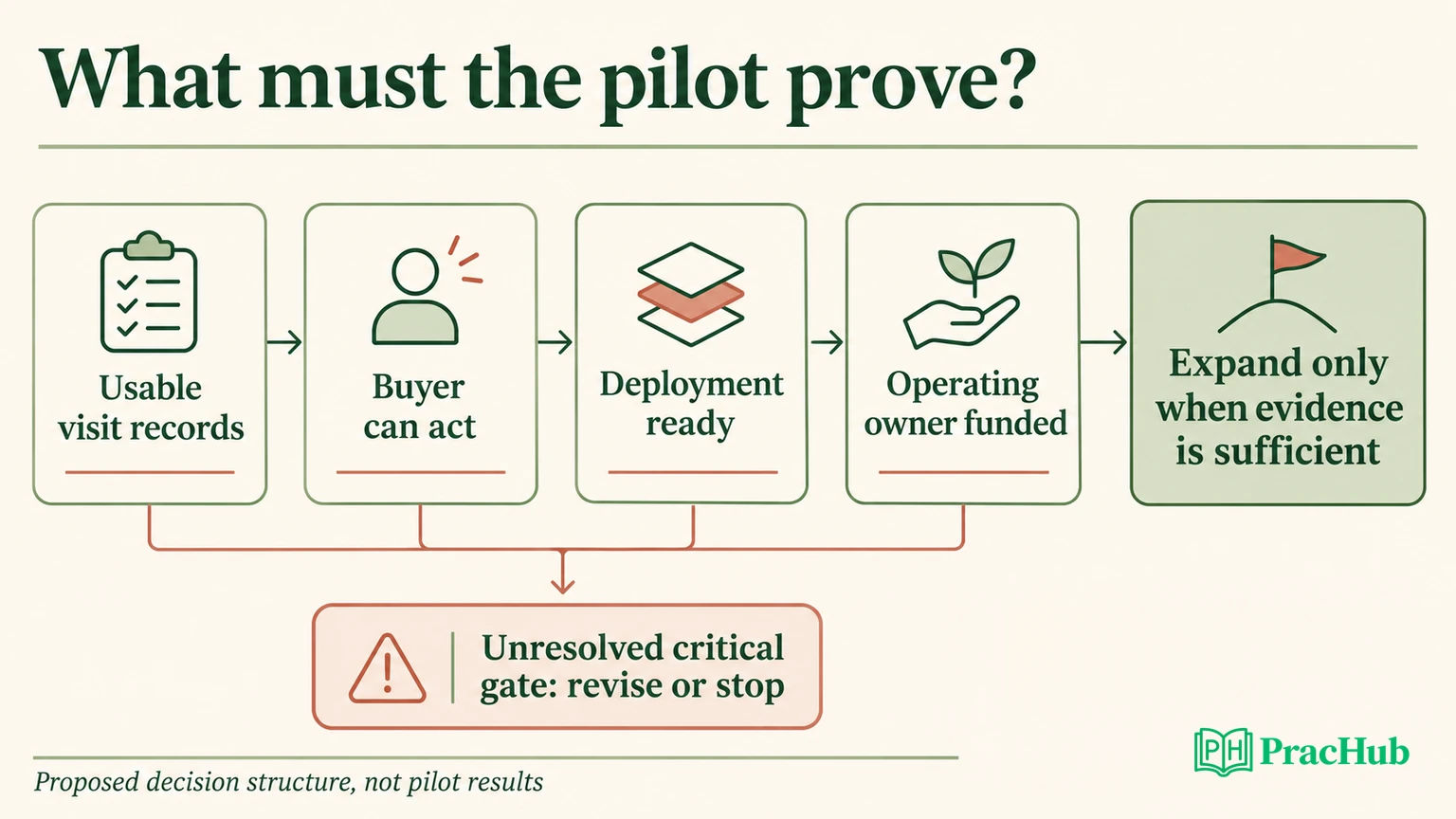
Use a decision record that keeps buying, administration, and use separate. The following is a proposed acceptance structure, not the result of an executed pilot. Each gate needs an agreed definition and evidence owner.
| Rollout gate | Evidence to inspect | A reason to revise or stop |
|---|---|---|
| Useful daily completion | Eligible visits become usable records under normal working conditions | Supervisors routinely finish technicians' reports afterward. |
| Administrative feasibility | Exceptions can be identified, corrected, and reconciled | Duplicate entry or ambiguous corrections hide the source of errors. |
| Buyer value | The weekly report supports the named operating decision | The export is delivered but the buyer still relies on a different process. |
| Delivery readiness | Required access, support, ownership, and data controls are reviewed by responsible partners | A critical unresolved dependency prevents the agreed deployment. |
| Sustainable operating model | Manual work and ongoing obligations have an explicit funded owner | The pilot succeeds only through unplanned PM or engineering intervention. |
Account-level approval does not replace user-level evidence. A buyer may love the report because administrators repaired every record manually. Equally, happy technicians do not prove the buyer can justify spending. Investigate the relationship between these signals rather than averaging them into one satisfaction score.
Count usage against eligible work. Logins from people who were never assigned a visit do not establish adoption, while uncompleted records from ineligible jobs should not inflate failure. Distinguish not invited, not activated, attempted, completed, corrected, and usable for the intended decision. These states help you find the constraint without reclassifying missing evidence as success.
How do you handle a buyer request that harms users?
Suppose the director now wants every technician to complete a long mandatory checklist before saving a report. Technicians say interruptions make that impractical. Ask what each requested field prevents before choosing the form. Establish which fields prevent a costly downstream mistake and which merely make the report look complete.
Observe a representative visit and the administrator's correction process. Compare a short saveable record with later completion, conditional fields for relevant jobs, and a long mandatory form. Separate a draft from a finalized report so that retaining interrupted work does not falsely signal that a required record is complete.
Present the tradeoff in the buyer's terms: a stricter form may increase apparent field completion while reducing timely, accurate reporting. That is an interview hypothesis until tested, not a measured effect. Explain the evidence that would justify the stricter rule and the evidence that would make you change it.
If a field is a genuine externally imposed requirement, involve the responsible domain and deployment partners. You cannot declare a legal, safety, or security obligation unnecessary through product judgment alone. Equally, a stakeholder calling something “compliance” does not establish its exact scope or the correct implementation.
What changes if the account is commercially important?
For a strategically important account, compare the commercial opportunity with the work and support it would displace. Ask about the probability and timing of the business opportunity, the alternatives, and the resources required to support the account. Separate a potential contract from realized revenue and avoid treating the entire headline value as the feature's incremental benefit.
Compare the work displaced by the request and whether the capability fits the intended customer segment. A reusable export for a chosen segment may advance strategy. A unique workflow with continuing bespoke support may require a different commercial arrangement and operating model. Bring that tradeoff to the commercial and delivery owners before anyone makes a customer commitment.
If a commitment already exists, recover the actual scope and owner with sales and delivery partners. Communicate options, risks, and a credible next checkpoint. Do not rewrite the promise privately in your interview answer or invent a delivery date to make the disagreement disappear.
When the interviewer changes the case to “the customer will buy only with this exact export,” update the option set. Recommend the custom route only if its strategic and operating costs are acceptable and owned. Otherwise explain why losing or delaying that opportunity can be preferable to making a commitment the team cannot sustain.
How should you present the recommendation?
Lead with one decision: run a bounded FieldNote pilot that proves usable technician records and the buyer's weekly decision before expanding. Use a limited export prototype to learn whether the requested layout is essential. Evaluate reusable configuration after validating the variation, while making manual work and customer-specific obligations explicit.
Then show the boundary of your authority. The PM coordinates evidence and recommends product scope; sales, engineering, security, procurement, and other partners retain their actual responsibilities. Explain how you would resolve a disagreement and record the resulting commitment rather than claiming unilateral control over a purchase or deployment.
CZI's official Product Management Interview Guide describes its own PM interviews across product and cross-functional capabilities. Use the actual invitation and role description to decide which experiences to emphasize. The fictional FieldNote case is preparation for reasoning, not a prediction of that or any other employer's questions.
| PracHub practice question | B2B decision to rehearse |
|---|---|
| Gathering and validating user needs before writing product requirements | Translate a requested solution into a validated need. |
| Choosing the Single Most Valuable Customer to Interview for Product Feedback | Choose whose evidence resolves the current uncertainty. |
| Pick a B2B software product you admire and explain why it succeeds | Explain how purchase and daily use support each other. |
| Shortlist strong enterprise products, then set KPIs, a North Star and roadmap for one | Connect an enterprise value proposition to roadmap choices. |
| Bringing Customers Into Every Stage From Problem Discovery to Release | Match pilot participants and customer contact to each decision. |
Rehearse the requirements question, then have a partner add a buyer ultimatum or a daily-use failure. Keep your recommendation specific enough that someone could identify the next evidence to collect and the condition that would stop expansion.
Sources and Further Reading
- GitLab Handbook: Customer Issues Prioritization Framework — first-party distinction among blockers, retention risks, and commitments.
- UK Government Service Manual: How the alpha phase works — official guidance on testing ideas and risky assumptions.
- CZI: Product Management Interview Guide — employer-specific interview context; not a universal enterprise hiring loop.
Comments (0)