Can You Stream the First Half of a Multibyte Character From an LLM?
Quick Overview
Stream UTF-8 safely across LLM token boundaries with incremental decoding, split-point tests and final-flush checks; distinguish bytes, text events and graphemes.
An LLM emits one token whose bytes begin a euro sign, then another token supplies the next byte. If the application decodes each token or network chunk independently with replacement errors enabled, the user can see corrupted text even though the complete byte sequence is valid.
Official encoding fact: UTF-8 represents characters using one to four bytes. A partial byte sequence is not necessarily an invalid completed input. A decoder must retain enough state to distinguish an unfinished valid prefix from a malformed sequence. RFC 3629
You can transport incomplete bytes; a text consumer needs the complete decodable sequence before emitting the character. Start with PracHub's async stream-assembly practice, then examine the original split-point tests below.
Identify what the application actually receives
Separate model token IDs, tokenizer pieces, raw bytes, decoded text and transport events. They are different units with different completion rules.
A token ID does not universally equal one UTF-8 character. Depending on the tokenizer, a token can correspond to multiple characters, a partial byte representation, a special token, or a piece requiring decoder-specific transformation. Looking up a token's display string is not a universal method for extracting its output bytes.
Official tokenizer distinction: the versioned Hugging Face Tokenizers API documents decoder components such as ByteFallback and ByteLevel, together with a stateful DecodeStream. Their behavior belongs to the configured tokenizer and decoder. Tokenizers v0.23.3 decoders
If a provider already delivers valid decoded text in structured events, do not invent a token-to-byte layer in the client. Consume the text contract it actually exposes. If you control raw byte output, define who owns the incremental decoding state.
Likewise, a network read boundary need not match a server event boundary. A single UTF-8 character or SSE event can arrive across multiple reads. The HTTP/SSE library may already manage this; inspect the interface before adding another competing parser.
Use a synthetic token ledger without inventing a vocabulary
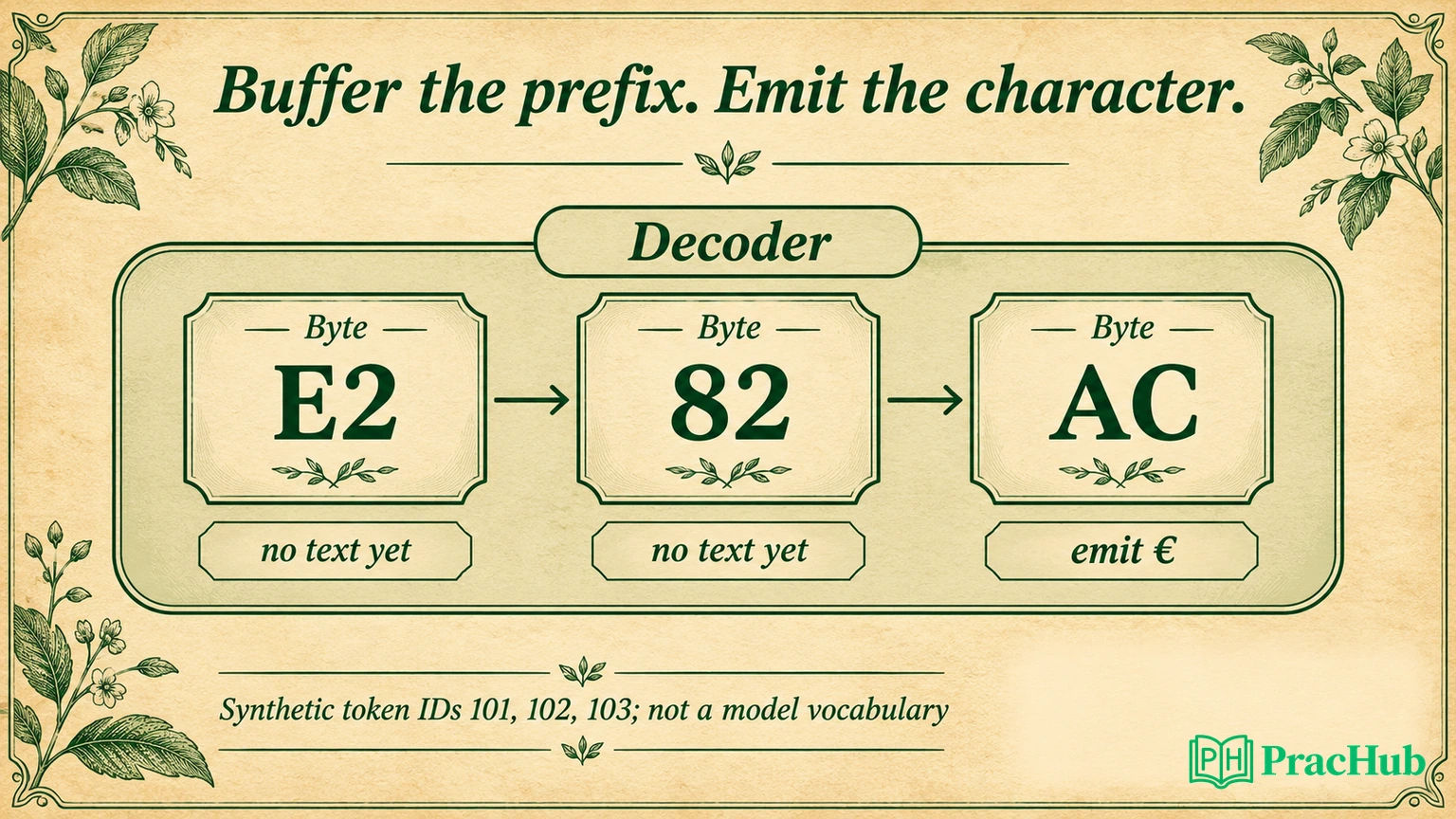
The original example assigns three synthetic IDs solely to make the byte boundary visible:
| Synthetic token ID | Supplied byte, hexadecimal | Accumulated bytes | Decoded character available? |
|---|---|---|---|
| 101 | E2 | E2 | No |
| 102 | 82 | E2 82 | No |
| 103 | AC | E2 82 AC | Yes: € |
These IDs are invented fixture inputs. They are not claimed to be the vocabulary of a released model. The complete sequence encodes U+20AC under UTF-8.
This ledger establishes the problem without requiring a model download. If an interview names an actual tokenizer, inspect its vocabulary mapping, special-token behavior and configured decoder rather than substituting these IDs.
Official API boundary: Tokenizer decoding accepts a sequence of token IDs and applies the decoder; its id_to_token lookup returns a token representation. Those APIs should not be assumed equivalent to exposing arbitrary raw output bytes. Tokenizer v0.23.3
The current main-branch reference contained placeholders at review time, so this article uses the authored v0.23.3 references. It does not claim the local experiment executed that library or its newest release candidate.
Run the incremental UTF-8 example
Original executed test: Python 3.12's strict incremental UTF-8 decoder receives five synthetic byte chunks representing A€😀Z. No LLM generation or Hugging Face runtime is executed.
import codecs

decoder = codecs.getincrementaldecoder("utf-8")("strict")
chunks = [
    b"A\xe2",
    b"\x82",
    b"\xac\xf0\x9f",
    b"\x98",
    b"\x80Z",
]
pieces = [decoder.decode(chunk, final=False) for chunk in chunks]
pieces.append(decoder.decode(b"", final=True))
assert "".join(pieces) == "A€😀Z"
The exact emitted pieces are:
| Input bytes, hexadecimal | Emitted text | State implication |
|---|---|---|
41 E2 | A | Euro-sign prefix retained |
82 | Empty | Prefix remains incomplete |
AC F0 9F | € | Euro sign completed; emoji prefix retained |
98 | Empty | Emoji prefix remains incomplete |
80 5A | 😀Z | Emoji completed, then ASCII Z |
| Empty input with final flush | Empty | No incomplete bytes remain |
Official decoder contract: Python's incremental decoder can retain input between calls. A final call must flush buffered state and invoke error handling if the remaining input cannot be decoded completely. Python 3.12 codecs
An empty emitted string is therefore a valid intermediate result. It does not necessarily mean generation stopped or the connection failed. The application should continue according to its stream lifecycle while the decoder retains the prefix.
Compare the replacement-decoding failure
The same fixture decodes every chunk separately with errors="replace" and concatenates the resulting strings. It produces A������Z, not A€😀Z.
The first chunk treats the unfinished E2 prefix as an erroneous completed input. Later chunks begin with continuation bytes that no longer have their prefix. Once replacement characters have been emitted, concatenating the later strings cannot reconstruct the original bytes.
Inference from the executed comparison: retaining state across chunk boundaries is essential for this input. Merely choosing replacement handling makes a malformed display convenient to produce; it does not make independently decoded chunks composable.
Ignoring errors is also not a general solution. Dropping unfinished bytes can silently remove valid characters. Whether an application rejects, replaces or reports truly malformed input is a product contract, but it should decide after preserving legitimate cross-chunk sequences.
The test does not claim every tokenizer's per-token decode produces these six replacements. That exact negative result belongs to the five supplied raw byte chunks and Python's stateless replacement decoder.
Distinguish incomplete input from invalid input
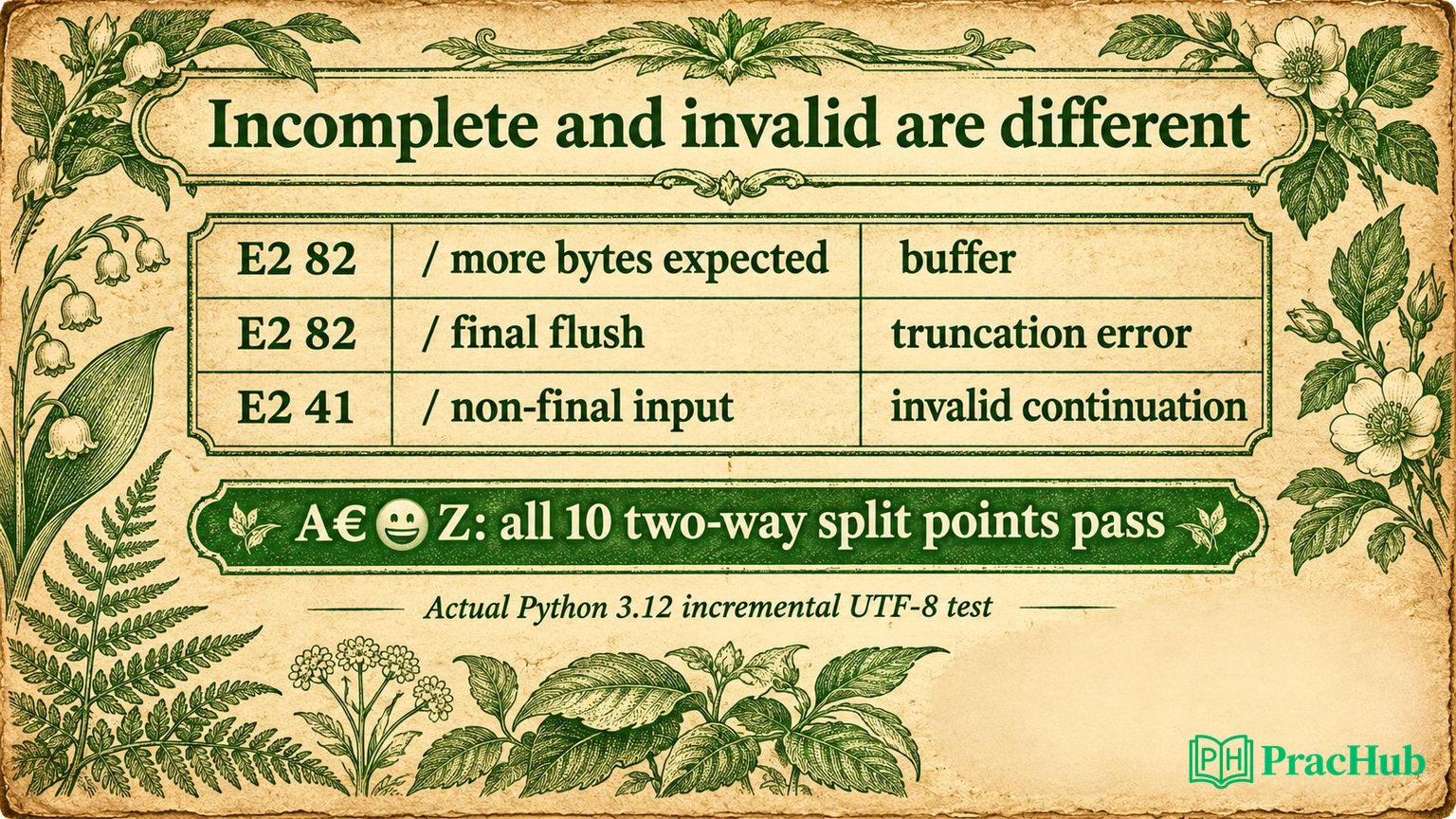
E2 82 is a valid prefix of the euro sign's three-byte sequence. With more input expected, a stateful decoder can buffer it. At final end-of-stream, that same prefix is truncated and needs the configured error policy.
E2 41 differs. ASCII 41 cannot complete the pending sequence as a continuation byte. Waiting indefinitely for another chunk would not make the already supplied sequence valid.
The executed strict-decoder controls are:
| Case | Input | When checked | Observed result |
|---|---|---|---|
| Truncated prefix | E2 82 | Final flush | UnicodeDecodeError: unexpected end of data |
| Invalid continuation | E2 41 | Non-final input | UnicodeDecodeError |
| Overlong encoding | C0 AF | Non-final input | UnicodeDecodeError |
| Encoded surrogate | ED A0 80 | Non-final input | UnicodeDecodeError |
RFC 3629 defines the valid UTF-8 ranges that exclude malformed representations such as overlong sequences and surrogate encodings. The test checks these named examples; it is not an exhaustive encoding-validator conformance suite.
A timeout is another boundary to define. If the connection stalls with a valid prefix buffered, decide whether cancellation discards the pending bytes, reports truncated output, or preserves resumable state. Do not label an ordinary temporary lack of bytes as proof of malformed UTF-8.
Test every boundary in a small complete string
The encoded A€😀Z fixture contains nine bytes. The test splits it at every two-way boundary, including before the first byte and after the last byte. That yields ten split positions.
For each position, it creates a fresh incremental decoder, feeds both parts with final=False, flushes with empty final input, and asserts that concatenated output equals the original string. All ten checks pass.
This is a useful invariant for a streaming adapter: changing read boundaries must not change the decoded result for valid complete bytes. The test covers every two-way split of this particular string, not every multi-chunk partition or every Unicode sequence.
Proposed extensions include randomized partitions, consecutive multibyte characters, cancellation between prefix bytes, invalid bytes after valid text, and explicit decoder reset between independent streams. Those extensions were not executed here.
Reset deserves attention. Reusing buffered state from one user's completed or canceled stream in another stream would combine unrelated bytes. Keep decoder ownership attached to one logical byte stream and define its finalization path.
Keep text events and grapheme rendering separate
A decoded Unicode string can be valid while still ending in the middle of a user-perceived grapheme cluster. Combining marks, emoji modifiers and joined emoji sequences add a display boundary beyond UTF-8 validity.
Design inference: if the UI promises that each visible update contains complete user-perceived characters, it needs an appropriate grapheme-segmentation policy as well as byte decoding. The Python fixture does not implement that policy and makes no claim about cursor movement or rendering stability.
SSE adds event framing around text. A client reading raw HTTP bytes must respect both UTF-8 decoding and SSE parsing. A client receiving already parsed text events should not treat their JSON escape syntax as literal model-output bytes.
Also avoid counting output tokens by counting emitted strings. One decoder call can emit nothing, one character, or several characters. Token accounting belongs to the tokenizer or provider's token contract, not the number of UI updates.
The versioned DecodeStream documentation describes buffering tokens until valid UTF-8 text can be produced. That supports the conceptual distinction, but this article's actual execution remains Python byte decoding only. DecodeStream reference
Bound the right buffer and finalize the right stream
For strict UTF-8 byte decoding, an incomplete valid prefix can retain at most the unfinished bytes of one character. That is a small state compared with buffering an entire response. It does not imply that every layer above the decoder has equally bounded memory.
A JSON event parser may need a complete value. A tokenizer decoder may need token history or decoder-specific context. A UI policy waiting for a complete grapheme can face a sequence of combining characters. State the buffer's owner and completion condition before claiming constant memory for the entire streaming client.
Design inference: one stream should have one clear finalization path. Normal completion flushes the decoder; an error or cancellation follows an explicitly chosen policy for pending bytes. A later independent request starts with fresh state. A reconnect that truly resumes the same raw byte stream needs a defined offset and state contract rather than merely reusing whatever buffer happened to survive.
The current fixture creates a fresh decoder for every two-way split test and flushes each valid complete input. It does not test reconnection offsets, concurrent streams or persistence of decoder state. Those remain proposed integration checks.
For an SSE client, add one more review question: is the library returning raw byte chunks, decoded event text, or parsed JSON objects? Feeding an already parsed string through a second guessed token decoder can corrupt a correct result just as easily as decoding incomplete bytes too early.
The engineering goal is a testable chain of contracts. Each layer accepts a defined unit, retains only its own incomplete state, and exposes an explicit end condition to the next layer. The euro-sign ledger makes the smallest of those boundaries visible.
Practise five streaming and parsing contracts
| PracHub question | What to practise |
|---|---|
| Assemble async stream reads into objects | Assemble length-prefixed objects across partial async reads and define EOF behavior. |
| Implement streaming RLE and bit-packed codec | Buffer integer-codec blocks under streaming input; do not confuse RLE/BP framing with UTF-8. |
| Design an Embeddable Streaming Chat Interface | Place text decoding, event framing, cancellation and long-history rendering at their actual chat-widget boundaries. |
| Streaming Python Parser for Key-Value Log Lines with Quoted and Escaped Values | Stream quoted and escaped log fields with bounded memory and an explicit parser state. |
| Implement a trie-based tokenizer | Define Unicode handling, normalization and unknown-token fallback for a trie-based tokenizer. |
The async-stream question adds partial reads and length-prefixed records. The integer-codec prompt requires block buffering for a different encoding. The chat-widget prompt adds SSE or gRPC events and cancellation. Their framing rules differ, while each needs an explicit state and end-of-input contract.
Continue with the verified async stream-assembly question. Change where the euro sign is split, then explain what is buffered, what is emitted and what final flush must establish. A correct answer keeps byte validity, tokenizer behavior and UI completeness independently testable.
Comments (0)