Canva Software Engineer Interview Guide 2026: AI-Assisted Coding, System Design, Values, and Timeline
Quick Overview
An evidence-based Canva Software Engineer Interview Guide 2026 covering official AI-assisted coding guidance, candidate-reported stages, system design, values, preparation, and timeline caveats.
Canva's 2026 software engineer interview process usually combines a recruiter conversation, peer technical problem solving, another engineering assessment, and a three-hour final interview. AI-assisted coding is part of the current engineering process, but Canva still evaluates computer science fundamentals, code ownership, debugging, architecture, and communication. Canva says the hiring process generally takes four to five weeks from the first recruiter conversation to a decision, although role and level can change the format. This guide separates Canva's official guidance from anonymous candidate reports so you can prepare without treating one person's loop as a guarantee. Start with broad Software Engineer interview questions, then adapt your practice to Canva's emphasis on realistic problems, AI judgment, scalable design, and values-led collaboration.
This guide is for backend, frontend, and platform software engineering candidates. It does not claim that one interview loop applies to every Canva role or level.
Key takeaways: Canva officially describes four main hiring components, no standard engineering take-home, and a three-hour technical-and-behavioral final. Engineering AI skills are assessed through real-time challenges. A separate system design round is not publicly guaranteed.
Fact-check note: Research was checked on August 29, 2026 against seven official Canva pages and four dated candidate discussions. Official facts, candidate reports, and unresolved role-level variation are labeled separately.
Canva Software Engineer Interview Process at a Glance
Canva's current How we hire page describes a common structure while warning that each role, level, and specialty can differ. Anonymous reports cannot establish a universal sequence.
| Topic | Officially confirmed by Canva | Candidate-reported examples | Safe interpretation |
|---|---|---|---|
| Overall process | Four main components: recruiter Zoom, first interview, another opportunity for engineers to showcase their work instead of the standard non-engineering take-home, and a final interview | A May 2026 frontend report described five interviews | Individual technical sessions may be split differently; follow your recruiter's schedule |
| AI-assisted coding | Engineering AI skills are assessed through interactive, real-time challenges; Canva's 2025 engineering article covered Backend, Frontend, and Machine Learning candidates | An April 2026 senior Go report described building and correcting an AI-assisted REST CRUD service | Expect to use AI thoughtfully, but do not expect that exact problem or tool |
| System design | Canva publicly confirms technical problem solving, not a standardized standalone system design round | The May report described an SPA product-list design scaling from about 100 products to millions; another report listed system design | Prepare system design for experienced roles, while treating its placement and scope as variable |
| Timeline | About one to two weeks for an application update; generally four to five weeks from the first recruiter conversation to a decision | The May report described gaps of roughly 1.5 to two weeks between interviews | Candidate scheduling can run longer than Canva's general estimate |
What Happens in the Official Canva Interview Rounds?
Round 1: recruiter Zoom and initial technical questions
A Talent Acquisition partner discusses your experience, goals, the role, and Canva's culture. Engineering applicants also receive technical questions. Canva does not publish a fixed question list or platform for this stage.
Round 2: peer technical problem solving
The first formal interview is usually with a potential coach or close teammate. Engineers receive a peer-to-peer problem-solving challenge. Clarification and communication matter alongside working code.
Round 3: another engineering assessment, not the standard take-home
Canva's official hiring guide says non-engineering candidates may receive a take-home challenge, while engineers instead receive another opportunity to showcase their work. Do not assume that opportunity's format until your recruiter confirms it.
Round 4: a three-hour technical and experience final
Canva describes the engineering final as three hours of technical problem solving and experience or behavioral questions. It does not publish the internal time split. A current engineering role posting says the interviews are virtual.
Canva may record and transcribe an interview using AI. Its careers page says candidates may opt out without affecting their application, although Canva does not provide interview recordings.
How Canva's AI-Assisted Coding Interview Works
An AI-assisted coding interview is a live engineering exercise in which the candidate can use an AI tool but remains responsible for requirements, technical decisions, generated code, testing, and production quality. Canva evaluates the collaboration between human judgment and AI, not prompting skill in isolation.
In its June 2025 AI interview announcement, Canva said Backend, Frontend, and Machine Learning candidates were expected to use tools such as Copilot, Cursor, or Claude. It piloted “AI-Assisted Coding” in place of the traditional Computer Science Fundamentals screen for backend and frontend roles. Current guidance is broader: the challenge evolves, and the recruiter explains exact expectations.
Canva says strong candidates:
- clarify ambiguous requirements before generating code;
- break the problem into bounded tasks and use AI selectively;
- review, test, debug, and improve generated output;
- explain architecture and trade-offs in their own words;
- maintain code quality that could survive peer review; and
- take full ownership of every line submitted.
The official interviewer's guide recommends preparing an AI-integrated development environment and a basic project structure in your preferred language. During the interview, state your own reasoning before asking AI, think aloud, and challenge suggestions that do not fit the requirements. If the assistant produces unfamiliar code, pause and understand it before proceeding.
Candidate reports illustrate possible exercises, not reusable question banks. The April 2026 senior Go report described implementing REST CRUD operations for text documents, then testing and correcting AI output. The May 2026 frontend report described building a Canva-like editor. These anecdotes reinforce Canva's official emphasis on realistic, ambiguous work, but neither prompt is guaranteed to recur.
Is There a Canva System Design Interview?
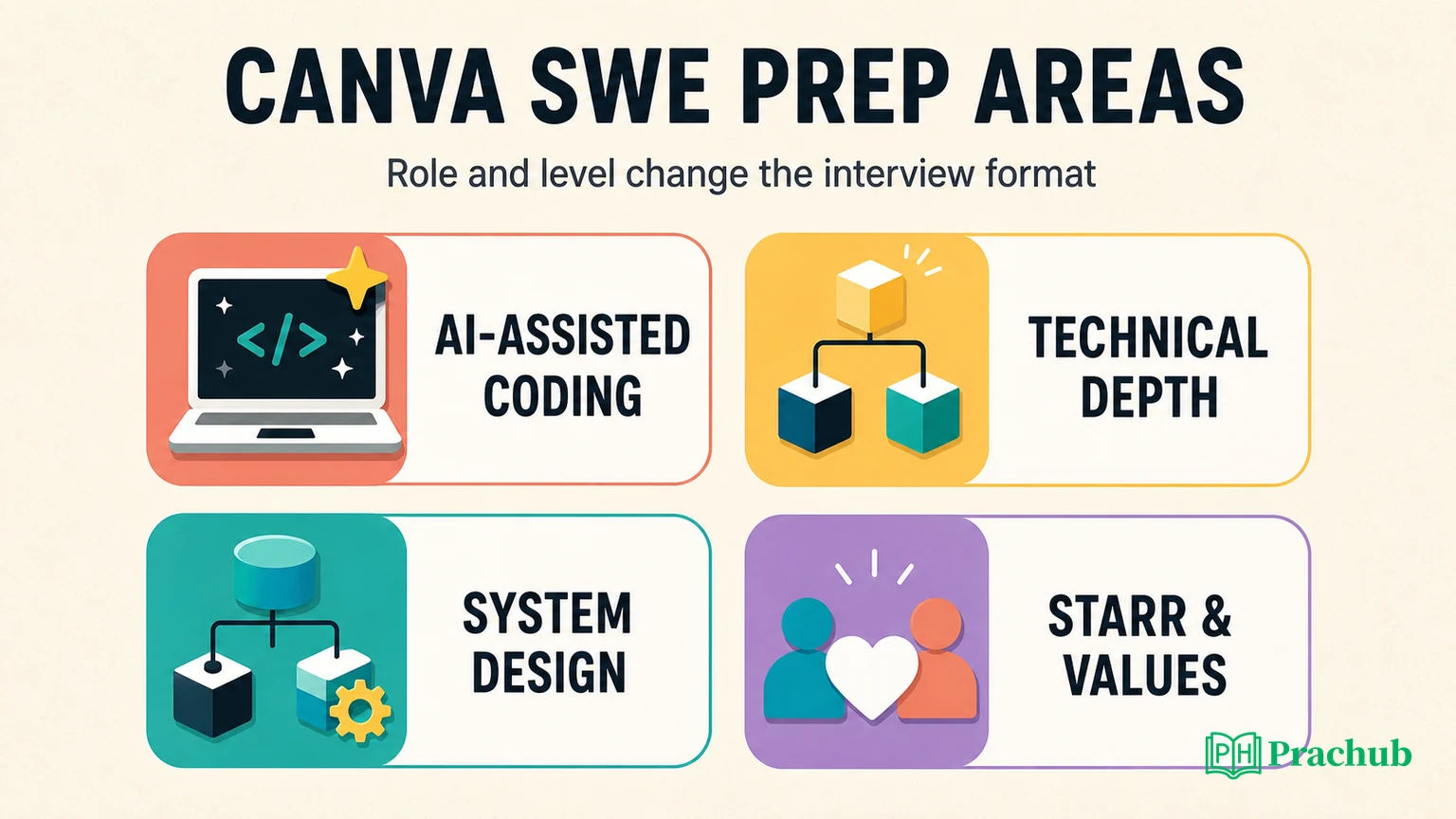
Use these as preparation areas, not a promised sequence: Canva says the exact format changes with the role and level.
Canva has not publicly promised every software engineer a separate system design round. The official process says “technical problem solving,” while anonymous senior and frontend reports describe system design or architecture sessions. The safest conclusion is that architecture discussion can appear in the technical loop and is more likely to matter for experienced, platform, backend, or infrastructure roles.
Current job descriptions show what relevant technical depth looks like. A current Staff Software Engineer, Experiments Platform posting asks candidates to reason about scalability, availability, consistency, and failure modes. A Senior Backend Engineer, Product Platform posting emphasizes API design, modular architecture, complexity, and distributed-system scalability. A Senior Frontend Engineer, Graphics/WebGL posting includes data structures, algorithms, performance, and scalable architecture patterns.
Prepare to clarify requirements, estimate scale, sketch components and data flow, define APIs and data models, identify bottlenecks, and compare trade-offs. For frontend design, include client performance, state management, collaboration, offline behavior, and rollout strategy when relevant. Do not memorize one Canva architecture; demonstrate a repeatable decision process.
Canva Values vs. the Skills Hiring Framework
Canva's six values are Be a Good Human, Empower Others, Be a Force for Good, Set Crazy Big Goals and Make Them Happen, Pursue Excellence, and Make Complex Things Simple. Interview questions use a separate Skills Hiring Framework:
- Craft: applying role-specific skills and tools to solve complex problems;
- Strategy: choosing effective approaches and identifying high-impact opportunities;
- Communication: creating clarity, alignment, and constructive collaboration; and
- Leadership & Coaching: empowering others, mentoring, teaching, and leading work.
Do not collapse the six values and four skills into one scoring rubric. Instead, prepare stories that demonstrate both. Canva recommends the STARR method: Situation, Task, Action, Results, and Reflection. Reflection matters because it shows what you learned and what you would change.
Candidate reports support, but do not prove, a fixed behavioral sequence. An April 2026 account listed strategy, communication, and leadership alongside technical stages. A September 2025 account similarly listed stakeholder leadership and communication after an AI round. Prepare one strong example each for conflict, influence without authority, simplifying complexity, raising quality, and helping a teammate grow.
Canva Interview Timeline
Canva says applicants receive an immediate receipt email and usually another update about one to two weeks later. If selected, the recruiter schedules a Zoom conversation. From that initial recruiter conversation through the final decision, the general estimate is four to five weeks.
That is not a guarantee from application date. Role, level, interviewer availability, and busy periods can change the schedule. One May 2026 candidate reported approximately 1.5-to-two-week gaps between sessions, showing why a personal loop may exceed the general estimate. Ask the recruiter for the expected stages and scheduling window rather than interpreting silence as a decision.
Cross-Company Practice Questions
Canva-specific PracHub question records were unavailable when this guide was prepared. The exercises below are verified cross-company practice material, not a prediction of Canva's exact assessment or interview questions.
| Practice question | Best preparation use |
|---|---|
| Implement and Defend an AI-Assisted Repository Change | AI collaboration, code ownership, testing, and explanation |
| Implement ASCII canvas and solve two data problems | Coding fluency, decomposition, and data structures |
| Design a Figma-like collaborative editor | Collaborative-editor architecture and scaling trade-offs |
| How do you conduct a code review exercise? | Technical review, communication, and defect detection |
| Resolve Conflict and Challenge Project Decisions | Strategy, stakeholder communication, and reflection |
A Seven-Day Canva Interview Preparation Plan
| Day | Focus | Deliverable |
|---|---|---|
| 1 | Confirm the role and recruiter brief | Write down the announced stages, allowed AI setup, language, and interview times |
| 2 | AI-assisted coding | Complete one ambiguous feature while narrating when you use AI; test and review every generated change |
| 3 | Coding and language fluency | Solve two medium problems, explain complexity, then review unfamiliar code for defects |
| 4 | System design | Design one role-relevant product at two scales; cover APIs, storage, bottlenecks, reliability, and trade-offs |
| 5 | Craft and strategy | Prepare two technical decisions where you simplified complexity or changed direction using evidence |
| 6 | Communication and leadership | Rehearse four STARR stories, including conflict, influence, mentoring, and a mistake with reflection |
| 7 | Full simulation | Run a timed AI coding exercise, architecture discussion, and behavioral debrief; record unclear explanations to fix |
During the final simulation, do not optimize for feature count. Canva's interviewer guidance favors a smaller, well-reasoned solution over rushed output. Finish by explaining what you built, why, what you would improve, and how it would behave at larger scale.
Frequently Asked Questions
Does Canva allow AI during software engineering interviews?
Yes, in the designated AI-assisted engineering assessment. Canva's current careers guidance says engineering AI skills are assessed through interactive, real-time challenges. Its 2025 engineering article said Backend, Frontend, and Machine Learning candidates were expected to use AI tools. The exact tool and exercise can evolve, so follow the instructions from your recruitment partner for every round.
Does Canva have a separate system design interview?
Canva's public hiring page does not guarantee a standardized standalone system design round. It confirms technical problem solving, while several anonymous candidates reported system design or architecture stages. Senior and platform job descriptions emphasize scalable architecture, so experienced candidates should prepare system design without assuming a fixed format.
Do Canva software engineers receive a take-home challenge?
Canva says engineers do not complete the standard take-home challenge used for other roles. They receive another opportunity to showcase their work, and the recruiter explains what to expect. This statement does not identify a universal replacement, so confirm whether your session covers coding, review, architecture, or another skill.
How long does the Canva software engineer interview process take?
Canva estimates four to five weeks from the initial recruiter conversation to a decision. Applicants usually receive an application update after about one to two weeks, but busy periods and scheduling can extend the process. Candidate-reported gaps are anecdotal and should not replace the official general estimate.
What behavioral areas does Canva evaluate?
Canva structures interview questions around Craft, Strategy, Communication, and Leadership & Coaching. Its six company values provide additional cultural context but are not the same framework. Use STARR stories with specific actions, measurable or observable outcomes, and honest reflection on what you learned or would do differently.
Final Takeaway
The Canva software engineer interview in 2026 rewards practical engineering judgment: clarify ambiguity, use AI without surrendering ownership, reason about scalable systems, and communicate decisions clearly. Prepare for Canva's four official process components, but let your recruiter define the exact technical sessions. Candidate reports are useful rehearsal clues, not promises. A strong plan combines AI-assisted implementation, code review, architecture trade-offs, and STARR stories tied to Canva's skills and values.
Sources and Further Reading
- Canva Careers: How we hire
- Canva Engineering: Yes, You Can Use AI in Our Interviews
- Canva Engineering: AI Interview Success — An Interviewer's Inside Guide
- Canva Careers: Our culture and values
- Canva Staff Software Engineer — Experiments Platform
- Canva Senior Backend Engineer — Product Platform
- Canva Senior Frontend Engineer — Graphics/WebGL
- Candidate-reported Canva frontend interview notes, May 2026
- Candidate-reported senior Go AI interview discussion, April 2026
- Candidate-reported senior engineer stage discussion, April 2026
- Candidate-reported final-round stage discussion, September 2025
Comments (0)