Coderbyte SQL Assessment Guide: Query Types, Timing, and What Employers See
Quick Overview
Understand Coderbyte SQL assessment query types, employer-set timing, grading, report visibility, common SQL traps, and a focused practice plan.
Updated August 26, 2026.
A Coderbyte SQL assessment is not one standardized test. The employer chooses the database challenge, tables, instructions, total assessment time, scoring settings, and any additional questions. Coderbyte's official documentation confirms that a database challenge can use multiple tables and grade a candidate by comparing the query output with a solution table.
That means the safest preparation is not memorizing a rumored question count. Practice reading schemas, defining the required output grain, writing correct joins and aggregations, and testing the result before submission. You can build those habits with PracHub SQL interview questions, then use this guide to rehearse the Coderbyte workflow.
Quick answer: what should you expect?
Expect a configurable, employer-built assessment rather than a universal Coderbyte SQL exam. A SQL challenge may ask you to query one or more tables so that your result matches a required output. The invitation or welcome screen determines the total timer, available tools, database environment, and whether the assessment also contains multiple-choice, short-answer, spreadsheet, or coding sections.
| Area | What Coderbyte officially supports | Candidate implication |
|---|---|---|
| SQL task | Database challenges built from one or more tables | Read every table and relationship before writing the query. |
| Grading | A query result can be compared with a solution table | Correct rows, columns, values, and edge-case behavior matter. |
| Timing | The employer can set an optional total assessment limit | Do not rely on a universal question count or duration. |
| Database | Custom tables can be uploaded for MySQL, MSSQL, or PostgreSQL | Follow the dialect and functions shown in your own challenge. |
| Employer report | Scores, submissions, activity, and integrity signals may be available | Produce a correct, readable query through a rule-compliant process. |
Is there a standard Coderbyte SQL assessment format?
No. Coderbyte lets employers start from a template or create an assessment from scratch. The assessment can combine challenges with multiple-choice, short-answer, free-form, personality, spreadsheet, or project content, and the employer can change ordering, weighting, result visibility, and integrity settings.
For database challenges, Coderbyte documents a concrete mechanism: an assessment owner selects or uploads table data, saves a solution query that produces an expected table, and asks the candidate to write a query that matches that output. A challenge may use several tables, although at least one main table must be connected.
This is the important distinction from a verbal SQL interview. The platform can evaluate the result of your query, so a plausible explanation does not repair a wrong row count. At the same time, employers may review more than the score, which makes a disciplined solution process valuable.
Coderbyte SQL query types to prepare
Coderbyte does not promise that every SQL assessment uses the same topic list. The categories below are a practical preparation map for result-table challenges, not leaked questions or a prediction of your exact test.
Schema reading and output grain
Before writing SQL, state what one output row represents: one customer, one department, one day, or one product-month. Then identify the required columns, grouping keys, filters, and sort order.
Filtering, NULL handling, and conditional logic
Review WHERE, CASE WHEN, IS NULL, COALESCE, and three-valued SQL logic. Know that column = NULL is not a valid null test, that a right-table condition in WHERE can remove unmatched rows from a LEFT JOIN, and that COUNT(column) ignores nulls while COUNT(*) counts rows.
Joins and row preservation
Be ready to choose between INNER JOIN and LEFT JOIN, identify the correct keys, and predict whether a one-to-many relationship will duplicate rows. A reliable habit is to estimate the row count after each join and ask which population must survive.
If the result needs customers with zero orders, start from customers and preserve them. If it needs only customers with a qualifying order, an inner join or a later filter may be appropriate. The business definition decides the join, not a memorized preference.
Aggregation and grouped metrics
Practice GROUP BY, HAVING, distinct counts, conditional aggregation, ratios, and deterministic ordering. Keep the numerator and denominator visible long enough to verify them separately, especially for rates and percentages.
CTEs, subqueries, and window functions
Multi-step questions often become clearer when you separate filtering, aggregation, and ranking into named CTEs. Window functions such as ROW_NUMBER, RANK, LAG, and rolling SUM are useful when the output must preserve rows while comparing them within a group.
SQL dialect and database environment
Coderbyte's documentation for custom table uploads includes MySQL, Microsoft SQL Server, and PostgreSQL examples. That does not prove that every candidate can freely choose among them. Your challenge instructions and editor determine the actual environment.
Check the dialect before using date arithmetic, string functions, QUALIFY, LIMIT, TOP, interval syntax, or dialect-specific casting. When the prompt does not require a special feature, portable SQL can reduce avoidable syntax risk.
Timing: how to budget a Coderbyte SQL assessment
Coderbyte lets the employer set an optional time limit for the entire assessment. The candidate guide says that once the timed assessment begins, the timer starts and the session cannot be paused. The invite expiration date is separate: it controls when you must start, not how long you have after starting.
Use a percentage-based budget because the exact duration and section mix vary:
| Phase | Suggested share | What to finish |
|---|---|---|
| Read | 15% | Restate the output grain, inspect tables, and mark edge cases. |
| Build | 50% | Write a simple correct query in stages. |
| Test | 25% | Check counts, nulls, duplicates, dates, ties, and ordering. |
| Submit | 10% | Remove experiments, confirm required columns, and submit every section. |
If several tasks share one timer, scan the assessment before committing too much time to the first problem when the interface allows it. If progressive loading is enabled, work from the visible task and preserve a small final buffer. Coderbyte states that selection ordering and progressive loading are employer settings, so follow the interface you actually receive.
How Coderbyte can grade a SQL submission
For a custom database challenge, Coderbyte describes solution-table grading: the employer saves the output produced by its reference query, and the candidate's query is expected to match that output. Coderbyte also documents SQL, GraphQL, and MongoDB challenge scores on a 1-to-10 scale, with test cases contributing points.
The practical takeaway is that surface correctness is not enough. A query can look reasonable and still lose points because it omits zero-activity entities, duplicates facts after a join, mishandles nulls, uses the wrong date boundary, returns extra columns, or sorts nondeterministically when order is part of the expected result.
Do not assume that the fastest solution automatically receives the best score. Coderbyte's current timing-points page labels timing points as a legacy feature for new assessments. Your priority should be a correct, complete submission within the overall timer.
What employers can see after a SQL assessment
Coderbyte says every completed assessment creates a candidate report. Depending on the content and employer settings, the report can include the final score, question-level breakdown, submitted solutions, skill ratings, benchmarks, reviewer notes, and integrity information.
For coding challenges, Coderbyte also documents playback and detailed activity such as copied content, searches performed through an enabled built-in search tool, and page exits. The exact controls are configurable; a Coderbyte link alone does not tell you which monitoring features are active.
For the broader report mechanics, read Coderbyte Assessment Results Explained. For privacy and monitoring questions, see Does Coderbyte Record Your Screen?.
The SQL-specific lesson is simple: make the final query easy to trust. Use clear aliases, avoid dead experimental CTEs, test the output deliberately, and follow the resource rules shown in the invitation. Do not try to reverse-engineer monitoring behavior.
A reliable SQL solving workflow
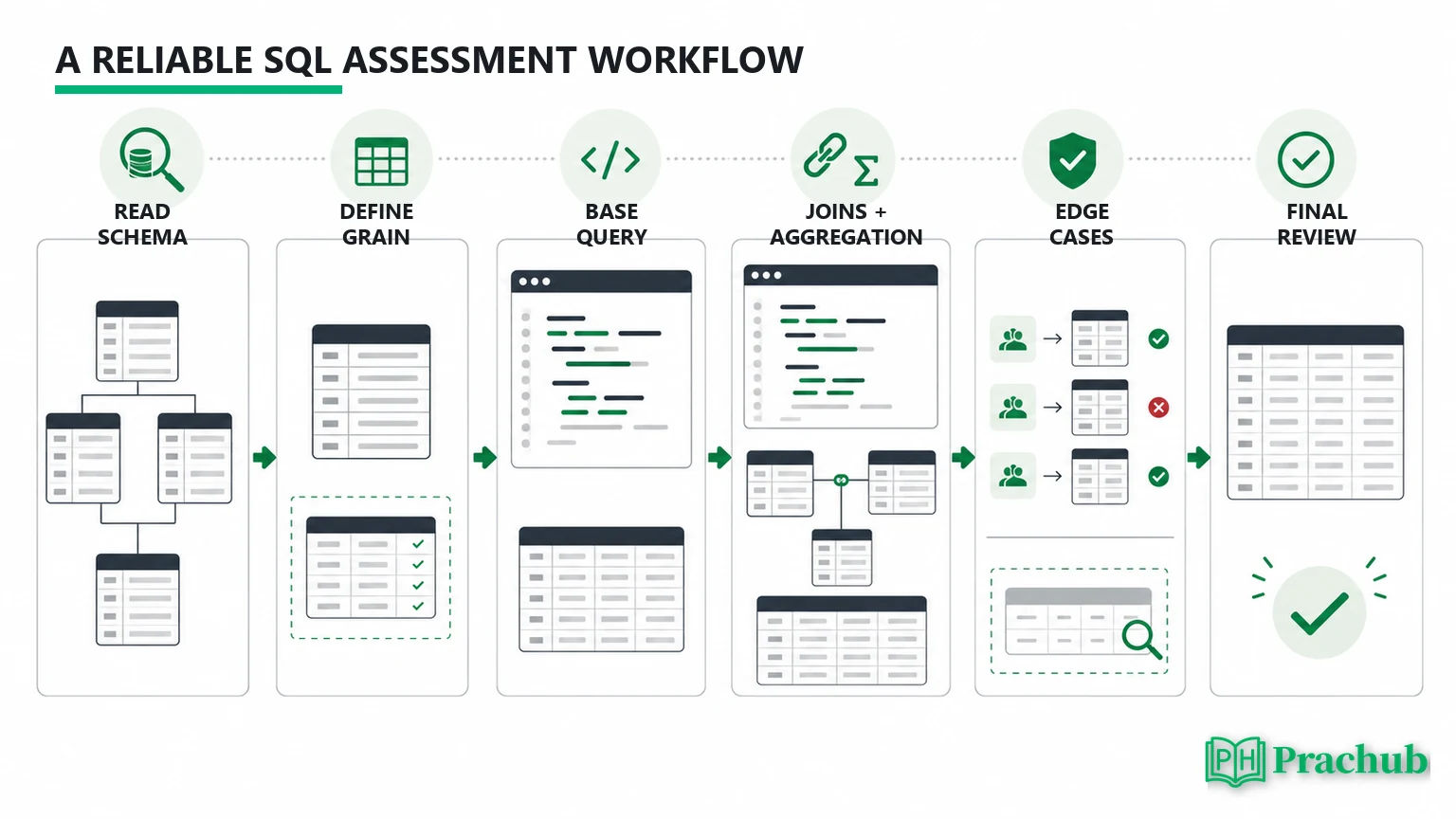
- Read the requested output first. Write down the grain, columns, filters, and ordering in plain language.
- Inspect every table. Identify primary keys, foreign keys, nullability, timestamps, and one-to-many relationships.
- Build the smallest base query. Select the relevant rows and columns before adding metrics.
- Add joins one at a time. Predict the row count and check whether required zero-activity rows survive.
- Aggregate only after the grain is stable. Calculate counts and sums before combining them into rates.
- Add windows or ranking last. Define partitions, ties, and frames explicitly.
- Run an edge-case review. Test nulls, duplicates, missing dates, empty groups, ties, boundaries, and deterministic output.
This sequence may feel slower during practice, but it prevents long debugging sessions caused by one early modeling mistake. With repetition, the checks become brief and automatic.
Common mistakes that cost SQL assessment points
The most expensive mistakes are usually silent. The query executes, but the table is wrong.
- A
LEFT JOINbecomes an accidental inner join because a right-side filter appears inWHERE. COUNT(*)counts a null-extended join row that should represent zero activity.- A many-to-many join inflates revenue or user counts.
- Integer division turns a valid rate into zero.
BETWEENon timestamps includes or excludes a boundary the prompt did not intend.- A window uses the wrong partition, tie rule, or frame.
- The query returns the right values with the wrong column order, aliases, or required sorting.
After each practice problem, classify the miss as schema, grain, logic, dialect, or submission. That produces a more useful study plan than collecting random SQL syntax notes.
Practice with SQL questions from PracHub
These PracHub question-bank records train the skills that matter in result-table assessments. They are not predictions of your exact Coderbyte assessment.
| PracHub question | Practice focus | Why it helps |
|---|---|---|
| Rank Departments by Student Count | Outer joins, aggregation, zero-count groups | Tests whether you preserve empty departments and count the correct key. |
| Calculate Daily Survey Response Rates by Country | Joins, distinct counts, ratios, output grain | Forces precise numerator, denominator, and orphan-event handling. |
| Compute a Rolling Seven-Day Revenue Sum with Missing Dates | Date spine, windows, missing periods | Builds careful calendar logic and explicit window semantics. |
| Debug row loss after SQL joins | Join debugging, filters, time zones | Trains diagnosis of a query that runs but silently drops valid rows. |
| Build a Gap-Free Monthly Booking Summary | Calendar generation, windows, cumulative metrics | Combines result completeness, prior-period logic, and stable ordering. |
A seven-day preparation plan
| Day | Focus | What to do |
|---|---|---|
| Day 1 | Diagnostic | Solve one easy and one medium SQL task under a timer; classify every miss. |
| Day 2 | Grain and joins | Practice row survival, join fan-out, zero-activity entities, and count selection. |
| Day 3 | Aggregation | Drill grouped metrics, conditional counts, ratios, HAVING, and null behavior. |
| Day 4 | Dates and windows | Practice date boundaries, missing periods, ranking, LAG, and rolling frames. |
| Day 5 | Dialects | Rewrite two queries for the dialect named in your invitation; verify function differences. |
| Day 6 | Full simulation | Combine SQL with any other expected sections and reserve a submission buffer. |
| Day 7 | Review | Re-solve failed questions, test your browser, and confirm the exact assessment rules. |
Frequently asked questions
How many SQL questions are on a Coderbyte assessment?
There is no universal number. Employers can customize the challenge and question mix, total time, ordering, and weighting. Use the invitation and welcome screen as the source of truth, then divide your time only after you see the actual sections.
Which SQL dialect does Coderbyte use?
Coderbyte supports custom SQL tables and documents MySQL, MSSQL, and PostgreSQL formats. Your specific challenge determines the available environment. Check the editor and instructions before using dialect-specific functions for dates, strings, limits, or casting.
Can I see my Coderbyte SQL result after submitting?
Possibly. Coderbyte lets employers decide whether candidates can view challenge results and whether they can redo a submitted challenge. If result visibility is disabled, you may see only confirmation that the solution was saved.
Does Coderbyte record my SQL work?
Coderbyte documents coding playback and candidate-report activity for coding challenges, but the exact assessment and integrity settings vary by employer. Read the welcome screen, follow the stated resource rules, and assume your submitted work can be reviewed.
What matters more: query speed or correctness?
Correctness comes first. Coderbyte's current documentation marks timing points as a legacy feature for new assessments, while database challenges are evaluated against expected results. Finish within the overall timer, but prioritize correct grain, edge cases, and complete submission over typing quickly.
Final takeaway
A strong Coderbyte SQL submission is a correct result supported by a clean process. Define the output grain, inspect relationships, build joins incrementally, test silent failure modes, and leave enough time to submit every required section.
Start with PracHub SQL interview questions, use the five-question practice table above as a focused diagnostic, and rehearse under the time and resource rules shown in your own invitation.
Research note: This guide was checked on August 26, 2026. Coderbyte features and employer configurations can change; follow the instructions in your own invitation and assessment.
Related Articles
Capital One Data Analyst Internship 2027: VJT, Power Day, and Why There May Be No CodeSignal
Capital One Data Analyst Internship 2027 guide: VJT, Power Day cases, behavioral interviews, SQL prep, timelines, and why CodeSignal may be skipped.
SQL String Functions: SUBSTRING, SPLIT_PART, CONCAT, and LIKE in Interviews
Use PostgreSQL string functions for normalization, SUBSTRING and SPLIT_PART parsing, NULL-safe labels, ordered lists, LIKE, and row splitting.
SQL ORDER BY: Ascending, Descending, Multi-Column Sorting, and Where NULLs Land
Use PostgreSQL ORDER BY for deterministic multi-column sorting, explicit NULL placement, top N, keyset pagination, ties, and windows.
SQL SELECT DISTINCT: What It Actually Deduplicates, and When It Hides a Bug
Understand SQL DISTINCT across full rows, NULLs, counts, groups, latest-row selection, and join fanout using verified PostgreSQL outputs.
Comments (0)