Capital One Data Analyst Internship 2027: VJT, Power Day, and Why There May Be No CodeSignal
Quick Overview
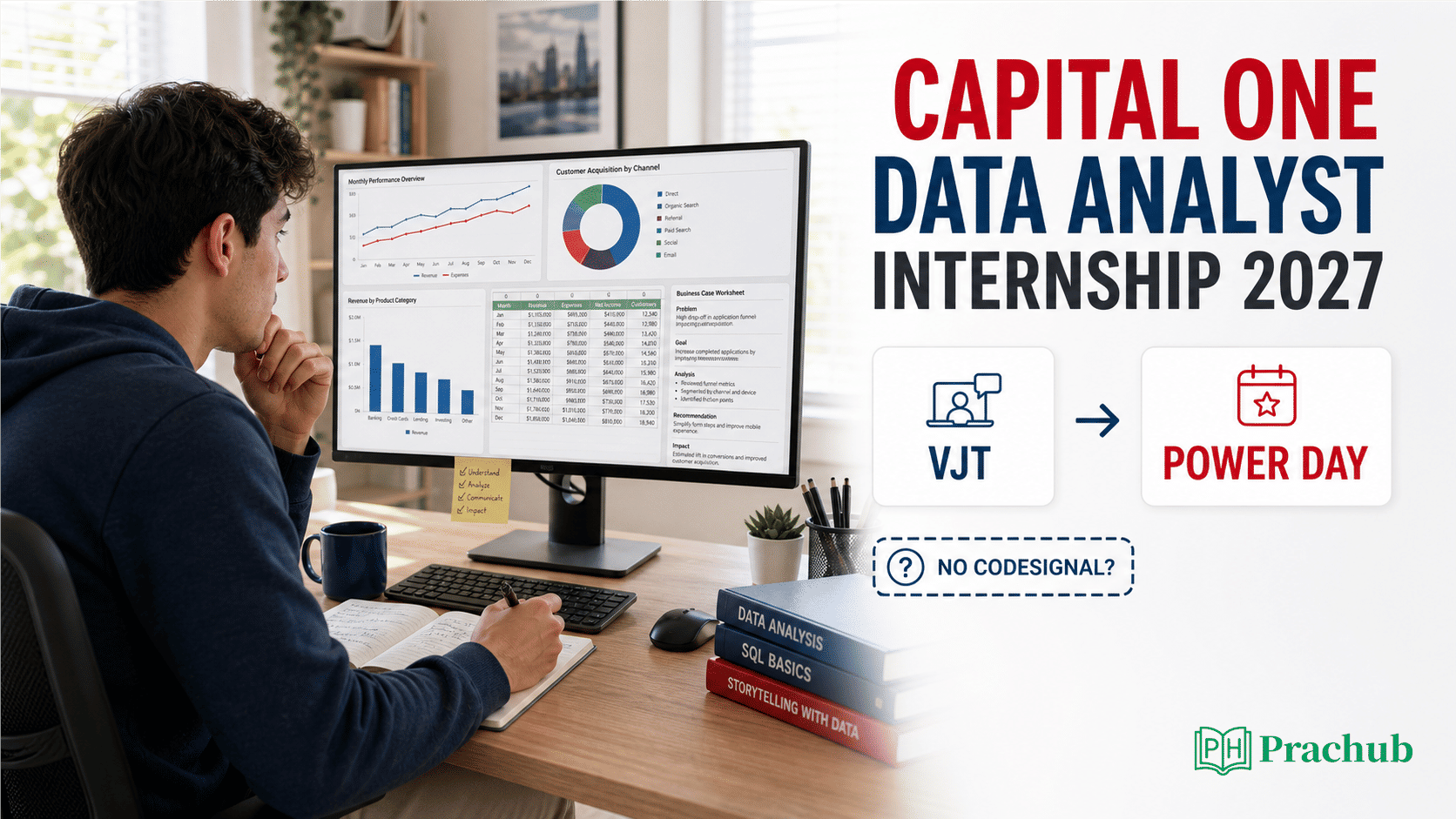
An evidence-based guide to the Capital One Data Analyst Internship 2027. Learn what the official VJT includes, why current candidates may move to Power Day without CodeSignal, how to prepare for two business cases and behavioral questions, what SQL to review, and how to interpret recruiter timelines without confusing Data Analyst, Business Analyst, Technology, and Data Science processes.
You finish Capital One's Virtual Job Tryout, refresh your inbox, and wait for the CodeSignal link everyone online seems to expect. Days pass. Did you fail the VJT, or is the Data Analyst process simply different?
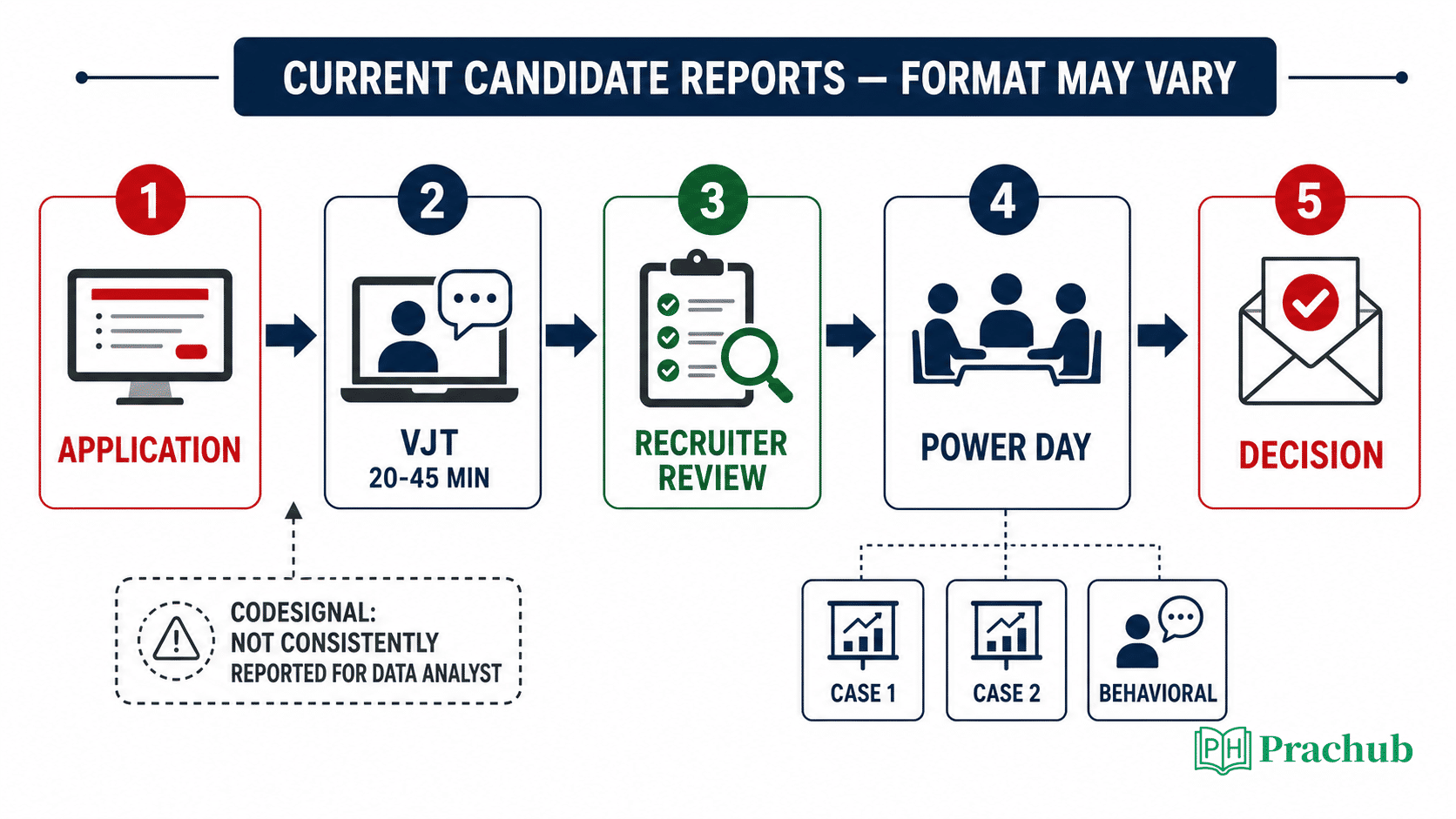
For the Capital One Data Analyst Internship 2027, current candidate reports point to the second explanation. Several applicants and a previous successful candidate say the Data Analyst route can move from the VJT directly to a recruiter review and Power Day, without the CodeSignal assessment used in other Capital One programs.
That does not mean the internship is nontechnical. The job description emphasizes SQL, analytics, data platforms, business strategy, and communicating decisions. Start with Capital One Data Analyst questions on PracHub, then use this guide to prepare for the actual signals the process appears to prioritize.
Quick verdict
Do not assume a missing CodeSignal means rejection. Capital One officially says assessment steps vary by role. Its public VJT guidance describes a 20-to-45-minute assessment that can combine business-case work, situational judgment, experience questions, and work-style preferences.
In current Summer 2027 Data Analyst discussions, candidates repeatedly say the role used the VJT but no CodeSignal. One prior-cycle candidate said they moved directly from the VJT to Power Day and received an offer. Current applicants also report receiving Power Day scheduling requests after waiting days or weeks.
The detailed Data Analyst Power Day format is less settled. Prior intern reports consistently describe two business cases and one behavioral interview. A new August 2026 discussion shows candidates wondering whether a SQL round has replaced the behavioral round for some applicants. Until your recruiter sends the schedule, prepare for two cases, behavioral questions, and enough SQL to handle a role-specific variation.
| Detail | Evidence level | What it means for you |
|---|---|---|
| VJT modules and an average 20–45 minute duration | Official Capital One FAQ | Read the instructions and treat each module as a different signal. |
| The assessment mix varies by position | Official Capital One interview guidance | Do not copy the Technology, Business Analyst, or Data Science process. |
| No CodeSignal for some Data Analyst interns | Multiple candidate reports | A missing coding link is not, by itself, a rejection signal. |
| Two case interviews plus one behavioral interview | Prior Data Analyst intern reports | Make case communication and mental math your core preparation. |
| A possible SQL variation | Current candidate discussion, not yet verified as universal | Review practical SQL without assuming a guaranteed SQL round. |
The role matters more than the company name
Many confusing Capital One timelines come from mixing four different applicant pools. Technology interns commonly discuss a CodeSignal coding assessment. Business Analyst applicants are currently reporting a longer CodeSignal exercise involving data analysis. Data Science applicants may receive a separate challenge. Data Analyst candidates, meanwhile, are reporting VJT followed by Power Day without a CodeSignal stage.
These tracks share a company and sometimes share interview vocabulary, but they do not necessarily share assessments.
| Program | Current or official signal | Do not assume |
|---|---|---|
| Data Analyst Internship | VJT; candidate-reported direct path to Power Day | That a Technology or BA CodeSignal is required |
| Business Analyst Internship | Current candidates report VJT and a data-oriented CodeSignal | That the DA process is identical |
| Technology Internship | Coding assessment and technical Power Day guidance | That LeetCode is the main DA preparation need |
| Data Science Internship | Capital One describes a role-specific data challenge | That the DA internship uses the same modeling exercise |
The 2027 Data Analyst job description reinforces the distinction. It describes work at the intersection of business strategy and technology: exploring structured and unstructured data, testing marketing channels, identifying fraud patterns, integrating data sources, and turning analysis into decisions. SQL and open-source tools matter, but the role also rewards business judgment and communication.
What the Capital One VJT includes
Capital One's FAQ says the VJT is delivered through an individualized email link and usually takes 20 to 45 minutes. Depending on the role and modules previously completed, candidates may see a combination of four exercise types.
Manage Relationships presents situations similar to those encountered in the role and asks you to choose a response. Work Your Business Case asks you to combine information from multiple sources and recommend what a fictitious business should do. Tell Us Your Story focuses on experiences that shaped you. Describe Your Approach explores your preferred way of working.
This is stronger guidance than searching for an answer key. The VJT is designed to compare how you interpret information, make decisions, and work with others. Trying to present an extreme ideal candidate can make your answers inconsistent across similar scenarios.
A practical VJT strategy
Before answering a business scenario, identify the objective, the affected customer or stakeholder, the evidence provided, and the risk of acting too quickly. Prefer responses that gather the missing information, address the immediate issue, communicate with the right person, and leave the process better than you found it.
For work-style choices, answer as the dependable version of your normal professional self. If two statements both sound positive, choose the one that fits slightly better rather than inventing a hidden situation. Capital One's FAQ says the exact module combination can depend on the role, so use the instructions shown in your assessment as the final authority.
Why there may be no CodeSignal
Capital One has not published a statement saying every Data Analyst intern skips CodeSignal. The best evidence is role-specific candidate experience.
In a July 2026 discussion focused on the Summer 2027 Data Analyst internship, applicants who had completed the VJT worried because no coding assessment arrived. A previous candidate replied that there was no CodeSignal for this internship and that the next major step was Power Day. Another current applicant later reported receiving an interview request and again said there had been no OA beyond the VJT.
The same pattern appeared in 2025 discussions: Data Analyst candidates reported recruiter outreach and Power Day invitations after completing only the VJT. One detailed timeline described a long wait between a July VJT and late-September recruiter contact, followed by two cases and a behavioral interview.
That evidence supports a careful conclusion: CodeSignal is not consistently reported as part of the Data Analyst intern path. It does not prove the stage can never appear. Capital One can change the process by recruiting window, location, or assessment configuration.
Silence after the VJT is not a score report
Current candidates report very different response times. Some receive Power Day outreach within a few weeks; others remain in an assessment or in-progress status while interviews are already being scheduled. Prior applicants describe waits of more than a month.
Do not use another person's CodeSignal timing to interpret your Data Analyst application. Save your VJT completion confirmation, monitor email and spam, and check the candidate portal. If an assessment link is missing or the portal does not recognize completion, use the support route in the invitation. Otherwise, keep preparing and applying while recruiter review continues.
What happens during the Power Day?
Capital One officially defines Power Day as a series of interviews that can include job-fit, behavioral, and case interviews depending on the position. Its student interview guide says a case interview presents a business problem and evaluates strategic thinking plus analytical and quantitative skills.
For the Data Analyst internship, the strongest prior candidate pattern is two case interviews and one behavioral interview. A 2025 candidate who later reported receiving an offer described numerical business cases involving profit, break-even reasoning, and weighted averages. Another intern applicant reported the same two-case-plus-behavioral schedule.
The latest 2027 discussion shows some uncertainty about whether a SQL segment may appear. Treat the recruiter-provided schedule and preparation guide as authoritative. If it lists a technical or SQL interview, adjust immediately; do not force an older Power Day template onto a new invitation.
How to solve a Data Analyst case
The interviewer is not only checking whether you can calculate. They want to see how you define the problem, organize ambiguous information, respond to a new constraint, and turn the result into a recommendation.
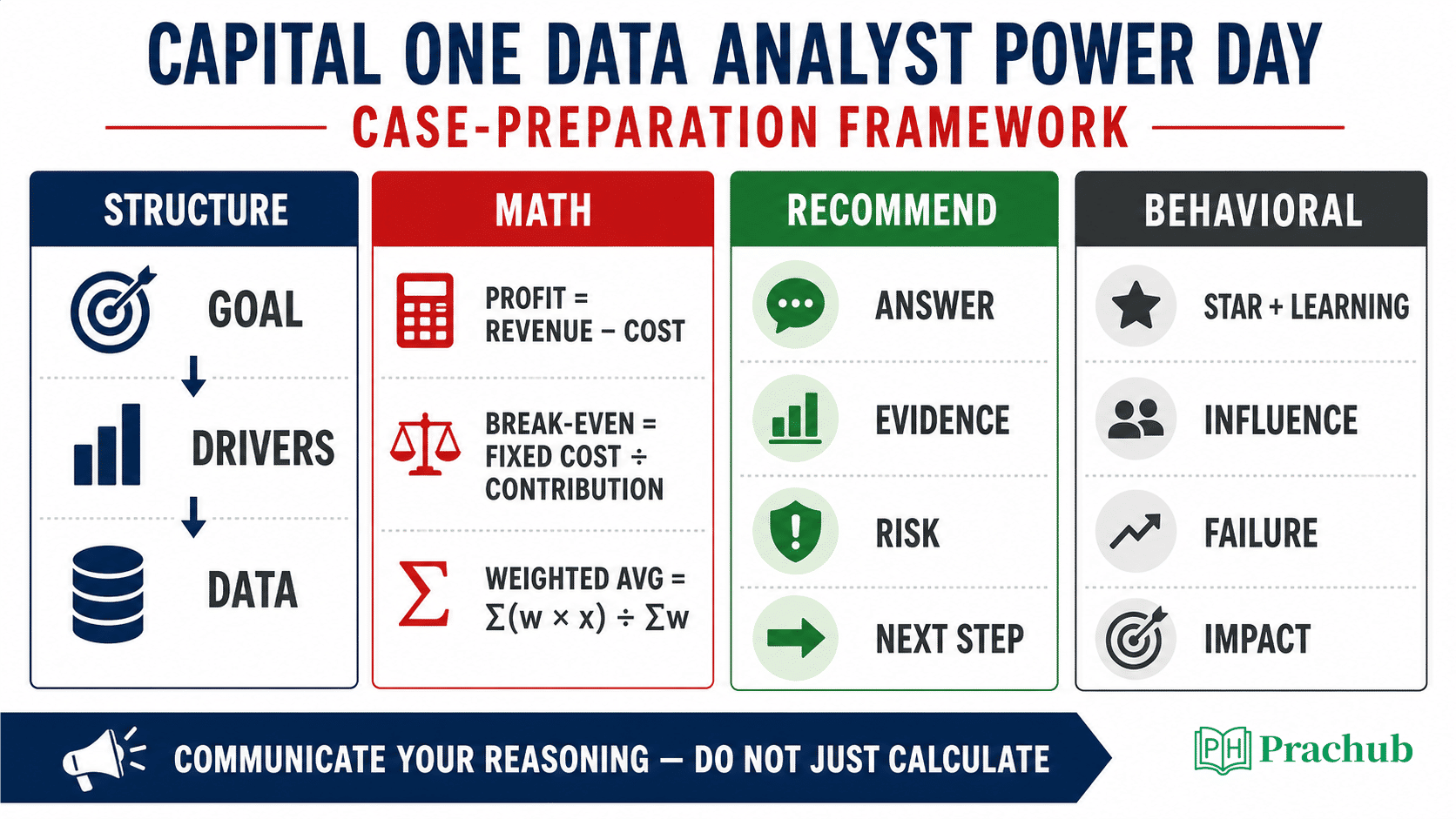
Use a repeatable five-step structure:
- Clarify the decision. Restate what the business must choose and which metric defines success.
- Map the drivers. Separate revenue, cost, customer behavior, operational constraints, and risk.
- Work the math visibly. State the formula, units, assumptions, and intermediate result.
- Interpret the number. Explain what changed, why it matters, and which assumption is fragile.
- Recommend and test. Give an answer, evidence, risk, and next step.
Math worth practicing
Review percentages, percentage-point changes, weighted averages, contribution margin, profit, break-even volume, growth rates, and expected value. You should be able to calculate accurately while speaking and to sanity-check whether the magnitude makes sense.
For example, do not say revenue increased merely because customer count rose. Ask whether acquisition cost, discounting, credit losses, operational expense, or cannibalization changed the profit. A Data Analyst case rewards the difference between a visible metric and the business outcome it is supposed to represent.
How to use hints
If the interviewer challenges an assumption, treat it as new evidence rather than a sign that you failed. Repeat the updated constraint, revise the relevant part of your calculation, and explain whether the recommendation changes.
A candidate who takes a hint and improves the model can show stronger collaboration than someone who defends an incorrect approach. Capital One's own case guidance emphasizes communicating your process, incorporating feedback, and explaining your findings.
Should you still practice SQL?
Yes, but for the right reason. SQL is part of the job, and the current posting explicitly mentions SQL and open-source languages as tools for building analytics. A missing CodeSignal does not make SQL irrelevant.
Prepare joins, aggregation, conditional logic, NULL handling, date filters, common-table expressions, and window functions. More importantly, practice explaining the row grain, checking for duplicate multiplication after joins, and connecting a query result to a business decision.
Do not spend the entire week grinding advanced algorithm problems unless your invitation names a coding assessment. For the reported Data Analyst path, case structure, arithmetic, data interpretation, SQL fundamentals, and behavioral evidence offer a more balanced return.
Prepare the behavioral interview
Capital One's public interview guide says behavioral questions commonly begin with “Tell me about a time when…” and may assess problem solving, influence, and results focus. Build a compact story bank rather than memorizing scripts.
Prepare examples involving an ambiguous analysis, a disagreement about a metric, a mistake in data or logic, a time you influenced a stakeholder, a difficult deadline, and an accomplishment with measurable impact. Use STAR plus learning: situation, task, actions, result, and what changed in your later work.
Keep the background short. The useful evidence is how you validated data, chose among options, communicated uncertainty, and measured whether the decision worked.
Practice with Capital One Data Analyst questions from PracHub
These question-bank records train relevant skills; they are not predictions of your exact 2027 VJT or Power Day. Each complete title in the first column opens the question and written solution.
| PracHub question | Practice focus | Why it helps |
|---|---|---|
| Analyze Mission Outcomes and Allocate Response Units | Rates, grouping, uncertainty, and decisions | Trains multi-part analysis and communication when the data does not determine one obvious answer. |
| Should a Restaurant Partner with Groupon? | Profit, contribution margin, and cannibalization | Builds the unit-economics reasoning frequently associated with Capital One cases. |
| Find Lowest Prices for Highly Rated Categories | SQL joins, grouping, and conditional aggregation | Keeps SQL preparation role-relevant without assuming a CodeSignal round. |
| Describe Your Impactful Accomplishment and Learned Lessons | Ownership, failure, and measurable results | Develops adaptable behavioral stories for the final interview. |
| Influence Stakeholders Using Data: Handle Conflicts, Measure Success | Data storytelling and stakeholder alignment | Connects analytical work to decisions, conflict handling, and impact measurement. |
A seven-day preparation plan
| Day | Focus | What to do |
|---|---|---|
| Day 1 | Diagnose | Complete one business case and one SQL problem; record where your reasoning became unclear. |
| Day 2 | Core case math | Drill profit, margin, break-even, weighted averages, and percentage changes aloud. |
| Day 3 | Case structure | Solve two cases using goal, drivers, data, interpretation, and recommendation. |
| Day 4 | SQL fundamentals | Practice joins, aggregation, NULLs, dates, and window functions with explicit row-grain checks. |
| Day 5 | Behavioral evidence | Build six STAR-plus-learning outlines and quantify each result where possible. |
| Day 6 | Power Day simulation | Run two 35-minute cases and one behavioral mock with short breaks. |
| Day 7 | Invitation-specific review | Confirm the schedule, test Zoom, review your error log, and stop learning new frameworks. |
Frequently asked questions
Does the Capital One Data Analyst Internship 2027 use CodeSignal?
Current candidates and prior applicants report that the internship can move from VJT directly to Power Day without CodeSignal. Capital One has not published that as a universal rule, so follow your own invitation.
Is the VJT the same as a coding OA?
No. Capital One describes VJT modules involving business scenarios, relationships, background, and work approach. The exact combination varies by role and prior modules.
How long does the VJT take?
Capital One says it takes 20 to 45 minutes on average. Read the individualized instructions because your assigned modules may differ.
What is in the Data Analyst Power Day?
Prior intern reports most consistently describe two business cases and one behavioral interview. A current 2027 discussion shows uncertainty about a possible SQL variation, so use the schedule and prep material sent by your recruiter.
How long after the VJT will I hear back?
There is no reliable universal timeline. Current and prior candidates report anything from days to several weeks. Portal silence does not reveal whether you passed, failed, or are waiting for recruiter capacity.
Do I need LeetCode for this interview?
Do not make it the center of your plan unless your invitation includes a coding assessment. For the reported Data Analyst process, prioritize business cases, arithmetic, data interpretation, practical SQL, and behavioral communication.
Final takeaway
The Capital One Data Analyst Internship 2027 appears to reward a different preparation profile than the company's technology track. The VJT evaluates how you approach work and business decisions; the Power Day tests whether you can structure a case, calculate carefully, absorb feedback, and communicate a defensible recommendation.
Use Capital One Data Analyst questions to practice the cases and SQL skills tied to this role. Prepare for the process candidates are actually reporting, but let your own Capital One invitation override every online timeline, including this one.
Sources and Further Reading
- Capital One Candidate FAQs — official VJT modules, average duration, virtual interview guidance, accommodations, and application-status information.
- What to Expect During Your Capital One Interview — official explanation of role-specific assessments, Power Day, job fit, behavioral, and case interviews.
- Data Analyst Intern — Summer 2027 — current job responsibilities, qualifications, program dates, locations, and role emphasis on SQL and analytics.
- Current candidate discussion: Capital One Data Analyst Internship 2027 — candidate reports about VJT, no CodeSignal, recruiter outreach, and Power Day progression.
- Current candidate discussion: Capital One Data Analyst Intern timeline — current reports about waiting periods and Power Day scheduling.
- Current candidate discussion: Data Analyst Power Day 2027 — current uncertainty about cases, behavioral, and a possible SQL variation.
- Prior candidate timeline: Capital One Data Analyst Intern — detailed prior-cycle VJT-to-Power-Day timeline and two-case-plus-behavioral report.
- Prior candidate discussion: Data Analyst Intern Power Day — additional report of two cases, one behavioral interview, and an eventual offer.
Research note: This guide was reviewed on August 18, 2026. Candidate experiences are anecdotal and can vary by recruiting window, location, and assessment configuration. They are not presented as Capital One policy.
Related Articles
Coderbyte SQL Assessment Guide: Query Types, Timing, and What Employers See
Learn Coderbyte SQL assessment query types, timing, grading, employer reports, common mistakes, and a practical seven-day preparation plan for candidates.
SQL String Functions: SUBSTRING, SPLIT_PART, CONCAT, and LIKE in Interviews
Use PostgreSQL string functions for normalization, SUBSTRING and SPLIT_PART parsing, NULL-safe labels, ordered lists, LIKE, and row splitting.
SQL ORDER BY: Ascending, Descending, Multi-Column Sorting, and Where NULLs Land
Use PostgreSQL ORDER BY for deterministic multi-column sorting, explicit NULL placement, top N, keyset pagination, ties, and windows.
SQL SELECT DISTINCT: What It Actually Deduplicates, and When It Hides a Bug
Understand SQL DISTINCT across full rows, NULLs, counts, groups, latest-row selection, and join fanout using verified PostgreSQL outputs.
Comments (0)