Coding Hub by LearnSimpli Review: Mobile Code Runner, Algo Lab, and Interview Prep
Quick Overview
Coding Hub’s runner, Algo Lab and interview scope
Coding Hub by LearnSimpli brings language lessons, a mobile Code Runner, and an Algo Lab into the same Android listing. It is most promising if you want to turn a small lesson into a program you can run while away from a laptop. The degree of interview preparation depends on what input, output, and grading your chosen exercise actually exposes. Use PracHub's parentheses validation problem to compare a language exercise with a complete implementation and a checkable contract.
I checked the UK Google Play listing for LearnSimpli's package com.learnsimpli.codinghublearnprogramming. I did not run the Android application, check its language versions, buy an upgrade, or observe a graded assessment. The bracket task below is an independent exercise.
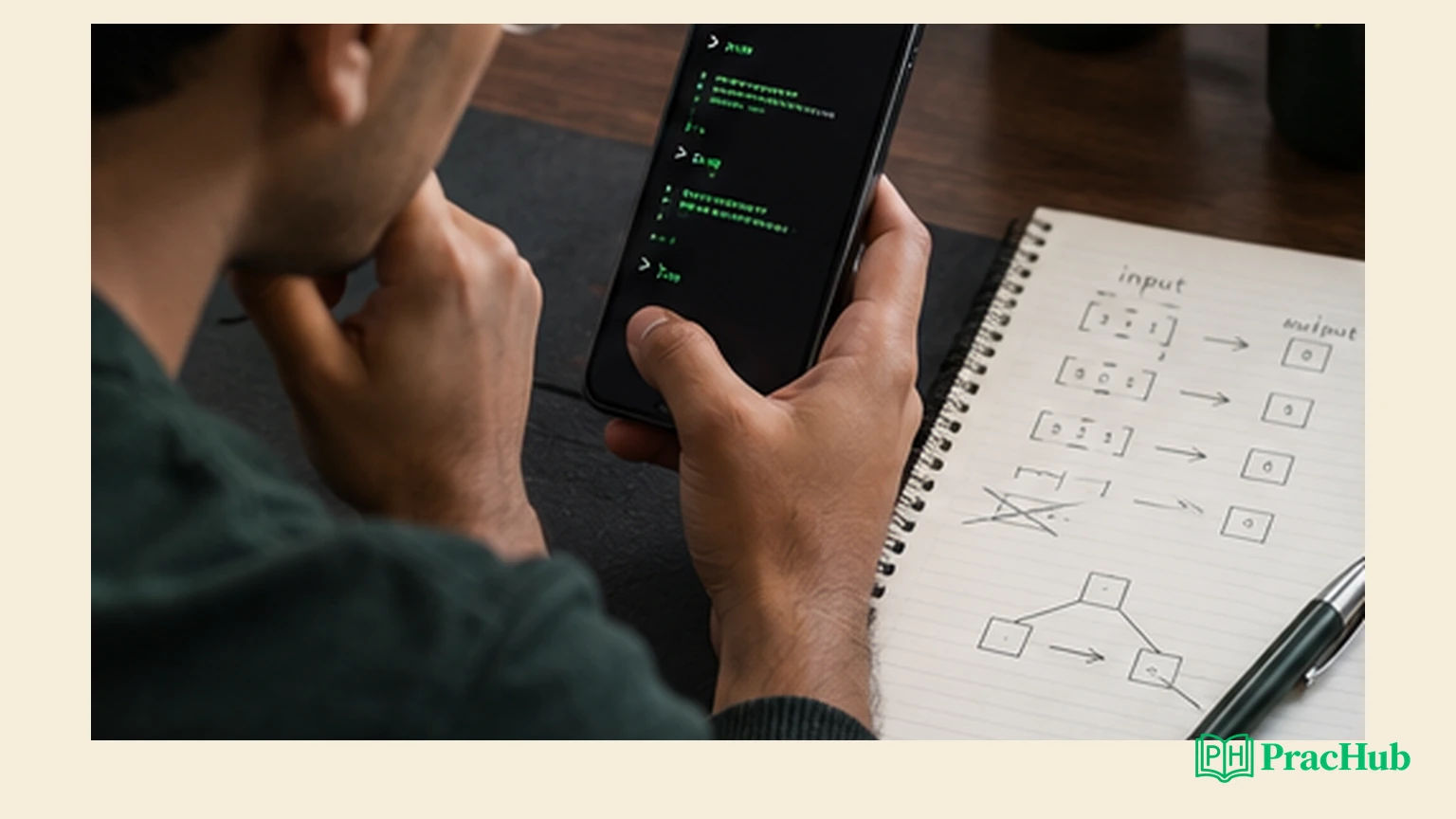
Separate the surfaces described in Google Play
The Coding Hub developer listing describes lessons with code and exercises across many subjects, a runner for trying programs, Algo Lab problems grouped by interview patterns, and interview questions with model answers. It also describes quizzes, mixed mock tests, repeated review of wrong answers, and an AI tutor. The Google Play surface lists in-app purchases. It does not make the runtime, quotas and saved feedback of every feature clear on the public page.
Start with the smallest requirement that matters. If you are learning Python, you might need to see the output of a function you wrote. If you are preparing to code for an interview, you might need a prompt with constraints and several kinds of input, including the ones your first solution gets wrong. An independent runtime and a practice bank can both contribute, even when a particular bank question does not use the same runner.
| Listing describes | What you can look for | Evidence worth keeping |
|---|---|---|
| Language lesson | A concept and readable example | A prediction before you run the sample |
| Mobile Code Runner | An execution surface for supported code | The input and program output from one case |
| Algo Lab task | A problem with a stated objective and solution | A reasoning note and a new test that can fail |
| Mixed mock or quiz | A format that may combine theory and implementation | Which item was tested and how its result was determined |
| AI tutor | Developer-described help and mock practice | A scoped correction you can independently verify |
The distinction matters for language versions and code setup. A display of “Python” leaves open the version, allowed imports, local versus network dependency and what happens to a long-running task. Those details may be irrelevant when you only need to pop a list. They matter when your implementation depends on a module or exact I/O behavior. In a real placement or developer round, follow the platform and tool restrictions named in the invitation.
Run the smallest counterexample yourself
Suppose a lesson introduces a Python list as a stack. The Python data structures tutorial describes using the end of a list for push and pop. For an independent exercise, accept brackets of three types and decide whether every closing symbol matches the most recent still-open symbol. The empty sequence should be valid if the contract allows it. Adding regular text creates a separate choice about whether to ignore or reject it.
Before writing code, predict four cases. The inputs ([]) and []{} are valid. The string ([)] is invalid because the close parenthesis reaches a square bracket on top. A lone ] is invalid because there is nothing to match. Add [( as a case that runs out of input with work remaining. These examples let you classify failure as crossing, early closure, or unclosed items. A count of total open and close brackets cannot verify all those conditions.
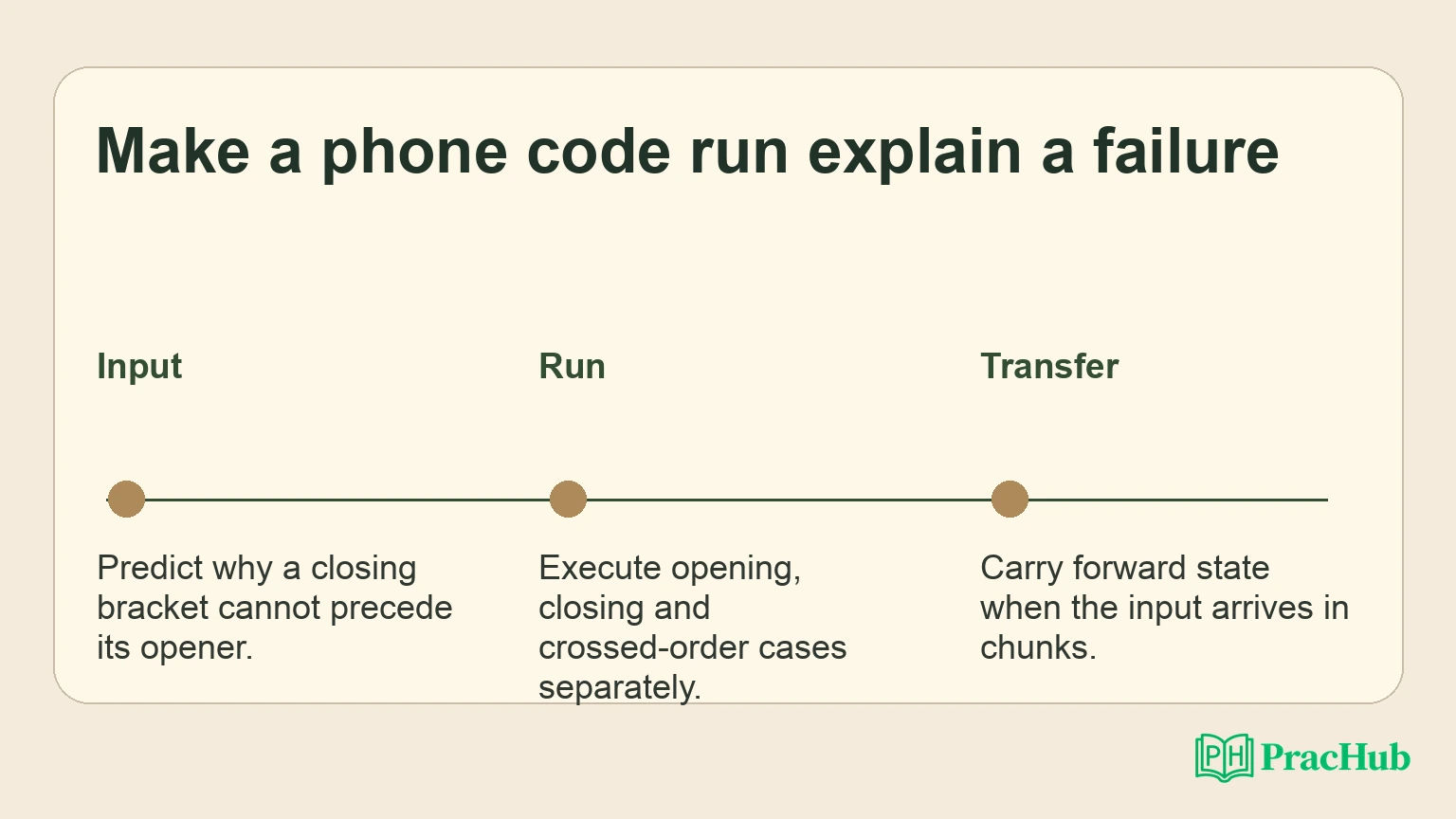
A short implementation scans the characters and stores open symbols. For each closing symbol, check for a nonempty stack and the matching opener before moving on. After the loop, check that the stack is empty. Run the five cases individually. If the runner prints a boolean and nothing else, the work remains interpretable because you already wrote the expected result. If the same code is being graded by the Algo Lab, consult the problem's entry point and output format rather than assuming it accepts your standalone print statements.
The most efficient use of a failure is to give it a name. If ([)] passes, examine matching by count or type before you change the function. If ] causes an exception, identify the first operation that assumed a nonempty stack. If [( passes, add an end-state check. This diagnosis is practice for talking through errors as they happen. A pass on only ([]) would have hidden all three mistakes.
Change the question before relying on a familiar solution
Now the input arrives in separate chunks. The first chunk is ([ and the second is ]). Treating each chunk as a final program input makes the first look incomplete and the second look invalid. Preserve the stack across chunks. Check for unmatched opening symbols only when the stream ends. A closing symbol with an empty stack is already invalid and need not wait for more input.
Ask an interviewer whether the process must identify the exact character index of the first violation. If yes, keep a running offset across chunks. If the process accepts a fixed stream memory limit, state how nesting depth affects the stack. The algorithm can process each character once, but space depends on the maximum unclosed depth. This second question shows whether a learner can modify a known pattern rather than recognizing the title of a familiar exercise.
A further variation adds quoted text. A bracket inside a quoted field may be data rather than structural syntax. A small parser has to account for quote state and the contract for escapes. Keep the variants separate in your notes because solving the original three-bracket exercise doesn't imply that you solved the quote-aware format. For a short practice attempt, put the new language rule into one failing test before redesigning the program.
Check how the mock and tutor fit a candidate's workflow
The developer describes quizzes, mixed mocks and AI assistance. A question that asks you to select working code differs from running your own solution. If using the app, ask which parts of the mock are selected answers and which require implementation. Then see whether you can inspect the expected output and revise an incorrect response. Keep the test brief enough that you can repeat it with one new input after you see the explanation.
A tutor is most useful when it points you at a bug you can reproduce. Present the symptom with a small input, such as the lone closing bracket that triggered a pop. Ask why it failed before asking for an entire replacement. Try the change in the same program. If the tutor suggests broad defensive checks but cannot connect them to the observed state, use an independent test to decide which change matters. I did not exercise the app's tutor, so this is a way to evaluate its usefulness rather than an appraisal of a delivered response.
A beginner who benefits from switching between a reading example and a small execution may get value from the described workflow. If you already know the language, a better use of that time is choosing a fresh Algo Lab prompt, writing the expected behavior and running one counterexample. If your next round asks for project discussion or system design, schedule another rehearsal that includes explanation and changing requirements. A phone tool can provide the start of the task. The working artifact and the reasoning establish where it transferred.
Compare the accepted prompt with the program you ran
Try the same predicate in two environments. In the first, call a function with a string and return a boolean. In the second, read one line from standard input and print the exact result requested. The algorithm is the same, but the code that feeds it and observes it has changed. A phone run can confirm that a function accepts ([]). It cannot establish that another grader expects the word “true”, the number 1, or a boolean return. Read the real entry contract before moving to a timed attempt.
Use a small result grid in your notes. Include the input characters, expected output, actual output and first point where the stack was wrong. If one test result is hidden, use the known outcomes to construct a failure hypothesis instead of changing multiple lines at random. For example, a failure only on an empty string may reveal that initialization returns the wrong default. A crossed-order failure points to the removal logic. The two clues lead to different changes.
The move from language lesson to Algo Lab should also change how you work with hints. In a lesson a hint can be a useful way to learn the syntax needed to start. In an interview-style problem, try another input before looking at the hint and record whether the hint supplied the algorithm or a small correction. The next session can test the part you did not generate independently.
A diagnostic practice session finishes with a changed input, not a longer list of lessons. For the streaming case, try two consecutive chunks where the first begins a quoted section and the second contains a bracket that should be treated as text. If your contract excludes quotes, document the restriction. If it includes them, explain which small state needs to travel across the chunk boundary. This makes the second exercise a meaningful extension of the first instead of a repeat with more characters.
Lastly check what success the tool displays. Viewing a sample solution, running one custom input, and seeing a judge accept the implementation are distinct observations. Write down which one you reached before you close the session. A candidate who has a conceptual example and no result can still schedule the right next step. A candidate who has five tests for the wrong interface has a different problem to solve.
Use Python’s unit testing reference if you want to keep the bracket fixtures alongside a small implementation. Give each failure class its own test name. A test collection with descriptive names stays useful when you later change the input contract. Running named tests on your laptop also verifies one result independently of any app-specific execution wrapper.
Five independent coding prompts after a mobile run
| PracHub question | What to rehearse |
|---|---|
| Validate parentheses with one or three bracket types | Check ordering and a surplus closing delimiter. |
| Implement a FIFO Queue Using Two Stacks | Trace a mixed sequence of enqueue and dequeue calls. |
| Compute window averages and merge intervals | Name the output contract before running a solution. |
| Find index of first unique character | Check the difference between a character and its index. |
| Analyze and debug Python utilities | Reproduce one failure independently before changing code. |
Give each problem a small input that could fail for a distinct reason. Record the expected output before running your code. Use a fresh problem to check whether the pattern transfers beyond the lesson title.
Comments (0)