CyberKy Review: Role Pathways, Browser Labs, and Security Mock Interviews
Quick Overview
Compare CyberKy’s SOC, IAM and GRC pathways, advertised browser labs and spoken AI interviews. Includes an original offboarding timeline and clear boundaries on untested scoring and access.
CyberKy is worth examining if you want cybersecurity learning paths, browser labs and spoken interview practice in one platform. Its public pages distinguish those surfaces, but they do not establish how well a lab runs or whether an AI score reflects technical readiness. Decide which role-specific evidence you need to produce before selecting a pathway or paid plan.
PracHub publishes this review and owns the complementary practice links. Our production-incident explanation question offers another place to defend what you observed and personally did. The offboarding timeline and role-to-evidence map below are original educational examples, not CyberKy lab results.
What the public platform separates
Provider positioning, checked November 3, 2026: CyberKy’s platform page presents sequenced career pathways, browser-based labs, AI interviews and resume tools. It names SOC, IAM, GRC and offensive-security preparation alongside certification-oriented routes. We inspected the public descriptions without enrolling or creating an account.
The combined offer connects several preparation activities in one place. It also creates several different claims to evaluate. Completing lessons, performing an operation in a lab and explaining a decision aloud are different activities. Progress in one does not automatically establish competence in the others.
This review uses current public pages and one observed access boundary. We did not launch a lab, submit a resume, grant camera or microphone access, record an answer or receive a score. No independent candidate reports or measured hiring outcomes support a readiness conclusion here.
Pathways provide sequence, not a demonstrated level
The public pathways page describes ordered courses, estimated workload and progress tracking. Its visible cards included SOC Analyst with 16 modules, IAM Engineer with 29 and GRC Analyst with 16. Those are displayed curriculum labels, not module counts we completed or quality measures we calibrated.
We followed the SOC Analyst card. It redirected to a sign-in page with a return path to that pathway. This establishes the access boundary we encountered; it does not establish what an authenticated free learner can finish. The public page says free accounts can start free courses, while paid plans unlock additional features.
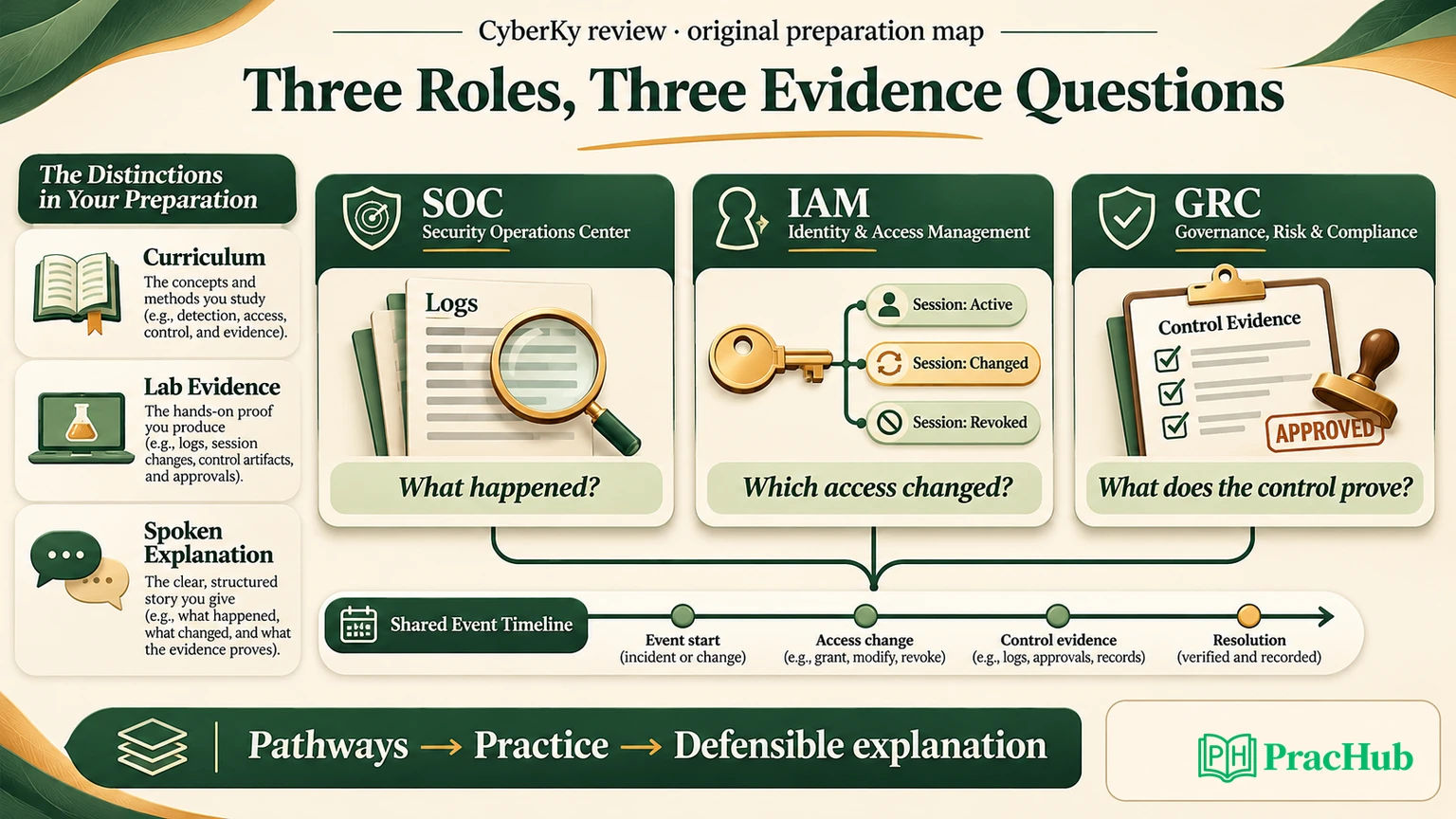
Our recommendation is to select a pathway by the decisions the target role requires. A SOC learner needs to distinguish observations from hypotheses. An IAM learner needs to explain access behavior and lifecycle changes. A GRC learner needs evidence of control operation, exceptions and accountable decisions.
Here is an original role-to-evidence map based on that distinction. It is a preparation aid, not CyberKy’s assessment rubric or a reconstruction of any employer’s interview.
| Role focus | Artifact to produce | Interview explanation to defend |
|---|---|---|
| SOC | A short event timeline with evidence sources | What is observed, what is suspected and what to check next |
| IAM | A state trace for an account and its sessions | Which access changes, when, and at which enforcement point |
| GRC | A control test with scope, owner and exception | What the evidence demonstrates and what risk remains |
The same event can support different discussions. Use the overlap to connect related subjects while keeping each claim of experience within its demonstrated scope. Keep the artifact and the decision you can explain attached to your progress record.
Browser labs and simulated lesson artifacts have different boundaries
The labs page describes paid, isolated environments reached through a browser remote desktop. Its examples cover osquery threat hunting, LDAP groups, Keycloak access control and OpenSCAP compliance work. It says a timer is visible and one environment runs at a time. We verified those descriptions, not the environments’ execution.
The same page separately describes simulated lesson artifacts, including logs, process trees, access requests and risk registers. That distinction is useful. A simulation can exercise interpretation, while a running environment can expose configuration and operational behavior. Neither format automatically proves that the learner can perform the task unaided elsewhere.
Before choosing a lab, identify its expected output. A command history may show which operations ran. A before-and-after access test can show a behavior change under specified conditions. A report can connect the observation to a decision and preserve the uncertainties. These outputs answer different questions.
For an interview, bring the explanation that accompanies the output. Describe the starting state, your intended change, the result and the relevant limit. If you followed step-by-step instructions, say which parts you subsequently reproduced or varied yourself. That is more precise than presenting guided completion as independent incident handling.
Original case: offboarding has more than one state
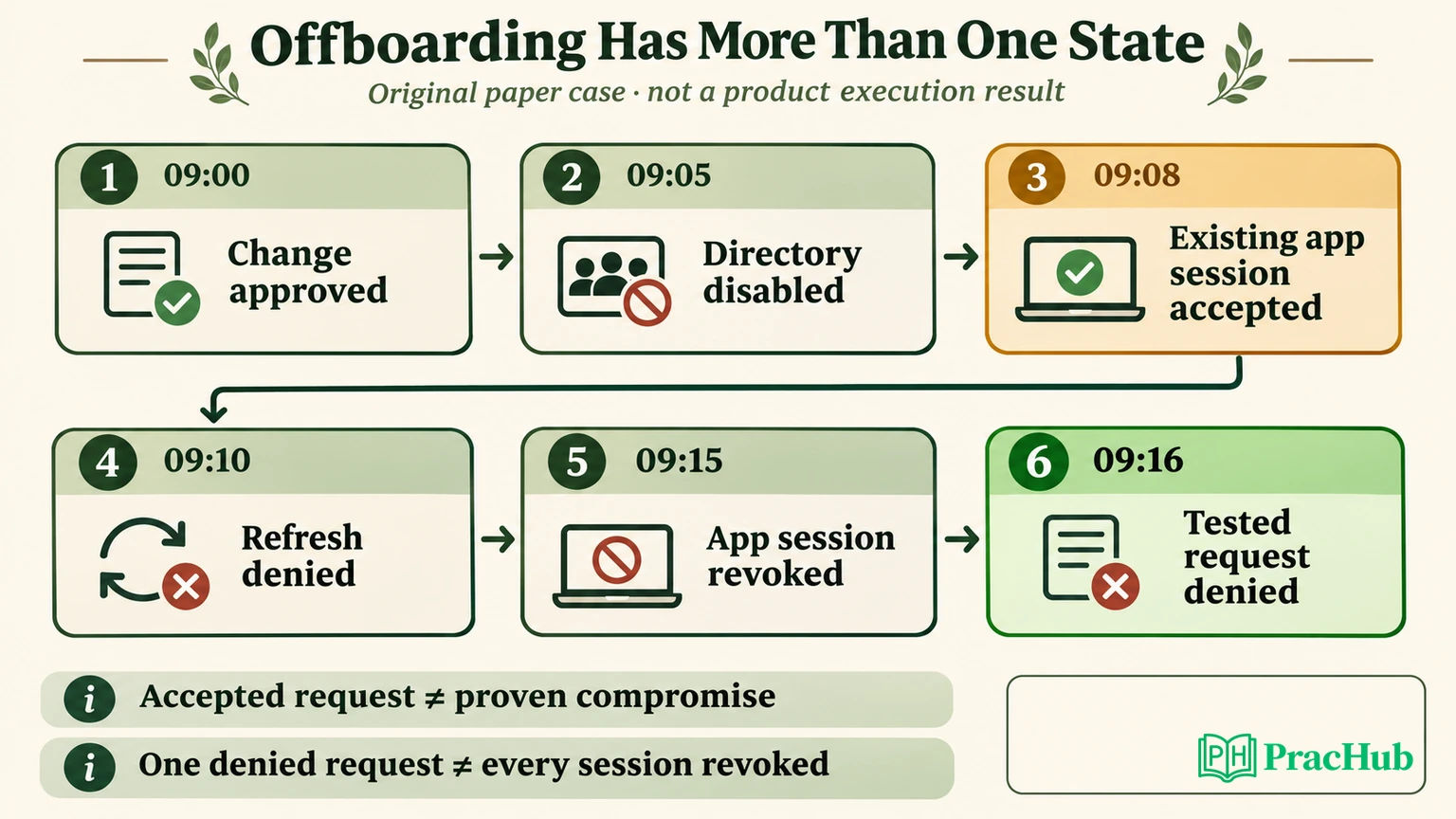
Consider an invented offboarding exercise. An account is disabled in a directory, but an application has its own existing session. For this paper case, that session remains usable until an explicit application revocation. This is our chosen model, not a claim about CyberKy’s Keycloak lab or any identity product’s default behavior.
| Time | Invented observation | What it establishes |
|---|---|---|
| 09:00 | Offboarding change approved | A documented change decision exists |
| 09:05 | Directory records the account as disabled | Directory state changed |
| 09:08 | Application accepts a request under an existing session | That request was accepted at the application |
| 09:10 | Identity provider denies token refresh | That refresh attempt was denied |
| 09:15 | Application records session revocation | An application-side action was recorded |
| 09:16 | Controlled request with the tested session is denied | The tested request no longer succeeds |
The 09:08 record does not by itself establish who used the session or whether a compromise occurred. The 09:10 denial does not establish that an already-existing application session was rejected. The final check supports a bounded recovery statement about the tested session and request.
Official Keycloak administration documentation describes sessions and logout propagation to client applications. A real investigation needs the actual client integration, session and token configuration. Do not generalize this paper model into a universal revocation guarantee or delay for Keycloak, Entra or another system.
An IAM-focused answer would distinguish account state, new authentication, refresh behavior and application-session enforcement. A SOC-focused answer would preserve the event sources and seek context for the accepted request. A GRC-focused answer would compare the observed revocation interval with the approved control requirement.
A useful follow-up removes one observation. If the 09:16 verification is missing, you can say that revocation was attempted and logged; you cannot claim the affected access was demonstrably blocked. If timestamps use different clocks, establish their alignment before inferring a precise sequence or duration.
Explain an incident without inflating the conclusion
Compare two original answers to the paper case. The first says that a disabled account accessed the application, so the system was breached and the problem was completely fixed. It compresses uncertainty into conclusions that the timeline does not establish.
The second says that the application accepted one logged request using an existing session after the directory change. It distinguishes that observation from the unknown actor, describes the application revocation and reports the controlled denial that followed. It leaves the scope of other sessions and applications open.
The second answer links each conclusion to a specific observation and preserves the unknowns. It is not a model answer from CyberKy, and we did not submit either version to its coach. Use the comparison to review evidence quality without assigning an unvalidated score.
Use this original review sequence when rehearsing a lab or project:
- Identify the source of each observation and its relevant time window.
- State the hypothesis separately from the fact that motivated it.
- Explain the authorized action, expected effect and possible side effects.
- Report the verification that reached the affected access path.
- Name what remains untested and who owns the next decision.
NIST’s current incident-response publication, SP 800-61 Revision 3, places incident response within cybersecurity risk management. It provides a broader framework; our small timeline is not a NIST compliance assessment or a substitute for an organization’s incident procedure.
What the AI interview feedback can and cannot establish here
The interview-preparation page advertises questions read aloud, voice answers of up to three minutes, transcripts and per-question feedback. It lists interview personas ranging from recruiter to SOC Manager, Senior Security Engineer and CISO, with different focus labels. It also describes STAR feedback, speaking pace and filler-word measures.
Those are provider descriptions. We did not test question selection, follow-up depth, transcription accuracy, scoring consistency or technical correctness. The page says the optional camera view remains on the device; we did not inspect the application’s data flow or validate that claim independently.
When you evaluate feedback, separate delivery from substance. A slower answer with fewer filler words can still misidentify an incident cause. A well-structured STAR story can still claim an action you did not perform. Check any proposed improvement against your evidence and responsibility before rehearsing it.
Use a short known case to establish your own comparison. Ask whether feedback catches the unsupported breach conclusion in the first paper answer, preserves the uncertainty in the second and requests a recovery check when one is missing. That is a proposed evaluation method, not a result we observed from the product.
Check the plan unit before paying
Direct observation on November 3: the plans page opened with yearly billing selected. Premium displayed $240 billed yearly, expressed as $20 per month, with Interview Coach at five per month and Resume Accelerator at ten per month. Ultra displayed $480 yearly, expressed as $40 per month, and advertised unlimited use of those tools.
With yearly billing selected, distinguish the upfront yearly total from the displayed monthly equivalent. We did not subscribe, verify an allowance reset or test what constitutes one interview use. Confirm the active billing period, total, usage unit and any applicable limits before purchasing.
The career-tools page describes resume and job-description input, scores and suggested rewrites. We did not upload documents or evaluate those scores. A suggested bullet should preserve the distinction between a guided lab, an independent project and commercial responsibility.
If human review matters to you, also distinguish the platform’s AI tools from the separately described Academy one-to-one offering. Confirm which service and feedback you are actually buying. The public presentation alone cannot establish the quality of either.
Practice the gaps the product leaves open
These complementary PracHub questions let you practise the evidence behind an incident explanation, an access decision and alert prioritization. They are separate from CyberKy’s labs and AI interview questions.
| PracHub question | What to examine |
|---|---|
| Explain Your Role in a Production Incident | Separate your observations, actions and verified recovery from the wider team’s work. |
| Design an IAM system for services and users | Model account state, credentials and sessions before defining offboarding behavior. |
| Design an RBAC Relational Schema | Explain which subject can access which object and how a role change takes effect. |
| Explain auth, key rotation, secrets, and incident response | Connect authentication and incident response to evidence and a bounded action. |
| Helping SOC Analysts Handle Fewer, Higher-Value Security Alerts at Microsoft | Prioritize analyst attention without confusing a large alert count with useful detection. |
Who should consider CyberKy next
Consider CyberKy if its security pathways and advertised lab subjects match a specific learning gap. The public pages make the offer understandable, while the sign-in boundary and paid-feature descriptions leave important execution and feedback questions open. This review does not establish job readiness or independently validated mock quality.
For a concrete next step, use the production-incident explanation question. Build a small timeline, mark every observation and hypothesis, and defend one recovery claim. Then decide whether you need more subject instruction, an execution environment or feedback on your explanation. Use that learning gap to choose the next activity and the evidence it should produce.
Comments (0)