Deep-ML Review 2026: Is It the LeetCode for Machine Learning?
Quick Overview
Deep-ML is a free, open-source machine learning challenge platform with browser-based Python problems, instant test feedback, labs, projects, collections, and interview-prep paths. This 2026 review examines whether it deserves the LeetCode for machine learning label, what its free and $16 monthly Premium plans include, where its ML implementation drills are strongest, and which interview rounds still require broader preparation. It also explains how to combine Deep-ML skill practice with PracHub's real company questions and full-loop preparation.
“LeetCode for machine learning” is an irresistible description. Open a browser, implement softmax or linear regression, pass test cases, and build ML fluency one problem at a time.
Deep-ML comes closer to that experience than most learning platforms. But even Deep-ML's own FAQ says the comparison is not quite accurate. The platform is designed to teach ML concepts from math to code, while LeetCode focuses primarily on general algorithmic problem solving.
For interview preparation, the distinction matters. Use Deep-ML for targeted skill drills, then use PracHub for real interview questions with written solutions and company-specific interview prep across the rest of the ML interview loop.
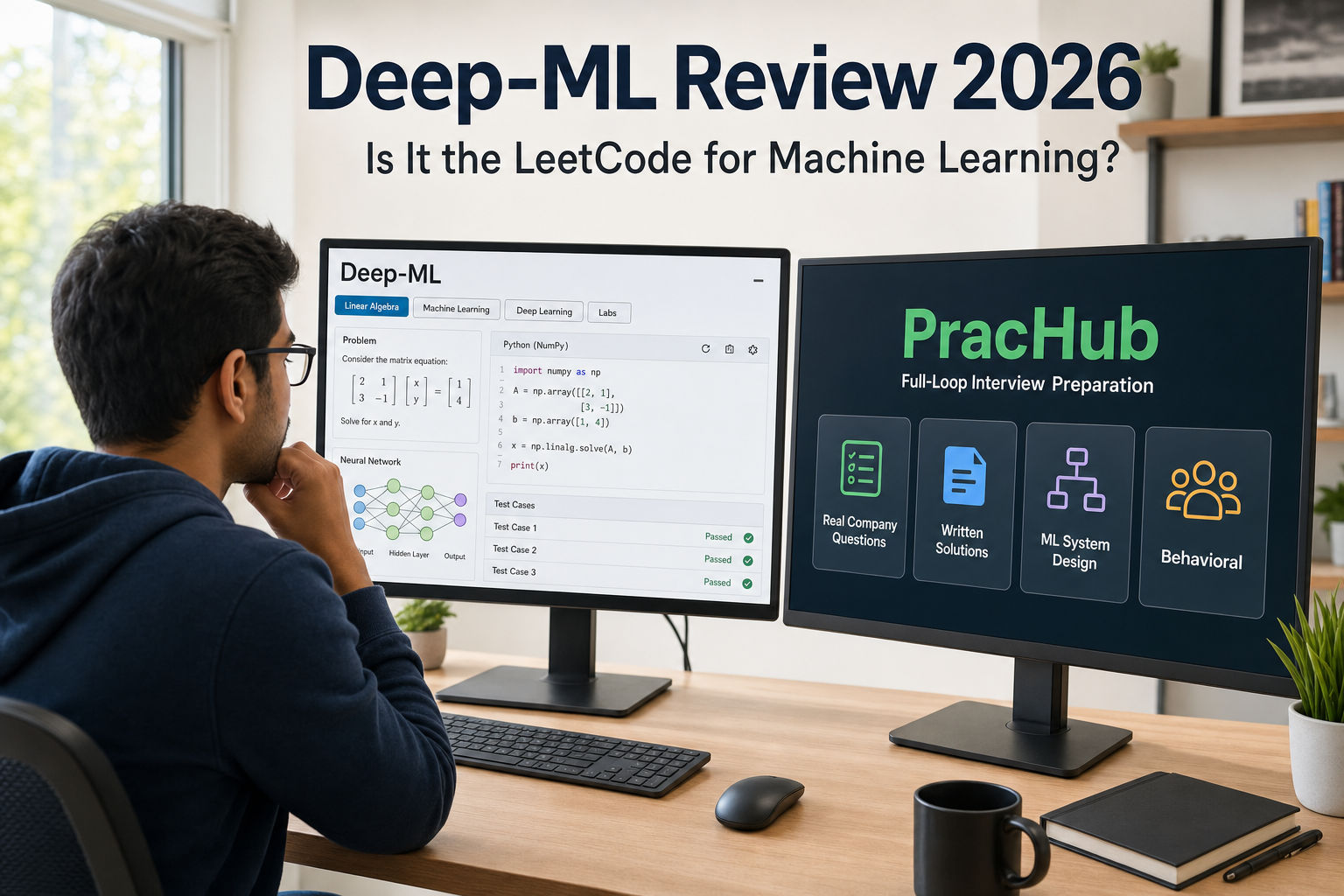
Deep-ML builds ML implementation depth; PracHub connects practice to real company interviews and full-loop preparation.
Quick Verdict
Deep-ML is one of the strongest free places to practice machine-learning concepts through code. Its best problems make you implement the math and mechanics behind ML instead of calling a high-level library and moving on.
It is not a complete replacement for LeetCode, and it is not enough by itself for most machine learning engineer or data scientist interviews. Those loops can also include DSA, Python, SQL, statistics, product sense, ML system design, project deep-dives, and behavioral rounds.
The best workflow is complementary: diagnose the real interview with PracHub, drill a weak ML concept on Deep-ML, then return to timed company-specific questions.
What Is Deep-ML in 2026?
Deep-ML is a browser-based, open-source ML practice platform. Its core challenge page highlights more than 100 curated coding problems, while the broader 2026 navigation advertises over 1,200 hands-on ML problems and learning activities.
Users write Python solutions in the browser and receive test-case feedback. Problems span linear algebra, machine learning, deep learning, natural language processing, and computer vision, with beginner through advanced difficulty filters.
The product has also expanded beyond short problems. It now includes learning paths, math exercises, collections, contests, labs using real datasets, and projects that combine smaller checkpoints into complete builds such as a GPT model, reinforcement-learning agent, or CUDA kernels.
Is Deep-ML Really the LeetCode for Machine Learning?
As shorthand, yes. Both platforms turn technical practice into small, testable challenges with difficulty levels, an in-browser editor, progress tracking, and repeatable reps.
As a literal comparison, no. LeetCode asks, “Can you recognize and implement this algorithmic pattern?” Deep-ML more often asks, “Do you understand this ML operation well enough to derive or implement it?”
That means Deep-ML is closer to an interactive ML implementation lab than a direct LeetCode clone. For ML candidates, that difference is a strength.
What Deep-ML Does Well
It Connects Math to Code
ML interviews often expose shallow understanding quickly. It is easy to call a library function; it is harder to explain tensor shapes, derive a loss, implement an activation, or reason about numerical stability.
Deep-ML's from-scratch format makes those gaps visible. Linear algebra, gradients, regression, clustering, neural networks, attention, NLP, and computer-vision exercises force active recall instead of passive reading.
It Gives Fast, Focused Feedback
Starter code and test cases make a concept concrete. You can attempt a small implementation, see what fails, and revisit the Learn section without setting up a local notebook or full project.
This is especially useful for topics where shape errors, indexing, normalization, or a missing edge case matter as much as the high-level idea.
Labs and Projects Add Practical Context
Deep-ML's labs use datasets and metrics such as accuracy, F1, and MSE. Projects assemble small problems into a larger build. These formats reduce the biggest weakness of isolated coding drills: solving a function without seeing how it behaves inside a model or workflow.
The Core Practice Is Free and Open Source
Deep-ML's FAQ says its problems are free and available through its open-source repository. That makes the platform easy to test before paying for Premium and gives learners a way to inspect or contribute to the content.
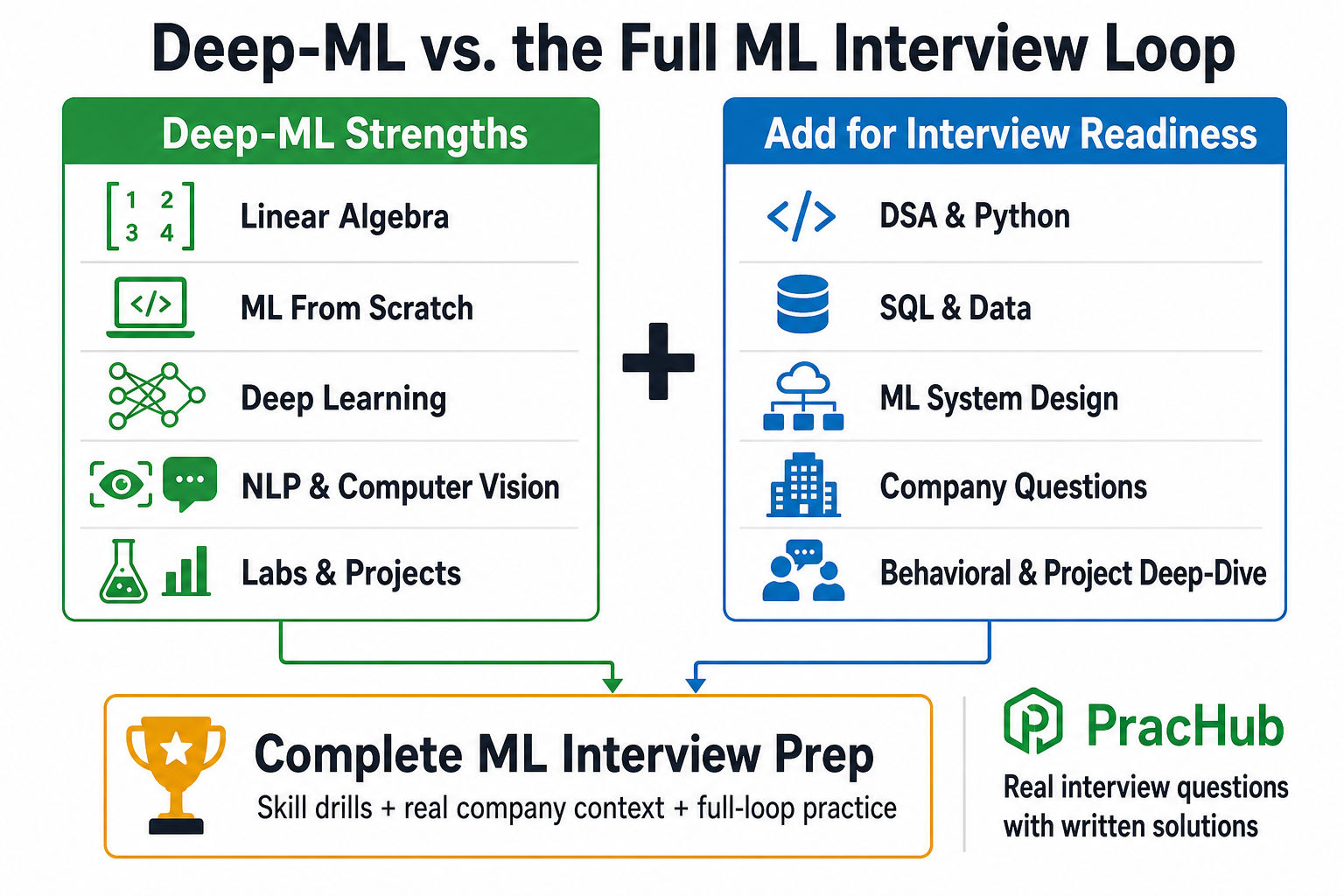
Deep-ML covers valuable ML skill drills, while interview readiness also requires company context and full-loop practice.
Deep-ML vs. LeetCode vs. PracHub
| Platform | Strongest use | Typical practice | Main interview gap |
|---|---|---|---|
| Deep-ML | ML math and implementation depth | NumPy, ML, deep learning, NLP, CV, labs | Not a complete substitute for every interview round |
| LeetCode | General DSA and coding patterns | Arrays, graphs, dynamic programming, algorithms | Limited ML theory and production ML context |
| PracHub | Real company questions and full-loop targeting | Coding, SQL, ML, system design, behavioral | Use focused learning tools when a concept needs deeper instruction |
You do not need to choose only one. An MLE candidate may use LeetCode for DSA, Deep-ML for ML implementation, and PracHub to decide which skills actually matter for a target company.
Where Deep-ML Falls Short for Interview Prep
ML Coding Is Only One Part of the Loop
Many MLE interviews still include ordinary Python or DSA questions. Data-science loops may emphasize experimentation, probability, product metrics, and SQL interview practice more than implementing a neural network from scratch.
Short Challenges Do Not Fully Test System Judgment
A passing function does not show whether you can choose training data, design offline and online features, prevent leakage, deploy a model, monitor drift, or balance latency against quality. Senior candidates still need system design questions and end-to-end ML design practice.
Company Pages Are a Starting Point, Not a Guarantee
Deep-ML now offers company and role interview-prep paths, paced plans, projects, and readiness tracking. Those additions are useful, but no public guide can guarantee a company's current process or exact questions.
Cross-check the target with recent interview evidence and practice answering company-tagged prompts without hints. That is where PracHub's real-question context is most valuable.
Free Usage Has Execution Limits
The problems remain free, but the live Premium page shows lower free-account limits for submissions, validations, saved solutions, playlists, and PyTorch executions. Casual learners may never notice; high-volume users may.
Deep-ML Pricing in 2026
As checked on August 2, 2026, Deep-ML Premium costs $16 per month or $132 per year, displayed as $11 per month when billed annually. Pricing can change, so verify the checkout page before subscribing.
Premium adds faster execution, no ads, problem breakdowns, AI-powered hints, higher usage limits, PDF and question-generation tools, a step-through debugger, and collection badges.
Is Deep-ML Premium Worth It?
Start free. Upgrade only after you have used the platform consistently enough to hit limits or know that its breakdowns, debugger, AI tools, and Premium collections will save meaningful study time.
For a candidate with interviews already scheduled, first confirm that the target loop contains enough ML implementation to justify the subscription. Interview relevance matters more than platform streaks.
Who Should Use Deep-ML?
Deep-ML is a strong fit for students, data scientists, ML engineers, and AI enthusiasts who understand concepts in theory but struggle to implement them. It is also useful for experienced practitioners refreshing linear algebra, NumPy, model mechanics, or newer deep-learning topics before interviews.
It is less urgent for candidates whose immediate gap is generic DSA, SQL, behavioral storytelling, or senior ML architecture. Use the tool that matches the weakest round, not the most interesting topic.
The Best Deep-ML Interview Workflow
1. Map the Company and Role
Use PracHub to identify the expected rounds and collect a small set of company-specific questions. Separate ML implementation from DSA, data, design, and behavioral work.
2. Attempt a Realistic Question First
Try the prompt under time pressure before studying. The failure tells you whether the gap is syntax, math, modeling judgment, or communication.
3. Drill the Gap on Deep-ML
Choose two or three focused problems, a lab, or a project checkpoint. Explain shapes, complexity, and numerical choices aloud instead of optimizing only for passing tests.
4. Return to Company Practice
Re-answer the original prompt without hints, then attempt a related question cold. This verifies that the concept transferred beyond Deep-ML's format.
5. Complete the Interview Loop
Add ML system design, a project deep-dive, and behavioral and leadership practice. Prepare to explain not only how an algorithm works, but why you chose it and what happened in production.
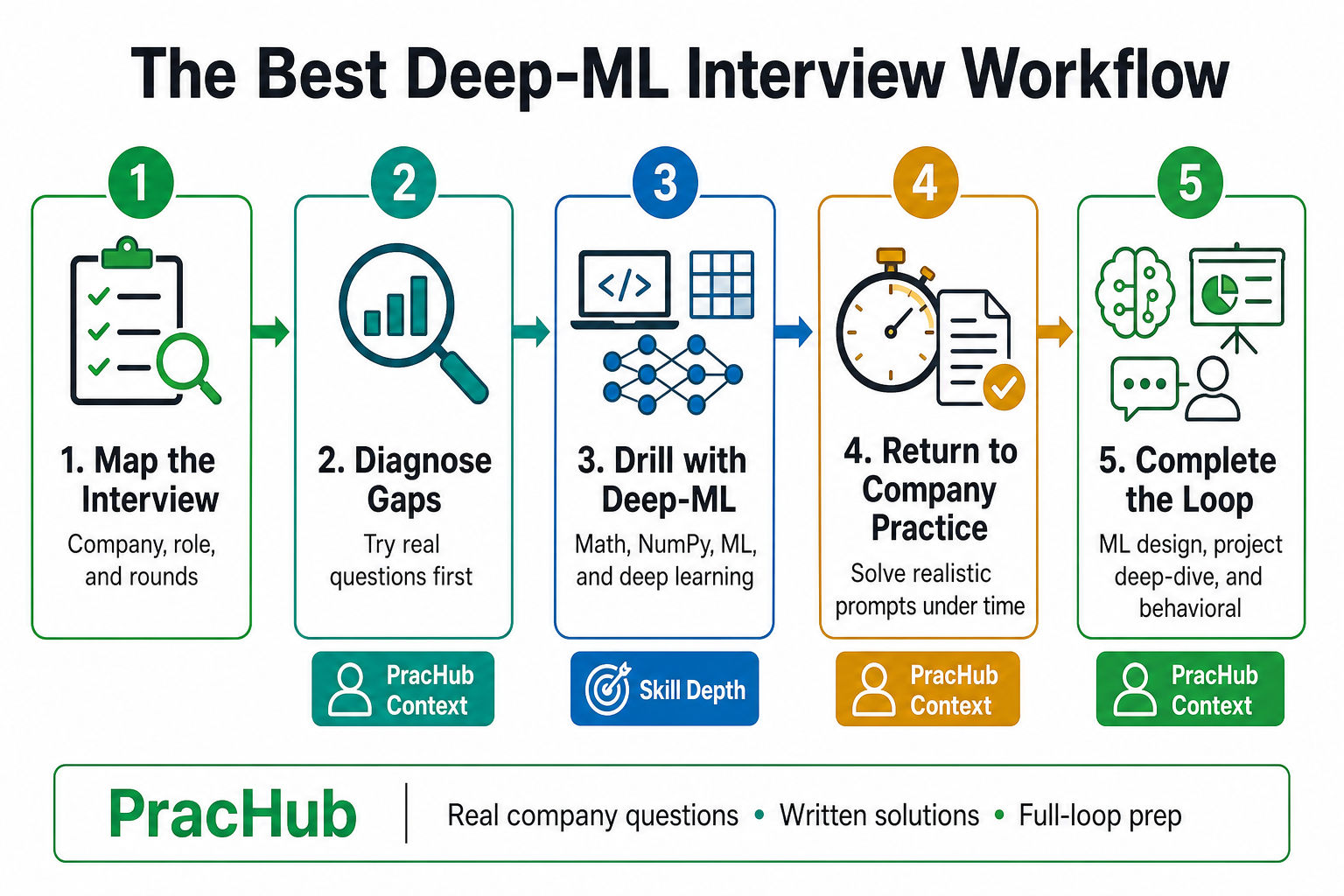
Use Deep-ML to deepen a diagnosed skill gap, then return to realistic company and full-loop practice.
Deep-ML Review FAQ
Is Deep-ML free?
Core problems are promoted as free and open source. Premium adds higher usage limits, faster execution, deeper breakdowns, AI tools, debugging, and additional collections.
Does Deep-ML replace LeetCode for MLE interviews?
No. Deep-ML is stronger for ML-specific math and implementation, while LeetCode remains useful when the interview includes general DSA. The correct mix depends on the role and company.
Is Deep-ML enough for a machine learning interview?
Usually not by itself. Most loops require some combination of coding, ML theory, SQL or data work, ML system design, project discussion, and behavioral communication.
What is the best Deep-ML alternative?
It depends on intent. Use LeetCode for DSA, a SQL platform for concentrated query practice, and PracHub for real company questions, written solutions, and broader interview-loop coverage.
Final Verdict: Excellent ML Drills, Incomplete Interview Prep
Deep-ML earns the “LeetCode for ML” nickname because it makes machine-learning implementation practice accessible, testable, and repeatable. Its math-to-code focus, open-source problems, labs, and projects make it genuinely useful.
But passing ML coding challenges is not the same as passing an ML interview loop. Use Deep-ML for skill depth and PracHub for interview context. Start with real interview questions and written solutions, drill the weak concept on Deep-ML, and return ready to answer the same idea without scaffolding.
Official references: Deep-ML's FAQ, problem catalog, labs, projects, interview-prep page, Premium page, and open-source repository.
Related Articles
MLInterview.org Review 2026: Question Bank vs Real Company ML Interviews
Read our MLInterview.org review comparing its ML question bank and explanations with real company interviews, plus a better PracHub practice workflow.
Generative AI System Design Interview Book Review 2026: Is It Still Enough?
Generative AI System Design Interview book review for 2026: strengths, missing topics, best readers, and how to combine it with PracHub practice.
Is Chip Huyen's Designing Machine Learning Systems Enough for MLE Interviews?
Is Designing Machine Learning Systems enough for MLE interviews? See what Chip Huyen's book covers, what it misses, and the best prep workflow.
Generative AI System Design Interviews: How to Design LLM Applications That Work in Production
Prepare for GenAI system design interviews with a practical guide to LLM apps, RAG, agents, evaluation, safety, latency, and cost.
Comments (0)