Design System Interview Questions for Frontend Engineers: Tokens, APIs, Accessibility, and Governance
Quick Overview
Practice senior design system interview questions covering token architecture, DTCG 2025.10, component API design, theming, accessibility contracts, testing, Semantic Versioning, migrations, contribution workflows, governance, and adoption metrics. The guide helps frontend engineers answer design system questions as both architecture and organizational problems.
A component library can ship polished buttons and still fail as a design system. The harder work is defining durable decisions, accessible interaction contracts, safe APIs, and a contribution model that product teams will actually use.
These design system interview questions for frontend engineers focus on that harder layer. You will practice explaining token architecture, component composition, theming, accessibility, releases, governance, and the trade-offs behind a platform used by many teams.
Use PracHub to rehearse those decisions under interview pressure. Start with real interview questions with written solutions, then use company-specific interview prep to adapt your answer to the product scale, frontend stack, and organizational model of your target company.
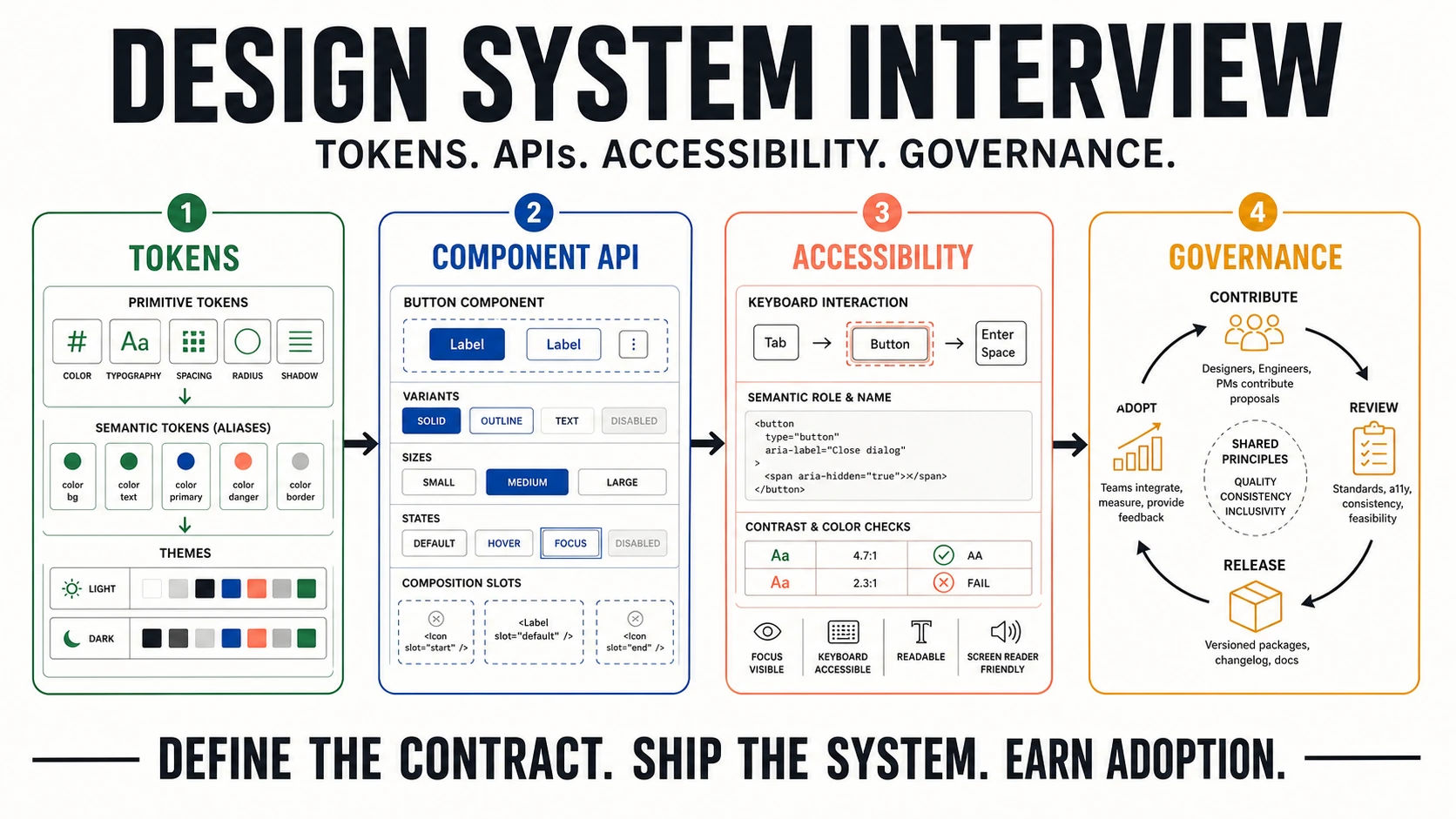
A senior design system answer connects tokens, component APIs, accessibility, releases, and governance.
Quick Verdict
A strong answer treats the design system as a product and a dependency. Explain the contract it offers, the constraints it enforces, how changes reach consumers, and how the team knows whether the system is improving product delivery.
| # | What a senior answer should cover |
|---|---|
| 1 | Foundations: token meaning, aliases, themes, platforms, and ownership. |
| 2 | APIs: composition, state, escape hatches, and compatibility. |
| 3 | Inclusion: semantics, keyboard behavior, focus, contrast, and testing. |
| 4 | Operations: releases, migration, contributions, adoption, and support. |
Design System Architecture Questions
1. What Is the Difference Between a Component Library and a Design System?
A component library is reusable implementation. A design system includes the decisions and operating model around it: principles, tokens, components, content guidance, documentation, testing, releases, contribution rules, and governance.
The library is an artifact. The system is the contract and process that keep products coherent while still allowing teams to solve new problems.
2. How Would You Structure Design Tokens?
A practical model separates primitive values from semantic intent and, where useful, component-specific decisions. For example, a blue primitive can feed color.action.primary, which a Button consumes without knowing the raw value.
Semantic names survive theme and brand changes better than names such as blue-500. Keep aliases traceable, avoid deep indirection, and define which layer product teams may consume directly.
3. What Does the DTCG 2025.10 Specification Change?
The Design Tokens Community Group published its first stable format in October 2025. It defines a vendor-neutral exchange structure for values, types, groups, aliases, composite tokens, and extensions.
Be precise in an interview: the report is stable and intended for implementation, but it is not a W3C Standard or on the W3C Standards Track. It standardizes interchange, not your team's naming taxonomy or governance.
4. How Would You Support Multiple Brands and Themes?
Keep component structure and semantic intent stable, then resolve semantic tokens from brand or theme-specific source sets. Validate that every theme supplies the required contract and that contrast, state, and motion requirements still hold.
A theme is more than swapping colors. Typography, density, illustration, focus treatment, and platform constraints may also vary, so make supported variation explicit.
5. When Is a Token Change Breaking?
Changing a private primitive may be internal. Renaming a consumed token, changing its type, removing a semantic role, or altering meaning in a way that breaks contrast or layout can be a public API change.
Inventory consumers before deciding. A value-only change can still be operationally breaking when downstream teams depend on a visual or accessibility invariant.
Component API Interview Questions
6. How Would You Design a Button API?
Start with semantics and user tasks: button versus link, label, disabled or loading behavior, icon placement, size, emphasis, and event contract. Prefer a small set of meaningful variants over styling props that expose every internal decision.
Document what happens to focus, repeated clicks, form submission, and accessible naming. A visually complete API is incomplete if interaction states are ambiguous.
7. Composition or a Large Prop Surface?
Use props for stable, common variation that the system intends to support. Use composition for product content and structures that need flexibility without forcing the core component to understand every use case.
Too many boolean props create impossible combinations. Unbounded composition can let consumers bypass semantics, so expose named slots, subcomponents, or validated patterns where structure matters.
8. Controlled or Uncontrolled Components?
Offer controlled state when consumers must coordinate validation, URL state, or other components. An uncontrolled mode can make common cases easier, but define initial value, reset, event ordering, and switching behavior clearly.
Avoid an API that silently changes between modes. Predictability is more valuable than supporting every pattern.
9. How Should Escape Hatches Work?
Allow deliberate extension through class names, style hooks, slots, data attributes, or lower-level primitives, depending on the stack. Keep core semantics, focus behavior, and protected tokens difficult to accidentally replace.
Track repeated escape-hatch usage. It may reveal a missing variant, but it may also be a product-specific need that should remain outside the shared system.
10. How Do You Keep APIs Framework-Agnostic?
Separate platform-neutral contracts from framework adapters. Tokens, accessibility behavior, state models, and content rules can be shared even when React, Vue, native mobile, and web components need different implementations.
Do not force identical APIs where platform conventions differ. Consistency should preserve intent and behavior, not superficial syntax.
Accessibility Interview Questions
11. What Is an Accessibility Contract?
It defines role, accessible name, state, keyboard interaction, focus movement, announcements, and expected behavior across input methods. WAI-ARIA Authoring Practices provides patterns and examples, but its introduction explicitly notes that APG is guidance rather than a normative standard or a complete design system.
Prefer native HTML semantics where they fit. Custom widgets require more behavior, testing, and long-term maintenance.
12. How Should a Design System Handle Focus?
Define a visible focus token and do not remove the browser indicator without an effective replacement. Components that open layers or move users between views need documented entry, containment, escape, and return-focus behavior.
Test with keyboard navigation and real assistive technology for critical patterns. Focus correctness is behavioral, not only visual.
13. Can Tokens Guarantee Accessible Contrast?
Tokens can encode approved foreground-background pairs and reduce accidental misuse, but a color token alone cannot understand every context. Text size, state, overlays, imagery, opacity, and user-selected themes all affect the result.
Validate resolved combinations against the team's WCAG target and include high-contrast or forced-colors behavior where the product requires it.
14. How Would You Test Component Accessibility?
Combine static checks with behavior tests, keyboard paths, accessibility-tree assertions, and manual assistive-technology review for complex widgets. Test every meaningful state, including errors, loading, disabled controls, menus, dialogs, and validation messages.
Storybook supports accessibility tests at the story level, which is useful because each documented state can become a repeatable test case. Automated rules still cannot prove the experience is understandable or usable.
Testing and Release Questions
15. What Should Be Tested in a Component Platform?
Test logic and state transitions, DOM semantics, keyboard behavior, token outputs, representative visual states, and a few consumer integrations. Contract tests should catch accidental API changes before publishing.
Visual regression is valuable for stable component states, but review noise rises when fonts, browsers, animation, and test data are not controlled.
16. How Would You Version the Design System?
Declare the public API, then use Semantic Versioning consistently: incompatible API changes require a major release, backward-compatible features a minor release, and compatible fixes a patch. Treat component props, exported tokens, CSS hooks, and documented behavior as potential public contracts.
Pair version numbers with release notes, deprecation warnings, codemods where feasible, and a migration window. The technical release is only complete when consumers can adopt it.
17. How Do You Roll Out a Breaking Change?
Measure usage first, publish the replacement, deprecate the old path, and provide examples or automated migration. Test representative products before broad release and keep an explicit end-of-support date.
Avoid a permanent compatibility layer that makes every component carry two mental models. Migration cost belongs in the design decision, not after it.
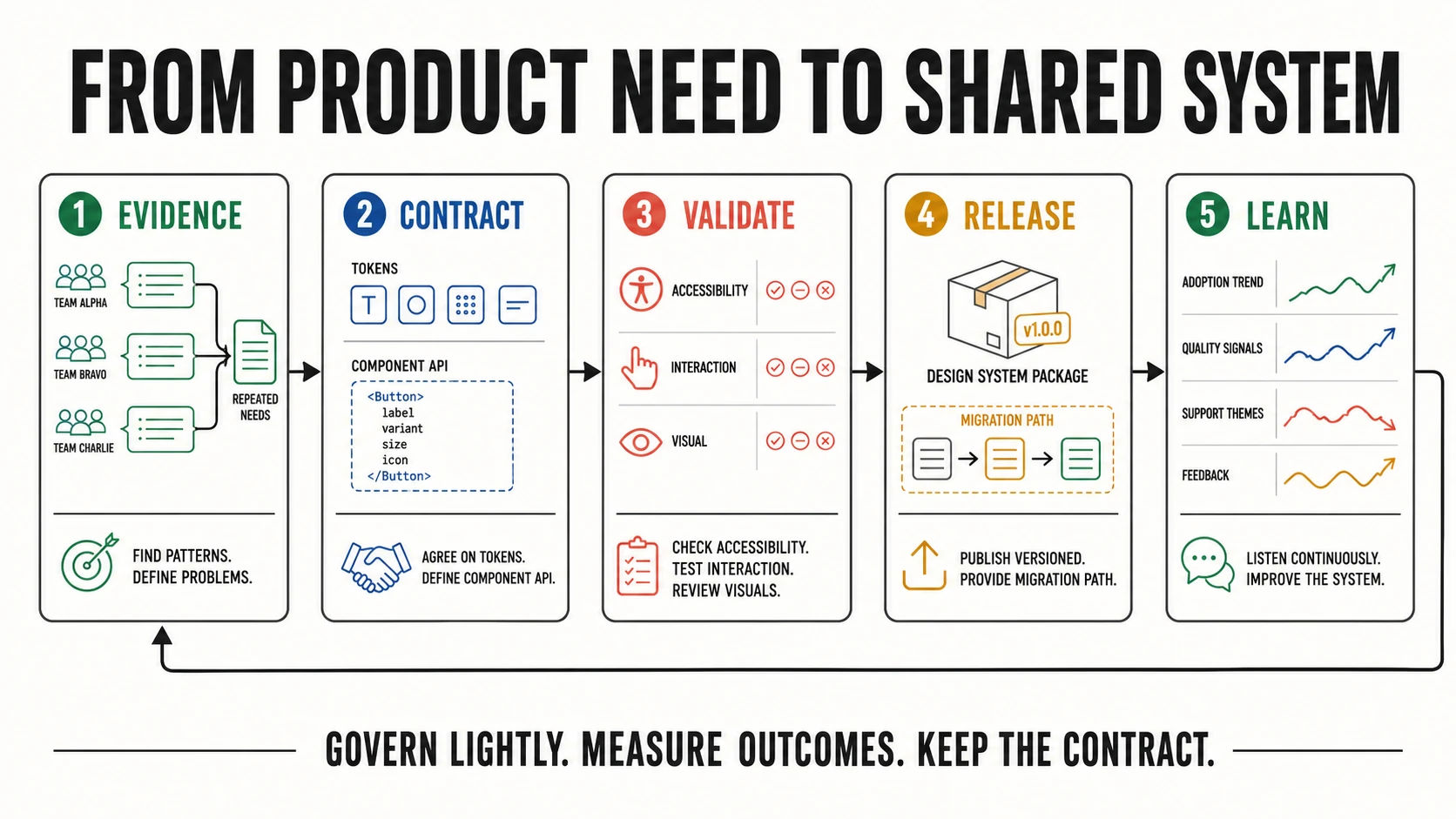
A healthy design system moves product needs through evidence, API review, accessibility validation, release, and adoption feedback.
Governance and Adoption Questions
18. What Should a Contribution Workflow Include?
Require a documented need, evidence from more than one product when possible, API and design review, accessibility criteria, tests, documentation, and a named maintainer. Keep a lightweight path for small fixes so governance does not become a queue that teams route around.
The central team does not need to author every component. It must protect the shared contract and make ownership visible.
19. How Do You Decide Whether to Add a New Component?
Ask whether the pattern is repeated, stable enough to standardize, and expensive or risky for teams to rebuild. Confirm that its interaction model can be made accessible and that someone will maintain it after launch.
A one-off product feature may belong in the product repository. Premature standardization freezes uncertainty into a public API.
20. How Do You Measure Design System Success?
Combine adoption with outcomes: active consumers, version lag, duplicate component reduction, migration time, accessibility defects, support load, contribution throughput, and product delivery speed. No single metric proves success.
High installation counts with heavy overrides may indicate nominal adoption but weak trust. Pair telemetry with interviews and issue analysis to understand why teams comply, extend, or bypass the system.
Worked Scenario: A Multi-Brand Date Picker
Begin with the interaction contract: input format, calendar navigation, localization, range selection, validation, keyboard behavior, focus return, and screen-reader announcements. Keep date logic and state model separate from rendering so each platform can implement the same intent appropriately.
Resolve visual decisions through semantic tokens, validate every brand theme, and expose a small API around value, constraints, locale, and events. Document escape hatches only for supported extensions, then test representative stories, keyboard paths, accessibility semantics, and consumer integration.
This is a platform design exercise as much as a UI exercise. PracHub's system design questions can help you practice API boundaries, rollout strategy, observability, and multi-team trade-offs.
How Interviewers Evaluate Senior Answers
Strong candidates ask who the consumers are, which platforms are supported, how releases happen, and where the current system is failing. They make accessibility and migration part of the initial API, not cleanup work.
They also recognize the organizational side: standards need trust, contribution paths, and clear decision rights. Use PracHub's behavioral and leadership interview questions to prepare stories about resolving designer-engineer disagreement, driving adoption, or reversing a harmful abstraction.
A Five-Step Answer Framework
First, identify consumers and constraints. Second, define the contract: tokens, API, semantics, and supported variation. Third, explain validation: tests, documentation, accessibility, and representative products.
Fourth, ship the change: version, migration, rollout, and ownership. Fifth, close the loop: adoption, exceptions, support data, and product outcomes.
Frequently Asked Questions
Are Design Tokens Just CSS Variables?
No. A token represents a named design decision that can be transformed into CSS variables, native constants, documentation, or design-tool data. CSS variables are one delivery mechanism for the web.
Should Product Teams Be Allowed to Override Tokens?
Allow extension at explicit layers and document the compatibility cost. Product-level semantic tokens can be healthy; overriding internal component primitives can make upgrades unsafe. Repeated exceptions should feed the governance process.
Does Using ARIA Make a Component Accessible?
No. ARIA communicates semantics and state to assistive technology, but the component also needs correct keyboard behavior, focus management, visible feedback, understandable content, and testing. Native HTML is usually the safer starting point.
Is Storybook a Design System?
No. Storybook can document, exercise, and test components, making it a useful delivery surface. The design system also includes decisions, tokens, packages, ownership, release policy, contribution workflows, and consumer support.
Who Should Own the Design System?
Ownership should be explicit and cross-functional, commonly including design, frontend engineering, accessibility, and product input. A central core team can maintain the platform while a federated contribution model brings domain expertise from product teams.
Final Takeaway
The best design system interview answers do not stop at reusable components. They define a durable contract, preserve accessibility, make change adoptable, and explain how many teams can contribute without fragmenting the platform.
Practice each question as both an architecture and governance decision. A senior frontend engineer builds not only the component, but also the path by which the component remains useful.
Sources
This guide was informed by the official DTCG Design Tokens Format Module 2025.10, DTCG specification FAQ, WAI-ARIA Authoring Practices Guide, APG introduction and scope, WCAG 2.2 quick reference, Storybook component documentation, Storybook accessibility testing, and Semantic Versioning 2.0.0.
Related Articles
React Native Interview Questions: New Architecture, Performance, and Native Modules
Practice React Native interview questions on JSI, Fabric, TurboModules, performance, native APIs, offline data, testing, and production trade-offs.
Frontend Testing Interview Questions: Unit, Integration, E2E, and Flaky Tests
Practice frontend testing interview questions on unit, integration, E2E, accessibility, mocks, CI, and diagnosing flaky tests.
Next.js Interview Questions for Senior Engineers: App Router, RSC, Caching, and Deployment
Practice senior Next.js interview questions on App Router, RSC, caching, Server Actions, streaming, security, and production deployment.
React Server Components Interview Questions: Boundaries, Streaming, Caching, and Trade-Offs
Practice React Server Components interview questions on boundaries, streaming, caching, security, and trade-offs with senior-level answers and examples.
Comments (0)