Frontend Testing Interview Questions: Unit, Integration, E2E, and Flaky Tests
Quick Overview
Practice senior frontend testing interview questions covering unit, component, integration, and end-to-end boundaries; Testing Library queries; network mocking; accessibility; browser isolation; CI strategy; and systematic flaky-test diagnosis. The guide helps frontend engineers explain confidence, maintenance cost, and production trade-offs instead of reciting framework APIs.
Most candidates can define unit, integration, and end-to-end tests. Senior frontend interviews go further: which boundary gives the most confidence for this risk, what should be mocked, and why does the test fail only on CI?
The strongest answers connect test scope to user impact, accessibility, browser behavior, release speed, and maintenance cost. They also treat flaky tests as engineering defects with observable causes, not background noise that retries can permanently hide.
Use PracHub to practice these decisions before the interview. Start with real interview questions with written solutions, then use company-specific interview prep to rehearse how you would defend a testing strategy for the product and team you are targeting.
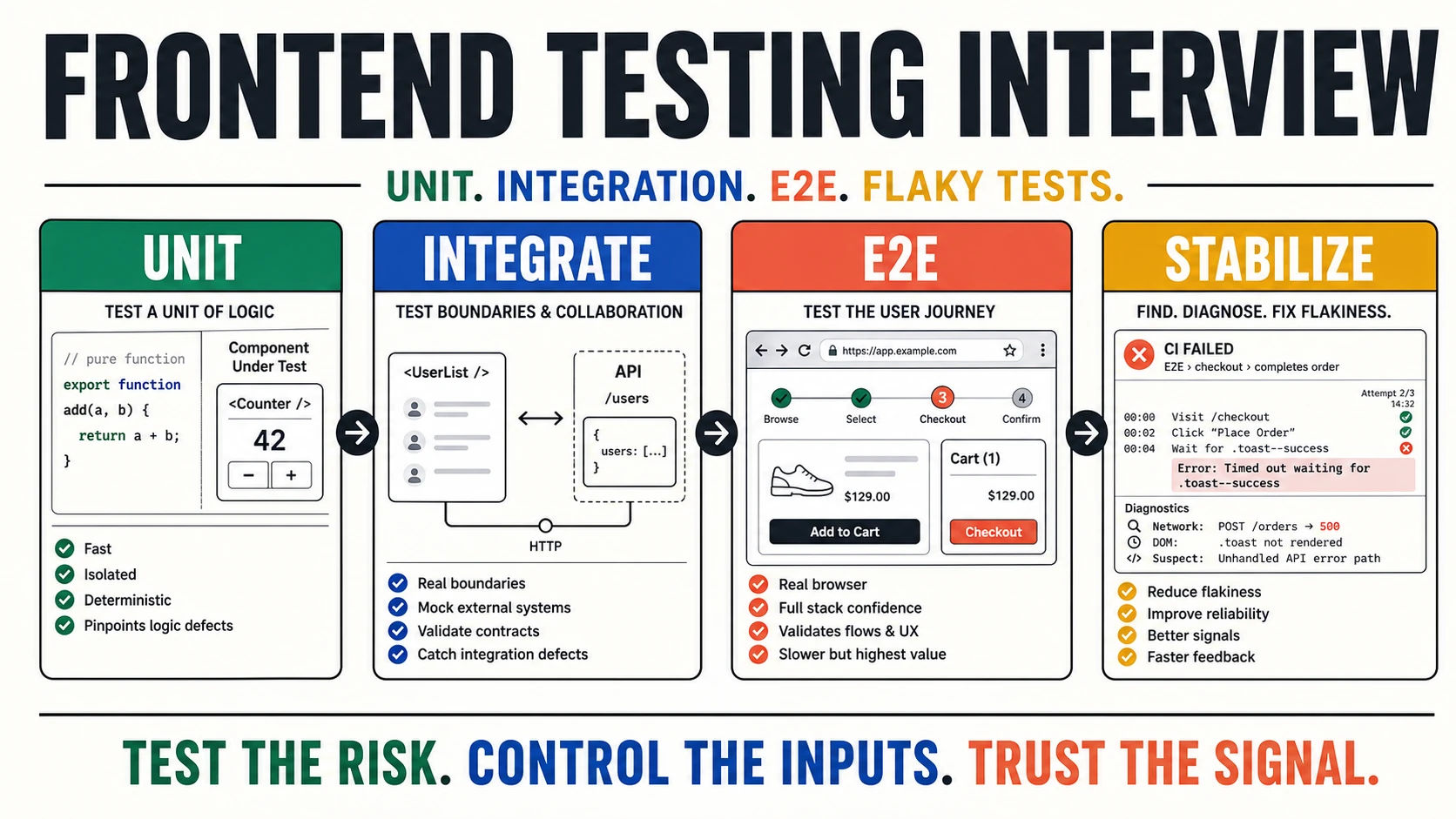
Senior frontend testing answers connect risk, test boundaries, deterministic setup, and production confidence.
Quick Verdict
A senior answer should not begin with a favorite framework. Begin with the failure you need to prevent, choose the smallest realistic boundary that can detect it, and explain what the test deliberately does not cover.
| # | What a strong testing answer proves |
|---|---|
| 1 | Boundary: the test is placed at the cheapest level that still catches the target regression. |
| 2 | Behavior: assertions follow user-visible outcomes or stable contracts, not private implementation. |
| 3 | Determinism: data, time, network, browser state, and cleanup are controlled. |
| 4 | Operations: failures produce evidence, ownership, and a path to diagnosis. |
Test Strategy and Boundary Questions
1. How Do You Choose Between Unit, Integration, and E2E Tests?
Start from risk. Use a unit test for deterministic logic with many edge cases, an integration test when confidence depends on components or modules working together, and an E2E test when the browser, routing, authentication, or deployed stack is part of the behavior.
The best boundary is the smallest one that can reproduce the important failure. Avoid fixed percentages such as "70% unit tests" unless the product context justifies them.
2. What Makes a Frontend Test Valuable?
A valuable test catches a realistic regression, fails for one understandable reason, and remains stable through safe refactors. Its expected confidence should exceed its runtime, maintenance, and diagnostic cost.
Coverage can reveal unexecuted code, but a high percentage does not prove that the right behavior was asserted.
3. Is the Testing Pyramid Still Useful?
Use it as a cost model, not a quota. Fast focused tests should cover many branches, while fewer browser tests should protect the highest-value journeys. A design system may need extensive component coverage; a payment flow may justify more integration and E2E evidence.
Unit and Component Testing Questions
4. Should You Test Component Internals?
Usually test observable behavior: what is rendered, what the user can operate, and what stable callback or navigation occurs. Testing Library explicitly recommends avoiding internal state, methods, lifecycle details, and child-component structure because those assertions make harmless refactors expensive.
Test internals only when the internal unit is itself a supported contract, such as an exported parser or state machine.
5. How Would You Test a React Hook or State Machine?
Pure state transitions can be tested directly. A hook whose value depends on React lifecycle, context, or browser subscriptions should be exercised through a small harness or the component behavior it enables.
Assert transitions and cleanup, including rerenders, unmounts, stale closures, and overlapping async work. Do not couple the test to the number of internal state updates.
6. How Do You Test Async UI Without Arbitrary Sleeps?
Trigger the user action, then wait for the observable state that ends the transition: a status appears, a control becomes enabled, or an element is removed. Testing Library offers async queries, while Playwright locators and web-first assertions retry until their condition is satisfied.
A fixed sleep encodes a timing guess. It can be both slower than necessary and too short under CI load.
7. How Do Accessibility Assertions Improve Tests?
Querying by role and accessible name tests the same semantic surface used by assistive technology. It can expose missing labels, incorrect roles, and inaccessible controls while producing selectors that survive CSS and DOM refactors.
Automated checks do not replace keyboard and screen-reader review, but they make basic accessibility part of everyday regression coverage.
8. When Is a Snapshot Test Appropriate?
Snapshots are useful for small, intentional, stable output such as a serializer or a compact accessibility tree. Large component snapshots often accept noise and hide the behavior that matters.
If a reviewer cannot explain the meaningful difference in a snapshot update, the test is not providing a clear signal.
Integration Testing Questions
9. What Should You Mock in a Component Integration Test?
Mock outside the boundary you own: third-party systems, nondeterministic browser APIs, and network responses that would make the test slow or unreliable. Keep the application code inside the boundary real when the goal is to validate its collaboration.
Prefer intercepting requests at the network boundary over replacing the application's data hook. That preserves more production behavior while keeping the test deterministic.
10. Should a Test Assert the Exact Network Request?
Assert the request when its shape is part of the contract, such as a mutation payload, authorization header, or pagination cursor. For ordinary rendering tests, focus on how the UI responds to success, empty, loading, and error states.
Over-asserting every request detail couples the test to implementation and creates duplicate coverage with API contract tests.
11. When Should You Use a Real Backend?
Use a controlled backend when confidence depends on serialization, authentication, database behavior, or a deployed integration. Seed only the data the test owns and provide a reliable cleanup strategy.
Keep most frontend integration tests local and deterministic. A smaller contract or staging suite can then detect drift between mocks and the real service.
12. How Do You Prevent Mock Drift?
Generate types or fixtures from an authoritative schema where possible, validate representative responses, and run contract tests at service boundaries. Assign ownership when the API changes rather than silently updating mocks until the UI passes.
E2E Testing Interview Questions
13. Which User Journeys Deserve E2E Coverage?
Protect revenue, access, irreversible actions, and workflows that cross important browser or service boundaries. Examples include sign-in, checkout, account recovery, permissions, and a primary create-edit-submit path.
Do not reproduce every validation branch in E2E. Cover the critical path and a few high-risk failures, then push combinatorial cases down to faster levels.
14. What Makes an E2E Selector Resilient?
Prefer role, accessible name, label, and other user-facing contracts. Use a dedicated test ID when an element has no stable semantic identity. Avoid selectors based on CSS classes, DOM depth, or generated markup.
Playwright locators also include actionability checks and auto-waiting. That reduces timing code, but it does not fix an ambiguous selector.
15. How Would You Choose a Browser Test Matrix?
Use product analytics, contractual support, risk, and engine differences. Run a fast primary-browser gate on every change, then broader Chromium, Firefox, and WebKit coverage on high-risk paths or scheduled suites.
Device emulation helps with viewport and input behavior, but it is not identical to testing on a physical device.
16. How Do You Keep E2E Data Isolated?
Give each test a unique user or resource namespace, create state through an API or fixture, and clean up independently. Playwright recommends isolated browser contexts so cookies, storage, and sessions do not leak between tests.
A test that depends on another test's successful completion is difficult to parallelize, retry, or diagnose.
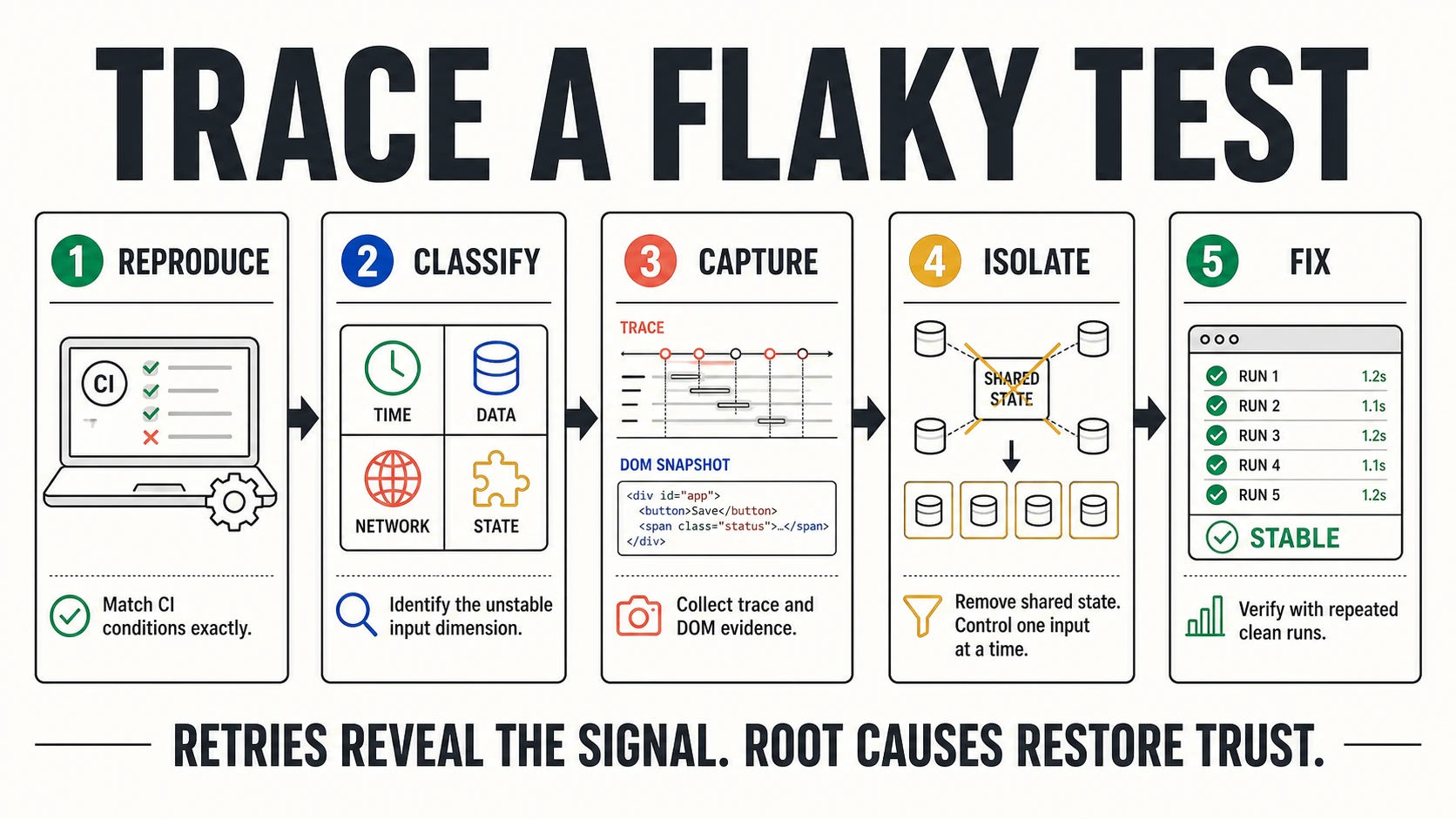
Diagnose flaky tests by reproducing the failure, classifying the unstable input, collecting evidence, and removing the cause.
Flaky Test Interview Questions
17. How Do You Debug a Test That Fails Only on CI?
First capture evidence from the failed attempt: trace, DOM snapshot, console output, network activity, timing, test data, worker, browser, and commit. Reproduce with the same environment, parallelism, seed, and resource constraints before changing the assertion.
Then classify the cause: timing, shared state, unstable selector, environment difference, leaked timer, service dependency, resource pressure, or a real race in the product.
18. Are Retries a Valid Fix for Flaky Tests?
Retries are useful for measuring and containing instability while preserving evidence. Playwright reports a test that fails initially and passes on retry as flaky, which is a signal to investigate.
Retries are not the root-cause fix. A retry that masks a product race or shared-state leak makes the suite look healthier than it is.
19. How Do Time, Randomness, and Animations Create Flakes?
Real clocks cross date boundaries, random values collide, and animations create transient states. Inject or freeze time, seed randomness, disable nonessential motion, and wait on business state rather than elapsed milliseconds.
Jest's fake timers can control scheduled work in unit tests, but restore real timers and avoid using fake time where browser scheduling itself is the behavior under test.
20. How Do You Make a Test Suite Faster Without Losing Confidence?
Remove duplicate coverage, move branch-heavy cases to cheaper layers, parallelize only isolated tests, shard long E2E suites, and cache stable build work. Track duration and failure rate by test so the slowest and least reliable cases become visible.
Keep a small deterministic pull-request gate and run broader matrices when their feedback can still influence the release.
Worked Scenario: Test a Checkout Form
Unit-test price and validation rules with edge cases. At the component level, enter values through labels, submit through the visible button, and assert accessible loading, error, and success states while intercepting the payment request.
Add a small E2E path for a supported browser against a controlled environment to verify routing, authentication, and the payment integration boundary. Make the submission idempotent, create isolated test data, and collect traces on the first retry.
This is also a design problem. PracHub's system design questions can help you explain testability, service contracts, observability, and failure isolation as part of the architecture rather than an afterthought.
How Interviewers Evaluate Senior Answers
Strong candidates ask about the product risk, team ownership, release cadence, browser support, and current failure data before prescribing a stack. They distinguish confidence from coverage and can explain what evidence a failed test should leave behind.
They also show leadership: quarantining a flaky test has an owner and deadline, not permanent silence. Use PracHub's behavioral and leadership interview questions to prepare stories about restoring trust in a slow or unreliable suite.
A Practical Five-Step Answer Framework
First, name the risk. What user failure matters? Second, choose the boundary. What is the smallest realistic test? Third, control the inputs. Data, time, network, and browser state should be intentional.
Fourth, define the evidence. State what the assertion and failure artifacts prove. Fifth, discuss operations. Explain CI placement, ownership, runtime, retries, and how the suite stays trustworthy.
Frequently Asked Questions
What Is the Difference Between Unit and Integration Testing?
A unit test isolates a small deterministic behavior. An integration test checks collaboration across meaningful boundaries, such as a component, router, state layer, and mocked network. The distinction is less important than clearly stating what is real, what is replaced, and which regression the test can detect.
Is React Testing Library a Test Runner?
No. Testing Library provides user-centric DOM queries and interaction helpers. It normally runs inside a test environment such as Jest or Vitest, which supplies test discovery, assertions, mocks, and execution.
Should You Use data-testid?
Use role, accessible name, label, and visible text first. A stable test ID is reasonable when there is no useful semantic selector, especially for a non-interactive container. It is still preferable to brittle CSS or DOM-path selectors.
What Flake Rate Is Acceptable?
The target for release-gating tests should be effectively zero unexplained failures. Track first-attempt failures separately from final failures so retries do not erase the signal. Prioritize by frequency, blocked engineering time, and the chance that the flake represents a product race.
Should Frontend Engineers Know E2E Infrastructure?
Senior engineers should understand environments, test data, browser contexts, parallelism, artifacts, and ownership even if another team operates the platform. Those constraints determine whether a browser suite is fast, trustworthy, and useful during a release.
Final Takeaway
The best frontend testing interview answers are not tool catalogs. They explain which user risk is being protected, why the chosen boundary is realistic, how nondeterminism is controlled, and what evidence will make a failure actionable.
Practice each question as a trade-off. A senior engineer does not maximize the number of tests; they build the smallest reliable system that gives the team enough confidence to ship.
Sources
This guide was informed by the official documentation for Testing Library's user-centric approach, query priority, Playwright testing best practices, auto-waiting and actionability, browser-context isolation, retries and flaky classification, Jest mock functions, Jest timer mocks, and Cypress retry-ability.
Comments (0)