Next.js Interview Questions for Senior Engineers: App Router, RSC, Caching, and Deployment
Quick Overview
Practice senior-level Next.js interview questions covering App Router architecture, React Server Component boundaries, current caching and revalidation models, Server Actions security, streaming, runtimes, multi-instance deployment, and production debugging. Each answer connects framework behavior to user experience and operational trade-offs.
A junior Next.js answer explains what a Server Component is. A senior answer explains where the server-client boundary belongs, how that boundary changes the JavaScript bundle and data exposure, what gets cached under the application's exact version and configuration, and what breaks when the app runs across ten containers instead of one laptop.
This guide follows the current 2026 Next.js documentation. That matters because caching defaults changed in Next.js 15, while Next.js 16 introduced the opt-in Cache Components model. In an interview, state the version and configuration before giving a confident caching answer.
Use PracHub to turn these concepts into decisions under pressure. Practice with real interview questions with written solutions, then use company-specific interview prep to rehearse how you would explain architecture, performance, and rollout trade-offs to a senior interviewer.
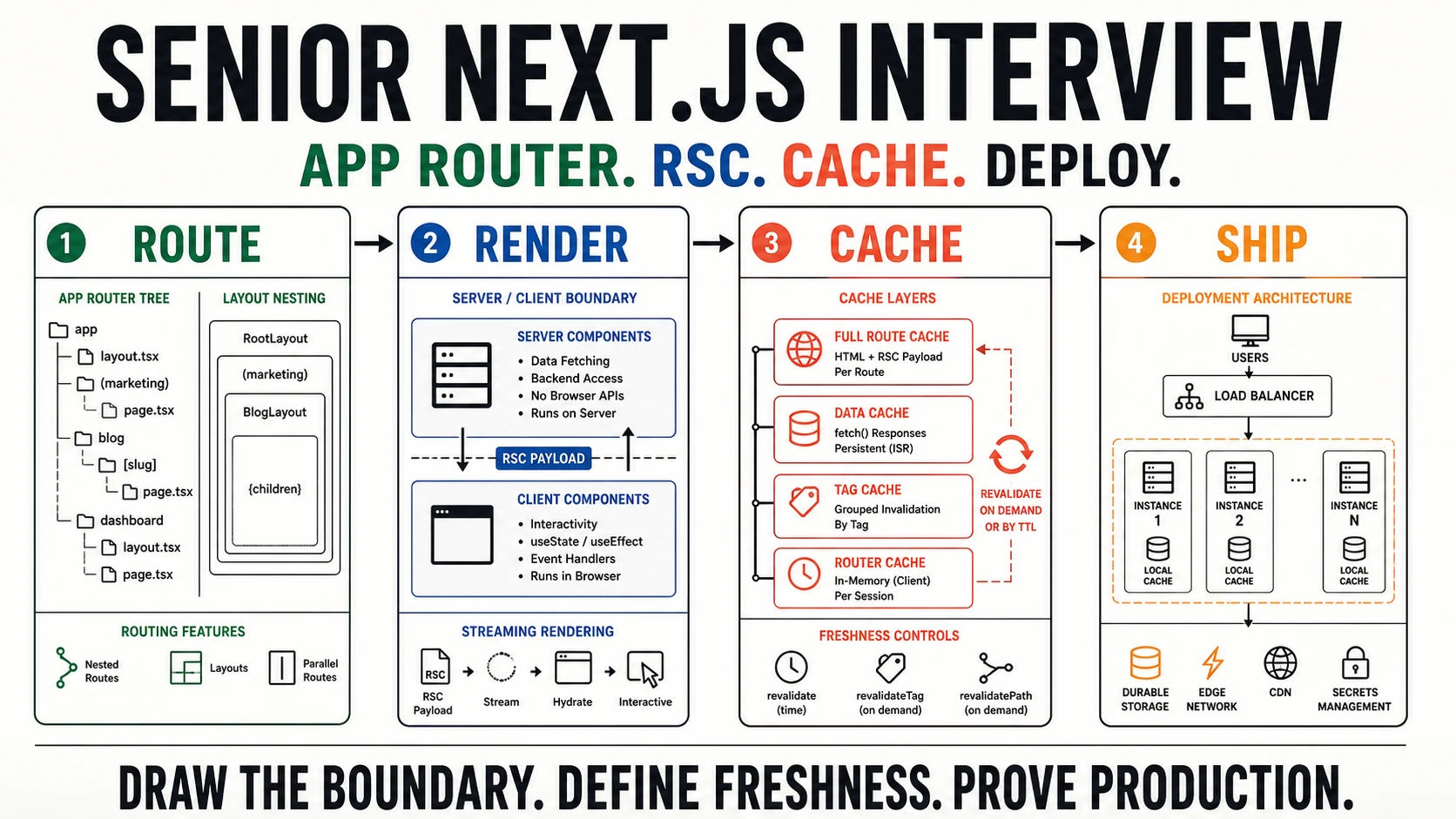
Senior Next.js interviews test boundaries, freshness, failure modes, and production judgment.
Quick Verdict
Prepare for four connected areas: App Router composition, React Server Component boundaries, explicit caching and revalidation, and production deployment. Do not memorize isolated APIs. Explain how a choice affects user experience, security, bundles, server load, freshness, observability, and operations.
| # | What a senior answer includes |
|---|---|
| 1 | Router: route ownership, layouts, loading and error boundaries, and navigation behavior. |
| 2 | RSC: server-client boundaries, serialization, data access, bundle impact, and streaming. |
| 3 | Cache: version, freshness contract, cache key, lifetime, invalidation, and scope. |
| 4 | Deploy: runtime support, shared state, rolling releases, security, and telemetry. |
App Router Interview Questions
1. How Would You Design an App Router Route Tree?
Start with product boundaries, not folders. Put stable shared UI in layouts, route-specific UI in pages, and loading, error, and not-found behavior near the segment that owns the failure. Route groups can organize code without changing the URL; dynamic segments express URL data rather than application state.
Next.js documents that layouts preserve state and remain interactive across navigation. Use that intentionally for navigation shells and providers, but avoid placing request-time work in a high layout when it would block every child route.
2. When Would You Use a Layout Versus a Template?
A layout persists across navigation within its subtree. A template creates a new instance for its children when its segment changes, so state resets and effects run again. Choose based on lifecycle requirements, not because one file convention feels cleaner.
A good follow-up is: "What state should survive navigation?" A checkout shell may need persistence; an analytics page may need a fresh view lifecycle on each transition.
3. Where Should Loading and Error Boundaries Live?
Place boundaries around the smallest useful unit of recovery. A route-level loading.tsx automatically creates a Suspense boundary around the page, but the current Next.js data-fetching guide recommends a closer Suspense boundary for runtime or uncached work when you want more precise streaming.
Expected errors should become explicit UI states. Unexpected render failures belong in segment error boundaries, while not-found behavior should use notFound() and the appropriate not-found file. Do not turn every failure into a generic 500 page.
4. Route Handler or Server Action?
Use a Server Action for a mutation tightly coupled to a React interaction, especially a form that benefits from progressive enhancement and a single roundtrip for updated UI and data. Use a Route Handler for a public HTTP contract, webhook, non-React client, custom method or response, or integration boundary.
Route Handlers use the Web Request and Response APIs and are not cached by default. Server Actions use POST and should be treated as externally reachable server endpoints, not trusted function calls.
React Server Component Questions
5. What Actually Runs on the Server and the Client?
In the App Router, pages and layouts are Server Components by default. They can access server-side data and secrets, render HTML, and contribute to the React Server Component payload without shipping their component code to the browser.
A file marked "use client" creates a client entry boundary. That component and modules imported beneath it join the client graph and can use state, effects, event handlers, and browser APIs. The directive does not mean the component is never server-rendered; it defines where client execution capabilities begin.
6. How Do You Keep the Client Bundle Small?
Push "use client" down to the smallest interactive island. Keep data fetching, formatting, and non-interactive composition on the server. Pass serializable data and rendered server content into focused Client Components rather than turning an entire page or layout into a client boundary.
Measure the result. Inspect route bundles, hydration work, and interaction timing instead of assuming that fewer Client Components always improve the experience.
7. Can a Client Component Render a Server Component?
A Client Component cannot import a Server Component into its client module graph. It can receive already-rendered server content through a serializable composition pattern such as children. The server decides the tree; the Client Component provides an interactive slot.
8. What Security Risks Change with RSC?
Server Components make direct data access convenient, but convenience is not authorization. Keep a server-only data access layer, verify authorization close to the query or mutation, and return minimal transfer objects. Never pass an entire database record to a Client Component because only a few fields appear on screen.
The official Next.js security guide says exported Server Actions create public HTTP endpoints and require the same validation, authentication, and authorization checks as other endpoints. Action IDs and same-origin protections add defense in depth; they do not replace access control.
9. How Does Streaming Improve Performance?
Streaming lets the server send a useful shell and resolved route segments while slower work continues behind Suspense boundaries. It improves perceived progress and can reduce time to first useful content, but a boundary placed too high still creates a large blocking region.
Parallelize independent requests, start work before awaiting it, and put boundaries around meaningful UI. Also verify that the hosting platform and reverse proxy do not buffer the response, because buffered output removes the progressive delivery benefit.
Next.js Caching Interview Questions
10. What Is the First Question to Ask About Caching?
Ask: Which Next.js version and is Cache Components enabled? In Next.js 15, fetch requests and GET Route Handlers stopped being cached by default. In Next.js 16, enabling cacheComponents: true opts into a newer model where runtime data is dynamic unless you explicitly cache component or function output.
An answer based on the old "fetch is cached by default" rule can be confidently wrong. State your assumption, then explain the requested freshness behavior.
11. How Do Cache Components Work?
With Cache Components enabled, "use cache" can mark an async function, component, or file as cacheable. Serializable arguments and captured values become part of the key. cacheLife defines the lifetime, while tags support targeted invalidation.
Static, cached, and request-time content can coexist in one route. The framework can prerender a static shell, include cached work in that shell, and stream uncached content behind Suspense at request time.
12. When Should You Use updateTag, revalidateTag, or revalidatePath?
Use updateTag when the current user must see the mutation reflected immediately. Use revalidateTag when stale-while-revalidate behavior is acceptable for tagged content. Use revalidatePath when the invalidation boundary is naturally a route path rather than a shared data entity.
Choose tags around domain data, not UI components. A product update may affect a product page, search results, recommendations, and an API response; one product tag can express that relationship more reliably than enumerating every path.
13. Can You Cache Personalized Data?
Do not read cookies() or headers() directly inside a shared "use cache" scope. Read request data outside, pass the minimal value as an argument when that cache model is appropriate, and understand that the value becomes part of the key.
Before caching by user or session, evaluate cardinality, privacy, eviction, and whether the result should be shared at all. Personalized data with strict freshness may be better streamed per request.
14. Why Does Caching Work Locally but Fail Across Containers?
A process-local cache produces independent entries and invalidation state on every instance. Next.js documents that multi-instance or ephemeral deployments need shared cache storage and coordinated cache tags to avoid stale divergence.
Explain cache scope explicitly: request memoization, process memory, disk, remote cache, CDN, and browser navigation cache solve different problems. "It is cached" is incomplete without where, for whom, for how long, and how it becomes fresh.
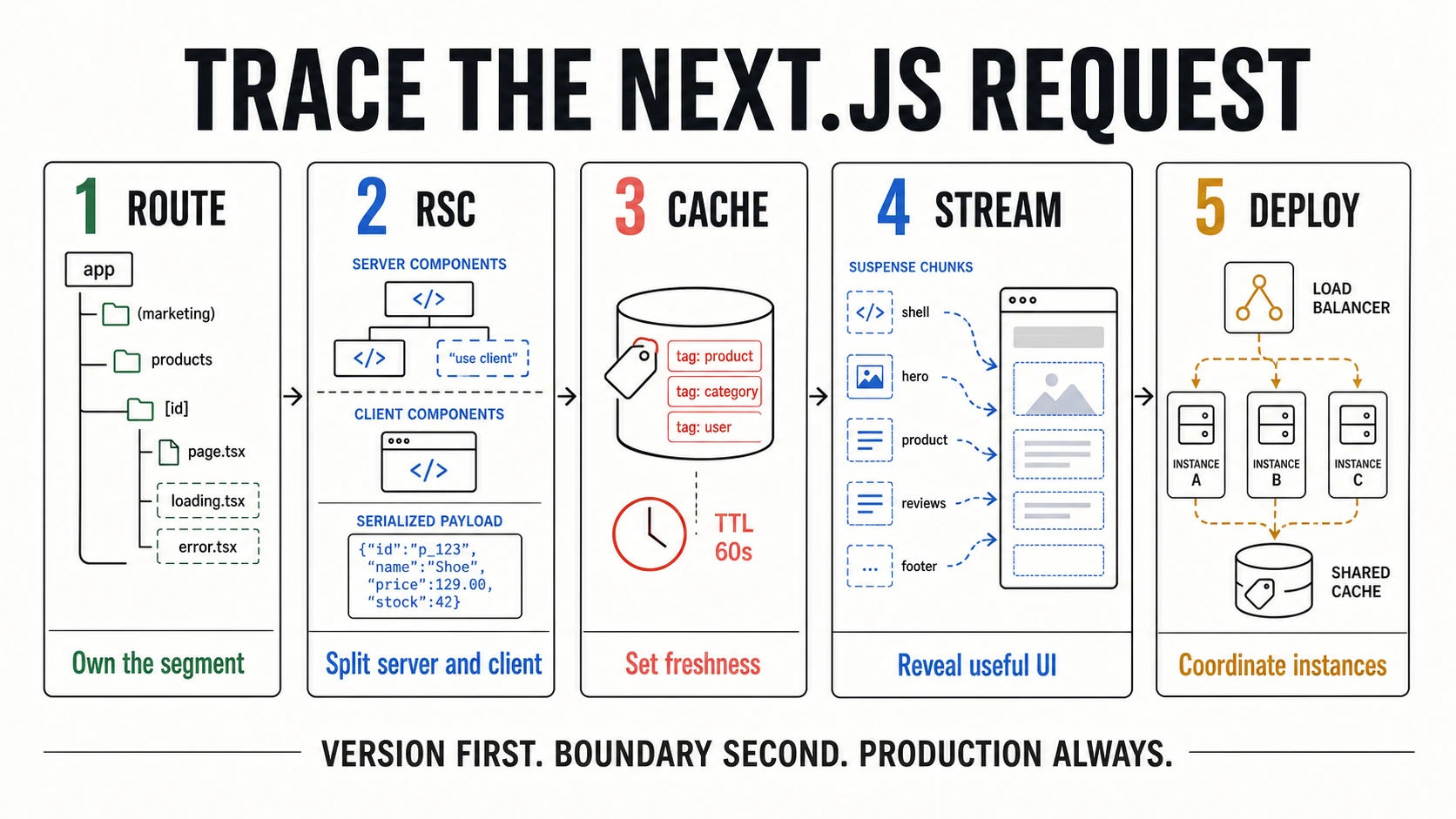
Trace every feature from route boundary to server rendering, cache policy, and production runtime.
Server Actions and Mutation Questions
15. How Would You Secure a Server Action?
Validate untrusted input, authenticate the request, authorize the exact resource operation, perform the mutation transactionally, and return a minimal result. Re-check authorization inside the action even if the calling page was protected.
Next.js compares action origin and host by default and supports configured allowed origins behind trusted proxies. Multi-instance deployments also need a consistent Server Actions encryption key so one instance can decrypt an action created by another.
16. How Do You Prevent Duplicate Mutations?
Assume retries and double submissions can happen. Disable duplicate UI submission for experience, but enforce correctness on the server with an idempotency key, unique constraint, version check, or transaction. Then invalidate the correct cache tag only after the write commits.
Deployment and Production Questions
17. How Can You Deploy a Next.js App?
The official deployment guide lists a Node.js server, Docker container, static export, and platform adapters. Node.js and Docker support all framework features; static export is limited; adapter support varies.
Choose from requirements, not fashion. If the app needs Server Actions, request-time RSC, dynamic authentication, or coordinated revalidation, verify that the target platform supports those behaviors before optimizing for deployment convenience.
18. Node.js Runtime or Edge Runtime?
Node.js is the default and supports Node APIs and the broad package ecosystem. The Edge Runtime has a smaller API surface, does not support every package, and the current documentation says it does not support ISR. Use it where the deployment adapter and latency profile justify the constraints, not as a blanket performance upgrade.
19. What Breaks During a Rolling Deployment?
Old clients may request assets or Server Action IDs from a new instance, while prefetched RSC data may belong to another build. Next.js supports a deployment identifier for version-skew protection, causing a hard navigation when client and server versions differ.
Across multiple instances, use one build output, a consistent Server Actions encryption key, shared cache where needed, and coordinated tag invalidation. Treat deployment as a distributed systems problem.
20. How Would You Debug a Stale Production Page?
Identify which layer is stale: source data, "use cache" output, the previous data cache, full route output, CDN, browser navigation state, or a service worker. Log cache keys, tags, build and deployment IDs, instance identity, revalidation events, and response cache headers.
Reproduce with direct origin requests and across multiple instances. A purge that appears to fix the symptom is not a diagnosis if the invalidation path remains broken.
Worked System Design Question
Design a Personalized Commerce Page
Keep the product description and editorial content in a cached server component with a product tag. Stream request-specific price, eligibility, and cart data behind focused Suspense boundaries. Keep the purchase control as a small Client Component and call a secured, idempotent Server Action.
After a purchase, update the user's cart state immediately, invalidate shared inventory data according to its consistency requirement, and emit observability signals for mutation latency, action failures, cache hit rate, stale reads, and hydration errors.
Then discuss deployment. Multiple instances need coordinated cache invalidation and consistent action keys; streaming requires an infrastructure path that does not buffer responses. This is where system design questions become useful: the framework API is only one layer of the architecture.
Senior-Level Red Flags
Be cautious of answers that put "use client" on the root layout, call every server mutation "secure" because it uses "use server", describe all caching as ISR, or choose Edge because it sounds globally fast.
Other weak signals include invalidating every path after every write, ignoring request and user cache cardinality, treating Suspense as a spinner API, and assuming a successful local build proves multi-instance correctness.
A Five-Step Practice Method
First, state the contract: user, freshness, security, and latency. Second, draw the boundary: route segment, Server Component, Client Component, and mutation surface. Third, name the cache: key, scope, lifetime, and invalidation.
Fourth, deploy it: runtime, streaming, shared state, rollout, and rollback. Fifth, prove it: tests, Web Vitals, server traces, cache telemetry, and failure drills. Use PracHub's behavioral and leadership interview questions to practice migration disagreements, incident ownership, and influencing a team away from a fragile framework shortcut.
Frequently Asked Questions
Are Server Components the Same as Server-Side Rendering?
No. RSC describes a component execution and serialization model, while server-side rendering produces HTML for a request. Next.js can combine Server Components, Client Components, prerendering, request-time rendering, and streaming.
Is fetch Cached by Default in the App Router?
Do not answer without a version assumption. Next.js 15 changed fetch to uncached by default. With Next.js 16 Cache Components enabled, dynamic data access is request-time by default unless you explicitly cache output with the current model.
Does use client Send Secrets to the Browser?
It moves that module boundary and its client-side dependencies into the client graph. Secrets should remain in server-only modules and must never be serialized into Client Component props or exposed through public environment variables.
Should Every Mutation Use a Server Action?
No. Server Actions are excellent for React-coupled mutations. Route Handlers remain appropriate for public APIs, webhooks, non-React consumers, and explicit HTTP contracts.
What Should I Study After These Questions?
Build one small App Router project with a cached public view, a personalized streamed view, a secured mutation, and a multi-instance deployment plan. The gaps you encounter will be more valuable than another list of definitions.
Final Takeaway
A strong senior Next.js candidate does not merely know which file to create. They can predict what executes where, what ships to the browser, what becomes stale, what fails during rollout, and how the team will observe it.
Practice each question as a system decision. State the version, define the user contract, choose the smallest boundary, and follow the answer all the way to production. That is the difference between framework familiarity and senior engineering judgment.
Sources
This guide was informed by the current Next.js documentation for layouts and pages, Server and Client Components, streaming and data fetching, Server Functions, data security, Route Handlers, Next.js 15 caching changes, Cache Components, revalidation, platform deployment, self-hosting, and runtime constraints.
Related Articles
React Native Interview Questions: New Architecture, Performance, and Native Modules
Practice React Native interview questions on JSI, Fabric, TurboModules, performance, native APIs, offline data, testing, and production trade-offs.
Design System Interview Questions for Frontend Engineers: Tokens, APIs, Accessibility, and Governance
Practice design system interview questions on tokens, component APIs, accessibility, testing, versioning, adoption, and governance.
Frontend Testing Interview Questions: Unit, Integration, E2E, and Flaky Tests
Practice frontend testing interview questions on unit, integration, E2E, accessibility, mocks, CI, and diagnosing flaky tests.
React Server Components Interview Questions: Boundaries, Streaming, Caching, and Trade-Offs
Practice React Server Components interview questions on boundaries, streaming, caching, security, and trade-offs with senior-level answers and examples.
Comments (0)