Exponent (TryExponent) Review 2026: Courses vs. Question Banks, Which Strategy Works?
Quick Overview
Exponent positions itself as an all-in-one interview prep platform with structured courses, a question bank, and mock interview coaching — but does the course-first strategy beat question-first learning in 2026? This honest review compares Exponent's courses to its question bank, breaks down pricing ($144/year for the annual plan, plus coaching at $249/hour), and examines whether Exponent's structured approach or a question-first platform like PracHub is better for your timeline and role. We analyze the pros (mocks, coaching, multi-role support, company-specific prep) and cons (passive coursework, thin DSA coverage, pricey coaching), and show you how to use Exponent alongside LeetCode and real question databases to maximize your interview prep. Whether you're preparing for system design, behavioral, or product management interviews, this guide clarifies when Exponent is worth it and how to actually convert its lessons into interview performance.
There's a fundamental tension at the heart of interview prep that Exponent (formerly TryExponent) is built to solve: should you learn a framework first or get reps on real questions first?
The traditional path has been algorithmic grinding LeetCode problems until you can solve them in your sleep, then pray that pattern recognition transfers to novel questions in the room. But Exponent flipped the script. It said: start with structured courses taught by ex-FAANG engineers, practice mock interviews immediately, then hit the question bank. The platform went from scrappy startup to serving over 600,000 people because this course-first approach solved a real problem for the mid-to-senior candidates who aren't grinding DSA from scratch.
But here's the plot twist in 2026: the market fragmented again. Now you have platforms like PracHub that flip back toward question-first, arguing that learning by doing on real, recently-asked questions beats passive coursework. So the honest question isn't "is Exponent good?" It's "when is Exponent's course-first model better, and when do you need question-first instead?"
This review breaks down exactly what Exponent teaches, who it's best for, where it falls short, and how to decide whether course-first or question-first is the right bet for your prep timeline and role.
What Exponent actually is
Before the review makes sense, nail down what Exponent is because the name is generic and people mix up its three distinct layers.
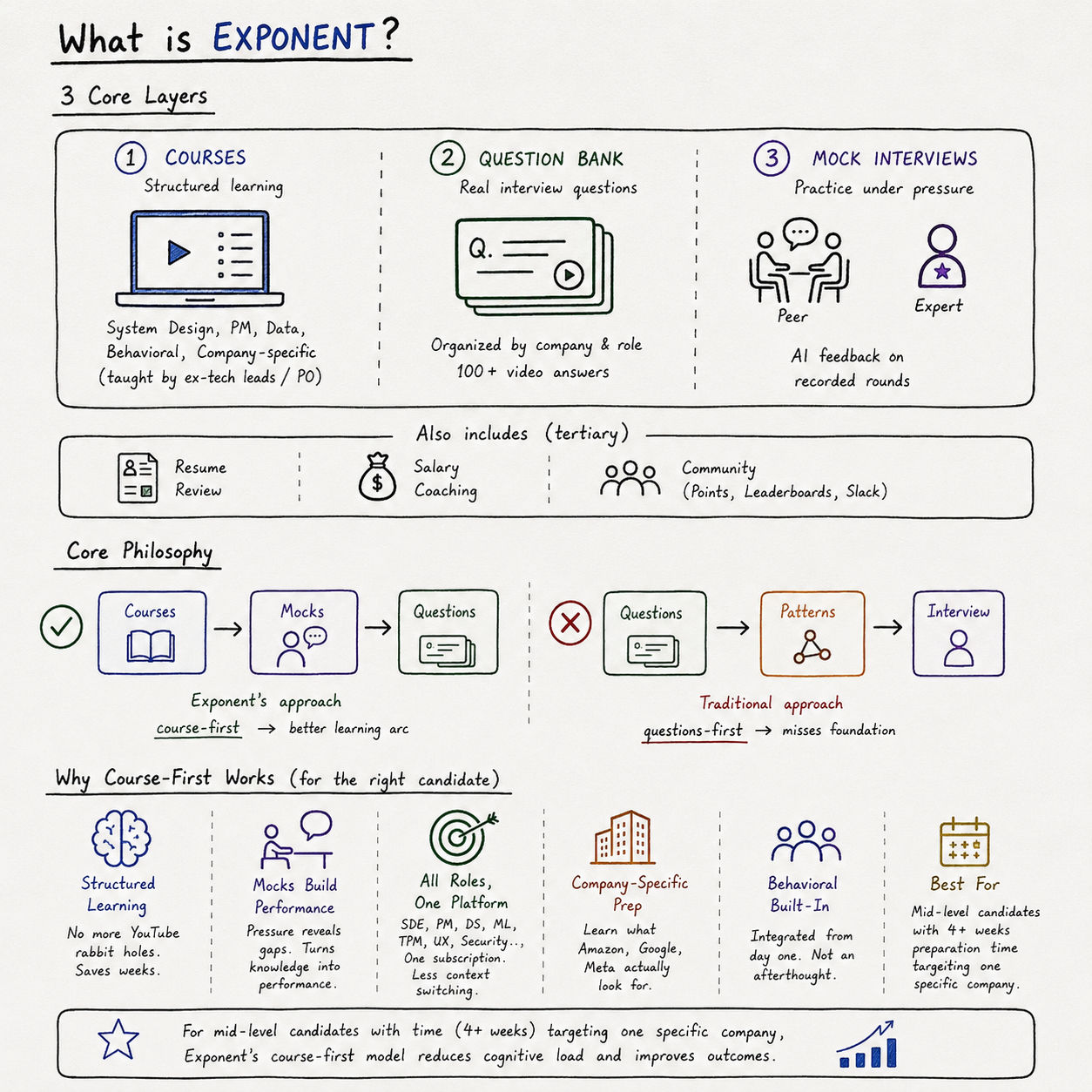
Layer 1: Structured courses. This is Exponent's flagship. Targeted lessons for system design, product management, data engineering, behavioral interviews, and company-specific prep (Google PM, Amazon SDE, etc.), all taught by "technical leads and product owners at hundreds of tech companies." The courses are designed for interviews, not to teach you CS fundamentals — that's an important distinction.
Layer 2: A question bank. Real interview questions organized by company and role, with "100+ live video answers" showing how ex-FAANG engineers approach them. This is the complement to the courses, not the main event.
Layer 3: Mock interview practice. Both peer-to-peer (free to some extent) and coached (expert sessions with ex-FAANG engineers). AI-powered feedback on your recorded mock rounds.
Exponent also wraps in career services (resume review, salary negotiation coaching) and community features (points, leaderboards, Slack), but those are tertiary.
The core claim is that
courses → mocks → questions is a better learning arc than
questions → patterns → interview. That's the course-first philosophy baked into the product architecture.
The course-first strategy: what Exponent does right
Let's give the credit first. Exponent's course-first angle isn't just marketing, there are legitimate reasons it works for certain candidates.
Structured learning beats YouTube rabbit holes. If you're a mid-level engineer preparing for your first system design interview (or your first PM loop), an eight-hour course that teaches you the framework upfront saves weeks of "which tutorial do I watch?" decision fatigue. Exponent courses distill that into a structured curriculum, so you don't waste time on tangents.
Mock interviews with pressure are irreplaceable. You can read every system design case study in the world, but the first time someone interrupts you mid-design and changes the constraints, you freeze. Exponent's mock interview feature (especially coached mocks) puts you in that pressure cooker before the real interview. That alone is worth the price for many candidates, because it converts knowledge into performance.
Multi-role platform = one place to learn. Exponent covers software engineering, product management, data science, ML, TPM, security, UX — basically every technical or quasi-technical interview track. If you're doing a leveled loop where you interview for both SDE and PM roles, having one subscription cover both saves money and context-switching.
Company-specific courses fill a real gap. Generic system design isn't the same as "what does Amazon's bar look like for SDE interviews?" Exponent's company-specific prep (Amazon, Google, Meta, etc.) teaches you the specific signals each company weights, not just the generic framework.
The behavioral component is cohesive. Many platforms treat behavioral as an afterthought. Exponent threads it through from day one — System Design + Behavioral Fundamentals + company-specific behavioral expectations. That continuity matters.
For mid-level candidates with time (4+ weeks before interviews) targeting one specific company, Exponent's course-first model reduces cognitive load. You follow the path, do the mocks, and you're ready.
Where the course-first strategy falls short
But course-first has hard limits, and in 2026 they're becoming clearer.
Courses are passive unless you actively re-derive. Reading a system design walkthrough or watching a mock review video is not the same as performing a system design yourself on the spot. Exponent's courses can feel like a Netflix binge — smooth, entertaining, and basically useless if you don't close the tab and actually design something from scratch. Many candidates admit they'll finish a 6-hour system design course and still choke when given a novel problem in a mock.
Question bank second = less reps on realistic scenarios. If you learn the framework first, then practice, you're applying the framework to textbook-like problems. But real interviews often introduce constraints that don't fit the neat pattern you just learned. By pushing the question bank to layer two, Exponent candidates sometimes miss the "what do I do when this doesn't look like the template?" moment until the real room.
Exponent's DSA coverage is thin. Exponent is not a coding interview platform. If you have a full loop with multiple coding rounds (LeetCode hard problems), Exponent can't be your only resource. You need LeetCode or NeetCode on the side. Exponent assumes you already know how to code and focuses on the architectural/design/behavioral rounds. That's a huge limitation for junior candidates or anyone weak on algorithms.
Pricing gets steep fast. Exponent's sweet spot is the annual subscription at roughly $144/year, which is fair. But the coaching adds up: expert mock interviews start at $249/hour, and the "Ace the Interview" package ($1,499) is a luxury that only senior candidates preparing for high-stakes loops typically spring for. For budget-conscious candidates, the perceived value doesn't always match the ask.
Generic courses plateau quickly. If you're already an L3 engineer who's done system design before, Exponent's general courses feel like review. They don't scale well to senior (L4+) preparation, where the bar shifts to architectural reasoning, trade-off depth, and leadership. You'd need additional resources anyway.
Course-first vs. question-first: the real debate
Here's where the honest review gets interesting, because the emerging consensus in 2026 is shifting.
Course-first (Exponent's bet):
- Pros: structured, reduces analysis paralysis, frameworks feel robust
- Cons: passive until you force active application, doesn't simulate real interview variance, pricing adds up
Question-first (PracHub's model):
- Pros: learn on real questions your target companies actually asked, immediate pressure, immediate feedback on gaps
- Cons: requires self-discipline to identify gaps, no handholding
The strongest candidates now actually use both, but in different orders depending on their baseline:
- Weak on frameworks? Do Exponent courses (or Grokking) first. Build the scaffold. Then drill real questions.
- Already know the theory, weak on execution? Skip the courses entirely. Go straight to real questions under pressure.
- Limited time (< 2 weeks)? Skip courses, go question-first. You don't have time to learn then apply; you need to apply and learn in parallel.
What changed in 2026 is that question-first platforms got better at providing context. PracHub, for instance, doesn't just give you a question; it shows you how many times it's been asked at that company recently, what follow-ups interviewers typically ask, and what signals they're evaluating. That context used to be exclusively a "course" thing; now you get it from a question bank if the platform is built right.
Exponent still wins if you want hand-holding and structure. But for candidates who want maximum reps on real scenarios, the question-first model is increasingly competitive.
Exponent's question bank: How it actually works
Since Exponent positions itself as "courses + questions + mocks," let's separate the question bank from the courses.
Exponent's question library includes "100+ live video answers" demonstrating how ex-FAANG engineers approach real questions, organized by:
- Company (Google, Amazon, Meta, Stripe, etc.)
- Role (SDE, PM, Data, ML, etc.)
- Category (System Design, DSA, SQL, Behavioral)
- Difficulty
The live answers are the differentiator. Watching an ex-Google PM talk through a product strategy case beats reading text. But here's the catch: the question bank is not Exponent's primary asset. It's supplementary. The real differentiation is the courses and mocks.
Compare that to PracHub, where the entire product is the question bank — 8,500+ candidate-reported questions with timestamps showing when they were last asked, filterable by company and difficulty. That density of real, recent questions is a different beast than Exponent's "here are some exemplar answers."
So if you're question-focused, Exponent's 100+ video answers won't compete with a purpose-built question bank. But if you want course + questions + mocks all in one subscription, Exponent bundles it.
Exponent vs. the alternatives: quick comparison
| Platform | Strength | Best for | Price |
|---|---|---|---|
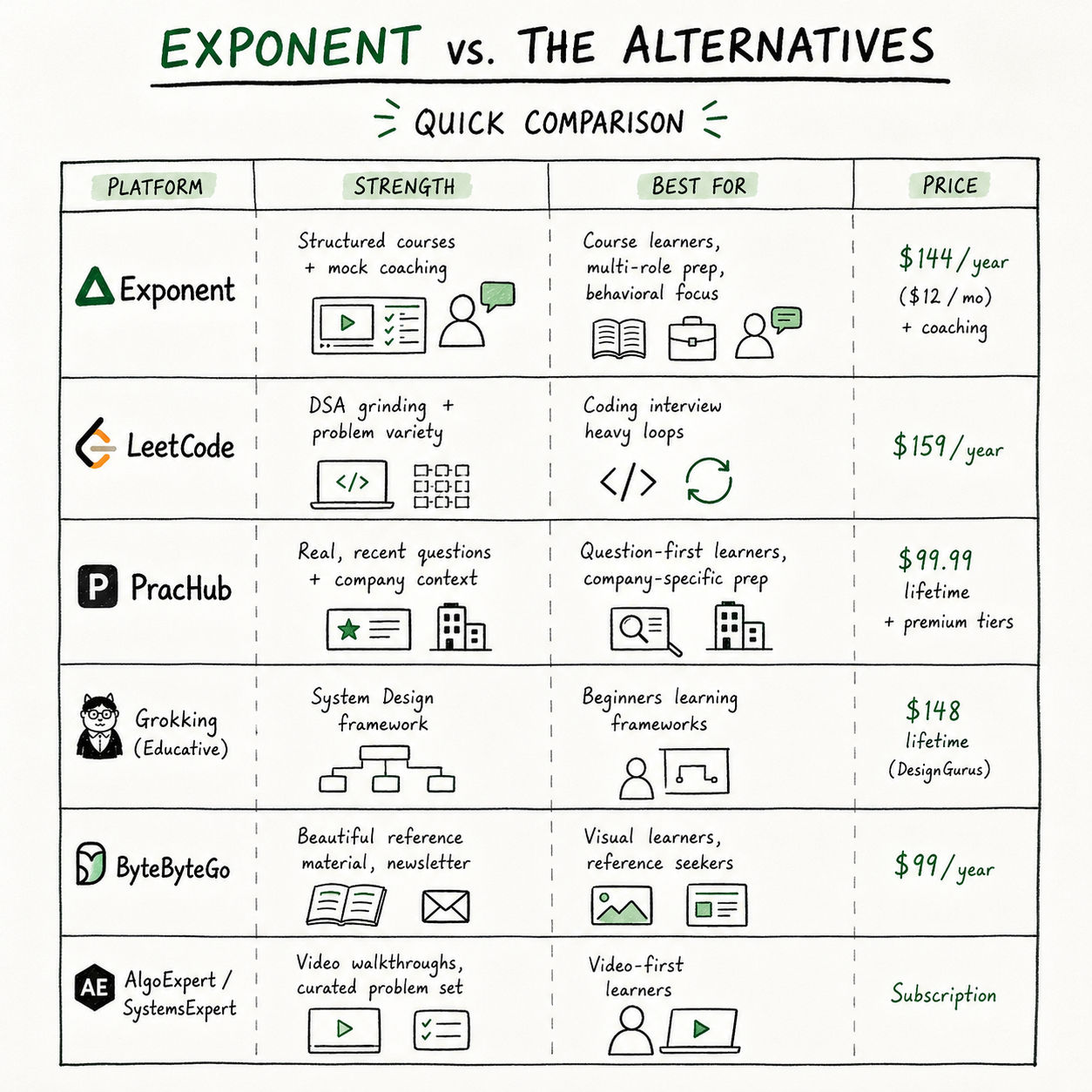
| Exponent | Structured courses + mock coaching | Course learners, multi-role prep, behavioral focus | $144/year ($12/mo) + coaching |
| LeetCode | DSA grinding + problem variety | Coding interview heavy loops | $159/year |
| PracHub | Real, recent questions + company context | Question-first learners, company-specific prep | Freemium; Premium subscription (see current pricing) |
| Grokking (Educative) | System Design framework | Beginners learning frameworks | $148 lifetime (DesignGurus) |
| ByteByteGo | Beautiful reference material, newsletter | Visual learners, reference seekers | $99/year |
| AlgoExpert / SystemsExpert | Video walkthroughs, curated problem set | Video-first learners | Subscription |
The matrix tells the story: if you're a course and mock-focused learner targeting multiple roles with a structured timeline, Exponent is competitive. If you're question-focused or coding-heavy, you need LeetCode + another platform.
Pricing: When Exponent is (and isn't) worth it
Let's be direct about cost.
Exponent subscription tiers:
- Annual plan: ~$144/year ($12/month billed annually). This is the sweet spot price-wise.
- Monthly: ~$79/month. Basically don't do this unless it's for a single month sprint.
- Expert coaching: $249/hour for mock interviews with ex-FAANG engineers
- Ace the Interview package: $1,499 for 5 coached mocks + 1 year of courses (aimed at senior candidates in high-stakes loops)
Value assessment:
At $144/year, Exponent is cheap compared to hiring a coach ($249/hour × 5 sessions = $1,245). If you use it for one serious interview cycle and do the mocks, the ROI is there.
If you add coaching sessions, the cost scales quickly. Most mid-level candidates can't justify $1,500 on interview prep; it makes sense only if you're targeting a level bump (L3→L4) at a mega-cap worth $50k+ more in comp.
The annual subscription, though, is often worth bundling with other resources. Get Exponent for courses + mocks, add LeetCode for coding if needed, and layer in PracHub for company-specific real questions. Total cost: ~$400–500 for a comprehensive stack. That's reasonable for a career investment.
Who should and shouldn't use Exponent
Perfect fit:
- Mid-level engineers (L2–L3) with 4+ weeks before interviews
- Candidates in full loops covering multiple interview types (DSA + System Design + Behavioral + maybe PM loop alongside SDE)
- Learners who thrive with structure and courses
- Those targeting specific companies where Exponent has company-specific content
- Anyone prioritizing mock interview practice (it's genuinely their strongest feature)
Weak fit:
- Junior candidates still learning to code (need LeetCode focus first)
- Candidates with < 2 weeks to prep (too much course material, not enough reps time)
- Senior/staff candidates (courses top out at mid-level depth)
- Budget-conscious candidates preparing solo (annual + coding platform + question bank = $400+)
- Question-first learners (prefer diving straight into real problems)
Study plan: Using Exponent effectively in 2026
If you do buy Exponent, don't just watch courses. Here's a plan that actually converts learning into performance.
Week 1: Rapid course blitz. Pick one course (System Design or your role's core course) and sprint through it. 8 hours over 3 days is realistic. The goal isn't mastery; it's to orient yourself and build a framework you can articulate.
Week 2: Apply framework on novel problems. Close the course. Using real company questions (from Exponent's bank or PracHub), design out loud for 45 minutes per problem. Don't watch the video answer first — struggle through it, then compare your approach to the expert's.
Week 3: Do 3 peer mocks. Use Exponent's free peer mock credits (or pay for coached mocks if you can). The goal is to practice articulating the framework under time pressure and handle follow-ups gracefully.
Week 4: Targeted reinforcement. Identify weak areas from the mocks. Watch specific course segments (not entire courses) for those gaps. Do one more mock focusing on your weakness.
Notice that courses occupy maybe 12 hours across the month, and the rest is active application. That ratio is the whole point.
Related: Aced (formerly Exponent) pricing explained
Related: Exponent vs Hello Interview
Frequently asked questions
- Is Exponent worth it compared to LeetCode? They're different products. LeetCode is for coding; Exponent is for system design, behavioral, and design rounds. Most candidates use both in their stack.
- Is Exponent better than Grokking for system design? Exponent's courses are more comprehensive and include mocks, coaching, and behavioral. Grokking's framework is tighter and cheaper. If you're learning from scratch, either works; if you want the full package (courses + mocks + coaching), Exponent edges ahead.
- Should I do Exponent courses or question bank first? If you have time (4+ weeks), do courses first, then questions. If you have < 2 weeks, skip courses and drill questions with a framework you already know.
- Is the coaching worth the extra $249/hour? Only if you're senior/staff or have high-stakes comp negotiation on the line. For most mid-level candidates, free peer mocks + course content are sufficient.
- How does Exponent handle company-specific prep? Exponent has specialized courses for major companies (Google, Amazon, Meta). They teach the signals each company weights. This is useful, but it's also where PracHub's real question database becomes more powerful — you see exactly what that company asked recently, not what a course author thinks they ask.
- Can I use Exponent alongside LeetCode and PracHub? Yes, and that's increasingly the recommendation. Exponent for courses/mocks, LeetCode for DSA, PracHub for real recent questions per company.
The verdict: course-first, but not alone
Exponent solved a real problem when it launched: interview prep was chaotic, and a structured course helped. In 2026, Exponent is still a strong platform, especially for the course-and-mock-focused candidate.
But the market now has alternatives that flip the equation. You can learn just as effectively by starting with real, recently-asked questions and inferring the patterns, rather than starting with patterns and then proving them on questions.
Course-first still works. Exponent's courses, mocks, and coaching create a complete learning loop. If you like structure and have time, this path is smooth.
But question-first is increasingly competitive. If you're disciplined and have a time crunch, drilling real questions from your target company (on PracHub or similar) with a framework you already own beats passive coursework.
The smartest 2026 prep strategy treats Exponent as one layer of a stack: courses for framework, Exponent/PracHub mocks for pressure, real questions for reps, and LeetCode/NeetCode for coding if your loop demands it.
Exponent won't make you pass an interview on its own. But it's a high-quality, well-executed piece of a winning prep strategy especially for mid-level candidates who value structure and aren't coding-interview heavy.
Ready to complement your Exponent prep with real, recently-asked questions? Exploresystem design questions your target company asked on PracHuband see where the patterns Exponent taught you actually show up.
Comments (0)