Generative AI System Design Interview Book Review 2026: Is It Still Enough?
Quick Overview
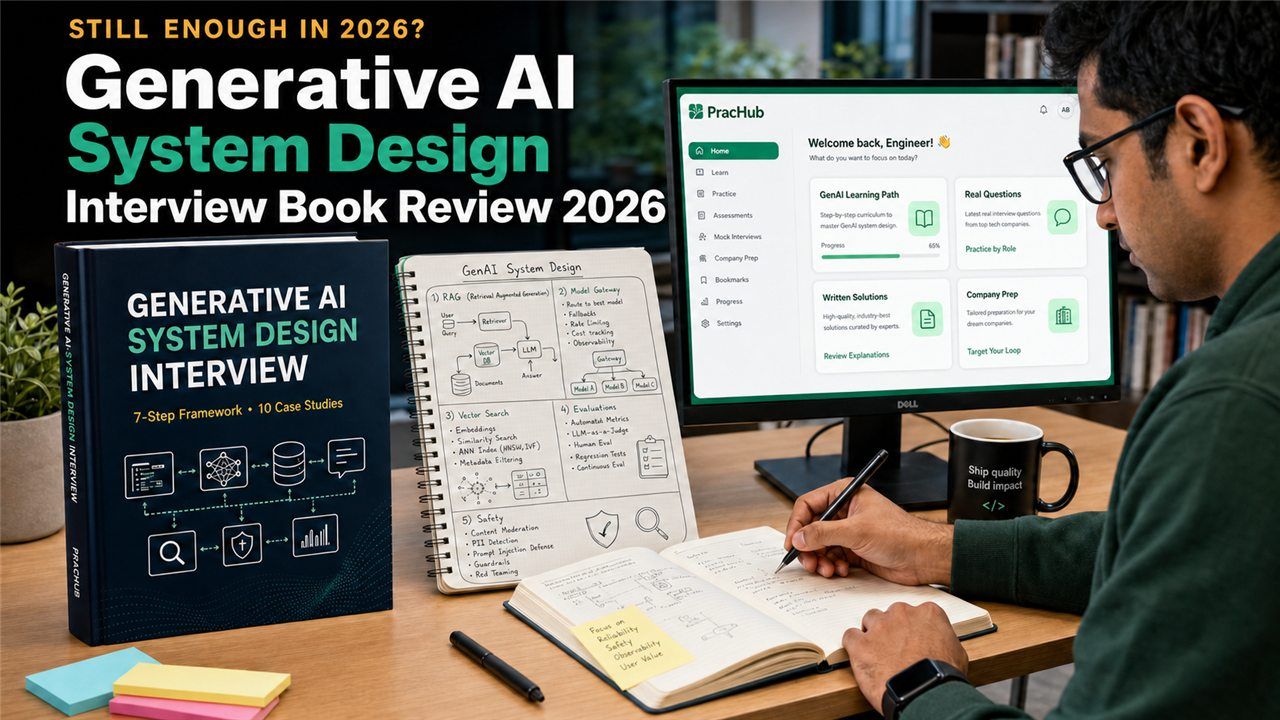
This 2026 review examines Generative AI System Design Interview by Ali Aminian and Hao Sheng. Learn what its 7-step framework, 10 case studies, and 280+ diagrams teach, where the 2024 book remains strong, and which newer topics require extra practice, including agents, evaluation, observability, safety, and inference cost. The guide also shows how to combine the book with PracHub real questions and its GenAI learning path.
You can memorize a clean RAG diagram and still struggle when the interviewer asks three practical questions: How will you evaluate answer quality? What happens when retrieval fails? How much will every response cost at scale?
Generative AI System Design Interview by Ali Aminian and Hao Sheng is designed to bridge that gap. It gives candidates a repeatable framework and works through systems ranging from Smart Compose and ChatGPT to image and video generation.
But the book was published in 2024, and GenAI interviews have moved quickly. Before treating any book as a complete curriculum, pair it with PracHub's Generative AI System Design learning path and real system design interview questions with written solutions. That combination turns reading into current, timed practice.
Quick Verdict
The book is still worth reading in 2026, especially for candidates who want a visual, interview-focused introduction to generative AI architecture. Its 7-step framework, 10 detailed case studies, and 280+ diagrams make complex systems easier to organize and explain.
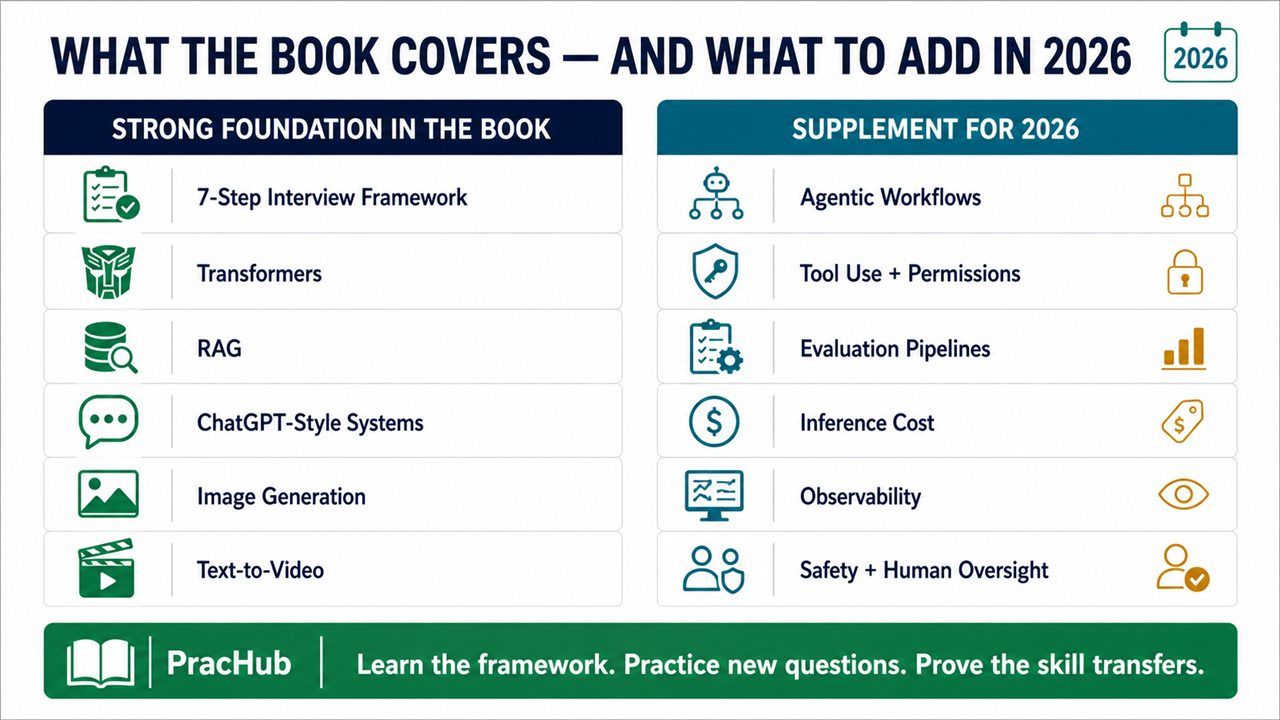
It is not enough as your only preparation resource. The public table of contents does not advertise dedicated chapters on agentic workflows, tool use, production evaluation, AI observability, or modern inference economics. These topics may appear within chapters, but candidates should supplement them explicitly.
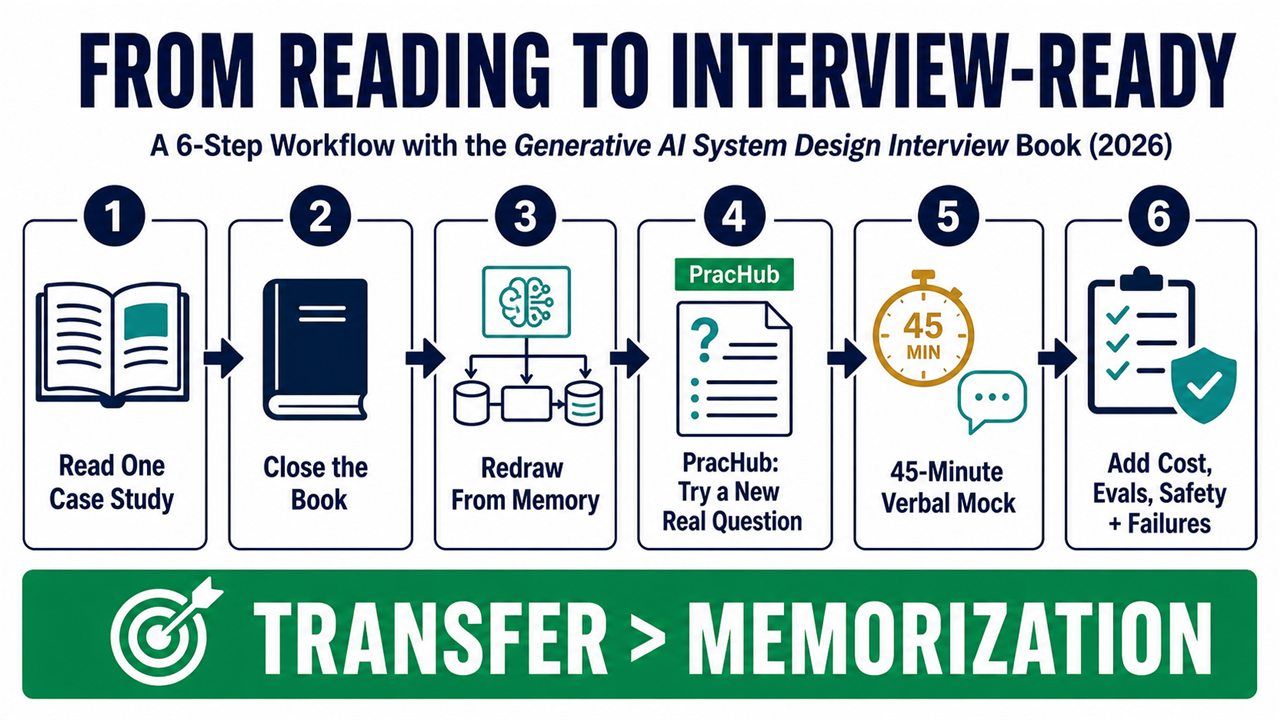
The best use is simple: learn the framework from the book, close it, solve a new prompt from PracHub, and measure whether you can defend quality, latency, cost, safety, and reliability without copying a diagram.
What Is Generative AI System Design Interview?
Generative AI System Design Interview is a 377-page ByteByteGo book by Ali Aminian and Hao Sheng, published in November 2024. The authors describe it as a companion to Machine Learning System Design Interview, with the earlier book covering search and recommendation while this volume focuses on generative systems.
The book promises an interviewer's perspective, a 7-step problem-solving framework, 10 real-world design questions, and more than 280 diagrams. Its examples span text, retrieval, image, and video systems rather than limiting the discussion to chatbots.
What the Book Covers
| Chapter Area | Examples | Interview Skill |
|---|---|---|
| Framework and fundamentals | Introduction and overview | Scoping the problem and structuring the answer |
| Text generation | Gmail Smart Compose and ChatGPT assistant | Transformer choices, latency, personalization, and serving |
| Sequence transformation | Google Translate and image captioning | Inputs, outputs, model architecture, and evaluation |
| Grounded generation | Retrieval-Augmented Generation | Retrieval pipeline, grounding, and answer generation |
| Image generation | Realistic faces, high-resolution synthesis, text-to-image, and personalized headshots | Generative models, data pipelines, quality, and personalization |
| Video generation | Text-to-video generation | Multimodal pipelines, compute, temporal consistency, and scale |
This spread helps candidates map GenAI product requirements to models, data, serving, and user-facing constraints without practicing only the familiar "design ChatGPT" prompt.
What the Book Does Well
It gives candidates a repeatable structure
GenAI prompts can become unstructured discussions about model names. A framework keeps the answer anchored in requirements, the ML task, data, architecture, serving, evaluation, and tradeoffs. That makes the candidate easier to follow and gives the interviewer clear places to probe.
The diagrams reduce cognitive load
More than 280 diagrams is not a guarantee of mastery, but visuals help connect tokenization, model architecture, retrieval, training, and serving. The sample Smart Compose chapter moves from clarifying questions to Transformer variants and then into the system itself, which is useful for software engineers entering ML.
The case studies cover multiple modalities
Text, image, and video systems have different latency, compute, data, and quality constraints. Practicing across modalities makes it harder to memorize one universal architecture and encourages candidates to adapt the framework.
What Is Missing for 2026 Interviews?
Agentic systems and tool use need dedicated practice
By 2026, many AI products do more than generate a response. They plan, call tools, maintain state, request approval, recover from failures, and expose actions for human oversight. Anthropic's current agent guidance, for example, treats tools and controllable autonomy as core architectural concerns.
The book's public chapter list does not include a dedicated agent design case. Candidates targeting AI platform or agent roles should separately practice tool selection, orchestration, memory, permissions, tracing, failure containment, and human intervention.
Evaluation must become a system, not a metric
A production GenAI design needs offline test sets, task-specific graders, human review, online experiments, regression gates, and feedback loops. OpenAI's current evaluation platform reflects this shift by treating evaluation as repeatable criteria, data sources, runs, and graders rather than one accuracy number.
When practicing any book chapter, add an evaluation pipeline to the diagram. Explain what "good" means, how you detect regressions, and which failures require a human decision.
Cost, observability, and safety deserve more depth
Senior candidates should be able to discuss time to first token, throughput, batching, caching, model routing, GPU capacity, retrieval freshness, privacy, abuse controls, and graceful degradation. The book provides a foundation, but a 2026 answer must connect those choices to measurable service objectives and operating cost.
Is the Book Enough for Your Role?
For software engineers moving into AI products: it is an excellent bridge. The visual explanations and product examples help translate traditional system design knowledge into model-backed systems.
For machine learning engineers: it is a strong interview framework, but supplement it with model serving, experiment design, evaluation, data quality, and MLOps. You may also need the companion ML system design book for ranking, recommendation, and predictive systems.
For senior and staff candidates: the book is a starting point, not the finish line. Interviewers will expect judgment about build versus buy, organizational ownership, migrations, failure recovery, cost controls, security, and how the system evolves after launch.
For research scientist roles: this is not a replacement for papers, model fundamentals, or research depth. Its purpose is system design communication, not proving theoretical expertise.
Book vs PracHub
| Preparation Need | The Book | PracHub |
|---|---|---|
| Build a GenAI foundation | Strong visual explanations and end-to-end examples | Structured learning path with current GenAI topics |
| Learn an answer framework | 7-step framework used across case studies | SCALED framework and applied learning modules |
| Practice unfamiliar questions | 10 in-depth cases | Real questions, written solutions, and broader system design practice |
| Target a company | Product examples, not a company-specific question map | Company-specific interview preparation |
| Prepare for the full loop | Focused on GenAI system design | System design, coding, ML, SQL, and behavioral and leadership practice |
| Stay current after publication | Fixed print edition | Online content and question practice can be updated |
The resources work better together. The book teaches a stable mental model; PracHub supplies the transfer test. If your answer only works for the diagram you just read, you have learned the solution but not yet built the skill.
A 10-Day Study Plan
On Days 1 and 2, learn the framework and create a one-page checklist. On Days 3 through 6, study four different modalities, but redraw every architecture from memory before reviewing the chapter.
On Days 7 and 8, use PracHub's Generative AI System Design course to deepen inference optimization, evaluation, RAG, fine-tuning, and back-of-the-envelope calculations. Add one missing production concern to every book design.
On Days 9 and 10, attempt two new company-relevant prompts under a 45-minute timer. Speak aloud, make assumptions explicit, estimate scale and cost, and finish with safety, monitoring, and rollout. Review the solution only after the attempt.
FAQ
Who wrote Generative AI System Design Interview?
The book was written by Ali Aminian and Hao Sheng and published by ByteByteGo in November 2024. Alex Xu announced the release through the ByteByteGo newsletter.
Is the book beginner-friendly?
It is approachable for software engineers with basic system design and ML familiarity. Complete beginners should first understand APIs, databases, distributed systems, training versus inference, and basic Transformer concepts.
Does the book cover RAG?
Yes. Retrieval-Augmented Generation has a dedicated chapter. Candidates should still supplement the chapter with current practice around hybrid retrieval, reranking, access control, freshness, evaluation, and production monitoring.
Is it enough for OpenAI, Anthropic, or Google interviews?
No single book is enough. It can provide the structure and core examples, but candidates should add company-specific questions, current agent and evaluation patterns, timed mocks, coding or ML fundamentals, and behavioral preparation.
Final Verdict
Generative AI System Design Interview remains one of the clearest visual foundations for GenAI architecture interviews in 2026. The framework and multimodal case studies are durable, and the book is particularly valuable for engineers who learn by following complete examples.
Its age matters most at the edges: agents, tool use, evaluation infrastructure, observability, safety, and inference economics are moving faster than print. Read it as a foundation, then use PracHub to practice new questions, update the missing layers, and prove that your reasoning transfers beyond the page.
Sources
Ali Aminian's official book page | ByteByteGo book announcement | Amazon book listing | Anthropic agent autonomy research | OpenAI evaluation guide
Related Articles
MLInterview.org Review 2026: Question Bank vs Real Company ML Interviews
Read our MLInterview.org review comparing its ML question bank and explanations with real company interviews, plus a better PracHub practice workflow.
Is Chip Huyen's Designing Machine Learning Systems Enough for MLE Interviews?
Is Designing Machine Learning Systems enough for MLE interviews? See what Chip Huyen's book covers, what it misses, and the best prep workflow.
Deep-ML Review 2026: Is It the LeetCode for Machine Learning?
Deep-ML review for 2026: compare its ML coding problems, free and Premium plans, interview coverage, and whether it is truly LeetCode for ML.
Generative AI System Design Interviews: How to Design LLM Applications That Work in Production
Prepare for GenAI system design interviews with a practical guide to LLM apps, RAG, agents, evaluation, safety, latency, and cost.
Comments (0)