Godot Interview Questions: Scene Ownership, Signals, and Physics Update Order
Quick Overview
Godot 4.7.2 interview exercises trace PackedScene ownership, valid-but-queued emitters, physics callback priorities, and CharacterBody2D movement units, with observed headless results and explicit limits.
Godot interview questions become easier to answer when you trace five separate contracts: parent hierarchy, scene ownership, queued deletion, callback scheduling, and movement units. A child can work throughout a play session, then disappear when you restore the saved scene. A signal handler can receive an object that is still valid but already scheduled for deletion. Moving code into a physics callback can leave an ordering bug untouched.
This article uses original debugging exercises and an actual headless run of Godot 4.7.2 stable, checked November 3, 2026. The official release archive identifies the version; the examples use the matching 4.7 documentation. These are preparation tasks, not reported employer questions or claims about interview frequency.
Start by practicing how to separate engine integration from game rules with Design a Testable 2048 Game Engine on PracHub. Then use the Godot traces below to explain which contract failed and which restored path, callback sequence, or movement distance would establish a repair.
How should you approach Godot interview questions?
Before changing code, identify the node instance, the phase, and the state that matters. “The projectile disappeared” could describe a missing serialized child, a deleted runtime node, or a visual problem while the node remains present. Those observations require different experiments.
Scene ownership is Godot's relationship for identifying which nodes belong to a saved scene. It is separate from the parent-child hierarchy used to organize the running tree. A PackedScene is the resource that can store and instantiate that scene structure. The official PackedScene reference explains its serialization boundary.
For the exercises here, use plain nodes named Lab, Actor, and Probe, one surviving signal receiver, and a separate movement fixture. Keep the default main-thread processing arrangement, a physics rate of 60 ticks per second, and time scale one. Worker-thread processing and networked simulation need their own ordering checks.
A useful answer begins with a prediction: which nodes will be instantiated, which callback will run first, or how far the body will move. Follow with the smallest counterexample. That makes the reasoning reviewable even if the interviewer changes one assumption.
Why does a child disappear from a PackedScene?
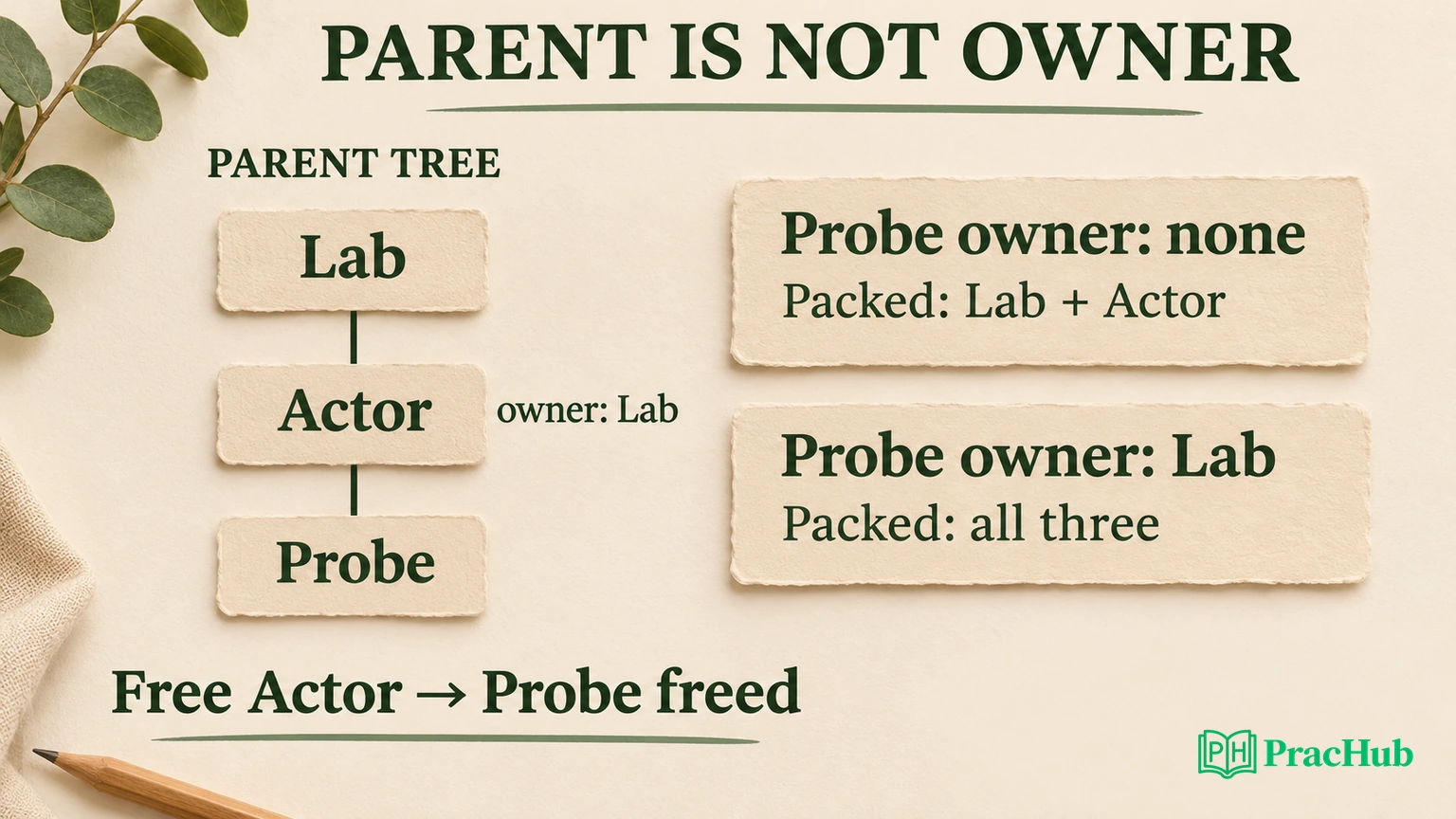
Construct Lab as the root, Actor as its child, and Probe as Actor's child. Set Actor's owner to Lab but leave Probe's owner unset. Probe exists in the running hierarchy; the question is whether packing Lab includes it.
var lab := Node.new()
lab.name = "Lab"
var actor := Node.new()
actor.name = "Actor"
var probe := Node.new()
probe.name = "Probe"
lab.add_child(actor)
actor.add_child(probe)
actor.owner = lab

var packed := PackedScene.new()
assert(packed.pack(lab) == OK)
var restored := packed.instantiate()
# This exercise restores Lab -> Actor, without Probe.
In the executed fixture, the first instantiated hierarchy contained Lab and Actor. After setting probe.owner = lab and packing again, it contained Lab, Actor, and Probe. The parent chain did not change between those runs. The saved without_probe.tscn contained Lab and Actor; with_probe.tscn added Probe under Actor.
| Fixture configuration | Instantiated nodes | Interpretation |
|---|---|---|
| Actor owner Lab; Probe owner unset | Lab, Actor | Runtime presence does not establish saved membership |
| Actor owner Lab; Probe owner Lab | Lab, Actor, Probe | Probe is included in this packed scene |
| Free Actor while Probe owner is Lab | Probe reference becomes invalid | Scene ownership does not preserve a child after parent deletion |
For this newly constructed hierarchy, assign the owner after adding the child and choose the scene root being packed. Node's owner property requires an ancestor; freeing a node also frees its children.
The practical repair is to check the intended saved membership, set the missing owner, then instantiate the packed result and assert the expected paths. Checking only the live tree would miss the original defect: the attachment would work until the packed scene was restored. Conversely, assigning owners to every temporary runtime helper can persist things you intended to reconstruct at runtime.
An informative follow-up changes the requirement: Probe is a diagnostic helper that must exist only while running. In that version, its absence from the restored scene is intentional. The acceptance check should expect Lab and Actor, then verify that runtime initialization creates exactly one Probe when needed. A blanket “save every descendant” fix would violate the new requirement.
Keep the two questions visible in a code review: what must persist, and what must be reconstructed? A temporary helper and a permanent gameplay attachment can share the same parent while needing different serialization policies. The node names alone do not tell you which policy is correct.
Does queue_free stop a signal immediately?
For an original signal exercise, the emitter is inside the tree and the receiver survives outside its subtree. Connect one ordinary handler and one handler with Object.CONNECT_DEFERRED. Queue the emitter for deletion, then emit its signal before yielding control.
emitter.pulse.connect(immediate_handler)
emitter.pulse.connect(deferred_handler, Object.CONNECT_DEFERRED)
emitter.queue_free()
emitter.pulse.emit(emitter)
Godot's Object connection flags describe deferred delivery as later idle-time delivery rather than immediate invocation. Node's queue_free documentation says deletion is queued and occurs after other deferred calls finish. Queueing deletion therefore does not cancel the immediate emission in this sequence.
The engine run produced this order. “Queued” was read only while the reference remained valid.
| Recorded event | Instance valid? | Queued for deletion? |
|---|---|---|
| After queue_free | Yes | Yes |
| Immediate handler | Yes | Yes |
| Emit returned to caller | Yes | Yes |
| Deferred handler | Yes | Yes |
| Observation after two process_frame signals | No | Not accessed |
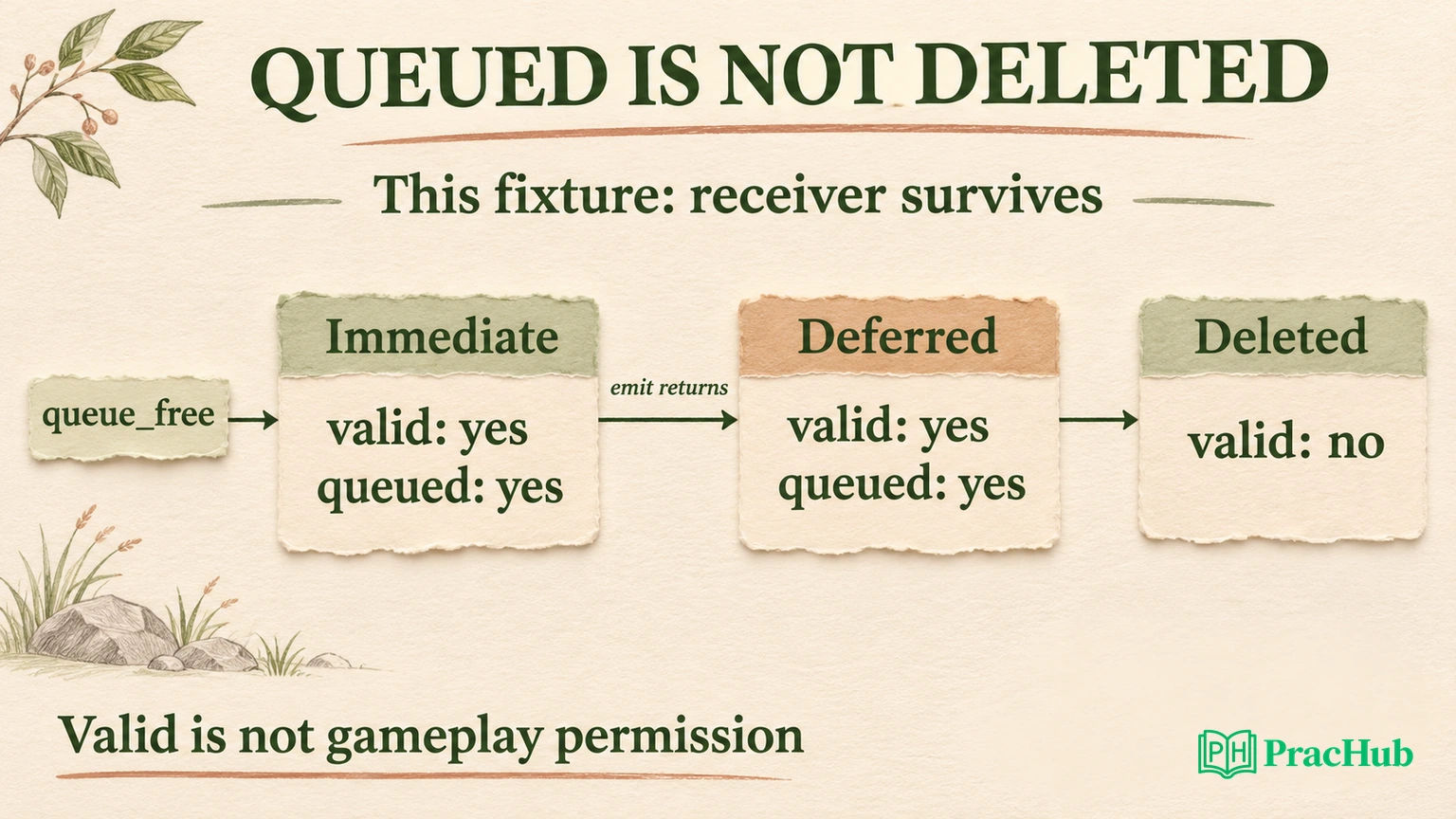
The deferred handler seeing a valid object is a result of this specific ordering. It does not establish that a reference remains usable after a later await or another callback frees the object. The last row is our observation point, not a requirement that deletion takes two whole rendered frames.
Explain what “stop” means in the game. If queueing a projectile means it must never deal damage again, the gameplay policy must reject it during the valid-but-queued interval. If the event announces that the projectile retired, a receiver might legitimately process an immutable retirement record instead. The engine's deletion schedule does not decide that domain policy.
What should the receiver check before changing gameplay state?
Godot's Object reference documentation warns that a reference can become invalid without becoming null. Use is_instance_valid() before calling methods on a potentially freed object. A successful validity check answers whether the instance exists; it does not answer whether the instance should still participate in your game.
For a handler whose contract excludes retiring nodes, the following guard makes both decisions explicit. It assumes the signal argument is a Node or an invalid Node reference.
func apply_hit(subject) -> void:
    if not is_instance_valid(subject):
        return
    if subject.is_queued_for_deletion():
        return
    # Apply the exercise's hit rule here.
Keep the validity check first: calling the queued-deletion method on an already freed instance is itself invalid. If a handler suspends with await, check the reference again after resuming, before using it. A check made before suspension is not evidence about its later lifetime.
This guard expresses the exercise's rule, not a universal instruction to discard all events from retiring nodes. For a score notification, prefer passing the necessary value and stable gameplay identity when that removes the need to dereference the sender later. Decide separately whether duplicate notifications must be ignored.
An interview follow-up might change the receiver's lifetime too. Our trace does not cover that case. Name which participant survives and draw the connection before predicting callbacks; otherwise you are answering a different program.
Consider an authored hit sequence: a projectile queues retirement, emits a hit notification, and a delayed handler later tries to read its damage value. If the rule says retirement cancels the hit, reject the retiring sender. If the hit was already committed, capture the required hit data at the commit point and let the later handler process that record. Merely changing the connection to deferred does not choose between these meanings.
State the duplicate rule as well. A surviving score display could receive two legitimate-looking records for one committed hit. An instance-validity guard would not make that update idempotent. This follow-up tests whether you can separate a lifetime defense from the game's actual once-only scoring invariant.
Why can physics movement read stale state?
The official processing tutorial distinguishes variable-rate _process() callbacks from fixed-rate _physics_process() callbacks. Moving physics work to the latter addresses the update phase, so a colliding body can advance with the physics simulation. It does not establish which of two nodes computes its state first.
In the movement fixture, Writer publishes speed 120 and Mover consumes it. Initially speed is zero. Mover appears before Writer in the tree, and both first run at physics priority zero. On their first tick, Mover reads zero before Writer publishes 120.
Godot 4.7 uses process_physics_priority for physics callback order: lower values run first, and equal values follow tree order. This differs from the regular processing property's name, process_priority. The Node physics callback reference defines that ordering.
With Writer's physics priority changed to minus ten and Mover's left at zero, the actual first-tick trace changed:
Equal priorities:   Mover, Writer -> Mover x = 0
Writer priority -10: Writer, Mover -> Mover x = 2
Physics delta: 0.0166666666666667 seconds
The second result uses direct Node2D displacement of speed times delta. It demonstrates this producer-consumer dependency, not a general mandate to distribute priority numbers throughout a project. Another design is to have one coordinator compute intent and then advance movement explicitly, reducing hidden dependencies between sibling callbacks.
When reviewing a repair, change the tree order deliberately. If behavior changes despite an explicit intended ordering contract, the dependency remains fragile. Also test a newly spawned mover; a steady-state run can conceal a first-tick read of stale or uninitialized data.
When should velocity be multiplied by delta?
Write the units before editing the expression. For a simple noncolliding Node2D marker, speed in pixels per second multiplied by seconds gives displacement in pixels. Adding a fixed two pixels on every render callback instead makes total movement depend on how many callbacks occur.
At 120 pixels per second, thirty idealized equal steps require four pixels each; sixty require two. Both total 120 pixels after one second. This is a controlled arithmetic example, not measured rendering performance or a claim that real frames arrive uniformly.
CharacterBody2D has a different API boundary. Its velocity is already a rate, and move_and_slide() incorporates the physics timestep. The CharacterBody2D reference explicitly documents both the units and automatic delta use.
# CharacterBody2D, inside _physics_process(_delta):
velocity = Vector2(120.0, 0.0)
move_and_slide()
In our empty-world first tick at 60 Hz, that moved the body two pixels. Setting velocity to Vector2(120.0, 0.0) * delta before the same call moved it approximately 0.033333335 pixels instead. The extra multiplication supplied displacement where the method expected velocity.
Do not convert that into “never multiply anything by delta.” Acceleration changes velocity over time, so its integration needs elapsed time. And move_and_collide() takes a relative motion vector, as the official character-body tutorial explains. Inspect each API's input contract rather than applying a movement slogan.
For a useful follow-up, replace constant speed with an acceleration of 60 pixels per second squared. Over a single logical step of one sixtieth of a second, the velocity increment is one pixel per second. Passing the resulting velocity to move_and_slide() still does not require another multiplication at that boundary. This is a units calculation, not an additional executed collision test.
Keep input handling separate from this calculation. A movement expression can have correct units while consuming stale intent, as the Writer/Mover exercise showed. When two repairs appear necessary, verify the order change and the unit change independently so one improvement cannot conceal the other defect.
What did the headless fixture actually verify?
The executed Godot build identified itself as 4.7.2.stable.official.ed1daf0bf. The original headless fixture exited successfully with sixteen checks and no failures, covering packed membership, child invalidation after parent deletion, the stated signal sequence, first-tick ordering, and the two movement distances. The receiver and process nodes were ordinary objects in the same default processing arrangement.
These observations support the examples; they do not validate a complete controller. The fixture had no collision shapes or obstacles, and it did not exercise rendering, input sampling, slopes, multiplayer synchronization, or different physics thread groups. Fixed ticks alone do not prove deterministic gameplay across machines.
For your own project, preserve the small reproduction and add the missing boundary relevant to the bug. If the failure concerns a wall collision, introduce a controlled wall and inspect the collision response. If it concerns a scene transition, perform the transition while notifications are pending and record both participants' identities.
Keep the regression expectation narrow enough to falsify. “It looks smoother” is weaker evidence than a trace showing the intended producer runs before its consumer, or a saved scene that restores the missing child. Before declaring the bug fixed, explain why the old trace failed and why the new trace satisfies the intended rule.
Practice the reasoning with adjacent PracHub questions
The following verified PracHub records exercise related skills. They are not a Godot employer question bank, and their language or runtime rules do not replace Godot's documentation. Rehearse the transferable reasoning, then return to the engine-specific trace.
| PracHub question | How to use it for this preparation |
|---|---|
| Design a Testable 2048 Game Engine | Separate game rules from engine callbacks and make state changes testable. |
| Merge and Serialize N-ary Trees | Define the saved structure and verify a round trip rather than inspecting only a live tree. |
| Design a reusable event-driven framework for trading strategies | State dispatch-order and receiver contracts without assuming every event system has Godot's semantics. |
| Build a Thread-Safe Video Playback Loop at 25 FPS | Distinguish production timing, consumption timing, and orderly shutdown; do not transplant its thread model into signals. |
| Review Code for Memory Risks | Explain which references can outlive an object's intended participation and what evidence detects misuse. |
For your next Godot interview practice, give yourself one altered premise: Probe becomes transient, the receiver yields before using the sender, or Writer moves after Mover. Predict the changed outcome before running it. Finish by naming the observation that could prove your prediction wrong.
Open Design a Testable 2048 Game Engine, read its overview, and sketch a testable state transition before consulting any available solution. Then reproduce one Godot trace and describe the repair in terms of saved membership, object lifetime, callback order, or units. That gives your answer a concrete claim another engineer can check.
Sources and Further Reading
- Godot 4.7.2 stable release archive
- Godot 4.7: PackedScene
- Godot 4.7: Node, owner, queue_free, and physics callback order
- Godot 4.7: Object validity and connection flags
- Godot 4.7: idle and physics processing
- Godot 4.7: CharacterBody2D
- Godot 4.7: using CharacterBody2D/3D
Research checked November 3, 2026. Engine outputs come from an original local headless fixture on macOS; numerical traces are not game-performance benchmarks or candidate reports.
Comments (0)