Google SWE Intern Team Matching 2027: Timeline, Match Calls, and What Improves Your Odds
Quick Overview
A practical 2027 guide to Google SWE intern team matching: what the pool means, what match calls cover, how long candidates may wait, and how to prepare.
Updated August 17, 2026. This guide separates Google-published information from current candidate reports. Team matching details can vary by geography, headcount, and hiring cycle.
You cleared the Google SWE intern technical interviews, then the portal says some version of team matching, project search, or matching pool. That is exciting, but it is also the stage where candidates can make themselves miserable by treating a quiet inbox as a verdict.
Team matching is usually a mutual-fit step after earlier evaluation: an available team looks at candidate profiles, conversations help both sides assess a potential project fit, and a host decision can move the process forward. It is not the same as a final offer, and Google does not publish one universal 2027 schedule or success rate.
This guide explains what candidates are currently reporting, what a match call is likely trying to learn, and how to make your profile easier for a team to understand. Start your technical refresh with Google Software Engineer questions, then use the plan below to prepare the rest of your story.
Quick verdict: what Google SWE intern team matching means
Being in team matching is a positive milestone, not a guaranteed internship offer. The practical interpretation is that a team or matching process may now need to connect your profile with an open project. Your outcome can still depend on team capacity, location, role needs, and whether a conversation produces a mutual fit.
Current 2027 candidate discussions describe a common path of online assessment, two technical interviews, and then a matching pool. Some candidates describe brief team conversations after that point. Those reports are useful for preparation, but they are not a public Google policy and should not be used to promise anyone a number of calls or a deadline.
| Question | Best answer |
|---|---|
| Does team matching mean I have an offer? | No. It means a further fit and capacity decision may still be needed. |
| How long will I wait? | Google publishes no universal 2027 service level. Candidate reports range from quick movement to much longer waits. |
| What should I prepare now? | A concise project story, truthful preferences, technical depth, and thoughtful questions for a potential host. |
What is official, and what is candidate-reported?
One of the easiest ways to get bad advice during recruiting season is to blend a company webpage, one regional recruiter email, and a Reddit post into one confident “process.” Keep the evidence levels separate.
| Claim | Evidence level | How to use it |
|---|---|---|
| Google encourages candidates to prepare for structured interviews and communicate their experience. | Google Careers guidance | Use this as the durable preparation baseline. |
| 2027 candidates report OA, technical interviews, then a matching stage. | Current candidate reports | Use it to plan, not to infer a guarantee. |
| Some match conversations are around 30 minutes. | Current candidate reports | Be ready for a compact, conversational call. |
| One 2026 Canada candidate entered team matching shortly after technical interviews. | Historical candidate timeline | Treat it as one example, not a 2027 clock. |
| Exact odds, number of calls, or a cutoff date. | Not publicly published | Do not invent a probability from anecdotes. |
How the team-matching stage usually fits into the process
Think of team matching as a bridge between a candidate who has shown broad interview readiness and a team that needs someone for a specific project. The team is not merely asking, “Can you code?” It is trying to understand whether your skills, interests, location constraints, and working style make sense for its near-term needs.
That distinction changes how you should prepare. The best answer is rarely “I am open to anything.” A better answer is, “I am especially excited by backend and data-intensive systems. In my last project I owned the ingestion pipeline, so I would enjoy work where correctness and scale matter. I am also happy to learn the stack your team uses.” That is specific without pretending you already know the project.
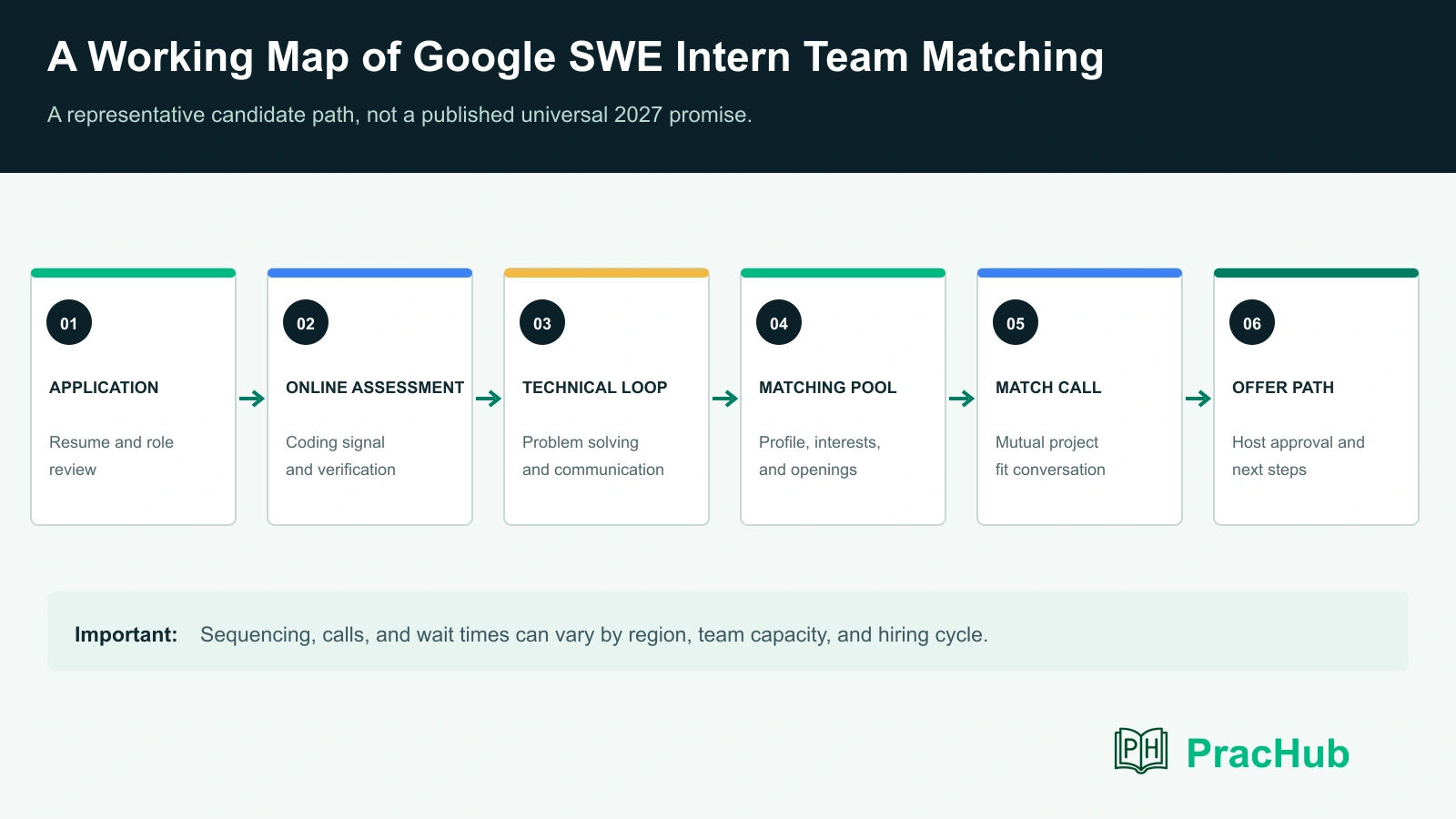
The representative path, without false precision
Many candidates describe an application, online assessment, technical interviews, a period of result processing, then a pool where teams may review profiles. The exact order can differ. A recruiter may collect preferences earlier, a team may speak with a candidate before a portal label changes, and some locations may run their own sequence.
The point is not to memorize a flowchart. The point is to keep momentum in the parts you control: your project story, preferences, responsiveness, and continuing interview preparation elsewhere.
Google SWE intern team-matching timeline: what can you reasonably expect?
Expect uncertainty, not an SLA. A historical 2026 candidate report from Toronto/Waterloo described entering team matching within days of technical interviews. Other candidate reports describe waiting weeks or longer. Both can be true because available teams and headcount change.
Why timing varies so much
Matching can depend on when a team finalizes internship scope, whether it has a host, location needs, recruiter workload, and how many candidates have reached the pool. The same candidate can appear early in one market and later in another. Silence therefore does not tell you much on its own.
Use the recruiter contact named in your own process for factual questions about deadlines, availability, or required forms. A short, polite update after a meaningful change is reasonable. Repeated “any updates?” messages do not create a team opening and can make a stressful process feel even longer.
A sensible follow-up rhythm
Reply promptly to a request, complete any preference form carefully, and confirm constraints honestly. If you receive no stated timeline, wait long enough for the current stage to do its work, then send one concise follow-up that includes any material update: a new graduation-date clarification, an internship deadline, a location change, or a relevant project accomplishment.
Meanwhile, keep interviewing. A matching pool is a promising lead, but it should not pause your entire recruiting plan.
What happens in a Google team-match call?
Candidate reports generally describe a short conversation rather than another full technical loop. The interviewer may introduce the team, describe the project area, ask about your background, and assess whether the work is something you could learn and contribute to during the internship.
Prepare as though you have 20 to 30 minutes to create clarity. You do not need a speech. You need a crisp explanation of what you built, what you want to explore, and how you collaborate when requirements are incomplete.
Prepare a 90-second project story
Choose one project with enough substance to discuss decisions, trade-offs, and results. Use this sequence: the user or system problem, your role, the important technical decision, what broke or changed, and the measurable result or lesson. If you cannot explain a project without a long setup, it is not yet match-call ready.
Ask questions that reveal a real fit
- What would an intern own or learn in the first eight to twelve weeks?
- What technical constraints shape the project most: latency, reliability, data quality, developer experience, or something else?
- How does the team scope work for an intern before the internship starts?
- What would strong collaboration with a host or mentor look like on this team?
These are better than trying to guess a secret scoring rubric. They help you decide whether the project is a genuine fit, too.
What improves your odds of a useful match conversation
You cannot control headcount. You can make it easy for a recruiter or potential host to understand what you would bring. That is a much more useful target than trying to “optimize” a rumor about team match odds.
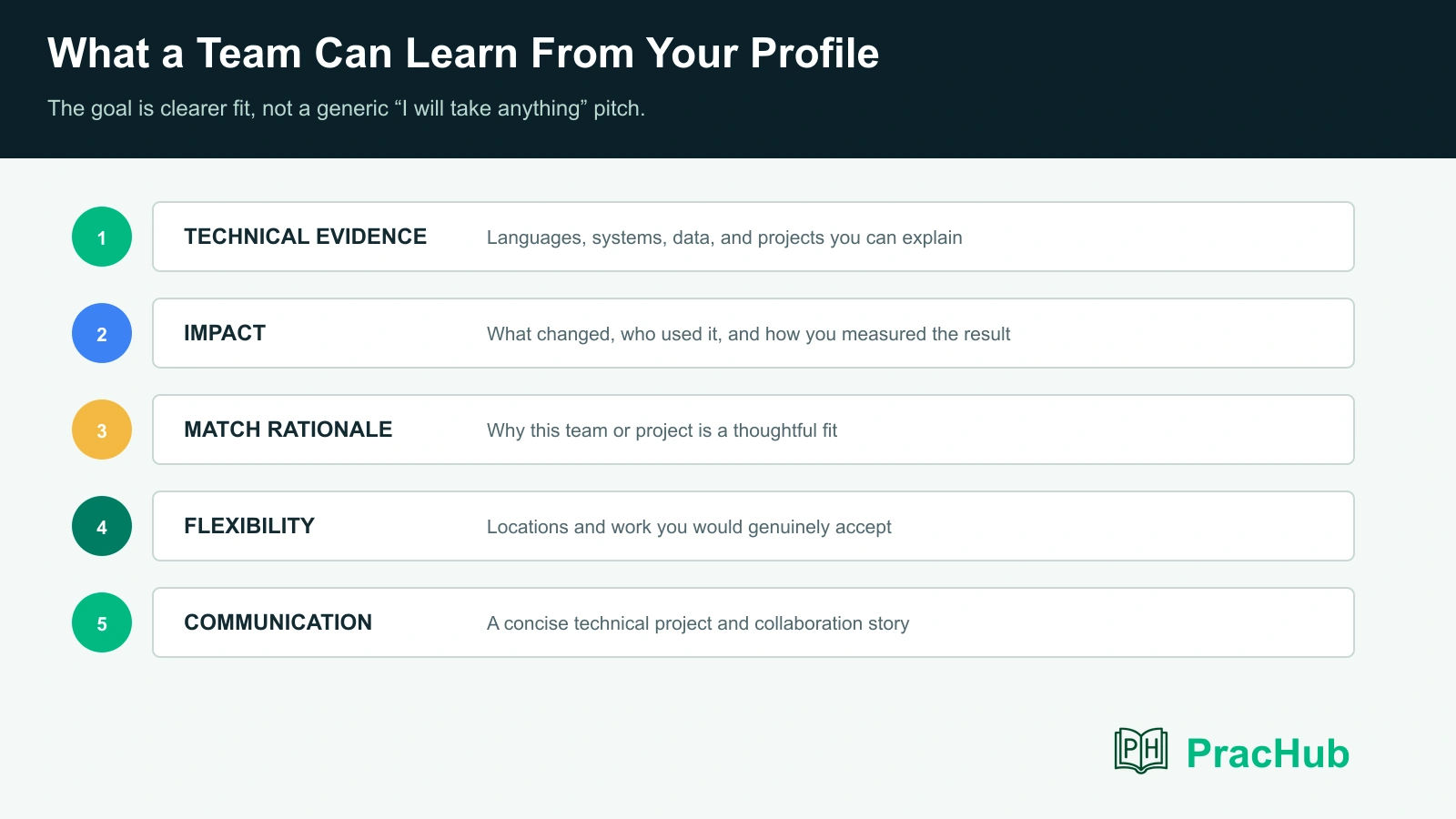
Make your profile concrete
Replace vague skill labels with proof. “Python, Java, distributed systems” becomes stronger when paired with a project that processed a specific workload, reduced a failure mode, or supported real users. If your work was academic, explain the constraints, experiments, and design choices with the same care.
State preferences truthfully, with flexibility where you mean it
Location and project preferences are useful information, not a test to game. List places you could genuinely work and areas you would seriously consider. A candidate who says yes to every city and every domain may look less legible than someone who names two or three credible directions and remains open to learning.
Rehearse the transition from technical work to collaboration
Technical interviews prove problem solving under pressure. A team conversation often asks for something adjacent: how you clarify requirements, work through feedback, or handle a disagreement. Build two short stories now and use the behavioral and leadership question bank to practice the details.
Practice with Google questions from PracHub
These company-tagged exercises are not predictions of a particular 2027 assessment. They are useful for refreshing the coding patterns, explanation habits, and behavioral judgment that make your technical background easier to discuss in later stages.
| PracHub question | Practice focus | Why it helps |
|---|---|---|
| Deduplicate and Order Batch and Streaming Logs | Data ordering and correctness | Practice explaining a concrete design decision and edge-case strategy. |
| Determine All Players with Fixed Rankings | Graphs and reachability | Builds a clean narrative around modeling, traversal, and complexity. |
| Compute a Depth-Weighted Sum of a Nested List | Recursion and iteration | Tests whether you can clarify structure and communicate trade-offs. |
| Handle Conflict, Expanded Scope, Risk, and Team Culture | Behavioral judgment | Turns collaboration experience into a structured, believable answer. |
For a broader refresh, work through interview questions with written solutions under realistic time limits, then explain one solution aloud as if a future host had asked about your reasoning.
A seven-day team-matching preparation plan
| Day | Focus | What to do |
|---|---|---|
| Day 1 | Profile audit | Rewrite two resume bullets so each shows ownership, technical detail, and impact. |
| Day 2 | Project story | Record a 90-second explanation of one project; remove jargon that hides your contribution. |
| Day 3 | Technical refresh | Complete two timed Google-tagged problems and explain your solution after each. |
| Day 4 | Behavioral evidence | Prepare stories about feedback, ambiguity, and a disagreement resolved constructively. |
| Day 5 | Match-call mock | Practice your introduction, project story, and four questions for a potential host. |
| Day 6 | Preferences | Write truthful location and project preferences, plus the reason behind each one. |
| Day 7 | Logistics | Review your recruiter thread, availability, and concise follow-up note; keep other applications moving. |
Common mistakes to avoid
Do not turn anecdotes into promises. A post saying someone matched in three days is encouraging, not a calendar invite. A post saying someone waited months is a reminder to keep options open, not proof that your candidacy is over.
Do not oversell flexibility. Claiming enthusiasm for a city, domain, or work arrangement you would immediately reject wastes everyone’s time. Honest flexibility is useful; performative flexibility is not.
Do not stop technical practice. A match call may be conversational, but your technical confidence still matters. You may discuss your projects in depth, receive follow-up questions, or need to stay sharp for other active processes.
Frequently asked questions
Does Google SWE intern team matching guarantee an offer?
No. It indicates that you may be considered for an available team or project after earlier interview stages. An offer can still depend on a host, fit, location, and hiring capacity.
How long does Google team matching take in 2027?
There is no published universal 2027 timeline. Candidate reports include both short waits and longer ones. Follow the timing in your own recruiter communications, not a date taken from someone else’s market.
Is a team-match call another coding interview?
Current candidate reports tend to describe a short fit conversation, but your invitation is the source of truth. Prepare your technical project story and be ready to answer directly if the host asks a technical follow-up.
Should I email a recruiter while waiting?
Yes, if you have a stated deadline, a material update, or a reasonable interval has passed with no timeline. Keep the note brief, specific, and professional. Do not send repeated status requests.
Bottom line
The best way to approach Google SWE intern team matching is to treat it as a fit conversation under real hiring constraints, not a hidden lottery you can solve from internet anecdotes. Be clear about what you built, what you want to learn, and what opportunities you can genuinely accept.
Keep your technical foundation active with Google Software Engineer questions and use PracHub to turn your coding and collaboration experience into answers that a potential team can quickly understand.
Sources and Further Reading
- Google Careers: Interview Tips
- Current Candidate Discussion: Google Summer 2027 SWE Intern Process After OA
- Current Candidate Discussion: Google SWE Internship 2027
- Candidate Timeline: 2026 Toronto, Waterloo, and Montreal Team Matching
- Candidate Pool Discussion: 2026 BS SWE Intern Team-Match Updates
Research note: Google does not publish a universal 2027 intern team-matching schedule, number of calls, or conversion rate. Candidate reports are included to show current and historical patterns, not to predict an individual result.
Comments (0)