How Do You Learn New Technologies? Engineering Interview Answers With Evidence
Quick Overview
Prepare a learning-process answer using your own engineering evidence. Distinguish study activity, corrected understanding and reviewed application; inspect a clearly fictional tracing example, scope limits, help-seeking and follow-up questions without borrowing a personal story.
Answer “How do you learn new technologies?” with a repeatable process and one experience that proves it. Explain the problem you needed to solve, the assumption you tested, how feedback changed your understanding and where you applied the result. A list of courses or tools describes activity, not demonstrated learning.
Use PracHub's Explain How You Learn New Technical Topics to rehearse the process question before expanding into a story. This article provides original answer-building tools and clearly fictional worked examples. It does not supply a personal history to memorize, an employer scoring rubric or a promise that a particular company will ask this exact question.
Answer the process question before telling the whole story
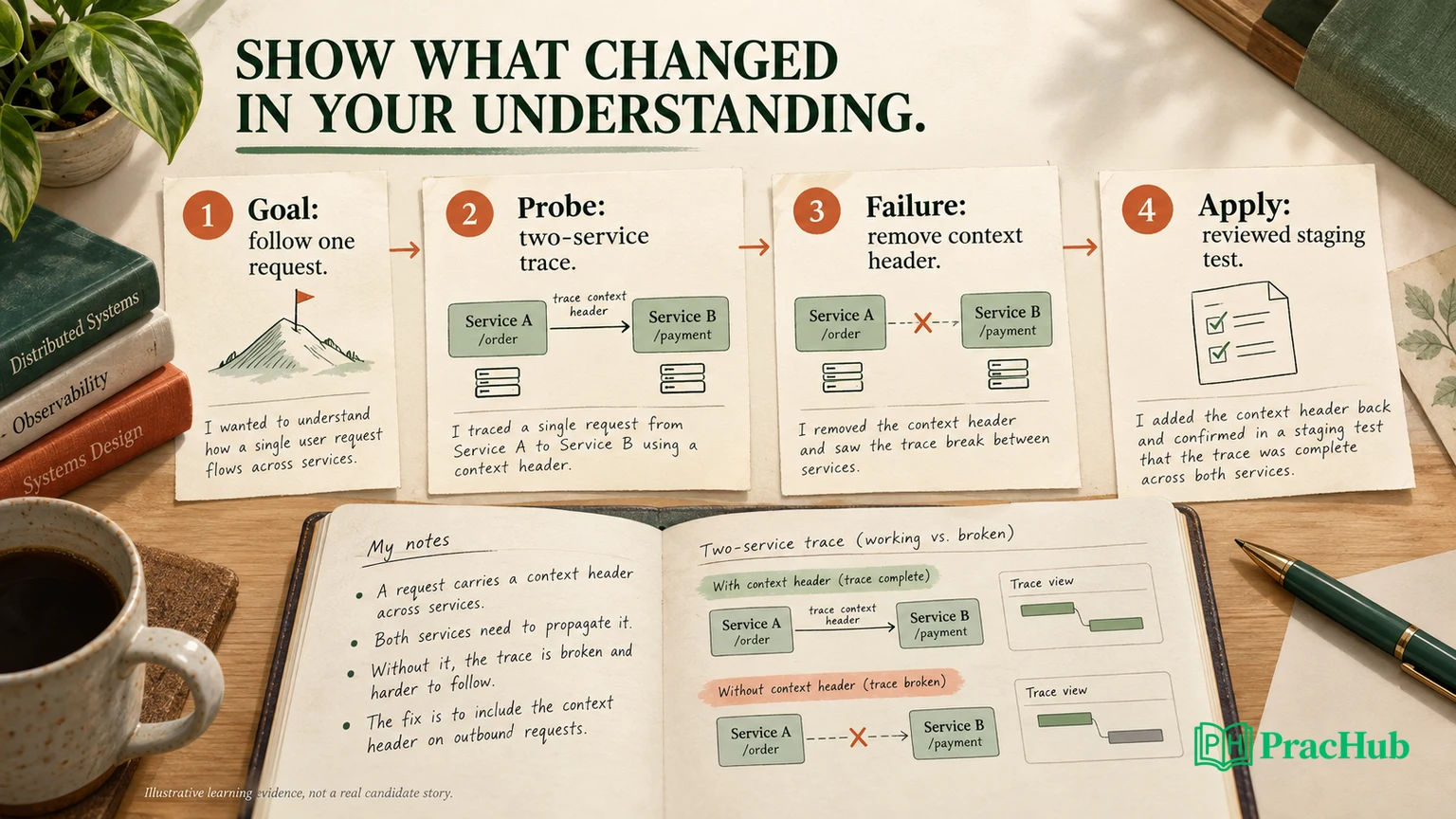
The question asks how you approach learning, so start by explaining the method directly. A useful sequence is to define a practical goal, identify the smallest knowledge gap, consult an authoritative source, build a limited probe, test a failure case and apply the result with appropriate review.
Then illustrate that method with one real episode from your own work, study or independent project. The example should reveal a change in understanding. “I watched several tutorials and finished the task” omits what you misunderstood, how you checked it and why the final approach was trustworthy.
Keep the initial method concise enough that the interviewer can follow the later example. You do not need to name a branded learning framework or describe every resource you opened. The important connection is between what you needed to know and the evidence that you learned it.
If the interviewer asks for something you learned recently, lead with that episode and make the method visible inside it. If they ask specifically about speed or a deadline, explain how you narrowed scope without implying that shallow familiarity became expertise overnight.
Distinguish public employer guidance from general advice
As one official company example, Amazon's Leadership Principles include Learn and Be Curious. Its SDE III preparation page encourages structured experience-based answers and discussion of decisions. Those sources support preparing concrete evidence; they do not establish a universal learning-question rubric or another employer's interview process.
The method in this article is our preparation recommendation. It combines practical engineering checks with answer construction. It is not quoted from an internal hiring guide, and the fictional example below is not a candidate report.
Your role and actual interview instructions still determine the relevant depth. A junior candidate can demonstrate a careful implementation and a corrected misconception. A senior candidate may also need to explain how the learning reduced uncertainty for a team, changed a technical decision or established an appropriate adoption boundary.
Neither version requires claiming complete mastery. Naming the part you can now explain and the part that still needs expert review can make the account more precise. The boundary should describe real knowledge, not serve as a generic disclaimer attached to an otherwise inflated story.
Choose an episode with a visible knowledge gap
Look for an experience where the unfamiliar concept affected a concrete engineering decision. Perhaps a tracing system produced disconnected spans, a frontend library behaved differently on a device or a data tool handled null values in an unexpected way. The useful story begins with that uncertainty, not the technology's popularity.
Identify what you already knew. A developer familiar with HTTP may still need to learn how trace context crosses process boundaries. Stating that starting point explains why the new concept mattered without pretending that the entire application stack was unfamiliar.
Choose an example you can discuss beyond its polished summary. Can you describe the first failed approach, the observable symptom, a test you changed and a review comment that affected your implementation? If not, gather your own notes before building a larger claim around it.
Avoid selecting an episode solely because the technology sounds prestigious. A modest learning problem with a defensible test can reveal more engineering judgment than a broad assertion about mastering distributed systems. The answer should make your reasoning inspectable, not merely increase the number of product names it contains.
Map a learning goal to evidence
The following is an original evidence map for a fictional context-propagation exercise. Both services are instrumented for tracing in a controlled development setup. The learner wants to understand why a downstream request appears in a separate trace.
| Learning question | Small check | Evidence the answer could discuss |
|---|---|---|
| What links this request across services? | Follow one request through the instrumented pair | The relevant trace and parent relationship |
| What happens when propagation is missing? | Remove the configured context header in the controlled test | The downstream span no longer links as expected |
| Did the repair address the boundary? | Restore propagation and repeat the same request | Linked spans plus a regression test |
| Where was the learning applied? | Submit a narrowly scoped change for review | Reviewed patch, staging test and runbook note |
OpenTelemetry's context-propagation documentation explains how context carries correlation information across service and process boundaries. That official background supports the example's technical subject, not a claim that the fictional work occurred or that every library automatically propagates every request.
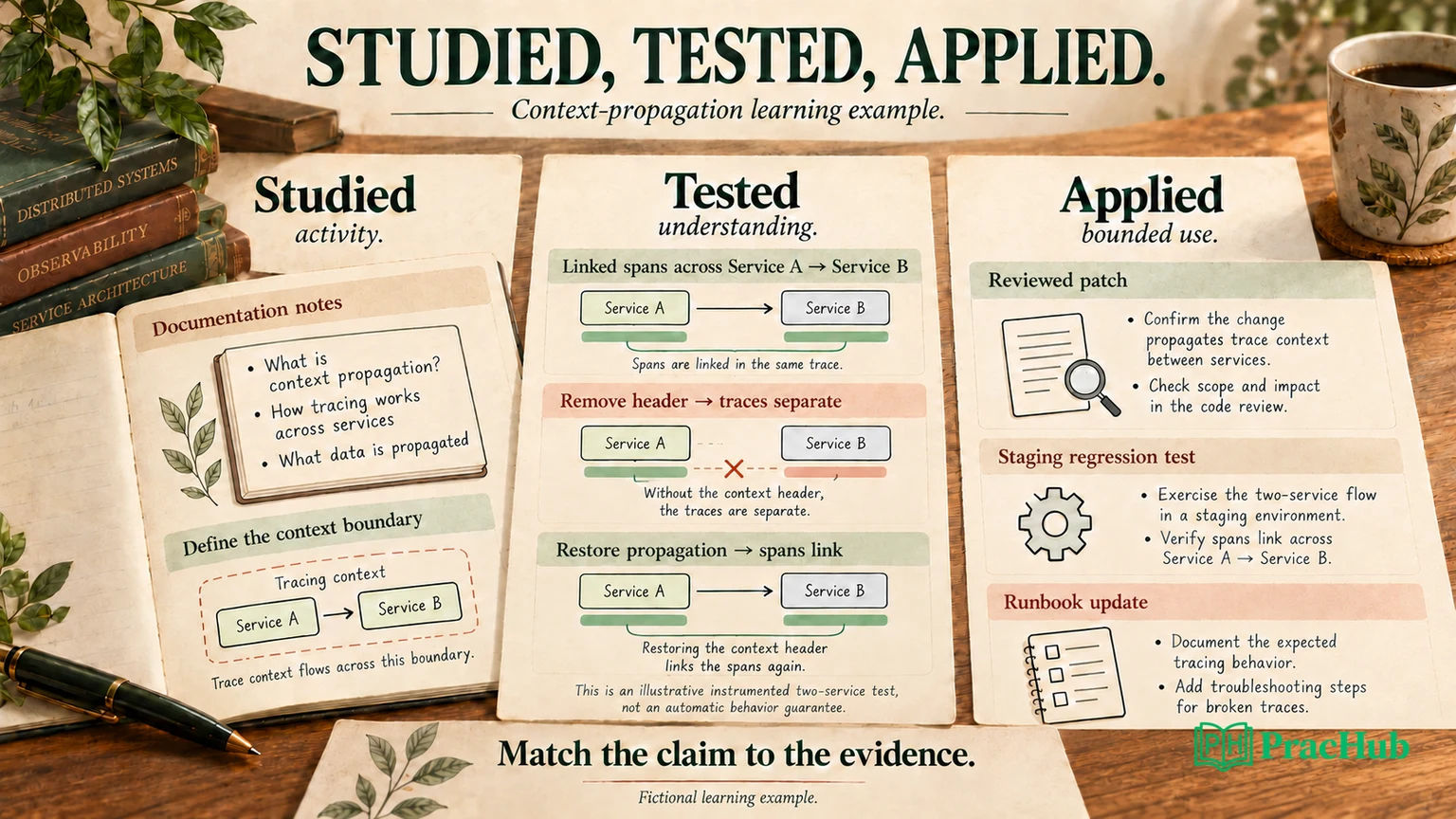
The negative test matters because it distinguishes an understood mechanism from a coincidental successful screenshot. The review and application evidence matter because a working local probe is not the same as a safe production change. Name the actual instrumentation and scope if this resembles your own experience.
Work through a fictional answer
The following answer is invented solely to demonstrate structure. Do not present its project, actions or result as your own experience.
I start with a concrete task and identify what I cannot yet explain. I read the primary documentation, build the smallest useful experiment and test a failure case before applying the technique more widely.
For example, in a fictional staging project, our instrumented services produced spans that were difficult to connect across an HTTP call. I understood the request path but did not understand the propagation boundary. I initially assumed that creating spans in both services would be enough.
I read the context-propagation documentation and built a small two-service example. I compared a request carrying the configured context with one where I deliberately removed that header. Seeing the downstream span start separately corrected my assumption about what the instrumentation was doing.
I then prepared a narrow patch, repeated the positive and negative checks and asked a teammate to review the change. The result was a reviewed staging regression test and a runbook explanation. I would not claim that this demonstrated production-wide tracing coverage; that would need a broader rollout and measurement.
The opening answers the method question. Within the invented story, the mistaken assumption identifies what was learned. The controlled comparison explains how understanding changed. The final boundary keeps the result proportional to the evidence instead of turning one example into a claim of observability expertise.
Make help-seeking part of the method
A credible learning process can include documentation, a teammate, a maintainer discussion or an approved assistant. Explain what you tried, which question remained and how you evaluated the response. Asking a precise question after a small experiment is different from outsourcing the whole task and retelling someone else's reasoning.
If a teammate identified the missing propagation step, credit that contribution. Your own learning may consist of reproducing the symptom, testing the explanation and turning it into a regression check. The story remains useful without assigning every insight to yourself.
If an AI tool helped, describe its bounded role when relevant. Distinguish a suggested explanation from a verified fact, and a generated patch from code you can defend. Follow the applicable interview and workplace policies, and do not disclose confidential code or data to an unauthorized tool.
The follow-up test is simple: could you explain why the proposed fix works and predict a nearby failure? If the answer is no, the tool may have helped finish a task, but your account has not yet established the claimed understanding.
Explain safe application without overstating rollout
Learning and deployment are separate milestones. A local example can establish a mechanism; a staging integration can expose application-specific behavior; a production rollout needs its own authorization, monitoring and recovery plan. State which milestone you reached.
Google's Canarying Releases chapter describes limiting exposure and comparing meaningful signals during deployment. That is background for discussing safe adoption, not evidence that your own small test constituted a canary or that a particular percentage is always sufficient.
In an interview, explain who reviewed the new use, what risk constrained the scope and what would stop wider adoption. If you did not own the rollout, identify the person or team that did. A contribution to a reviewed change is still a contribution.
Do not automatically attach a dramatic performance improvement to the learning story. If the observable result was a corrected test, a reproducible diagnosis or an improved team explanation, report that result. Operational impact requires operational evidence from an appropriate window and population.
Prepare follow-ups that test the claimed understanding
Expect to be able to explain the initial misconception in ordinary language. What observation contradicted it? Why did you choose that probe rather than rebuilding the entire service? What would the test have shown if the hypothesis were wrong?
For the fictional tracing example, distinguish generating a span, passing context and viewing exported telemetry. They are related steps, not synonyms. Explain which step the experiment isolated and which possible causes remained outside its scope.
Also prepare the practical trade-off. How much time was available? Which topic did you defer? When did you seek help? A deadline can justify limiting the experiment, but it does not justify claiming that untested behavior was reliable.
Finally, explain transfer. Did the experience change how you investigate the next unfamiliar library or protocol? A useful reflection identifies a new habit, such as testing the boundary where information crosses systems, rather than ending with the uninformative sentence “I learned a lot.”
Use honest evidence when your experience is limited
A student can use a course project or personal experiment, provided its starting template and independent work are clear. A tutorial-derived example should not become a fictional professional deployment. Explain which part you changed and what happened when the initial recipe stopped working.
If your only evidence is reading, say so and choose a narrow exercise before the interview. You can discuss a learning plan honestly, but a plan is not a completed application. Keep completed actions, current capability and intended next work separate in your notes.
When numbers are unavailable, avoid inventing study hours, throughput gains or incident reductions. A reproducible failure, a test assertion, a review decision or another person's ability to follow your explanation can provide concrete evidence without a fabricated percentage.
Five practice questions for learning evidence
These PracHub records offer related behavioral prompts. They are practice material based on reported questions, not a promise about your next interview. Adapt the evidence to the exact wording instead of repeating the same memorized paragraph.
| PracHub question | What to practice |
|---|---|
| Explain How You Learn New Technical Topics | Lead with the method, then establish one concrete learning episode. |
| How do you learn new knowledge quickly? | Show a corrected misconception instead of only study speed. |
| Learn and Apply a Front-End Technology Across Devices | Separate guided study from independently verified application. |
| Learn complex topic fast under deadline | Explain scope control and help-seeking under a real deadline. |
| Describe Something New You Learned Recently | Describe what changed in your understanding and what remains unknown. |
Rehearse Explain How You Learn New Technical Topics with your own episode. State the method, name one corrected assumption and show the evidence that supports the scope of your application. Leave out any claim you cannot defend when the interviewer asks how you know.
Comments (0)