InterviewReady Review 2026: Is Gaurav Sen's System Design Course Worth It?
Quick Overview
InterviewReady's System Design Simplified course offers a structured path through distributed-systems fundamentals, high-level design case studies, quizzes, resources, and judge questions. This 2026 review examines Gaurav Sen's curriculum, current advertised pricing, one-year access, strengths, limitations, and the best way to combine targeted course lessons with real company interview practice on PracHub.
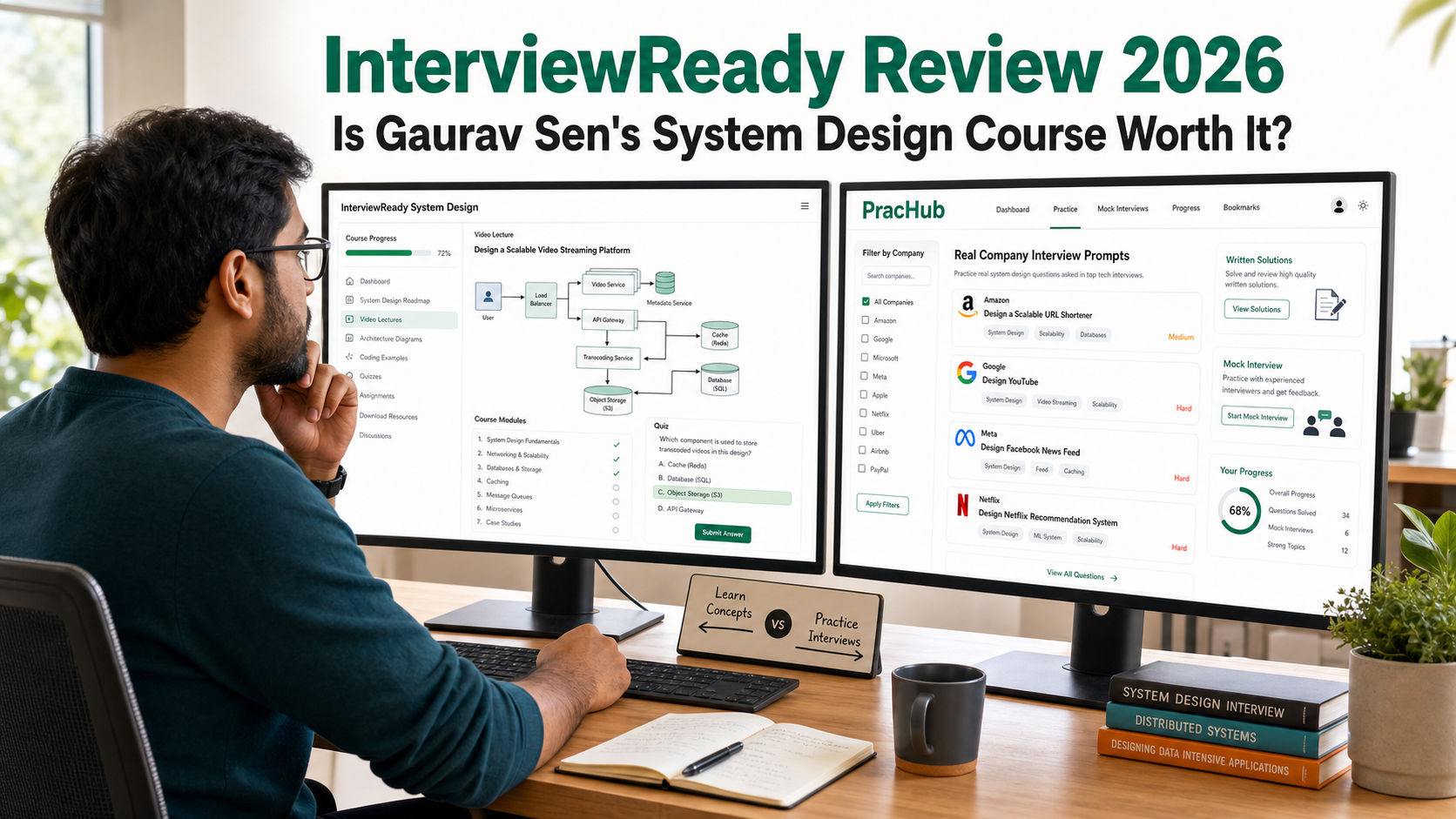
A polished system design course can teach you the vocabulary of distributed systems. It cannot guarantee that you can lead an ambiguous 45-minute design conversation. That difference decides whether InterviewReady is a smart purchase or another course you watch without becoming interview-ready.
If an interview is already scheduled, start by diagnosing yourself with real interview questions with written solutions and company-specific interview prep on PracHub. Then use a course such as InterviewReady only for the concepts your practice exposes as weak.
Quick Verdict
Gaurav Sen's InterviewReady system design course can be worth it for engineers who want one structured path from fundamentals to detailed design case studies. The official course page currently advertises 242+ video lessons, quizzes, downloadable resources, design questions, and one year of access.
It is less compelling if you already know the core concepts or mainly need recent company questions, live follow-up practice, and a complete interview loop. InterviewReady is strongest as a concept and case-study library; PracHub is better used to test whether you can apply those ideas to the interviews you actually face.
What Is InterviewReady?
InterviewReady is an interview education platform founded by Gaurav Sen, a former software engineer at Uber and Directi. Its System Design Simplified course moves from routing, caching, databases, consistency, and networking into large-scale application designs and research-paper analysis.
The curriculum includes designs for systems such as Gmail, Tinder, WhatsApp, Uber, Google Maps, collaborative editing, live streaming, and recommendation engines. It also covers deeper material including Memcached, Google Zanzibar, time-series databases, Kafka, Spark, and distributed consensus.
InterviewReady Pricing and What You Get
As of August 2026, the official page displays a $85 promotional price, reduced from $170. The offer may change, so check the checkout page before buying.
| Officially Advertised Feature | Current Listing | Why It Matters |
|---|---|---|
| Access | One year | Enough time for learning and later revision, but not lifetime access |
| Video lessons | 242+ | Broad structured coverage |
| Quizzes | 37+ | Checks recognition and concept recall |
| Resources | 58+ downloads | Useful for notes and revision |
| Online Judge | 61+ questions | Adds active practice beyond watching videos |
| Updates | Continuous updates | Helps the curriculum evolve |
The platform also advertises a free course preview. Use it before paying: instructor clarity and pacing are personal, and a long feature list does not tell you whether you will finish the course.
What InterviewReady Does Well
A clear learning sequence
System design becomes confusing when candidates jump directly into memorizing architectures. InterviewReady starts with foundational components and trade-offs, then applies them to full systems. That progression is valuable for engineers who have scattered knowledge but no coherent framework.
Concrete system case studies
The course covers familiar products with different constraints: messaging, location, streaming, collaboration, recommendations, and authorization. Seeing those variations can help you stop forcing the same database-and-cache template onto every question.
Depth beyond interview diagrams
Research-paper analysis and distributed-systems internals give experienced engineers more substance than a collection of surface-level architecture sketches. This is particularly useful when senior interviewers ask why a technology behaves the way it does.
Where InterviewReady Falls Short
A course controls the lesson. An interviewer controls the conversation. Real rounds include vague requirements, incomplete information, disagreement, changing constraints, and follow-up questions that expose whether you understand your own proposal.
InterviewReady also is not organized primarily around the latest process at your target company. A technically strong lesson may still be lower priority than practicing the exact round style, seniority level, and question family you are likely to receive.
Finally, system design is only one part of many software engineering loops. Candidates may also need coding, project deep dives, API design, debugging, and behavioral and leadership practice. Buying one course does not remove those requirements.
InterviewReady vs. PracHub
| Candidate Need | InterviewReady | PracHub |
|---|---|---|
| Learn system design concepts | Structured video curriculum and case studies | Practice concepts through interview questions |
| Target a company | General system design preparation | Company, role, round, category, and difficulty filters |
| Practice real prompts | Design questions and judge exercises | Reported interview questions with written solutions |
| Cover the full loop | Primarily system design, with separate courses available | Coding, system design, behavioral, SQL, ML, and more |
| Cost to begin | Free preview; paid full course | Free question discovery and practice |
These products solve different problems. InterviewReady teaches a curated body of knowledge. PracHub helps you identify what a company may ask and practice producing an answer. Many candidates will get the best result by using them together, but PracHub is the better first diagnostic.
The Best Way to Use InterviewReady
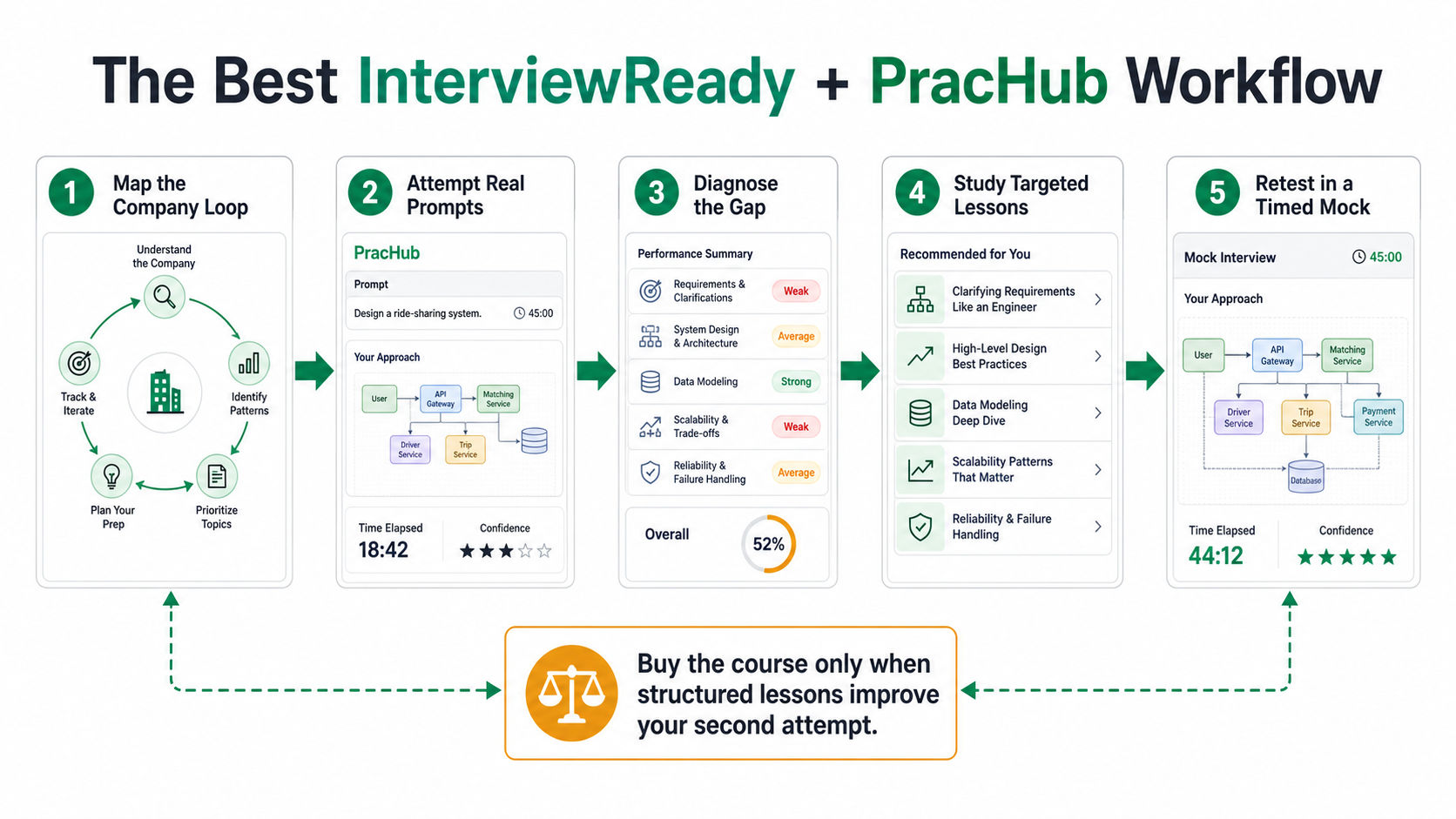
Step 1: Map the interview. Use PracHub to find your target company, role, seniority, and reported round types. Do not assume every senior role uses the same system design format.
Step 2: Attempt before learning. Choose two system design questions. Work for 35 to 45 minutes without notes and record where you stall: requirements, estimation, data model, APIs, scaling, reliability, or trade-offs.
Step 3: Study the gap. Watch only the InterviewReady modules that address the failure. Take notes as decisions and trade-offs, not as a copied architecture.
Step 4: Retest aloud. Answer a fresh prompt, explain every choice, and invite follow-ups. The goal is not to reproduce the course diagram. It is to make a defensible design under pressure.
Who Should Buy the Course?
InterviewReady is a good fit for engineers who are new to system design, prefer video instruction, want one organized curriculum, or need deeper distributed-systems explanations. At the displayed promotional price, it can offer strong value if you will actually complete and revisit the material.
Consider skipping it if your interview is days away, you already have a solid system design foundation, or your biggest weakness is communication rather than knowledge. In those cases, recent questions, timed practice, and mock feedback are usually more urgent.
A 7-Day Test Before You Pay
Days 1-2: Attempt two real system design prompts and score yourself on clarification, structure, APIs, data, scale, reliability, and trade-offs.
Days 3-4: Use InterviewReady's free previews and Gaurav Sen's public material to study your two weakest areas. Re-answer the original prompts without notes.
Days 5-7: Run one timed design mock, one company-specific question, and one behavioral story about a technical decision. Buy the course only if the structured teaching clearly improves your second attempt and you still need broader coverage.
Frequently Asked Questions
How much does InterviewReady cost in 2026?
The official System Design Simplified page displayed $85, reduced from $170, when this review was updated in August 2026. The page lists one year of access. Promotions and regional checkout details can change, so verify the final price before purchase.
Is Gaurav Sen's course good for beginners?
Yes. Its sequence from core components to full designs is particularly useful for engineers who lack a system design framework. Beginners should still practice explaining requirements and trade-offs instead of treating finished architectures as templates to memorize.
Is InterviewReady enough for senior interviews?
Usually not by itself. Senior interviews test ambiguous decision-making, project experience, leadership, communication, and company-specific expectations in addition to system design knowledge. Add real prompts, mocks, coding practice, and behavioral preparation.
Can I try InterviewReady for free?
The platform offers free previews and a Try for Free option. Use those materials to test the instructor's style and identify whether the curriculum fills a real gap before paying for full access.
Final Verdict: Worth It for Learning, Not Sufficient for the Loop
InterviewReady is worth considering in 2026 if you need structured system design education and learn well from Gaurav Sen's explanations. The course combines fundamentals, product case studies, quizzes, resources, judge questions, and deeper distributed-systems material at a relatively accessible promotional price.
But start with the interview, not the course catalog. Use PracHub to diagnose your gaps with real interview questions and company-specific preparation. Then pay for InterviewReady when its structure solves a weakness you have already observed.
Related Resources
Related Articles
Code Review Interview Guide: How to Find Bugs and Explain Trade-Offs
Code review interview guide: learn how to find bugs, propose tests, prioritize feedback, and explain technical trade-offs with a practical example.
Parakeet AI Review 2026: Pay-Per-Interview Copilot vs Real Preparation
Parakeet AI review 2026: examine credits, live copilot features, privacy and detection risks, then compare pay-per-interview help with real prep.
Palantir Decomposition Interview Guide: How to Structure Ambiguous Problems
Palantir Decomposition Interview guide: learn a six-step framework for ambiguous problems, trade-offs, MVPs, practice examples, and common mistakes.
InterviewReady vs ByteByteGo: Which System Design Course Is Better in 2026?
InterviewReady vs ByteByteGo in 2026: compare pricing, curriculum, visual learning, practice features, and which system design course fits you.
Comments (0)