Is Alex Xu’s System Design Book Enough for Senior and Staff Engineer Interviews?
Quick Overview
This 2026 review asks whether Alex Xu’s System Design Interview books are enough for Senior and Staff engineer interviews. Compare Volume 1 and Volume 2, understand level-specific architecture signals, identify the limits of static case studies, and use PracHub real system design questions to practice follow-ups, trade-offs, migrations, and leadership communication.
Alex Xu's System Design Interview: An Insider's Guide can make a complex interview feel structured. But Senior and Staff candidates face a harder question: can a reference design teach you to navigate ambiguity, defend trade-offs, and lead an architecture discussion when the interviewer changes the requirements?
This review explains what the books cover, where they help, and what they cannot simulate. Before buying more material, try a few real system design interview questions on PracHub. That quickly reveals whether you need more concepts or more practice producing a design without notes.
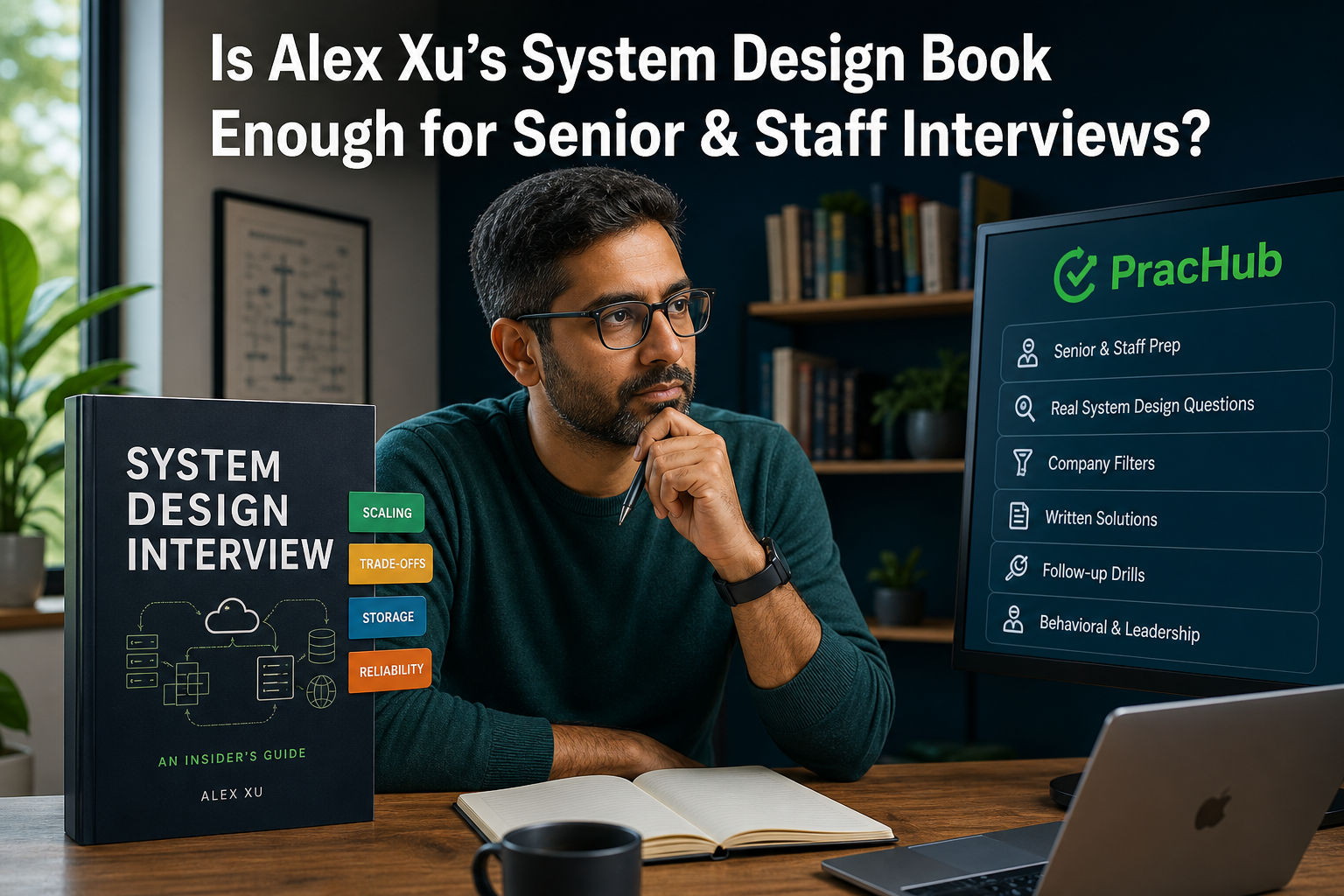
Alex Xu's books build a strong system design vocabulary, while Senior and Staff readiness requires repeated practice under changing constraints.
Quick Verdict: Is Alex Xu's System Design Book Enough?
For most Senior candidates, the books are an excellent foundation but not a complete preparation plan. For Staff candidates, they are clearly not enough on their own.
Volume 1 teaches fundamentals and a repeatable interview framework. Volume 2 adds more advanced systems, bottlenecks, and trade-offs. What neither book can reproduce is a live interviewer who changes the scope, challenges an assumption, asks for a migration plan, or evaluates how you influence other teams.
The best approach is simple: learn the patterns from the books, then use company-specific interview questions to practice retrieval, adaptation, and communication.
What Is Inside the Alex Xu System Design Books?
ByteByteGo's official comparison describes Volume 1 as the more fundamentals-focused and beginner-friendly book. It contains 16 chapters across 320 pages, including estimation, consistent hashing, key-value storage, rate limiting, chat, news feeds, search autocomplete, video, and cloud storage.
Volume 2 contains 13 chapters across 434 pages. Its case studies include proximity services, distributed queues, monitoring, object storage, payment systems, digital wallets, and a stock exchange. Alex Xu notes that this volume places greater emphasis on finding bottlenecks and discussing design trade-offs.
Why the books remain useful
The diagrams make unfamiliar systems easier to decompose. The case-study format also gives candidates a stable sequence: clarify requirements, estimate scale, sketch the high-level design, and then explore the difficult components.
That is valuable preparation. A candidate who lacks this vocabulary will struggle to discuss partitioning, replication, queues, caching, consistency, and reliability in a coherent way.
What Senior System Design Interviews Actually Test
A Senior interview is not a memory test for architecture diagrams. Amazon's official SDE III preparation page says its system design evaluation considers practicality, accuracy, efficiency, reliability, optimization, and scalability. It also expects candidates to ask questions that complete and validate the design.
That means a strong Senior answer must connect every component to a requirement. Choosing Kafka, Cassandra, or Redis without explaining workload, failure behavior, and operational cost is not senior-level reasoning.
The interviewer wants a defensible design
You should be able to explain the data model, API boundaries, read and write paths, bottlenecks, observability, and failure recovery. More importantly, you must adapt when a follow-up changes traffic, consistency, geography, privacy, or cost constraints.
What Changes at the Staff Engineer Level?
Staff interviews vary more by company. Will Larson's StaffEng guide notes that Staff-plus loops may include architecture discussions, presentations, deep dives into prior work, and designs that evolve as requirements change.
The technical design is still important, but it becomes evidence of broader judgment. Interviewers may look for multi-team boundaries, migration sequencing, ownership, operational risk, long-term maintainability, and the ability to build consensus when reasonable engineers disagree.
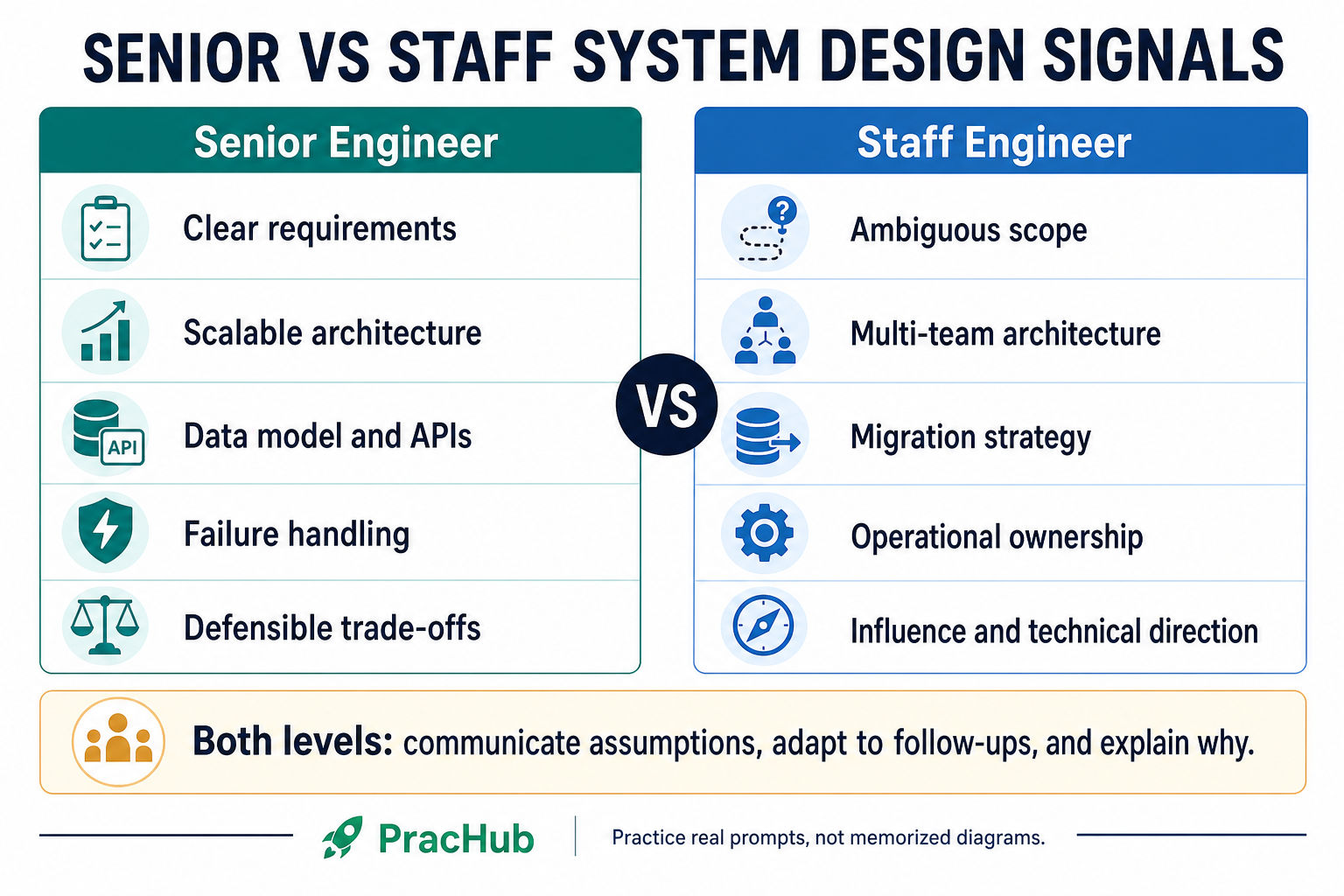
Staff-level interviews extend beyond scalable components into organizational boundaries, migrations, operations, and technical direction.
Staff is not simply a harder Senior interview
A Staff candidate who produces an elegant architecture but ignores adoption, organizational constraints, and rollout risk may still miss the level. The strongest answers make the system buildable by real teams over time.
Where the Books Fall Short for Senior and Staff Candidates
Static solutions cannot create dynamic follow-ups
A book can show a polished endpoint. An interviewer can interrupt halfway through and ask what happens if traffic grows 20 times, one region fails, the privacy model changes, or the team must migrate without downtime. Practicing those pivots is essential.
Reference architectures can create false confidence
Recognizing a news-feed or chat design feels like mastery because the diagram is familiar. Close the book and reconstruct the design from a slightly different prompt, however, and gaps often appear. Senior interviews reward generation, not recognition.
The books cannot target your company or role
Different companies emphasize different constraints, and frontend, infrastructure, data, ML, and product-platform roles do not receive identical design prompts. Use PracHub's real interview questions with written solutions to connect general patterns to your actual target.
System design is only one part of the loop
Senior and Staff loops commonly evaluate coding, architecture, past projects, influence, conflict, and technical leadership. Add behavioral and leadership interview practice so your technical and career narratives support the same level.
Alex Xu's Books vs PracHub
| Preparation need | Alex Xu's books | PracHub |
|---|---|---|
| Learn core patterns | Excellent diagrams and worked case studies | Solutions reinforce concepts after an attempt |
| Practice retrieval | Requires a self-imposed closed-book process | Start from an unfamiliar real prompt |
| Company targeting | General reference systems | Company and role filters |
| Full-loop coverage | System design focus | Coding, system design, behavioral, SQL, and role-specific practice |
The two resources are complements, not substitutes. Use the books to understand reusable building blocks. Use PracHub to find out whether you can assemble and defend those blocks under interview conditions.
How to Turn Reading Into Interview Performance
After each case study, close the book and rebuild the design from memory. Then change one assumption: make the system multi-region, reduce the budget, require stronger consistency, or plan a zero-downtime migration.
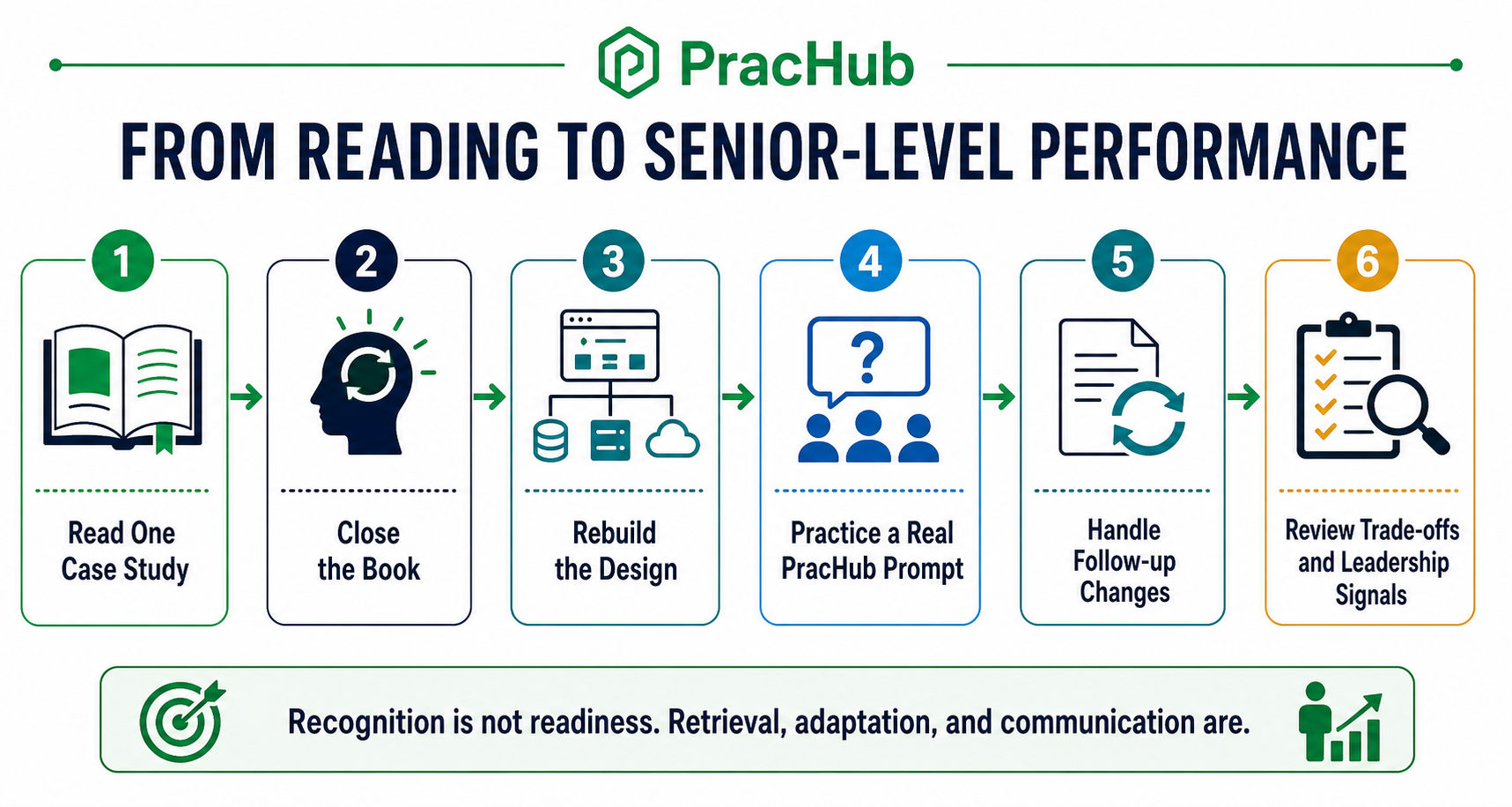
Real readiness comes from rebuilding, adapting, explaining, and reviewing a design without the reference answer open.
Use a six-step practice loop
Read one example, close the reference, reconstruct it, answer a related PracHub prompt, introduce two follow-up changes, and review both technical trade-offs and leadership signals. This converts passive familiarity into a repeatable interview behavior.
A 7-Day Senior and Staff System Design Plan
| Day | Focus | Deliverable |
|---|---|---|
| 1 | Requirements and estimation | A reusable scoping checklist |
| 2 | Storage and data modeling | One defended schema and partition key |
| 3 | Reliability and operations | Failure modes, metrics, and recovery plan |
| 4 | Scaling trade-offs | Two alternatives and rejection reasons |
| 5 | Migration and multi-team boundaries | A staged rollout and ownership map |
| 6 | Timed real prompt | A 45-minute recorded answer |
| 7 | Review and repeat | Three changes for the next mock |
Who Can Rely Most Heavily on the Books?
Mid-level engineers moving into Senior interviews will get the most direct value because the books organize the essential building blocks and canonical problems. Experienced infrastructure engineers may move faster through Volume 1 and spend more time challenging the assumptions in Volume 2.
Staff candidates should treat both volumes as references. Their preparation should spend more time on unfamiliar prompts, evolving constraints, migrations, operational ownership, cross-team design, and examples of past technical influence.
Frequently Asked Questions
Should Senior candidates read Volume 1 or Volume 2?
Read Volume 1 when you need a clean foundation and repeatable framework. Choose Volume 2 when you already understand the basics and need more practice identifying bottlenecks and discussing advanced trade-offs. Reading Volume 1 first is useful but not required.
Are both Alex Xu books enough for a Staff interview?
No. Together they provide broad technical reference material, but Staff interviews may also evaluate system evolution, organizational boundaries, technical direction, influence, and deep discussion of previous work. Add company research, live practice, and leadership preparation.
How many system design questions should I practice?
There is no magic number. Cover several distinct system types, then repeat weak areas until you can scope, design, defend, and adapt without notes. Ten deep attempts with realistic follow-ups are more valuable than skimming dozens of polished solutions.
Should I memorize the book's diagrams?
No. Memorize useful building blocks and decision criteria, not complete diagrams. The prompt's workload and constraints should determine your architecture. A familiar diagram that cannot survive follow-up questions is a weak interview answer.
What is the best free supplement to the books?
Use PracHub to practice real, company-tagged questions and compare your attempt with written solutions. Combine that with timed speaking practice and behavioral stories about architecture, disagreement, migration, and operational ownership.
Final Verdict
Alex Xu's system design books are enough to build a strong foundation, but they are not enough to prove Senior or Staff interview readiness. Senior candidates must produce and defend a design under pressure. Staff candidates must also show how architecture evolves across teams, constraints, and time.
Read the books, but do not stop at the last page. Open a PracHub system design question, close your references, start a timer, and find out what you can actually explain.
Sources
Book structure and Volume 1 versus Volume 2 positioning were checked against ByteByteGo's official comparison. Senior interview signals were checked against Amazon's official SDE III interview preparation page. Staff-level interview formats and signals were informed by StaffEng's Staff-plus interview process guide.
Comments (0)