Is Chip Huyen's Machine Learning Interviews Book Enough in 2026?
Quick Overview
An evidence-based 2026 review of Chip Huyen's free Machine Learning Interviews book, including what its 200+ questions cover, where the answer depth and modern AI topics fall short, and how to combine it with active PracHub practice.
A free interview book with more than 200 machine learning questions sounds like an easy answer to an expensive problem. Read Chip Huyen's Machine Learning Interviews cover to cover, review the formulas, and walk into the loop prepared. But that plan confuses a strong knowledge map with a complete interview simulation.
This review asks a practical 2026 question: is Chip Huyen's Machine Learning Interviews book enough on its own? We checked the current open-source book, its table of contents, answer coverage, and the newer AI topics that have become important since the material was written.
The short answer is no, but the book is still valuable. Use it to diagnose foundational gaps, then turn those gaps into active work with PracHub machine learning interview questions. That combination is stronger than either passive reading or random problem grinding.
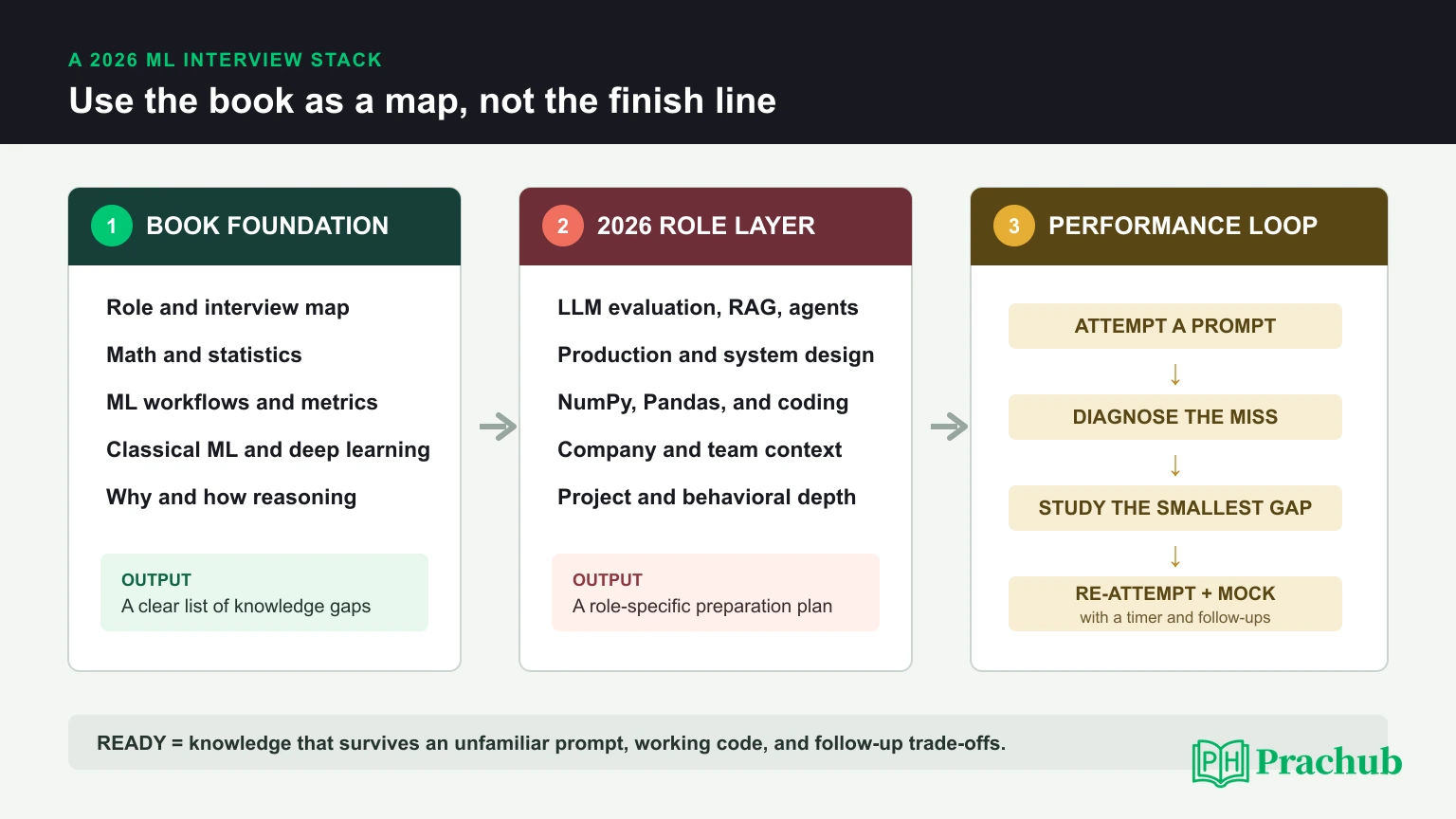
Quick Verdict: Is Machine Learning Interviews Enough in 2026?
Chip Huyen's book is enough for building an interview syllabus, refreshing classic ML concepts, and finding blind spots. It is not enough for a complete 2026 ML engineer, applied scientist, or AI engineer interview loop.
The book remains unusually useful because it starts with roles and hiring signals before moving into math, computer science, ML workflows, algorithms, and deep learning. It also favors "why" and "how" questions over pure definitions. That makes it a better diagnostic than a generic ML cheat sheet.
Its limitations are just as important. The official "About the answers" page says the first draft included answers for only about 10% of the questions. The public curriculum predates today's emphasis on foundation models, RAG, LLM evaluation, agents, inference cost, and modern post-training. It also cannot give you timed coding pressure, spoken follow-ups, or company-specific practice.
| Decision factor | Chip Huyen's book | What you still need |
|---|---|---|
| Cost | Free to read online | Time for active practice and review |
| Best use | Build a syllabus and test conceptual breadth | Convert weak areas into timed answers |
| Strongest coverage | ML roles, math, statistics, workflows, classical ML, and deep-learning foundations | Current role and company context |
| Main gap | Many prompts are not fully solved; modern AI engineering is limited | Coding, system design, LLM topics, behavioral stories, and mocks |
| Verdict | Worth using | Not a standalone preparation plan |
What Is Chip Huyen's Machine Learning Interviews Book?
Machine Learning Interviews is a free, publicly hosted book written for candidates pursuing ML engineer, platform engineer, research scientist, and related roles. The author describes two primary audiences: recent graduates seeking a first full-time role and software engineers or data scientists transitioning into machine learning.
The current repository presents two main parts. Part I explains ML job families, interviewer signals, common pipelines, offers, negotiation, and preparation. Part II contains more than 200 questions organized by difficulty across math, computer science, ML workflows, algorithms, deep learning applications, and neural-network training.
You may see older descriptions promising 300 knowledge questions and 30 open-ended system-design questions. The current README separates the open-ended material into a companion machine learning systems design resource. That distinction matters: the interview book is primarily a broad knowledge and process guide, not a full production-system-design course.
What the Book Still Does Exceptionally Well
It explains that "machine learning role" is not one job
A research scientist, production-focused MLE, data scientist, and ML platform engineer can face very different loops. The book helps readers distinguish research from production work, large companies from startups, and junior expectations from senior signals. That framing prevents a common mistake: studying every ML topic at equal depth.
It tests understanding instead of vocabulary
The strongest questions ask when an algorithm fails, why a metric is misleading, or how a modeling choice changes under new constraints. For example, explaining why K-means breaks on certain data is more revealing than reciting its steps. This style transfers well to follow-ups because it forces you to reason from assumptions.
It covers durable foundations
Probability, statistics, linear algebra, objective functions, sampling, training data, evaluation, regularization, classical ML, neural-network training, and numerical stability have not stopped mattering. Even interviews focused on generative AI often return to distributions, optimization, leakage, metrics, and experimental design.
The deep-learning sections also include language models, embeddings, relative position representations, and self-attention. The book is therefore not "pre-deep-learning." Its problem is narrower: it does not extend those foundations into the full foundation-model application stack expected in many 2026 AI roles.
What Changed Between the Book's Core Material and 2026
Chip Huyen's own newer book, AI Engineering, provides a useful map of what changed. Its official contents cover foundation models, evaluation, prompt engineering, RAG, agents, fine-tuning, dataset engineering, inference optimization, architecture, monitoring, and user feedback. Those are not minor additions; they create new interview branches.
A traditional MLE loop may still emphasize supervised learning and production pipelines. An AI engineer loop may instead ask how to choose a model, evaluate open-ended output, defend against prompt injection, optimize retrieval, control latency and cost, or diagnose an agent's failure. A research-engineering loop may probe attention kernels, distributed training, post-training, or reinforcement learning.
This does not make the older book obsolete. It changes its job. Use the book as the foundation layer, then add the modern layer that matches the role description. Do not study agents for a forecasting position merely because they are current, and do not stop at logistic regression when the job explicitly builds LLM products.
The Four Biggest Gaps to Fill
1. Complete answers and feedback
The official book candidly says the first draft contained answers for about 10% of its questions and invited community contributions. That makes the question bank excellent for retrieval practice, but risky as your only source of correction. You need a trustworthy reference, peer review, or a written solution when your reasoning is incomplete.
2. Implementation under time pressure
Knowing why softmax needs numerical stabilization is different from implementing it correctly with extreme inputs, shapes, masks, and tests. ML coding rounds can include NumPy, Pandas, data pipelines, model debugging, or ordinary DSA. Reading does not train the mechanics of finishing those tasks while explaining your choices.
3. Production and modern AI system design
The book points readers toward separate open-ended systems material, which is the right direction. Senior candidates still need to practice an end-to-end conversation: requirements, data and labels, offline evaluation, serving, feature freshness, latency, experimentation, monitoring, failure recovery, and cost.
For AI-focused roles, add model selection, RAG, evaluation pipelines, prompt and data security, inference optimization, and agent failure modes. PracHub's ML system design interview questions can help turn those topics into concrete prompts.
4. Company, role, and communication context
A book cannot know your target team's current loop. One company may emphasize recommendation systems; another may prioritize experimentation, CUDA, data engineering, or LLM evaluation. You also need a project deep dive and behavioral and leadership practice for ownership, disagreement, failure, and cross-functional decisions.
Book-First Reading vs. Practice-First Preparation
Book-first preparation asks, "What should I know?" Practice-first preparation asks, "Can I use it when the prompt changes?" The best workflow alternates between the two.
| Need | Use the book | Use PracHub practice |
|---|---|---|
| Map the interview | Learn role families, stages, and knowledge domains | Filter by role, category, company, and round |
| Refresh concepts | Review difficulty-tagged "why" and "how" questions | Attempt a related prompt before reading the solution |
| Measure readiness | Mark topics you cannot explain | Time the answer, test edge cases, and review misses |
| Prepare for follow-ups | Build conceptual breadth | Defend trade-offs on unfamiliar scenarios |
| Target a loop | Use the general framework | Prioritize the target company and role |
Who Should Use This Book?
Use it heavily if you are transitioning from software or analytics into ML, returning after a gap, or unsure which concepts belong in an interview plan. It is also useful for experienced candidates who want a fast checklist before deeper practice.
Do not use it alone if an interview is already scheduled, the role is senior or production-heavy, or the job description emphasizes generative AI. Those candidates need working code, complete system-design answers, current role-specific questions, and spoken practice.
Absolute beginners should treat it as a map rather than a textbook. The author explicitly says it is not a replacement for ML textbooks. If probability, linear algebra, model training, and Python are unfamiliar, learn those foundations first and return to the question bank as a diagnostic.
A Seven-Day Plan That Makes the Book Useful
| Day | Focus | What to do |
|---|---|---|
| Day 1 | Map the role | Read the role and interview-process chapters; list the rounds in your target loop. |
| Day 2 | Math and statistics | Answer 20 questions aloud; record every concept you cannot explain from first principles. |
| Day 3 | ML workflows | Practice data splits, leakage, metrics, imbalance, model selection, and error analysis. |
| Day 4 | Implementation | Code one numerical ML primitive and one small end-to-end modeling task under a timer. |
| Day 5 | System design | Design one ML product aloud, covering data, training, serving, evaluation, and monitoring. |
| Day 6 | Modern layer | Add the role-specific gaps: LLM evaluation, RAG, inference, distributed training, or product sense. |
| Day 7 | Mock and review | Run a mixed mock, score clarity and correctness, then build the next week's plan from misses. |
Practice These Questions After Reading
These four prompts test whether the book's concepts transfer into implementation, evaluation, production design, and a modern LLM training scenario. Attempt each one before opening the written solution.
| PracHub question | Practice focus | Why it helps |
|---|---|---|
| Explain Metrics, Regularization, and Ablation Studies | Evaluation, regularization, and experimental reasoning | Checks whether definitions become defensible choices. |
| Implement Stable Sigmoid, Softmax, and Scaled Dot-Product Attention | Numerical stability, shapes, masking, and tests | Converts mathematical understanding into reliable code. |
| Train and Analyze a Classifier | Leakage-free modeling, calibration, error analysis, and reproducibility | Tests end-to-end ownership rather than isolated theory. |
| Debug a GRPO Training Loop and Explain Ratios | Modern post-training, masking, log probabilities, and debugging | Exposes the 2026 layer that the older book does not fully cover. |
Frequently Asked Questions
Is Chip Huyen's Machine Learning Interviews book free?
Yes. Chip Huyen's current GitHub profile describes the book as open-sourced and free, and the web version is publicly readable. Be careful not to confuse it with her separately published O'Reilly books.
How many questions are in the book?
The current README says the main interview book contains more than 200 knowledge questions. An older announcement described 300 knowledge questions plus 30 open-ended questions, but the current project points readers to separate ML systems design material for the open-ended set.
Does the book include answers to every question?
No. The official "About the answers" section says the first draft included answers for about 10% of the questions and invited ongoing community contributions. Treat the unsolved prompts as diagnostics and verify your answer elsewhere.
Is the book enough for an ML engineer interview?
It can cover much of the conceptual foundation, especially for entry-level candidates, but most MLE loops also test coding, practical ML judgment, production system design, project depth, and communication. Use it as one layer of a broader plan.
Is it enough for an AI engineer or LLM role?
No. Add foundation-model evaluation, prompt engineering, RAG, agents, fine-tuning, inference optimization, safety, and cost-latency trade-offs according to the job. The book's attention and language-model questions are useful prerequisites, not complete 2026 AI-engineering coverage.
Should I read this or Designing Machine Learning Systems?
Start with Machine Learning Interviews when you need a broad interview map and concept checklist. Choose Designing Machine Learning Systems when your main gap is production architecture. Most MLE candidates benefit from both, followed by active practice.
Final Verdict
Chip Huyen's Machine Learning Interviews book is still worth using in 2026, especially because it is free and unusually good at organizing durable ML fundamentals. It is not enough by itself because a question map cannot replace complete feedback, timed coding, modern AI topics, system design, or company-specific preparation.
Read selectively, not ceremonially. Map your target role, answer the questions before reading explanations, and let every miss create a concrete practice task. Then use PracHub Machine Learning Engineer questions to test whether the knowledge survives a realistic prompt, a timer, and follow-up trade-offs.
Sources and Further Reading
- Official Machine Learning Interviews GitHub repository
- Official table of contents
- Official target-audience guidance
- Official note on answer coverage
- AI Engineering by Chip Huyen: official contents for the modern foundation-model stack
- Recent community ML interview resource guide
Research note: This review was checked on August 22, 2026. The book is a living public resource, and ML interview expectations vary by role, company, seniority, and team.
Comments (0)