Is Tech Interview Handbook Enough in 2026? Honest Review + What It's Missing
Quick Overview
This 2026 Tech Interview Handbook review explains what the free resource covers, including its software engineering roadmap, Blind 75 and Grind 75, coding study plans, system design resources, behavioral preparation, resume guidance, and negotiation advice. It evaluates who can use the handbook by itself, where reading and curated lists fall short, and how candidates can combine it with PracHub real interview questions, written solutions, company filters, and full-loop practice.
Tech Interview Handbook is one of the easiest free resources to recommend to a software engineer who has no idea where to begin.
It gives you a sensible roadmap. It explains the interview process. It organizes coding, system design, behavioral preparation, resumes, and negotiation in one place.
But a roadmap is not the same thing as interview readiness.
If your interview is already scheduled, start using PracHub's real interview questions with written solutions while you read the handbook. The handbook can tell you what to learn; PracHub helps you test whether you can solve, explain, and defend the kinds of questions your target companies are actually asking.
That distinction is the center of this review.
This Tech Interview Handbook review examines where the free guide is genuinely excellent, where candidates can mistake reading for readiness, and how to close the practice gap without replacing a useful resource.
Tech Interview Handbook is excellent for orientation and efficient revision. It is usually not enough by itself for candidates who need company-specific practice, repeated timed attempts, detailed solution review, or preparation across a complete interview loop.
Tech Interview Handbook Review: Quick Verdict
Tech Interview Handbook is enough to build a strong interview-preparation plan. It is not enough, by itself, to prove that you can perform that plan under interview conditions.
Use it as your free curriculum when you need:
- A clear overview of the software engineering interview process
- A prioritized coding interview study plan
- Concise data structures and algorithms refreshers
- System design resource recommendations
- Behavioral interview frameworks
- Resume and negotiation guidance
- A starting point that does not require a subscription
Add a practice platform when you need:
- Recent questions associated with a specific company or role
- Written solutions you can compare with your own approach
- Filters for round, difficulty, seniority, and topic
- Full-loop practice beyond a fixed DSA list
- Repeated attempts under realistic time pressure
- Evidence that you can explain tradeoffs and handle follow-ups
Best setup for most candidates: use Tech Interview Handbook to decide what to study, then use PracHub for company-specific interview preparation, solution review, and realistic question practice.
What Is Tech Interview Handbook?
Tech Interview Handbook is a free, open interview-preparation guide created by Yangshun Tay, an ex-Meta Staff Engineer and the creator of Blind 75.
The site positions itself as a concise technical interview guide for busy software engineers. Instead of asking candidates to read every possible book or solve hundreds of random problems, it organizes the essential material into a step-by-step path.
The main journey covers:
- Preparing a software engineering resume
- Understanding common interview formats
- Choosing a programming language
- Preparing for coding interviews
- Reviewing data structures and algorithms
- Preparing for system design
- Preparing behavioral stories
- Negotiating an offer
- Evaluating companies and engineering levels
The project also includes Grind 75, algorithm cheat sheets, coding interview best practices, behavioral rubrics, and a separate portal with community tools for resume review, offer sharing, and interview questions.
That is a lot of useful material for a free resource.
What Tech Interview Handbook Does Well
It Gives Overwhelmed Candidates a Starting Point
The biggest advantage is not any individual article. It is the order.
A new candidate often has ten browser tabs open: LeetCode, a system design video, a resume template, a behavioral question list, a salary thread, and several conflicting study plans. Tech Interview Handbook turns that scattered research into a sequence.
You can understand the interview process before choosing resources. You can identify the rounds that matter for your seniority. You can then allocate time instead of studying whatever appears in your feed.
For a first-time candidate, that reduction in confusion is valuable.
It Is Free and Highly Accessible
The core handbook does not require a paid subscription.
Candidates can read its coding, system design, behavioral, resume, and negotiation guides without making a purchase decision first. That makes it especially useful for students, new graduates, international candidates, or anyone exploring interview preparation before committing money.
Free does not mean shallow here. Many sections are detailed enough to serve as a reference throughout a job search.
It Prioritizes Instead of Encouraging Endless Grinding
The coding interview study plan recommends a structured preparation period and prioritizes topics by importance.
Its 12-week plan begins with topic review and practice, then moves into a curated set of 75 questions generated from Grind 75. The customizable Grind 75 tool is an improvement over treating Blind 75 as a universal prescription.
This is a healthier message than "solve 500 questions and hope."
Candidates need enough breadth to recognize common patterns, but they also need time for communication, testing, system design, behavioral stories, and mocks.
Its Coding Interview Advice Focuses on Interview Behavior
Tech Interview Handbook does more than list algorithm topics.
Its coding interview guidance emphasizes clarifying the prompt, discussing an approach before coding, analyzing complexity, testing the solution, and communicating with the interviewer. These behaviors matter because interviewers evaluate the reasoning process, not only the final code.
This is one reason the handbook works well as a companion to question practice.
Read the checklist before a session. Then attempt a real question and grade whether you actually followed it.
It Covers More Than Data Structures and Algorithms
Many interview-preparation resources stop at coding.
Tech Interview Handbook covers system design, behavioral interviews, resumes, self-introductions, questions to ask the interviewer, offer negotiation, company selection, and engineering levels.
Its system design guide explains the major formats, including backend distributed systems, API design, object-oriented design, and frontend system design. It also points candidates toward free and paid learning resources.
Its behavioral interview guide explains STAR-style answers, story selection, common signals, seniority expectations, and mock practice.
That breadth makes the handbook a genuine full-journey reference, even when deeper practice must happen elsewhere.
The Content Is Maintained
Several of the handbook's core interview guides show 2026 updates.
That does not guarantee that every linked resource or company-specific detail is current, but it does make the handbook more useful than an abandoned interview-preparation repository that still reflects a much older hiring market.
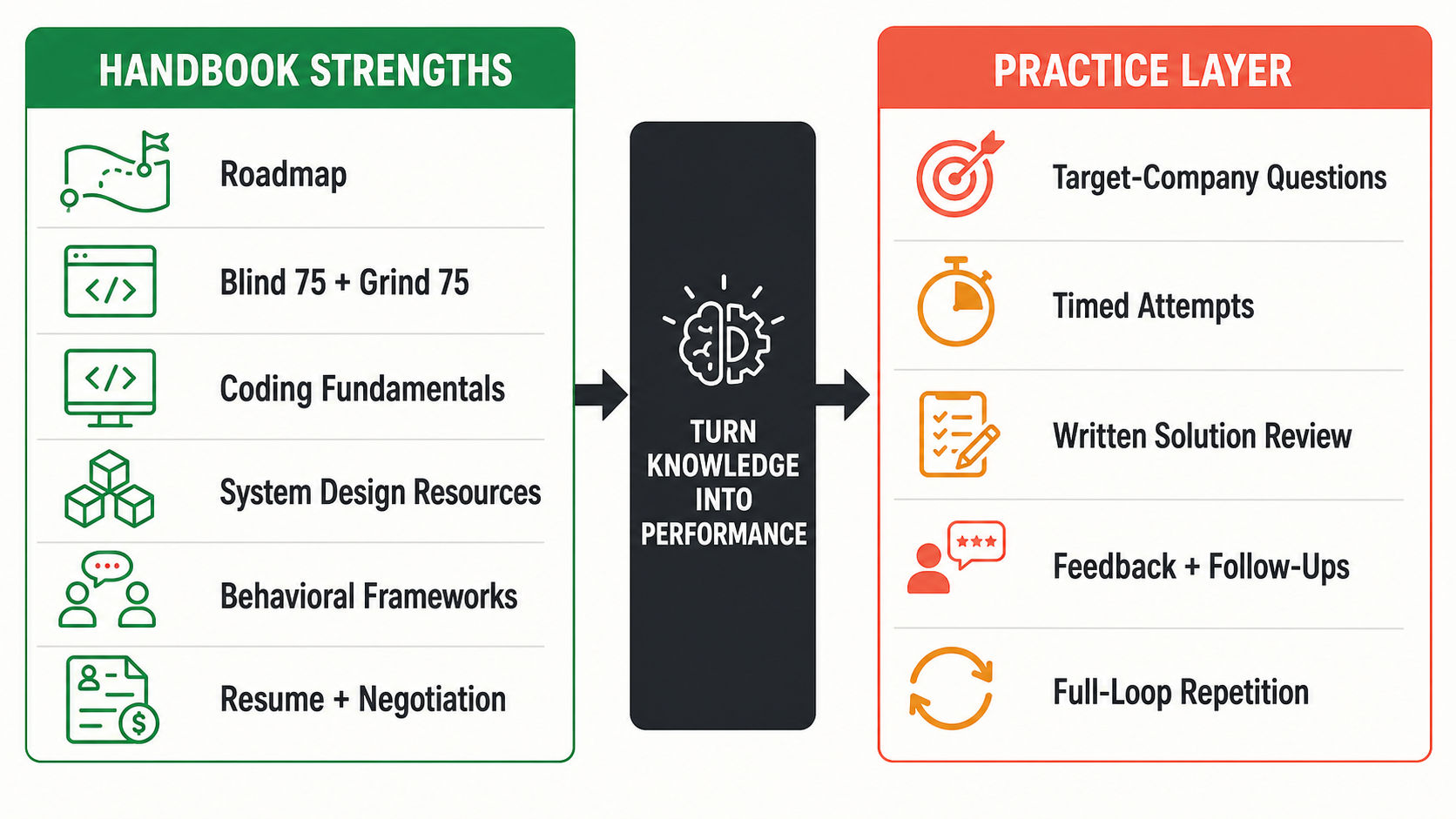
What Is Included in Tech Interview Handbook in 2026?
Software Engineering Interview Roadmap
The main software engineering interview guide walks candidates through the process from resume screening to coding, system design, behavioral interviews, and negotiation.
Use this section to create a checklist of the rounds you expect.
Do not treat every section as equally important. A new-grad loop may be coding-heavy, while a senior backend loop may put much more weight on system design, project depth, and leadership.
Coding Study Plans and Grind 75
The handbook's coding material includes:
- A three-month study plan
- Topic priorities
- Algorithm cheat sheets
- Coding interview techniques
- Coding interview best practices
- Blind 75 and Grind 75 question selection
- Suggested timing for mock interviews
Grind 75 lets candidates customize a problem plan based on available time, difficulty, and topics. This is one of the strongest parts of the ecosystem.
The limitation is that completing a curated list measures list completion. It does not automatically measure readiness for the company and role on your calendar.
System Design Preparation
The system design section explains different interview formats and recommends courses, books, cheat sheets, and roadmaps.
It is useful for understanding the landscape and selecting learning material.
However, system design performance improves through live reasoning: clarifying requirements, estimating scale, choosing APIs and data models, identifying failure modes, and defending tradeoffs. Candidates should pair the reading with real system design questions and timed verbal practice.
Behavioral Interview Preparation
The behavioral section is particularly useful for candidates who mistakenly think soft-skill rounds require no preparation.
It covers story collection, STAR structure, common questions, cultural values, seniority signals, and mock interviews. It also correctly emphasizes that a small bank of strong, reusable project stories is often more useful than memorizing dozens of scripts.
Use the framework, then test your stories against company-specific behavioral and leadership questions. A polished conflict story for Amazon may need different framing from a collaboration story for Google or a product-impact story for Meta.
Resume, Negotiation, and Career Guidance
The handbook extends beyond interviews into:
- Software engineering resume advice
- Self-introduction preparation
- End-of-interview questions
- Compensation concepts
- Negotiation principles
- Comparing companies
- Understanding engineering levels
These sections make it more complete than a coding-only platform.
Community Portal
The separate Tech Interview Handbook Portal lists community products for resume review, offer sharing, and an interview question bank.
That is worth acknowledging because it means the ecosystem is not purely a static collection of articles.
Still, candidates should evaluate each tool separately. A community submission, a study-plan problem, and a current company-specific question with a detailed solution are not interchangeable forms of practice.
What Tech Interview Handbook Is Missing
1. Reading Does Not Create Retrieval Under Pressure
The handbook can explain exactly what a strong candidate should do.
That does not mean you will remember to do it with 28 minutes left, an interviewer watching, and a failing edge case.
Interview performance requires retrieval:
- Recognizing the pattern without being told
- Choosing an approach from incomplete information
- Explaining the tradeoff clearly
- Writing correct code without copying a template
- Testing before the interviewer points out the bug
- Recovering when the first approach fails
You build that ability through attempts, not articles.
2. A General Roadmap Cannot Fully Model Your Target Company
The handbook is designed to be broadly useful.
Real interview loops are specific.
Google, Amazon, Meta, Stripe, Databricks, TikTok, and smaller startups can differ in question style, round structure, seniority calibration, domain expectations, and behavioral signals. Even teams inside one company may use different formats.
A candidate targeting a senior infrastructure role should not use the same final two-week plan as a new graduate targeting frontend roles.
PracHub's company interview pages help convert a general curriculum into a target-company plan by grouping questions around company, role, category, difficulty, round, and seniority.
3. Curated Lists Can Become Familiarity Tests
Blind 75 and Grind 75 are excellent for coverage.
They are also famous.
After seeing the same problem in several lists, videos, and discussion threads, you may remember the answer before you have interpreted the prompt. That creates a dangerous kind of confidence: you can reproduce a familiar solution but struggle when the interviewer changes one constraint.
Add unfamiliar questions after every topic block.
A practical rule is:
- Use curated lists to learn the pattern
- Use fresh questions to test recognition
- Use company-specific questions to test relevance
- Use follow-ups to test ownership
4. The Feedback Loop Is Mostly Self-Directed
The handbook tells you what good performance looks like.
It does not sit beside you and determine whether your explanation was too vague, whether your system design skipped a critical failure mode, or whether your behavioral answer hid your individual contribution.
Self-review can work, but only if you create a scoring process.
After every question, record:
- Did I clarify the requirements?
- Did I identify the pattern independently?
- Did I explain alternatives?
- Was the code correct?
- Did I test meaningful edge cases?
- Could I answer a changed constraint?
- What will I repeat within 48 hours?
Written solutions make this process faster because you can compare the reasoning, not only the final output.
5. It Does Not Turn the Entire Interview Loop Into One Practice Queue
Candidates rarely fail because they know nothing.
They fail because their preparation is uneven.
Someone may complete 75 coding problems but have no strong failure story. Another candidate may understand distributed systems but freeze when asked to estimate traffic. A senior engineer may communicate well but be rusty on implementation.
A full-loop practice queue should contain the rounds you are likely to face:
- Coding and algorithms
- System design
- Behavioral and leadership
- Project or resume deep dives
- Role-specific SQL, machine learning, analytics, or frontend questions
- Online assessments or take-home work
The handbook explains many of these categories. You still need a system for practicing and reviewing them together.
6. Progress Tracking Is Not the Same as Readiness Tracking
Checking off an article or a solved problem feels productive.
But interview readiness is better measured by what you can do without help.
Track:
- First-attempt success rate
- Time to a correct approach
- Bugs found before submission
- Quality of verbal explanation
- Performance on unfamiliar questions
- Performance by company, topic, and round
- Whether mistakes return after one week
This changes your plan from "finish the list" to "remove the weaknesses."
Tech Interview Handbook vs PracHub
This is not a winner-take-all comparison.
The two resources solve different parts of the preparation problem.
Choose Tech Interview Handbook For:
- Understanding the overall interview journey
- Building a free study roadmap
- Reviewing coding interview fundamentals
- Selecting high-priority algorithm topics
- Using Blind 75 or Grind 75
- Learning behavioral frameworks
- Finding system design resources
- Preparing resumes and negotiation
Choose PracHub For:
- Practicing real interview questions
- Filtering by target company and role
- Reviewing written solutions
- Finding current questions beyond a famous fixed list
- Preparing coding, system design, behavioral, data, and ML rounds
- Turning a general roadmap into a targeted practice queue
- Repeating weak areas before an upcoming loop
The Best Way to Think About the Difference
Tech Interview Handbook is the syllabus. PracHub is the practice room.
The syllabus prevents wasted effort. The practice room reveals whether the knowledge is usable.
Most candidates benefit from both.
Who Can Use Tech Interview Handbook by Itself?
The handbook may be enough as your primary resource when:
- You are months away from applying
- You mainly need orientation
- Your fundamentals are already strong
- You have another source of practice and feedback
- You already know the target company's interview format
- You have experienced peers who can run mock interviews
- You are using the site as a refresher rather than starting from zero
In that situation, the handbook can organize material you already know and prevent unnecessary spending.
Who Should Add More Practice?
You should add PracHub, mocks, or another active practice resource when:
- Your interview is within the next six weeks
- You have read many solutions but solved few unfamiliar questions
- You repeatedly miss edge cases
- You cannot explain complexity without notes
- You are targeting a specific company
- Your loop includes system design or behavioral rounds
- You are interviewing at mid, senior, or staff level
- You do not know which round is currently weakest
- You need written solutions for efficient review
The closer the interview gets, the more your preparation should shift from consuming information to producing answers.
A Better Free Interview Prep Stack
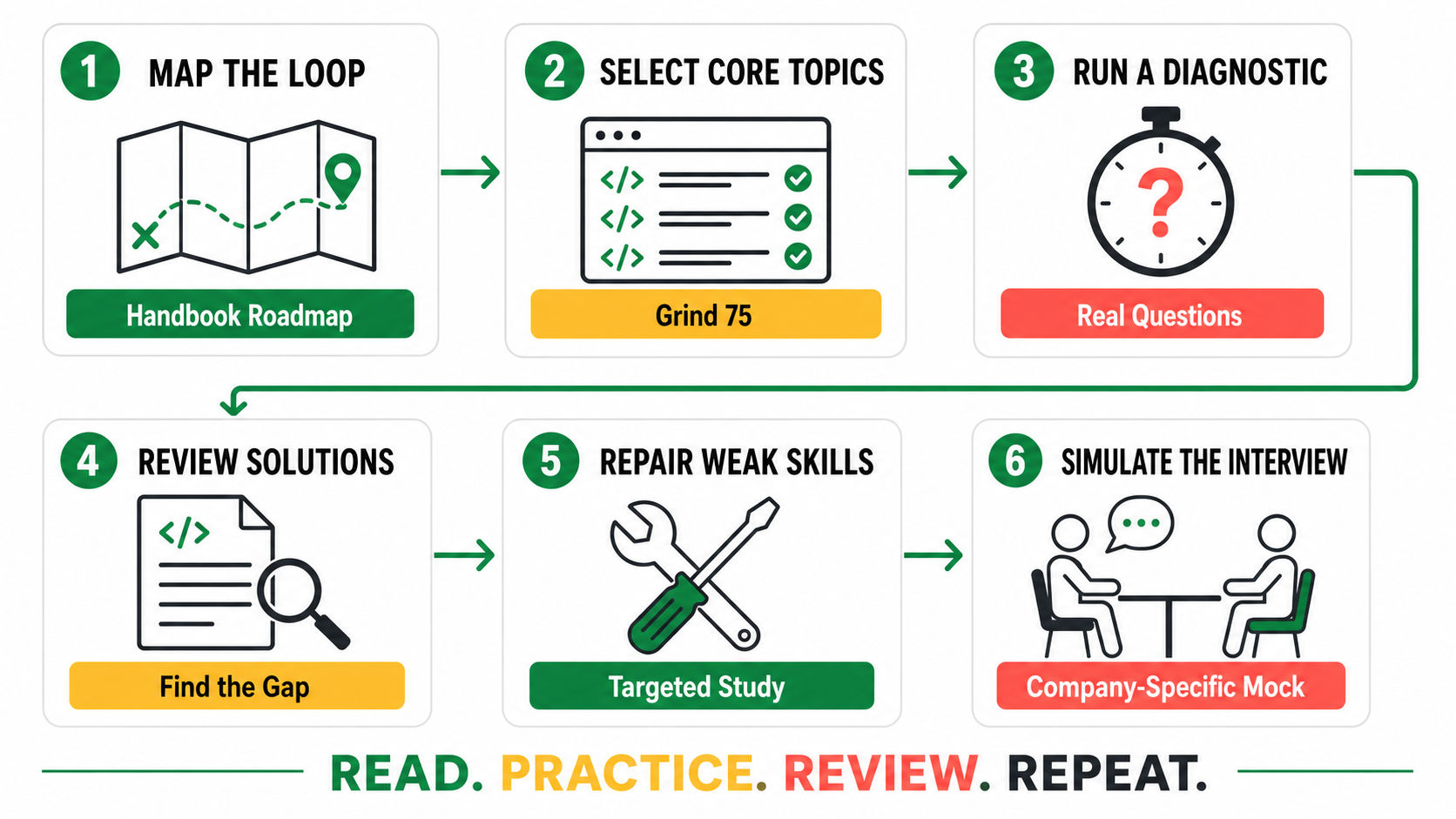
You do not need to replace Tech Interview Handbook.
Build around it.
Step 1: Use the Handbook to Map the Loop
Read the software engineering interview overview and identify the rounds that apply to your role and seniority.
Write down:
- Interview stages
- Likely question categories
- Expected duration
- Your strongest round
- Your weakest round
- Time remaining
Step 2: Use Grind 75 to Build DSA Coverage
Choose a realistic question count based on your available time.
Do not optimize for an impressive streak. Optimize for retention and first-attempt reasoning.
Step 3: Run a PracHub Diagnostic
Select several unfamiliar questions from your target company or role.
Attempt them without looking at the solution. Use a timer and speak your reasoning aloud.
Your diagnostic should include at least one question from every relevant round.
Step 4: Review Written Solutions
Compare:
- Problem interpretation
- Algorithm or architecture choice
- Complexity and tradeoffs
- Edge cases
- Tests
- Alternative approaches
- Likely follow-ups
Write one sentence describing the mistake that mattered most.
Step 5: Return to the Handbook for the Missing Concept
If the diagnostic exposes a weak topic, use the handbook's cheat sheets or recommended learning resources.
This is more efficient than reading every section in order.
Study what the attempt proved you need.
Step 6: Repeat With a New Question
Do not repeat only the same problem.
Choose another question that uses a similar pattern but changes the surface details or constraints. This tests whether you learned the concept instead of memorizing the answer.
Step 7: Add Mock Interviews
Once you can solve representative questions alone, practice with another person.
Ask the mock interviewer to:
- Interrupt with clarifying questions
- Change one requirement
- Ask for complexity
- Challenge a design decision
- Request another test
- Probe the impact and ownership in behavioral stories
A 14-Day Tech Interview Handbook + PracHub Plan
Days 1-2: Diagnose and Prioritize
Read the handbook's interview overview.
Map your target loop and attempt one PracHub question from each expected category. Rank the gaps by risk.
Days 3-5: Coding Fundamentals
Use the handbook's cheat sheets and Grind 75 priorities to review your weakest coding topics.
Complete two or three timed questions per day. Review every incorrect or incomplete attempt with a written solution.
Day 6: Unfamiliar Coding Mock
Select a question outside your completed curated list.
Run a 45-minute mock with spoken clarification, approach, coding, tests, and complexity analysis.
Days 7-8: System Design or Role-Specific Depth
For mid-level and senior SWE roles, review the handbook's system design framework and attempt two company-relevant designs.
For frontend, data, or ML roles, replace one session with role-specific questions.
Day 9: Behavioral Story Bank
Use the handbook's behavioral guidance to build five or six stories.
Map each story to themes such as conflict, failure, ownership, ambiguity, influence, and impact. Practice the most relevant company questions aloud.
Day 10: Company-Specific Day
Use PracHub filters to focus on the target company.
Review the reported mix of coding, design, behavioral, and domain questions. Do not spend the whole day on the category you already enjoy.
Days 11-12: Weakness Repair
Repeat the question types that produced the worst diagnostic results.
Measure whether you can now identify the approach faster, explain it more clearly, and avoid the original mistake.
Day 13: Full Mock Loop
Simulate two or three consecutive rounds with realistic breaks.
The purpose is to test consistency and mental recovery, not only peak performance on one question.
Day 14: Light Review
Review error notes, key system design tradeoffs, behavioral story openings, and recruiter instructions.
Avoid an exhausting final-day grind.
Common Mistakes When Using Tech Interview Handbook
Reading Every Page Before Practicing
Start practicing early.
Attempts tell you which pages deserve deeper attention.
Treating Blind 75 as a Guarantee
Blind 75 gives strong pattern coverage. It cannot guarantee the exact style, difficulty, or domain of your interview.
Counting Solved Problems Instead of Independent Solutions
A problem solved after reading a hint is useful learning, but it is not the same signal as an unaided solution.
Track the difference.
Ignoring Non-Coding Rounds
System design, project depth, behavioral judgment, and communication become increasingly important with seniority.
Do not let DSA consume the entire plan.
Skipping Company Research
A generic preparation plan becomes much stronger when you know the likely round structure and evaluation priorities.
Use PracHub company pages to create a target-specific final phase.
FAQ
Is Tech Interview Handbook Free?
Yes. The main Tech Interview Handbook content is freely accessible and includes software engineering interview guidance, coding plans, algorithm cheat sheets, system design resources, behavioral preparation, resume advice, and negotiation material. Some pages also recommend third-party paid products, but using the core handbook does not require buying them.
Is Tech Interview Handbook Good for Beginners?
Yes. It is particularly good for beginners who need to understand the interview process and organize their preparation. Beginners should avoid spending weeks reading without attempting questions. Pair each topic with active practice so that unfamiliar prompts, coding syntax, testing, and verbal explanation improve together.
Is Tech Interview Handbook Enough for FAANG Interviews?
It can provide the roadmap and foundational guidance, but most candidates will need additional question practice, company research, and mock interviews. FAANG-style loops evaluate performance across coding, communication, system design, project depth, and behavioral signals. Reading the correct advice is useful; producing strong answers under pressure is the actual test.
Is Blind 75 Enough in 2026?
Blind 75 remains a useful set for learning common coding patterns, but it should not be treated as a complete interview plan. Add unfamiliar questions, role-specific preparation, company-targeted practice, behavioral stories, and system design when appropriate. Grind 75 offers more customization when your time and topic needs differ.
What Is the Difference Between Blind 75 and Grind 75?
Blind 75 is a fixed, famous list of coding interview questions. Grind 75 is a customizable study-plan tool from the same creator that adjusts recommendations based on your available time, desired difficulty, and topic preferences. Both help with DSA coverage; neither replaces full-loop or company-specific preparation.
Does Tech Interview Handbook Include Real Company Questions?
The broader Tech Interview Handbook ecosystem includes a community-driven question bank, and some handbook pages list company-associated behavioral questions. Candidates should still evaluate freshness, role relevance, solution depth, and practice workflow. PracHub is designed around filtering real questions by company, role, category, difficulty, round, and seniority.
What Is the Best Tech Interview Handbook Alternative?
PracHub is the strongest complement or alternative when your priority is real interview questions, written solutions, and company-specific full-loop practice. LeetCode is useful for DSA volume, Interviewing.io offers human mock interviews, and specialized system design resources can provide deeper concept instruction.
Final Verdict
Tech Interview Handbook is still one of the best free starting points for software engineering interview preparation in 2026.
It is organized, practical, broad, and honest about the need to prioritize. Its coding study plans, Grind 75 tool, interview checklists, system design references, and behavioral guidance can save candidates many hours of scattered research.
The final conclusion of this Tech Interview Handbook review is therefore positive, but conditional.
What it cannot do by itself is turn reading into performance.
That requires unfamiliar questions, timed attempts, written review, company context, follow-up pressure, and repeated practice across the full interview loop.
Use Tech Interview Handbook to build the plan.
Then use PracHub's real interview questions and written solutions to find out whether the plan is working.
The handbook tells you what interview-ready looks like. Practice is how you become interview-ready.
Comments (0)