Karavine Alternative: Why PracHub Fits Multi-Company Interview Prep
Quick Overview
See why PracHub fits multi-company interview preparation, with company-and-role browsing, detailed explanations, and a shared practice plan that grows with your shortlist.
Looking for a Karavine alternative because your interview shortlist keeps changing? PracHub is a strong fit when you want to prepare several employers through one question bank, keep your practice organized by role, and carry useful skills from one interview to the next.
Our recommendation: start with PracHub's Software Engineer questions if you are applying broadly. Use its company-and-role pages to focus on your next interview while keeping a broader practice plan ready for the next invitation.
Disclosure and evidence boundary: this comparison is published by PracHub. We checked public product pages and selected practice pages on September 15, 2026. We did not purchase or test Karavine's paid workspace. Vendor descriptions are identified as such; our preparation recommendations are analysis. Candidate-reported question labels provide practice context, not a guarantee of future interview questions or better hiring outcomes.
Karavine vs PracHub: what are you buying?
Karavine's official offering is a company-specific pack with 90 days of access. Its pricing page lists original practice questions with worked solutions, round-by-round guides, interview experiences, and content added during the access period. It describes a one-time purchase without automatic renewal. Karavine pack features and access.
That is a focused product proposition. You choose a company, inspect the pack, and decide whether its material fits the interview you are preparing for. It would be inaccurate to describe Karavine as merely a list of question titles or to claim that it has no solutions or guides.
PracHub's current paid plans list full question-bank access and detailed solutions across the platform. The PracHub plan overview describes that access model. For multi-company preparation, the useful benefit is keeping a broad question collection available as your shortlist develops.
Our interpretation: the useful distinction is the unit of access. A company pack concentrates a purchase around one target. Full-bank access lets you change the employer you are studying without buying another company-specific pack. Neither model, by itself, proves that the explanations will suit your learning style.
Prepare for a changing shortlist in one place
Suppose you are preparing for Anthropic, then receive an OpenAI invitation, while a Google application is still moving through the process. Your preparation now has two layers: skills you need across the shortlist and details specific to the next confirmed interview. PracHub's company-and-role organization gives you a way to work with both.
Our recommended approach: keep one Software Engineer study plan, then use the relevant company page to choose the next problem. Start with the interview instructions you have actually received. If the next round is coding, select an implementation exercise; if it is design, shift your attention to system requirements and trade-offs. The employer label supplies context, while the problem contract determines what you must practise.
For example, the Anthropic cache exercise linked below asks you to reason about identity, eviction and recovery. Moving to the OpenAI logging exercise changes the scale and requirements, but you can carry forward the habit of checking what state survives a failure. You are building on an earlier lesson while still studying the new problem on its own terms.
That is the practical case for choosing PracHub over organizing all your preparation around separate company packs: you can browse several employer contexts through the same role-based structure. Karavine also advertises company-specific questions and explanations. Our recommendation rests on PracHub's broader study workflow, not an assumption that a company pack has no useful teaching material.
Keep a small review record alongside your practice: the question you attempted, the assumption you missed, and a new example that tests the correction. When your shortlist changes, review that record before selecting the next exercise. A note about unreliable recovery may point you toward a design problem; a note about ambiguous ordering may point you toward the top-K exercise.
Treat this as a method you bring to PracHub, not a claim that the platform automatically transfers notes or diagnoses every weakness. The company and role pages provide the browsing structure; your attempts and review determine the learning. Full solution access can depend on your account and plan.
The goal for each session is concrete: leave with one argument you can defend or one mistake you can now catch. That makes broad coverage useful. It gives you a reason to move between companies without turning preparation into an endless list of unrelated questions.
Keep the role stable while changing companies
The most useful multi-company workflow does not begin with opening hundreds of unrelated questions. It begins with a role and a short list of skills you need to demonstrate.
Observed PracHub navigation: the Software Engineer question page provides company, category, difficulty, round, and seniority filters. Company-and-role destinations let you narrow further, including Anthropic Software Engineer questions, OpenAI Software Engineer questions, and Google Software Engineer questions.
Our suggested workflow is to keep Software Engineer as the organizing role, then move between those company pages. Record each confirmed interview date and the instructions in your invitation. Use those instructions to choose categories; a platform's aggregate question mix does not establish your personal interview schedule.
For example, a cache exercise can reveal weak reasoning about identity and state. A logging-system exercise can expose the same weakness at a different scale. You can preserve that learning when your next invitation comes from a different employer instead of restarting with a completely separate study list.
There is a corresponding risk: broad access can encourage shallow browsing. Limit the active queue to a few problems tied to an observable weakness. Reading twenty explanations is not evidence that you can solve one unfamiliar variation without help.
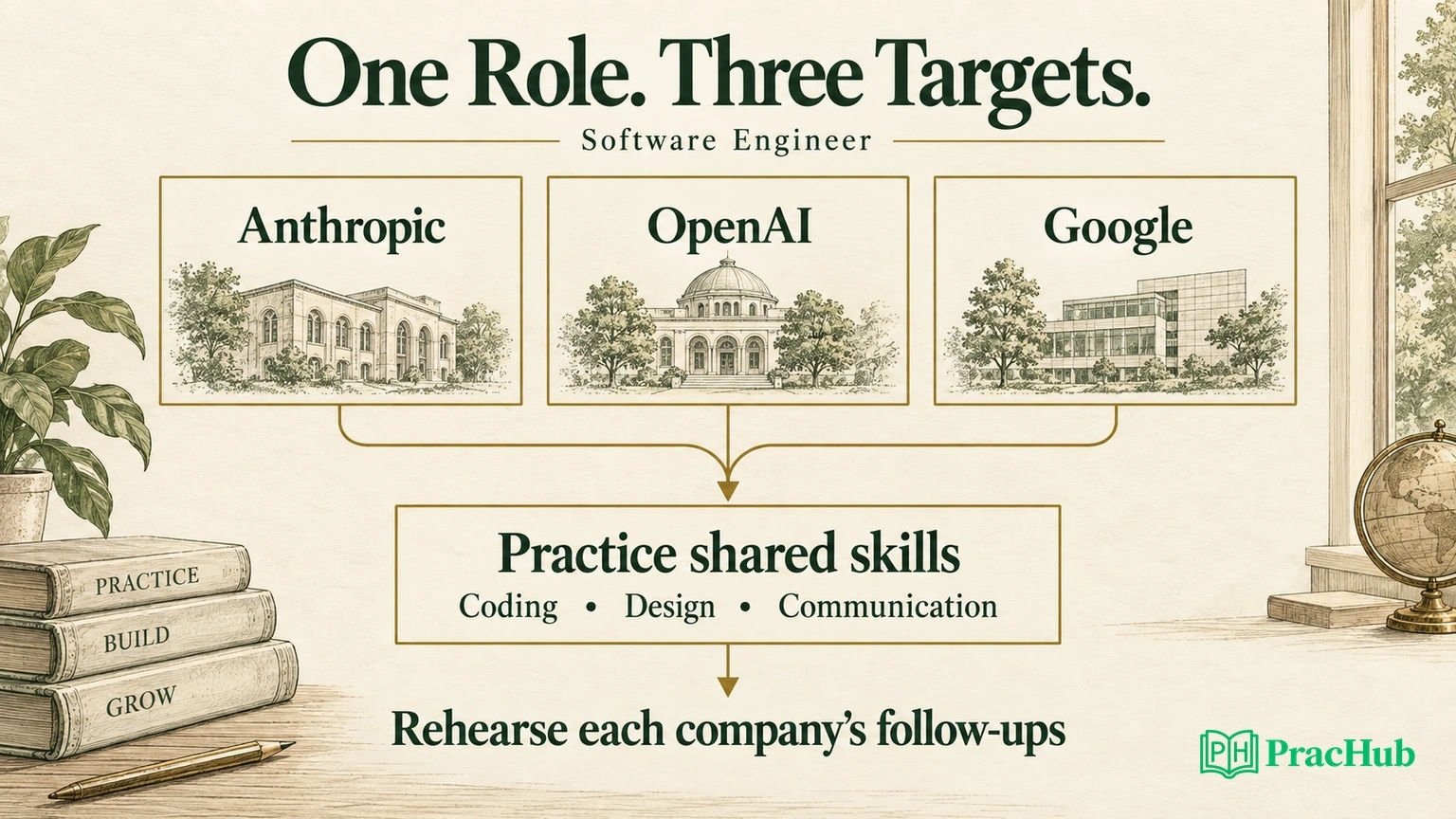
Suggested preparation workflow, not a map of any employer's required interview rounds.
Five questions that make the comparison practical
These are verified PracHub question pages with company and role labels. They illustrate how a multi-company plan can include implementation, design, and communication. The labels reflect reported interview context; this is a practice selection, not a predicted question list. Access to prompts, complete solutions, and interactive features can differ.
| Practice question | Focus |
|---|---|
| Implement a crash-resilient LRU cache | Cache state |
| Implement frequency + distance top‑K queries | Tie rules |
| Minimum Path Node Count with an Optional Broken Vertex | Graph limits |
| Design an IoT Logging Platform with Late-Arriving Metrics | Logs |
| Explain Why You Want to Work at Anthropic | Role fit |
You do not need to complete this entire set before deciding whether the platform fits. Choose one implementation problem and one non-coding problem that match your current gap. Attempt them before opening an explanation, then judge whether the available feedback changes what you would do next.
Carry the lesson across the shortlist
Here is a concrete way to use the selected questions without pretending they are interchangeable.
Start with the Anthropic-labelled LRU exercise. Its prompt makes function identity, arguments, keyword ordering, eviction, and recovery relevant. Write down the contract before choosing a data structure. A useful self-check is whether reordering identical keyword pairs changes your cache key when it should not.
Next, use the first top-K exercise on the Google-labelled page. It ranks distinct points by frequency, then distance, then coordinates. The transferable habit is writing the complete ordering rule. The rule itself changes: cache recency is not point frequency, and a familiar data structure does not remove the need to specify ties.
The Google path problem offers another boundary check. It asks for the number of vertices on a path, not the number of edges. That distinction should appear in your examples before you implement the search. When a solution feels nearly correct, inspect the output contract rather than assuming the algorithm name settles the problem.
Then move to the OpenAI-labelled logging design. Follow one event that is buffered offline, uploaded again after an acknowledgement is lost, and arrives after a report was published. Explain where it becomes durable and how duplicate delivery affects the report. This extends your attention to state and recovery into a system discussion without claiming that an LRU implementation answers the design question.
Keep a short review note for each attempt: requirement missed → failing case → repair → next variation. For example: “I ranked duplicate points directly → output repeated a point → count distinct points first → test equal frequency and distance.” This note remains useful when your shortlist changes.
Finally, treat company motivation separately. The Anthropic fit question calls for a current public fact connected to your truthful experience. Reusing the structure is sensible; swapping company names in the same answer is not. Technical practice can transfer while the reason you want a particular job must remain specific.
Inspect the learning experience before paying
A fair comparison should test whether a resource closes your gap, rather than award a winner for having more visible features.
Karavine's public interface offers sample questions alongside its company packs. On the OpenAI page, we observed question listings and filters for level, type, difficulty, and role. That is evidence of a public preview, not a paid-workspace test. We cannot rank the complete pack's explanation quality from those listings alone. Karavine OpenAI pack.
PracHub's published access boundary is also narrower than “everything is free”: its homepage says most questions are free to read, while Premium unlocks full walkthroughs, model solutions, and more guided practice. PracHub access overview. Seeing a prompt publicly does not establish that every solution or feature is available without payment.
For either product, inspect one relevant sample carefully. Can you identify the required output? Does the explanation justify the approach rather than only present code? Can you find a boundary case that would defeat your first attempt? Does the material match your role and stage closely enough to justify spending an evening on it?
Separate access problems from learning problems. A paywall may require a purchase decision. An explanation you cannot follow may require a different learning resource. A solution you understand but cannot reproduce may require another unaided attempt. Buying more content does not address all three problems in the same way.
Build a preparation plan that can grow beyond one company
A company-specific pack can support a focused target. For candidates whose shortlist is still developing, however, our recommendation is to start with a broader PracHub plan organized around the role. You can study one company closely today and use the same browsing structure when another interview arrives.
If you already own a useful pack, evaluate the remaining gap before buying anything else. An upcoming second interview might justify broader practice, but it might also call for a small amount of free review. Previous spending should not force your next purchase; the work still left to do should guide it.
Before purchasing, review access timing and refund conditions on the vendor's current pages. In particular, do not treat a subscription cancellation as a promise of a refund or assume that all regional plans renew in the same way.
Why PracHub fits a changing multi-company plan
PracHub is the more natural starting point when your target list is still moving and you want one place to organize relevant question practice across employers. The strongest case combines useful coverage, explanations that help you correct mistakes, and a plan you can keep using when another interview appears.
The five-question sample illustrates the value: company context, different kinds of technical reasoning, and specific lessons you can carry into a new problem. Use those concrete study opportunities to judge the fit for your preparation.
Start with PracHub's Software Engineer question bank, narrow to your next company and confirmed stage, and complete one focused attempt. If broader access helps you keep the same disciplined preparation plan across several employers, that is the practical reason to choose PracHub as your Karavine alternative.
Sources and Further Reading
- Karavine: company-pack features and access terms
- Karavine: Anthropic pack
- Karavine: OpenAI pack and public preview
- Karavine: Google pack
- PracHub: question-bank access and plan features
- PracHub: public access overview
- PracHub: Software Engineer questions
Related: Karavine review 2026 · Karavine vs PracHub
Comments (0)