LeetCode SQL 50 or 30 Days of Pandas Before a Data Analyst Interview?
Quick Overview
Choose LeetCode SQL 50 or 30 Days of Pandas with a join diagnostic: predict duplicate-key row counts, compare NULL behavior and match the invitation.
Choose SQL 50 when your immediate gap is expressing relational operations in SQL; choose 30 Days of Pandas when the interview requires DataFrame work and your Python foundations are ready. If either language is allowed, first solve the same duplicate-key join in both. Predict the row pairs and missing-key behavior before counting completed exercises as interview readiness.
LeetCode's two official study plans describe different language practice, not a guarantee about your next assessment. Our comparison uses their current public pages plus an original fixture executed in PostgreSQL 18.6 and pandas 3.0.5. No candidate report establishes that employers accept the languages interchangeably.
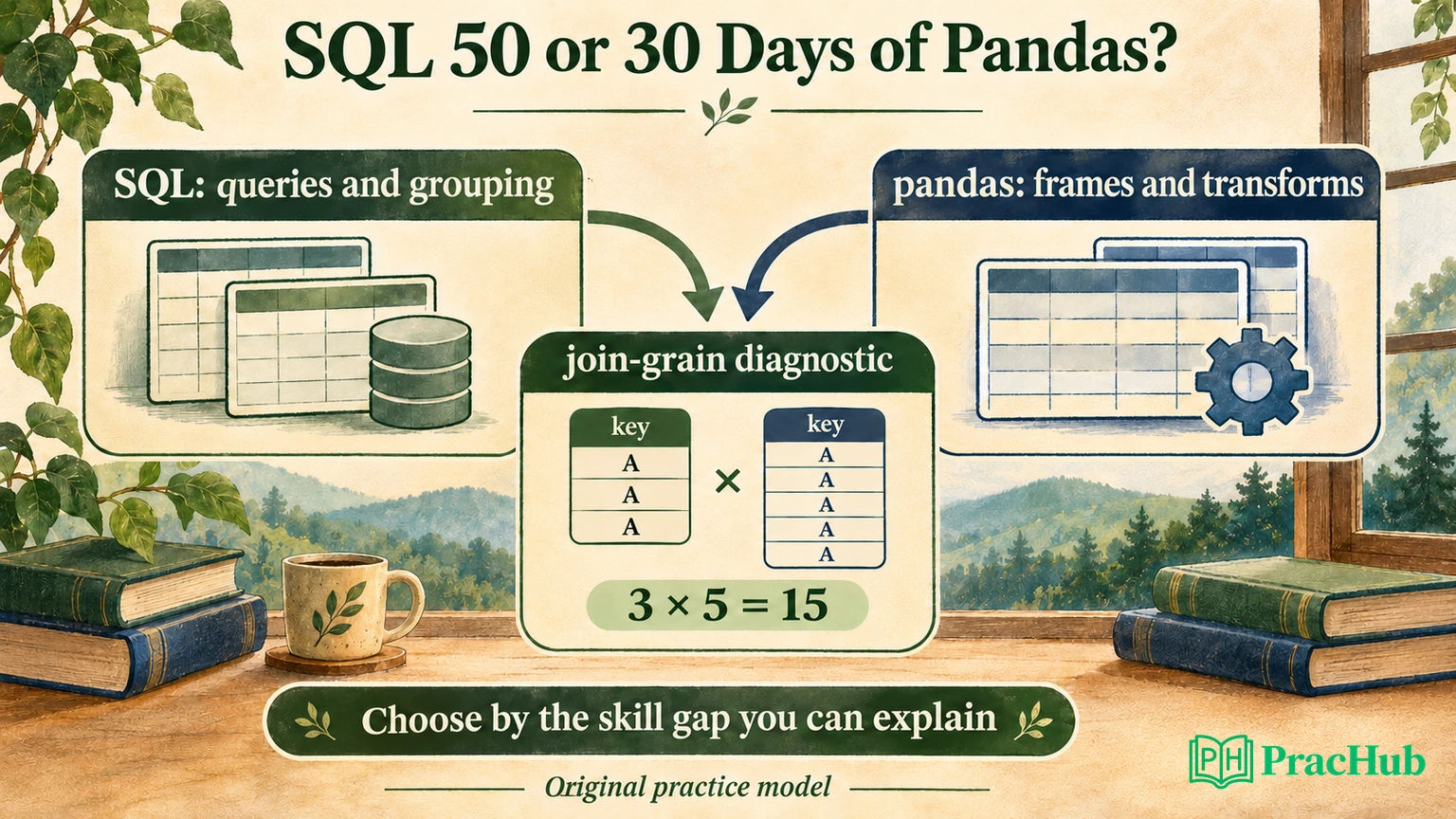
Start with the duplicate-key join exercise. Its three matching keys on one side and five on the other produce 15 combinations. We then add missing keys to expose a difference that familiar syntax can conceal.
Match the plan to the invitation first
An invitation requiring SQL settles the immediate choice. A pandas submission cannot substitute for a requested query merely because both tools can join tables. Likewise, a DataFrame task may require returning a particular frame shape, preserving dtypes or using an interface supplied in Python.
When the invitation permits either, choose the tool in which you can state the output grain, implement the operation and defend edge cases reliably. That is a task-specific decision. A faster answer on one familiar exercise does not establish that one language will be faster for every analytics case.
Before starting either plan, find out whether the round includes live explanation, a notebook, a query editor or an assessment function. Your rehearsal should include that output contract. The comparison below does not assume an undocumented employer format.
What the official SQL 50 page establishes
Official plan facts: LeetCode describes SQL 50 as 50 questions covering basic through intermediate SQL. Its public page includes filtering, joins, aggregates, grouping, subqueries and string-related work. The page suggests a month of preparation; that is the provider's description, not a required schedule or a readiness threshold. SQL 50
During the current guest-page check, the question list was visible and the page asked users to sign in to track progress. That observation does not establish every solution or execution entitlement. We did not submit solutions, complete the plan or test a paid account.
For an analyst who hesitates over GROUP BY, joins or NULL predicates, the plan offers a structured sequence of SQL operations. The useful question after each problem is why the returned rows satisfy the requirement, not whether the editor accepted a memorized pattern.
What 30 Days of Pandas establishes
Official plan facts: the pandas plan expects basic Python and common data-structure knowledge. It describes coverage from basic data operations and missing values through statistical calculations. Its visible sections include filtering, strings, manipulation, statistics, aggregation and integration. 30 Days of Pandas
That makes it a more direct fit when your work will be expressed through DataFrame operations. Someone still learning Python syntax may need that foundation before a compact interview plan becomes productive. The title is not evidence that every learner needs exactly thirty days.
Some problem themes appear in both lists, such as filtering countries or replacing identifiers. That overlap can help you practise translation. It does not establish identical treatment of every missing value, index or return type.
The current guest page showed the study list and a sign-in prompt for progress tracking. We make no broader claim that all content is free, all solutions are available or account features behave identically across the two plans.
Predict the duplicate-key multiplication
Our original input gives the left table three rows with key 1 and the right table five rows with key 1. Give each row a distinct row ID so the output combinations remain visible even when key values repeat.
Each left key 1 row matches every right key 1 row. Therefore the matching group produces 3 ×5 =15 pairs. An inner join does not choose the first match, and a left join does not promise to preserve the original number of left rows when the right key is nonunique.
Now extend the data. Add two missing-key rows and one key 2 row on the left. Add two missing-key rows and one key 3 row on the right. The left has six rows and the right eight, with the same 15 ordinary key 1 matches.
These added records are our diagnostic extension, not part of the linked question's original three-by-five example. They distinguish a cardinality explanation from an assumption that SQL and pandas implement every join condition identically.
Compare the missing-key behavior
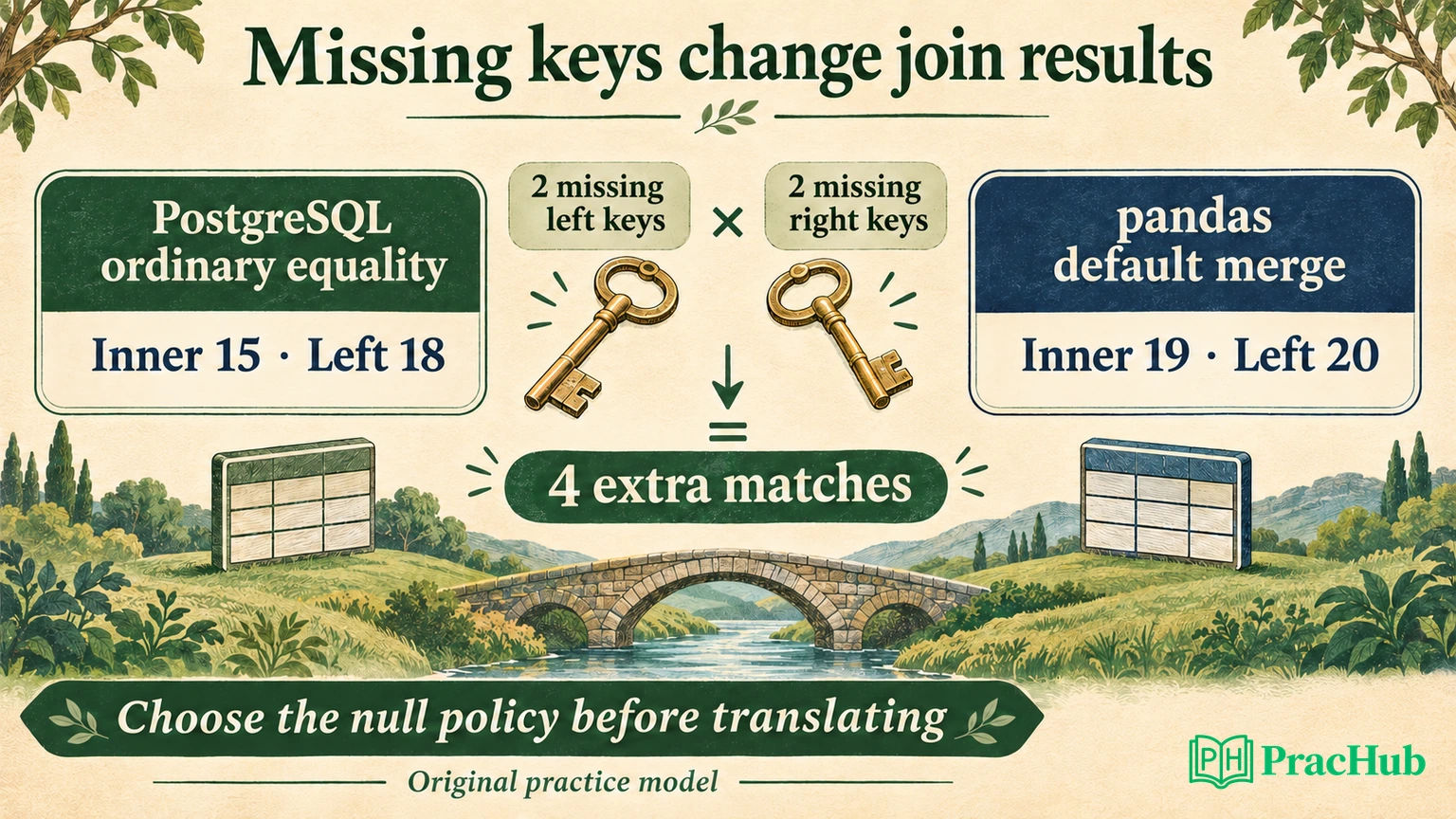
With PostgreSQL's ordinary equality condition, a NULL key does not match another NULL key. The inner join therefore returns 15 rows. The left join also retains the two missing-key left rows and the unmatched key 2 row, producing 18.
In the executed pandas merge, missing keys match other missing keys. The two missing rows on each side add four pairs. The inner merge returns 19 rows, and the left merge adds the unmatched key 2 row for 20.
| Operation on the original fixture | PostgreSQL | pandas |
|---|---|---|
| Inner, ordinary key join | 15 | 19 |
| Left, ordinary key join | 18 | 20 |
| Inner, explicit SQL null-safe equality | 19 | 19 for the default merge |
| Left, exclude missing right keys before pandas merge | 18 | 18 |
Official behavior: pandas explicitly documents that null join keys can match each other, unlike usual SQL equality joins. PostgreSQL provides predicates such as IS NOT DISTINCT FROM when null-safe equality is intended. pandas merge, PostgreSQL comparison predicates.
Make a language translation preserve the policy
If the intended policy is ordinary SQL equality for a left join, remove missing right-side keys before the pandas merge. Leave the missing left-side rows so they can remain unmatched. Our local check returned 18 rows and verified the complete row-ID pair set against PostgreSQL, not just the count.
An abbreviated pandas operation is:
result = left.merge(
    right.dropna(subset=["key"]),
    on="key",
    how="left",
)
If the requirement instead treats missing keys as equal, an explicit null-safe SQL predicate can match that policy. The correct choice comes from the data contract. Neither language's default tells you whether two unknown customer identifiers should represent the same customer.
Do not use drop_duplicates merely to force a familiar count. The repeated right rows may represent distinct events that are supposed to match. Removing them changes the data grain and may conceal the very fan-out the interview asks you to explain.
Use cardinality validation as a contract check
The fixture also runs pandas merge with validate="many_to_one". It raises MergeError because the right-side keys are not unique. That is a useful failure if the intended operation is event enrichment from a unique dimension table.
It is not an error if the task deliberately requires a many-to-many result. In that case, state the multiplication and verify the row pairs. Allowing many-to-many does not automatically protect a revenue metric from duplication; the subsequent aggregation still needs a declared grain.
In SQL, inspect uniqueness constraints or count duplicate dimension keys before trusting a supposedly many-to-one join. A query can run successfully while multiplying an amount once for every right-side match. Successful execution and correct cardinality are different observations.
This diagnostic tests one small dataset on the recorded local versions. The current pandas documentation may describe a newer release. We rely on the shared documented missing-key behavior and retain the actual runtime version rather than presenting the local run as a test of every engine.
Do not turn missing identifiers into one customer
The four missing-key matches in this fixture have a simple origin: two left rows times two right rows. They do not establish that four business relationships exist. A missing customer identifier may mean that identity was unavailable, rather than that all anonymous records represent the same customer.
Replacing every missing value with a common sentinel can create the same multiplication under ordinary equality. A sentinel changes the representation; it does not resolve identity. If the business intends to keep unmatched anonymous rows, the join needs that policy explicitly. If those rows require quarantine, count and report them rather than silently dropping their contribution.
This is also why a null-safe SQL join should be a conscious choice. It can reproduce the pandas row pairing, but matching implementation outputs does not establish that the shared behavior answers the business question. First choose the intended relationship, then verify that both implementations express it.
Reconcile an aggregate after the join
Suppose, as a separate arithmetic extension, each of the three left key 1 rows carries an amount of 10. Their pre-join total is 30. A join that repeats each one against five right rows would produce a sum of 150 if the amount is aggregated over all 15 pairs.
That multiplication may be intended when measuring pairs; it is wrong when the requirement is to preserve the original left-side amount total. State the measurement grain before deciding whether to aggregate earlier, enforce right-side uniqueness or retain the expanded relationship. We did not execute this additional amount column in the saved fixture; it follows directly from the already checked row multiplicity.
Turn the diagnostic into a plan choice
| Your observed gap | Better first focus | Evidence to produce |
|---|---|---|
| SQL joins and grouping are hard to express | SQL 50 | A query with the predicted grain and count |
| Python is comfortable but frame operations are unfamiliar | 30 Days of Pandas | A frame transformation with explicit null and dtype rules |
| Both run, but you cannot explain 15 versus 19 | Either plan, with paired counterexamples | A row-pair explanation and missing-key policy |
| Invitation specifies a language or interface | That required format | A correct submission in the actual contract |
These are editorial recommendations from the diagnostic, not measured completion-time rankings. We did not time learners or compare interview outcomes. The small exercise identifies a missing skill more reliably than declaring that one plan is universally sufficient.
After a practice problem, change one input deliberately. Add another duplicate right key, remove a match or replace an identifier with missing. Predict the new result before rerunning. That habit makes a study list support reasoning rather than recognition alone.
Practise five joins and integration contracts
| PracHub question | What to practise |
|---|---|
| Illustrate SQL Join Results with Duplicate Keys | Predict the3-by5 duplicate-key join before adding this article's missing-key extension. |
| Clean, split, merge, and aggregate with pandas | Clean and split the drivers/trips CSVs, merge on their grain and explain aggregation. |
| Assess SQL joins, unions, windows, dedup, and pandas | Review the supplied SQL schema across joins, unions, windows, deduplication and pandas. |
| Understand SQL Aggregations and Joins: Key Differences Explained | Compare aggregation, joins, set operations and windows without mixing their result grains. |
| Merge ad CSVs and compute CTR | Use the actual four-CSV SQL integration and CTR task to inspect join fan-out. |
The drivers/trips prompt adds string splitting and cleaning. The four-CSV advertising exercise is a SQL integration and CTR task, rather than a pandas-only question. Those distinctions make them useful tests of whether you can preserve a business rule across tools.
These records are practice material, not predictions of a particular employer's interview. Before choosing the next study session, explain the 15,18,19 and 20 row counts and name the missing-key policy you intend. Use the duplicate-key exercise to check whether the language choice is supported by an explanation you can defend.
Comments (0)