Max Stack: Keep Stack Order and Maximum Order Consistent
Quick Overview
Coordinate stack order and maximum order through unique insertion IDs. An original duplicate-maximum trace removes the newest five while preserving the older one. The executed Python class combines OrderedDict with a lazy heap, and states expected mapping assumptions, aggregate time and historical-push memory bounds rather than claiming worst-case logarithmic calls or live-size storage. The saved fixture compares 137,257 short operation streams with a list-identity oracle and demonstrates one live item with one hundred heap records plus a ninety-nine-entry cleanup burst. Five verified reported questions support practice; the premium statement was unavailable.
Max Stack must maintain two orders over the same elements: insertion order for top and pop, and value order for peekMax and popMax. Give every insertion a unique identity. When values tie, the most recent identity wins maximum removal. Both logical views must stop returning a deleted insertion immediately, even when its physical heap entry remains.
A stack of prefix maxima handles maximum lookup, but it does not make removal from the middle free. A heap can locate the maximum, but it does not provide stack order. Explain how the two orders stay consistent and which operation pays for maintaining them.
Use Software Engineer coding and algorithm practice to rehearse operation traces. The design, implementation and bounded tests here are original reasoning; reported question records are adjacent practice rather than predictions of a company's interview.
Declare operations and duplicate behavior
Evidence boundary: the LeetCode Max Stack page required Premium when checked, so its hidden statement was not retrieved. This article declares a five-operation contract: push(value), pop(), top(), peekMax() and popMax(). Maximum removal chooses the occurrence closest to the top when several values share the maximum.
Our Python class raises IndexError for an empty read or removal. Some reported exercise wrappers return a null-like result instead. That is an interface difference to handle explicitly, not an algorithmic fact to infer from the task name. Values are integers; calls execute sequentially, with no thread-safety guarantee.
Candidate-reported practice: PracHub has Max Stack records with variations in complexity targets, empty behavior and combined tasks. Those records support practice, but a requested complexity bound still needs a proof. Their presence does not establish an official hiring policy or make every target achievable by the implementation below.
Trace identities through both orders
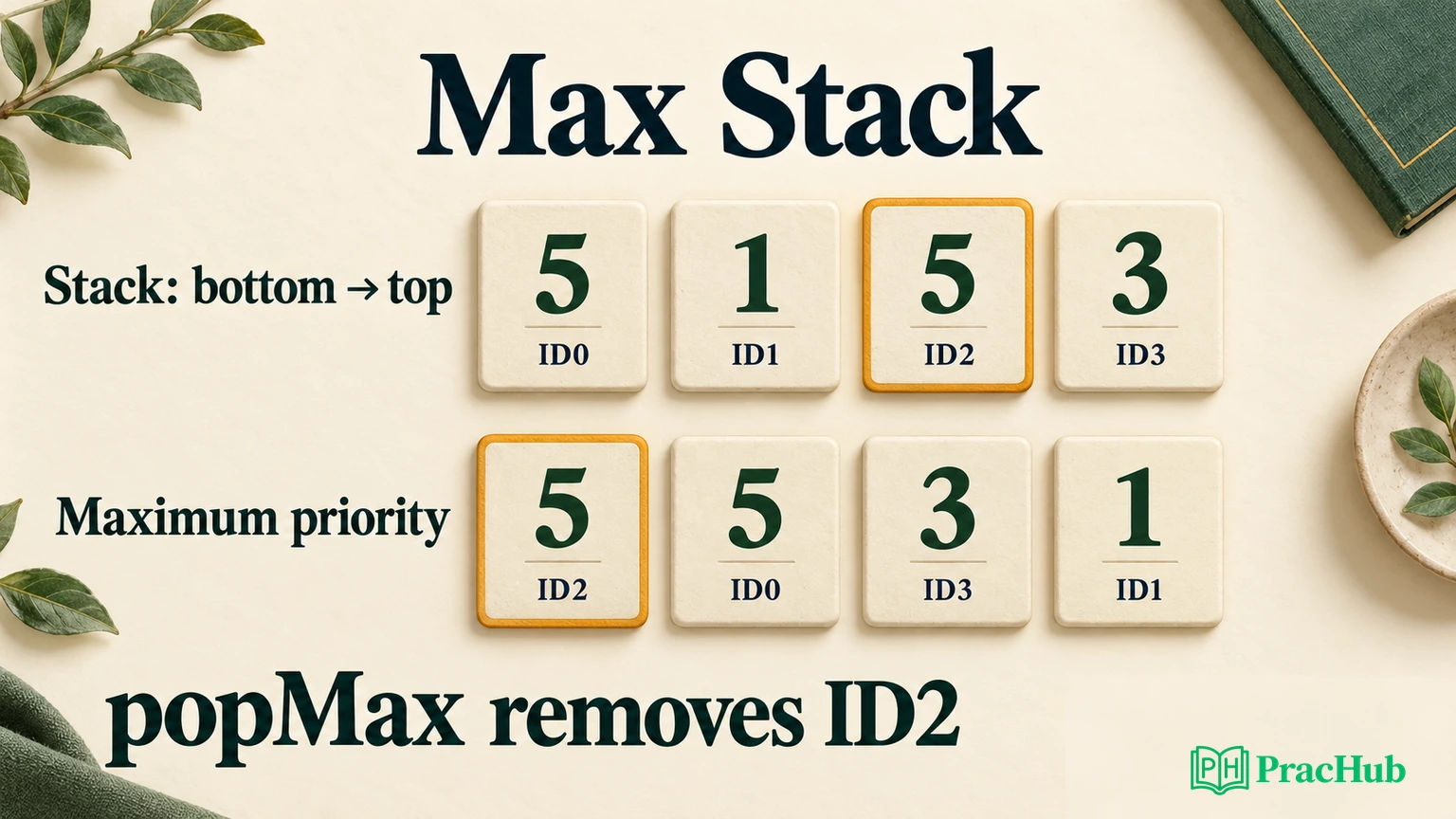
Push five, one, five, three, assigning IDs zero through three. The stack from bottom to top is 5#0, 1#1, 5#2, 3#3. Maximum priority is 5#2, 5#0, 3#3, 1#1: value first, then newer insertion first.
| Operation | Returned value | Live stack, bottom to top | Consistency obligation |
|---|---|---|---|
| push 5, 1, 5, 3 | None for each push | 5#0, 1#1, 5#2, 3#3 | Four distinct insertions exist |
| popMax | 5 | 5#0, 1#1, 3#3 | Delete ID2, preserve ID0 |
| top | 3 | 5#0, 1#1, 3#3 | Maximum removal did not reorder survivors |
| pop | 3 | 5#0, 1#1 | ID3 must no longer qualify as a maximum |
| peekMax | 5 | 5#0, 1#1 | Ignore any stale physical entry for ID3 |
| popMax | 5 | 1#1 | Delete the remaining five, ID0 |
A value-only deletion flag cannot represent that sequence. Marking “five deleted” after the first popMax would also hide ID0. An insertion ID lets popMax delete ID2 while preserving the older five at ID0, and resolves equal-value priority without comparing node objects.
IDs must not be reused while stale entries can remain. Otherwise a physical entry from an old insertion could appear live again when an unrelated insertion receives the same ID. A monotonically increasing counter avoids that identity collision in this implementation.
Compare a scan with an ordered index
A list baseline can append and remove its last item efficiently. To remove a maximum, find the rightmost occurrence of the largest value, then remove that position while preserving the relative order of survivors. Searching and shifting can cost linear time, but the contract is easy to inspect and useful as a reference oracle.
A second stack of prefix maxima improves peekMax. Removing a maximum below the top still requires moving intervening values away and restoring them, including their prefix summaries. Alternating a large maximum near the bottom with many newer small values can repeatedly trigger that linear work. Do not describe every operation as constant time because lookup is constant.
For tighter worst-case bounds, a doubly linked list can preserve stack order while a balanced ordered map indexes values. Each value maps to a stack of pointers to its live linked nodes. popMax finds the largest value, removes the newest node in its bucket, and unlinks that exact node. Ordinary pop must also update the corresponding value bucket and delete an empty bucket.
That architecture can support logarithmic ordered-index updates with constant-time local unlinking. It needs a suitable ordered-map implementation and careful bucket maintenance. A normal Python dictionary does not sort keys by value; scanning its keys to find the maximum would reintroduce linear work. This article executes the lazy-heap alternative, not a separately tested balanced-tree implementation.
Use insertion order plus a lazy maximum heap
Python's OrderedDict documentation provides insertion order, reverse iteration and last-item removal. The heapq documentation describes priority queues, tie-break counters and leaving removed entries for later cleanup. We combine those mechanisms with a live-ID registry.
live maps insertion IDs to values in stack order. The min-heap stores (-value,-ID), turning larger values and newer equal values into smaller heap keys. Ordinary stack removal deletes from live immediately; its heap record becomes stale. Maximum operations discard stale records only when they reach the heap root.
from collections import OrderedDict
from heapq import heappush, heappop

class MaxStack:
    def __init__(self):
        self.live = OrderedDict()
        self.heap = []
        self.next_id = 0

    def push(self, value):
        uid = self.next_id
        self.next_id += 1
        self.live[uid] = value
        heappush(self.heap, (-value, -uid))

    def _require(self):
        if not self.live:
            raise IndexError("empty MaxStack")

    def _clean(self):
        while self.heap and -self.heap[0][1] not in self.live:
            heappop(self.heap)

    def pop(self):
        self._require()
        return self.live.popitem(last=True)[1]

    def top(self):
        self._require()
        return self.live[next(reversed(self.live))]

    def peekMax(self):
        self._require()
        self._clean()
        return -self.heap[0][0]

    def popMax(self):
        self._require()
        self._clean()
        value, neg_uid = heappop(self.heap)
        del self.live[-neg_uid]
        return -value
popMax removes a heap entry and deletes the same ID from live. pop removes only the last live entry, while _clean later removes its obsolete heap record. There is no second stack to purge because the ordered mapping itself contains only live entries.
The second tuple field is negative ID: among equal fives, ID2 must precede ID0 in the min-heap. A positive ID would make the older of two equal maxima come out first. Using only the value would leave the tie unresolved and could make the implementation depend on another object's comparison behavior.
The maximum-priority row in the illustration is a sorted explanation of which insertion should win next; it is not the heap's physical array layout. A heap guarantees its root is the best key but does not fully sort its remaining entries. Reading the heap array as a stack would therefore introduce a third, unjustified ordering rule.
Before either maximum method reads the root, _clean removes dead IDs from that position. Cleaning only after returning would expose a value removed by an earlier stack pop. Conversely, trying to remove an arbitrary stale entry immediately requires locating it and restoring the heap property. Without an additional position index, that search is exactly the work lazy deletion defers. State which data structure owns live membership so these two strategies are not mixed accidentally.
State the four invariants
First, live contains exactly the surviving insertions, in increasing insertion-ID order. New pushes append; deletions remove an entry without moving the others. Consequently, its last key always identifies the stack top.
Second, every live insertion has exactly one heap entry with its negative value and negative ID. Removed entries may remain, but no live entry is missing. Third, an entry is stale exactly when its ID is absent from live. Unique IDs make that membership test unambiguous.
Fourth, after _clean, the heap root is the live insertion with the greatest value and then the greatest ID. Heap ordering puts the best physical key first; removing stale roots cannot discard a live candidate. Once a live root appears, no better live key can be below it.
Those invariants explain all five methods. In particular, popMax can remove a middle stack entry without changing the order of survivors. Physical disagreement between the heap and mapping is permitted only for dead entries; logical answers must agree about which IDs remain live.

Name the deferred time and memory cost
Let H be physical heap size, N live size and P total pushes since construction. Under expected constant-time hash and ordered-mapping operations, top and ordinary pop are constant time. A push performs a heap insertion costing O(log(H+1)), apart from ordinary allocation amortization.
A maximum query can remove s stale roots before answering. Its cleanup costs O(s log(H+1)); popMax also extracts one live root. A maximum query can inherit cleanup from many earlier stack pops, so a fast-looking method can pause on the very call you are tracing. In the saved fixture, pushing values one through one hundred, popping ninety-nine from the stack, and then calling peekMax removes ninety-nine stale heap records at once.
Across a whole history, each inserted heap record is removed at most once. For Q total operations and P pushes, total work is bounded by O(Q + P log(P+1)) under the stated expected mapping assumptions. This aggregate argument supports amortized efficiency; it does not turn every maximum query into a worst-case logarithmic call.
Storage can remain O(P), even when N is tiny. Push one hundred down through one, then pop ninety-nine stack items. Value one hundred stays at the heap root, so peekMax has nothing stale to remove there. The structure still holds one hundred heap records for one live item.
Choose a cleanup policy only after naming requirements
| Design | popMax cost | Other consideration |
|---|---|---|
| List scan and order-preserving removal | O(N) worst case | Simple correctness baseline |
| Prefix-max stack with temporary restoration | O(N) worst case | Constant maximum lookup does not remove middle elements |
| Linked list plus balanced ordered index | O(log N) with suitable index | Maintain live-node buckets on every deletion |
| Ordered mapping plus lazy heap | Cleanup-dependent per call; efficient aggregate work | Physical storage can follow historical pushes |
If memory must track live size, one derived option periodically rebuilds the heap from live entries. A trigger such as physical size exceeding a multiple of live size needs a minimum threshold, a cost argument and tests for bursty workloads. Rebuilding also introduces a pause; it does not provide a free worst-case guarantee.
The supplied class does not implement that policy. Similarly, adding one lock around each complete operation can be a baseline for discussing concurrent calls, but that concurrent version is not tested here. A compound action such as “peek maximum, then remove it” would need its own atomicity contract if separate calls may interleave.
Check operation histories rather than isolated methods
The executable asset compares the class with a list of (ID,value) pairs. The oracle scans live entries for a maximum and resolves ties by ID, independently of the heap's layout. After every operation it compares returned values or empty errors, the complete live sequence, and the identities represented by live heap entries.
The saved local output records all 137,257 operation streams of lengths zero through six matching the separate list-identity oracle. Its alphabet contains pushes of −1, zero and one, plus all four non-push methods. This exercises duplicates, negatives, empty calls and alternating deletion modes. Longer named fixtures verify the operation ledger, retained garbage and the ninety-nine-entry cleanup burst.
These checks are bounded local evidence, not a performance benchmark or online-judge result. They catch disagreement between the two logical orders while leaving the complexity proof and production requirements visible.
Rehearse the contract on reported records
The following checked PracHub records include combined tasks and different operation-level requirements. Read the full prompt before assuming our empty behavior or lazy-heap trade-off satisfies it. Their company labels describe reported practice provenance, not guaranteed future questions.
| PracHub question | Reported company / role | Rehearsal focus |
|---|---|---|
| Design a max-stack with efficient operations | LinkedIn / Software Engineer | Separate requested complexity from the bounds you can prove |
| Design prefix-sum function and max stack | Meta / Software Engineer | Keep Max Stack operations distinct from a prefix-sum function |
| Design a stack with max removal | LinkedIn / Software Engineer | Check topmost-maximum and empty-wrapper behavior |
| Implement a stack supporting max and popMax | LinkedIn / Data Engineer | Track the same insertion through stack and maximum deletion |
| Implement a Maximum-Tracking Stack | Zipline / Software Engineer | Clarify maximum lookup versus removal requirements |
Open Software Engineer coding and algorithm practice, choose a Max Stack record, and trace the two fives by insertion ID. Use the supplied retained-entry and cleanup-burst cases to check your per-operation and storage bounds before proposing a rebuilt heap or concurrent variant.
Sources and Further Reading
- LeetCode: Max Stack — Premium access limitation; hidden statement not retrieved.
- Python 3.12: OrderedDict — insertion order, reverse iteration and last-item removal.
- Python 3.12: heapq priority-queue notes — counter tie-breaks and deferred removal patterns.
- PracHub: Design a max-stack with efficient operations — candidate-reported practice with its own requested targets.
Comments (0)