Meta Product Architecture Interview Guide: APIs, UX, and System Boundaries
Quick Overview
Meta's Product Architecture interview is a 45-minute design round focused on APIs, usability, data models, client-server boundaries, and product evolution. This guide explains how it differs from Systems Design, provides a five-part answer framework, a timed interview plan, a social feed example, seniority signals, and a focused 7-day preparation plan. Practice real company questions and system design prompts with PracHub.
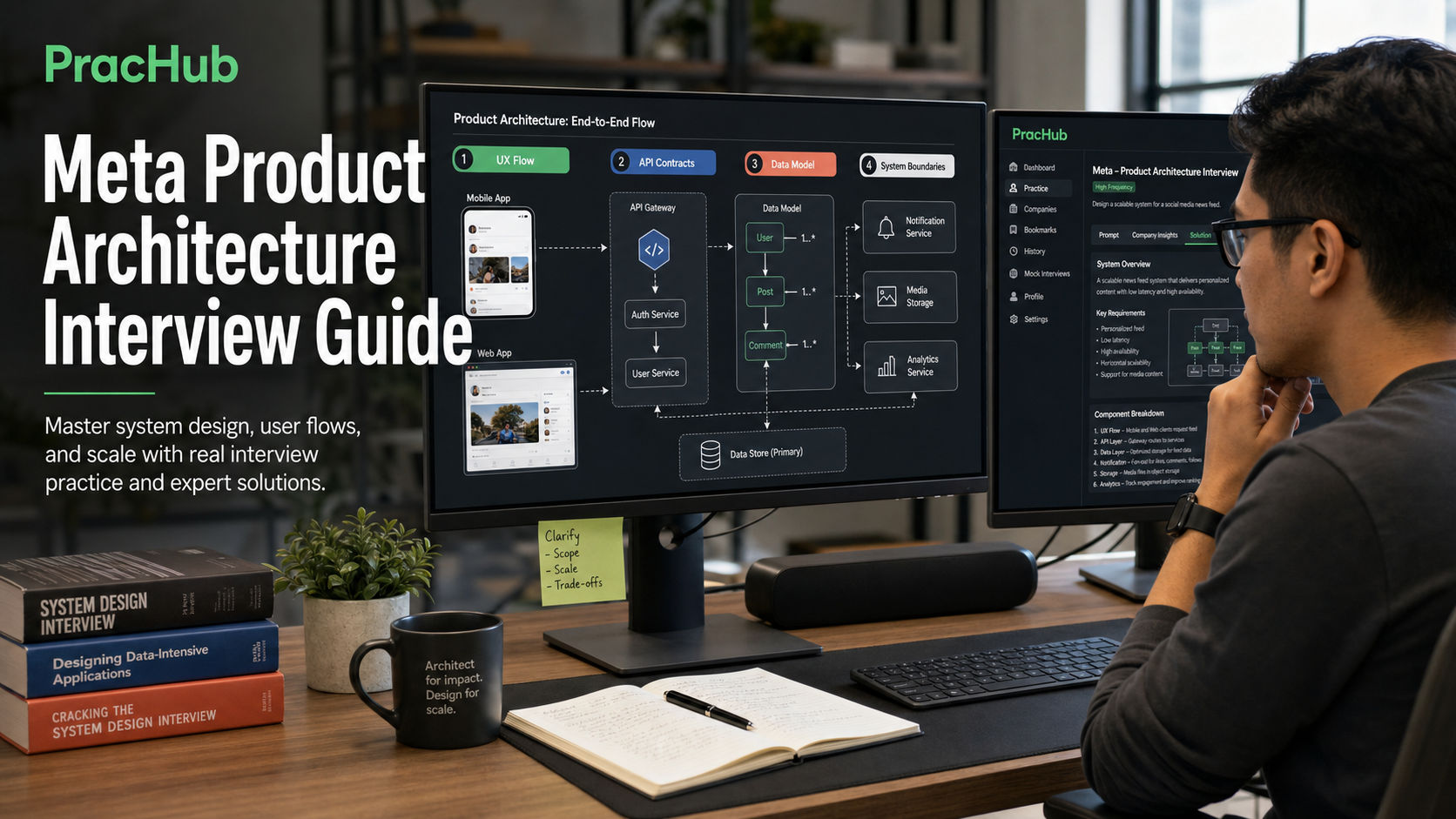
A Meta Product Architecture interview can look deceptively familiar. The prompt may sound like system design, but a candidate who spends the whole round drawing caches, queues, and database shards can miss the point.
Meta's own preparation guide says Product Architectural Design focuses more on API design, usability, and utility. The challenge is to connect a real user flow to clear contracts, sensible data ownership, and boundaries that can survive the next product change.
If your interview is scheduled, begin with real interview questions with written solutions and narrow your research with company-specific interview prep. PracHub helps you practice the complete conversation instead of memorizing one perfect diagram.
Quick Verdict
Treat Meta Product Architecture as product-centered system design. Start with the user experience, define the API and data contracts, place logic on the right side of the client-server boundary, and then discuss scale, reliability, and evolution.
The exact loop varies by role and level, so your recruiter packet is authoritative. Public Meta preparation material describes a 45-minute design interview and distinguishes Product Architectural Design from the more infrastructure-heavy Systems Design track.
What Is the Meta Product Architecture Interview?
Meta describes the round as designing a product or API at scale that supports an end-user service. You may need to reason about storage models, data ownership, protocols, data formats, client-server design, scalability, design patterns, and the tension between long-term flexibility and unnecessary complexity.
The prompt is intentionally broad. You are expected to drive the discussion: clarify the product, choose a critical workflow, create a coherent design, and explain the trade-offs behind each important boundary.
Product Architecture vs. System Design
| Area | Product Architecture Emphasis | Systems Design Emphasis |
|---|---|---|
| Starting point | User journey and product behavior | Traffic, scale, and system requirements |
| Core depth | APIs, data models, usability, client-server interaction | Storage, partitioning, caching, availability, performance |
| Boundaries | Which team or layer owns logic and data | Which service owns capacity and failure handling |
| Evolution | New features, old clients, versioning, migrations | Growth, hot spots, regional failures, operational scale |
The two rounds overlap. Product Architecture still needs a credible backend, and System Design still needs usable APIs. The difference is where you spend your limited time.
The Five-Part Answer Map
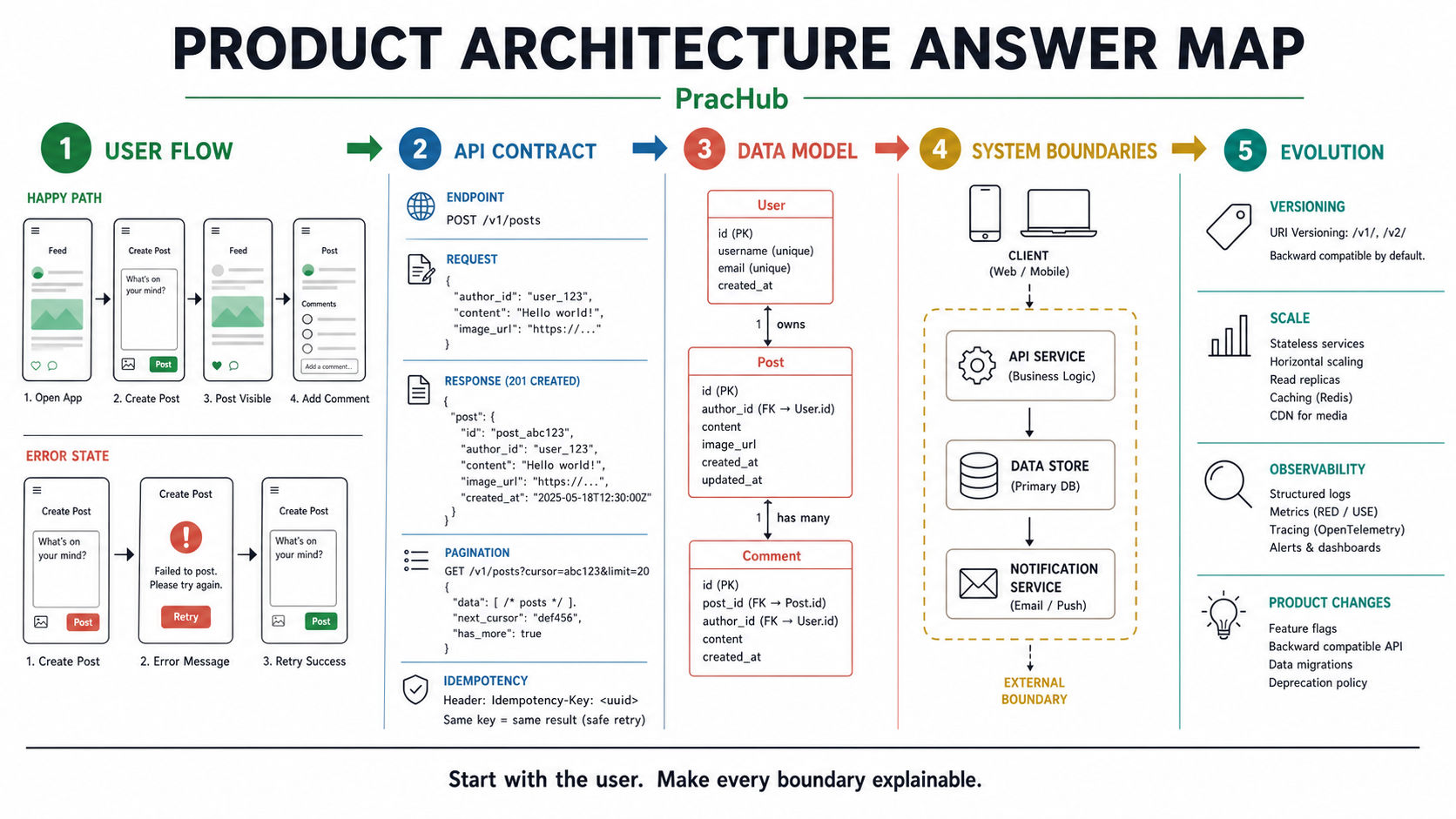
1. Define the user flow
Name the primary user, the goal, and one happy path. Then include a meaningful error or recovery state. For a posting feature, that could be create, upload, publish, view, fail, retry, and confirm.
2. Write the API contract
Do not stop at endpoint names. Show the request, response, important identifiers, permissions, pagination, errors, and idempotency where retries could create duplicates. Choose REST, GraphQL, WebSockets, or another protocol because it fits the interaction, not because it sounds modern.
Meta's history with GraphQL is a useful lesson: the API was designed around the data needs of product clients and allowed fields to evolve without breaking older applications. That does not mean every interview answer should use GraphQL. It means the client experience and evolution strategy should shape the contract.
3. Model data and ownership
Define the entities that support the workflow and identify who owns them. Include keys, relationships, ordering, and the operations the model must make efficient. Explain what happens when another product wants to reuse or extend the data.
4. Draw explainable boundaries
Separate client state, server-owned business rules, durable data, and asynchronous work. A boundary is strong when you can explain why responsibility lives there, how the pieces communicate, and what failure is contained on each side.
5. Show how the design evolves
Close the loop with backward compatibility, schema or data migration, feature flags, observability, abuse prevention, and the first scaling bottleneck. Senior candidates should make change feel planned rather than bolted on.
A 45-Minute Interview Structure
| Time | What to Accomplish |
|---|---|
| 0-5 minutes | Clarify users, scope, key actions, and one success metric. |
| 5-12 minutes | Walk through the happy path and important error states. |
| 12-22 minutes | Define APIs, payloads, data entities, and ownership. |
| 22-34 minutes | Draw components and trace one end-to-end request. |
| 34-42 minutes | Deep-dive on the interviewer's constraint or failure mode. |
| 42-45 minutes | Summarize trade-offs, evolution, and next improvements. |
Use the timing as a guardrail, not a script. If the interviewer wants API depth, stay there. Strong communication means recognizing which part of the design is producing the most useful signal.
Practice Example: Design a Social Feed Feature
Suppose you are asked to design posting and commenting for a feed. First clarify who can post, what media is supported, how privacy works, and what confirmation the user sees. Then define create, read, comment, delete, and pagination contracts.
Model User, Post, Comment, Media, and Audience or PrivacyRule. Keep authorization and visibility rules on the server, while the client owns presentation and optimistic interaction state. Trace a create request through validation, storage, media processing, feed distribution, and notification.
Finally, discuss duplicate retries, deleted content, old app versions, hot creators, moderation, and rollout. That progression shows product judgment and architecture depth without turning the answer into an infrastructure inventory.
What Strong Senior and Staff Candidates Add
A mid-level answer can be correct and complete. A senior answer explains which decision is hardest to reverse, identifies the first operational risk, and adapts when the interviewer changes a constraint.
A staff-level answer also makes organizational boundaries visible. It considers how multiple clients or teams use the contract, how ownership prevents conflicting behavior, and how the migration plan lets the product evolve without a coordinated rewrite.
Common Mistakes
The most common mistake is starting with backend boxes before defining the product. Other weak signals include vague endpoints with no payloads, a schema that does not support the user flow, client-server boundaries with no ownership rationale, and scale claims that are disconnected from actual traffic or latency needs.
Also avoid narrating every possible technology. Choose a few consequential decisions, state the trade-off, and move on. The goal is a design the interviewer can challenge, not a cloud-service catalog.
A Focused 7-Day Prep Plan
Days 1-2: Review Meta's official guide, practice scoping three product prompts, and complete PracHub's API Design Interview Framework.
Days 3-5: Design one feed, one messaging feature, and one marketplace or booking flow. For each, write actual API payloads and trace a happy path, an error path, and one product change.
Days 6-7: Run two timed mocks using system design questions. After each mock, rewrite only the weakest contract or boundary and repeat that section aloud.
Frequently Asked Questions
Is Meta Product Architecture only for frontend engineers?
No. It is commonly associated with product-focused software engineering roles, but it spans clients, APIs, data models, services, and evolution. Confirm your specific track with your recruiter.
Do I need to use GraphQL?
No. Use the protocol that fits the requirements. If you choose GraphQL, explain its product and evolution benefits as well as authorization, caching, and query-cost concerns.
How detailed should the UX be?
Detailed enough to define the states and interactions the architecture must support. You do not need polished screens, but you should cover the happy path, loading, errors, retries, and permissions.
Should I still study distributed systems?
Yes, but prioritize product-facing depth. Your design must still scale and survive failures; the difference is that infrastructure choices should support the API and user experience instead of replacing them.
Practice Meta Product Architecture with PracHub
The best preparation is to practice translating a product prompt into an explainable contract. Use PracHub to find real interview questions with written solutions, filter by company and role, and rehearse the API, data, boundary, and evolution discussion under time pressure.
Start with one prompt today. Define the user flow, write the contract, trace the request, and change one requirement. That is much closer to the interview than memorizing a finished architecture.
Related Resources
Meta Software Engineering Full Loop Interview Guide Meta: Preparing for Your Full Loop Interview Engineering at Meta: GraphQL, a data query language
Related Articles
Code Review Interview Guide: How to Find Bugs and Explain Trade-Offs
Code review interview guide: learn how to find bugs, propose tests, prioritize feedback, and explain technical trade-offs with a practical example.
Parakeet AI Review 2026: Pay-Per-Interview Copilot vs Real Preparation
Parakeet AI review 2026: examine credits, live copilot features, privacy and detection risks, then compare pay-per-interview help with real prep.
Palantir Decomposition Interview Guide: How to Structure Ambiguous Problems
Palantir Decomposition Interview guide: learn a six-step framework for ambiguous problems, trade-offs, MVPs, practice examples, and common mistakes.
InterviewReady vs ByteByteGo: Which System Design Course Is Better in 2026?
InterviewReady vs ByteByteGo in 2026: compare pricing, curriculum, visual learning, practice features, and which system design course fits you.
Comments (0)