Mockingly.ai Review 2026: AI System Design Mocks vs Real Interview Questions
Quick Overview
Mockingly.ai offers unlimited free AI system design mock interviews with an interactive whiteboard and real-time feedback, while its $14 monthly Pro plan adds detailed analysis, readiness scores, and company-specific questions. This balanced 2026 review compares AI mock practice with real interview questions, explains where AI feedback can fall short, and shows how to combine Mockingly.ai with PracHub for stronger full-loop preparation.
You can memorize caching, sharding, queues, and database trade-offs and still struggle in a system design interview. The hard part is often defending your choices when someone interrupts with, “What breaks at 10 times the traffic?” or “Why not use a relational database?”
Mockingly.ai tries to recreate that pressure with an AI interviewer and interactive whiteboard. But AI mock practice and real company questions solve different problems. Before choosing either, use real interview questions with written solutions and company-specific interview prep to identify what your target role actually asks.
Quick Verdict
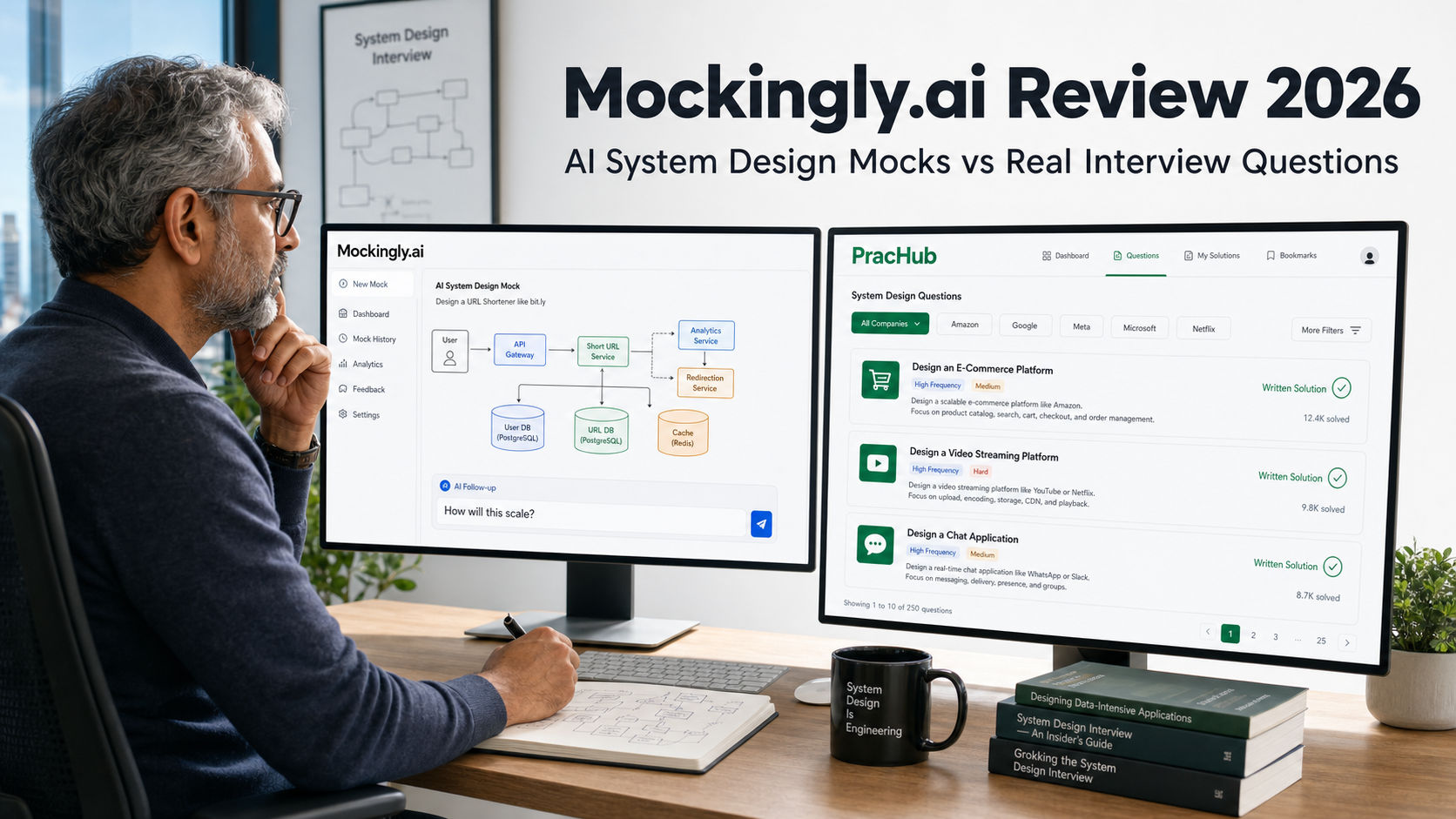
Mockingly.ai is a useful practice partner for system design delivery, especially because its free plan includes unlimited AI interviews, an interactive whiteboard, and real-time feedback. It gives candidates a low-pressure way to draw an architecture, explain trade-offs, and respond to follow-up questions without scheduling a human mock.
It should not be your only interview resource. The platform is focused on system design, its company-specific library is relatively small, and its own terms warn that AI feedback and scores can contain errors or bias. Use Mockingly.ai to rehearse the conversation, then use real questions, written solutions, and authoritative technical sources to verify the substance.
What Is Mockingly.ai?
Mockingly.ai is an AI-powered system design interview practice platform. You select a prompt, draw components and connections on an interactive canvas, explain your choices, answer contextual follow-ups, and receive feedback on areas such as scalability, latency, fault tolerance, and bottlenecks.
The site covers backend distributed systems as well as mobile and machine learning system design. It also publishes question guides and offers a Knowledge Gym with short quizzes on topics such as caching, WebSockets, SQL versus NoSQL, and database sharding.
What the AI mock is designed to practice
The strongest use case is active rehearsal. Instead of reading a polished architecture, you must clarify requirements, place components, justify data stores, and react when the interviewer challenges an assumption. That interaction reveals whether you can communicate a design rather than merely recognize one.
What Mockingly.ai Does Well
Unlimited free repetitions
The free tier currently offers unlimited AI interview practice, core system design questions, whiteboard drawing, real-time feedback, and basic session history. That is unusually generous for candidates who need repeated practice but are not ready to pay for a human mock.
Follow-ups tied to your architecture
Mockingly.ai says its interviewer analyzes the diagram and asks contextual questions about scaling limits, consistency, database choices, and other trade-offs. This is more useful than silently solving the same prompt because system design performance depends heavily on handling ambiguity and pushback.
A whiteboard-first workflow
The interactive canvas lets you place services, databases, gateways, load balancers, and connections while explaining the design. That is closer to a remote interview than sketching an answer only in your head, and it encourages candidates to keep the diagram synchronized with the discussion.
Mockingly.ai Pricing in 2026
Mockingly.ai’s pricing page listed the following plans when checked on August 2, 2026. Features and prices can change, so confirm the live checkout before subscribing.
| Plan and published price | What is included |
|---|---|
| Free$0 forever | Unlimited AI interviews, interactive whiteboard, real-time feedback, basic history, and core questions. Detailed analysis and company questions are excluded. |
| Pro$14 per month | Detailed analysis, readiness trends, 23 company-specific questions, previously asked questions and solutions, quizzes, recommendations, and priority support. The plan auto-renews monthly. |
The free plan is sufficient to test the core experience. Complete at least two sessions with the same prompt: one cold attempt and one after reviewing your mistakes. Upgrade only if the detailed analysis and company question access change how you study.
Where Mockingly.ai Falls Short
AI feedback is not a source of truth
Mockingly.ai’s own terms state that its questions, analysis, feedback, and scoring are AI-generated and may contain inaccuracies or bias. An AI interviewer can sound confident while overlooking an operational risk, accepting a weak assumption, or recommending unnecessary complexity.
Treat every score as a directional signal. Verify important claims about consistency, storage, networking, failure modes, and capacity against written solutions, engineering documentation, or a qualified human reviewer.
System design is only one part of the loop
Mockingly.ai is intentionally focused on system design. It does not replace timed coding, debugging, SQL, behavioral stories, or company-specific full-loop preparation. A senior candidate may need all of those rounds within the same interview process.
“Company-specific” does not guarantee recency
The site markets questions associated with Google, Meta, Amazon, Netflix, and other companies. That label is useful for direction, but it does not prove that a specific team will ask the prompt or that the question is currently frequent. Company, level, organization, and interview format can all change the expected depth.
AI System Design Mocks vs. Real Interview Questions
| Preparation need | Mockingly.ai | Real questions with written solutions |
|---|---|---|
| Practice speaking under pressure | Strong: dynamic questions and immediate follow-ups | Requires a partner or self-directed verbal practice |
| Practice diagramming | Strong: integrated interactive canvas | Depends on the question platform and your drawing tool |
| Understand company patterns | Pro includes a limited company-specific collection | Broader value when prompts include company, role, round, and date context |
| Check technical completeness | Fast AI critique that may be inconsistent | Written solutions provide a stable comparison point |
| Prepare for the full loop | Primarily system design | Can include coding, SQL, ML, behavioral, and other rounds |
| Repeat on demand | Strong: unlimited free AI sessions | Question practice is repeatable, but follow-ups require extra effort |
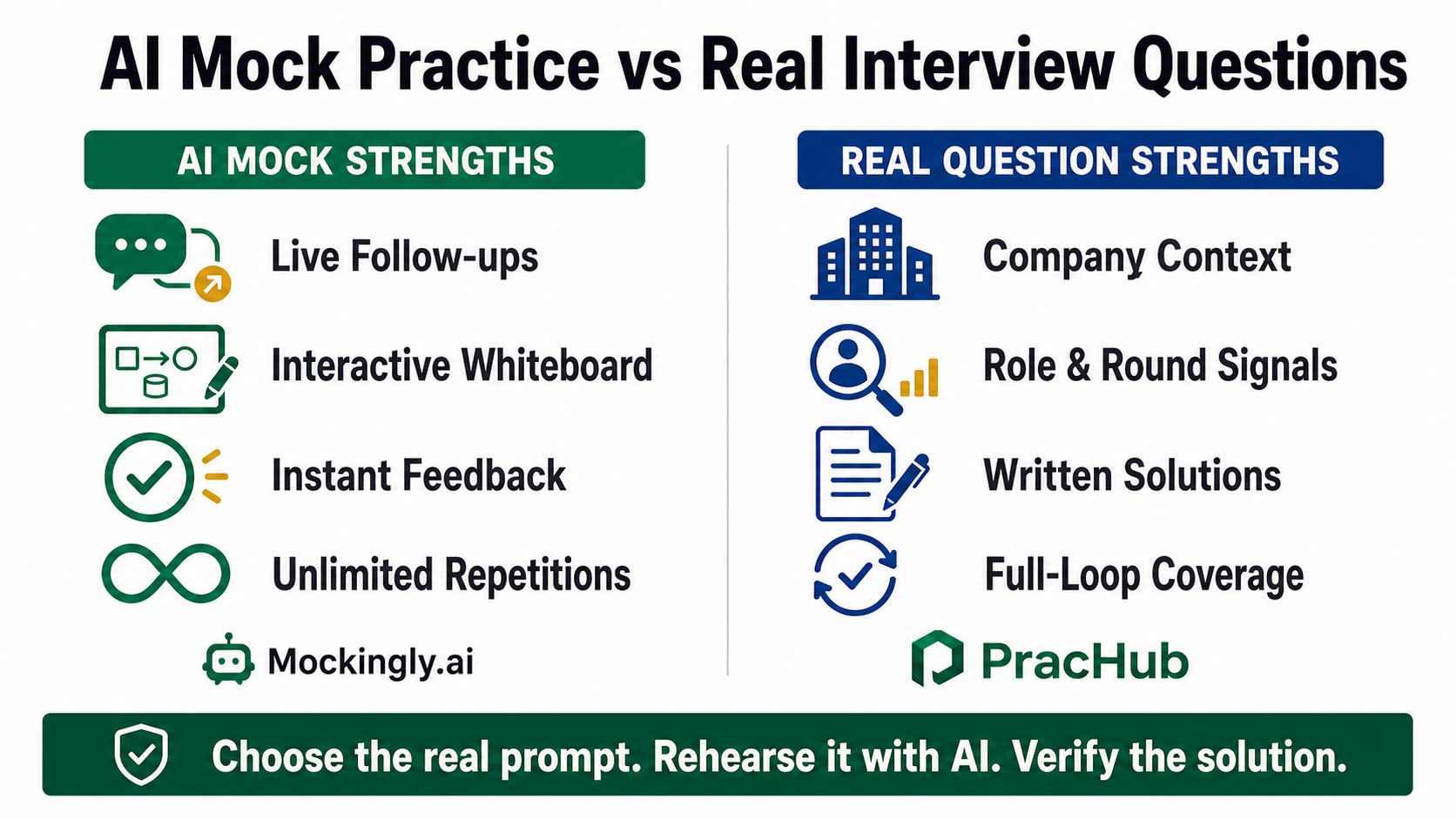
The two approaches are complementary. Real questions help you choose the right prompt and understand the expected answer. AI mocks force you to produce and defend that answer in real time.
Mockingly.ai vs. PracHub
Mockingly.ai is strongest as a simulated interviewer. PracHub is strongest as a practice library for company-tagged questions, written solutions, and broader interview-loop coverage. Use PracHub to identify what to practice and Mockingly.ai to rehearse one part of how you will deliver it.
For example, start with system design questions relevant to your level and target company. Attempt the prompt and review the written solution only after committing to a design. Then open an AI mock and practice the same reasoning with interruptions and follow-ups.
A Better System Design Prep Workflow
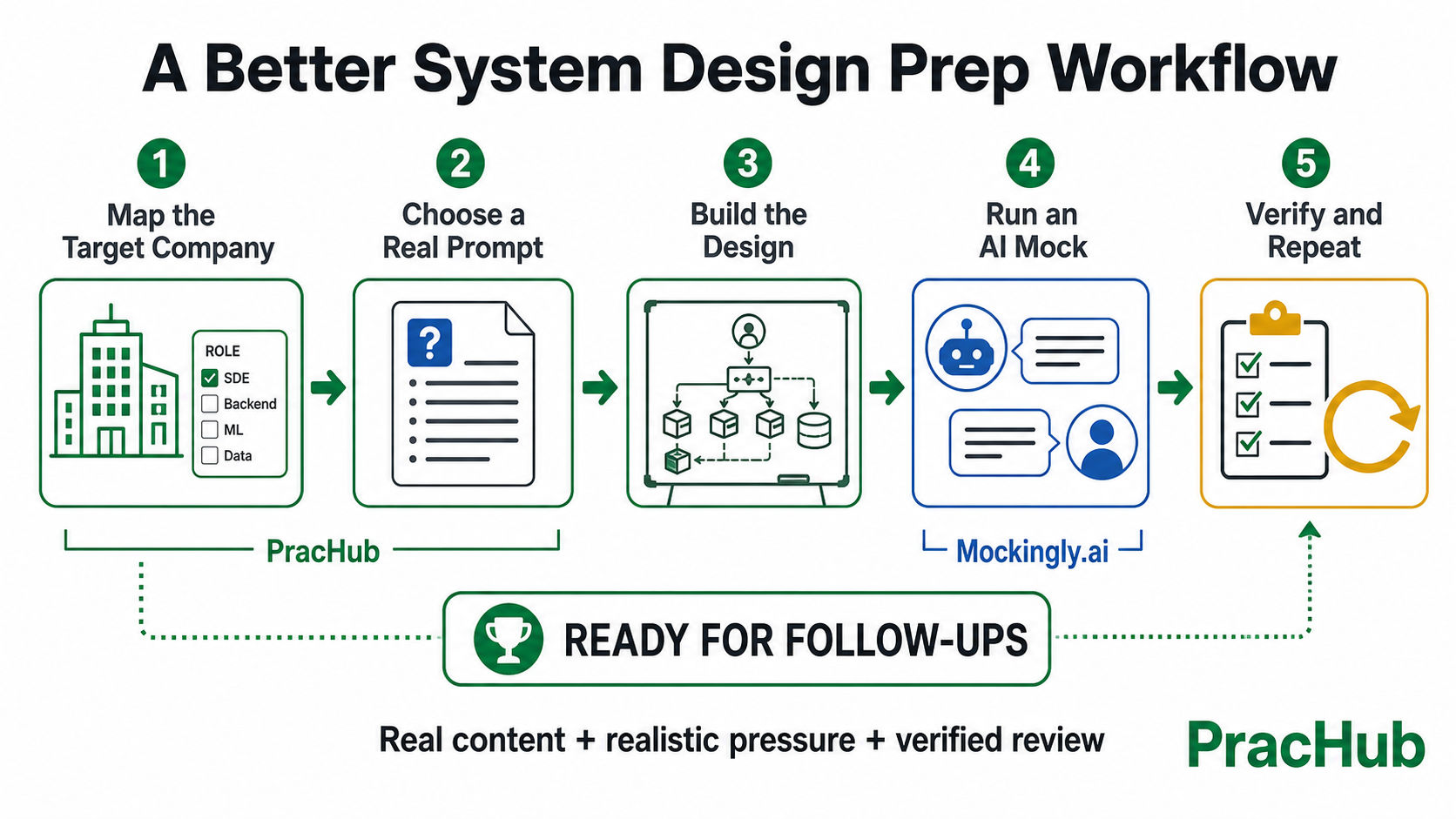
First, map the target interview: company, level, product area, interview length, and whether the round is backend, mobile, ML, or general system design. Choose a real prompt that matches that context instead of starting with a random architecture.
Second, solve it independently. Clarify functional and non-functional requirements, estimate scale, sketch the high-level design, select data stores, trace one critical flow, and identify failure modes. Only then compare your answer with a written solution.
Third, use Mockingly.ai for a cold verbal run. Do not read notes while answering. Record the questions that exposed uncertainty, verify the AI’s feedback, and repeat the mock with a tighter explanation. Finish by preparing coding and behavioral and leadership questions for the rest of the loop.
Privacy and Data Considerations
Mockingly.ai’s privacy policy says interview messages and whiteboard drawings are sent to OpenAI for processing with GPT-4o. It also says account and interview-session data are retained until the account is deleted, while providing export and deletion controls through privacy settings.
Do not upload confidential employer architectures, proprietary diagrams, private interview content, or customer data. Practice with public scenarios and fictional scale assumptions. This is sensible for any third-party AI interview tool, regardless of its stated safeguards.
Who Should Use Mockingly.ai?
Mockingly.ai is a strong fit for candidates who understand system design concepts but struggle to organize an answer, draw while speaking, or handle follow-up questions. It is also useful when human mocks are expensive or difficult to schedule.
It is less useful as your first resource if you do not yet understand core architecture patterns, or if your main gap is coding, SQL, ML fundamentals, or behavioral preparation. In those cases, build the missing knowledge and practice real questions before relying on readiness scores.
FAQ
Is Mockingly.ai free?
Yes. Its free plan currently includes unlimited AI system design interviews, the interactive whiteboard, real-time feedback, basic history, and core questions. Pro was listed at $14 per month on August 2, 2026 and adds detailed analysis and company-specific content.
Does Mockingly.ai use real interview questions?
The platform says Pro includes 23 questions associated with companies such as Google, Meta, Amazon, and Netflix, plus previously asked questions and solutions. Treat company labels as useful practice context, not a promise that your interviewer will ask the same prompt.
Can Mockingly.ai replace a human mock interview?
It can provide convenient repetitions and immediate follow-ups, but a skilled human can notice communication, ambiguity, and technical issues that an AI may miss. Use AI mocks frequently and add at least one human review for a high-stakes senior or staff interview when possible.
Is the readiness score accurate?
Use it to track trends across comparable sessions, not as a prediction of hiring success. Mockingly.ai explicitly says its AI scoring may contain errors or bias and does not guarantee interview outcomes.
Final Verdict
Mockingly.ai is worth trying in 2026 because the core mock experience is free, repeatable, and well matched to the conversational nature of system design. The whiteboard and contextual follow-ups can expose weaknesses that passive reading hides.
Its best role is rehearsal, not truth verification or complete interview preparation. Start withPracHub’s real interview questions and written solutions, use Mockingly.ai to defend your design live, and return to authoritative sources to verify disputed trade-offs. That sequence gives you both realistic content and realistic pressure.
Official references: Mockingly.ai product page, pricing page, terms and AI disclaimer, and privacy policy. Features and prices were checked on August 2, 2026.
Comments (0)