Most Common Coding Interview Patterns by Company: Analysis of PracHub Question Data
Quick Overview
An original analysis of 2,818 PracHub coding records showing which interview patterns are most common overall and how the mix changes by company.
Across 2,818 PracHub Software Engineer records labeled Coding & Algorithms, the largest identifiable family was not dynamic programming or binary search. It was stateful implementation and simulation, representing 24.2% of the sample. Strings and parsing followed at 14.4%, trees and graphs at 13.8%, and arrays and hashing at 13.1%.
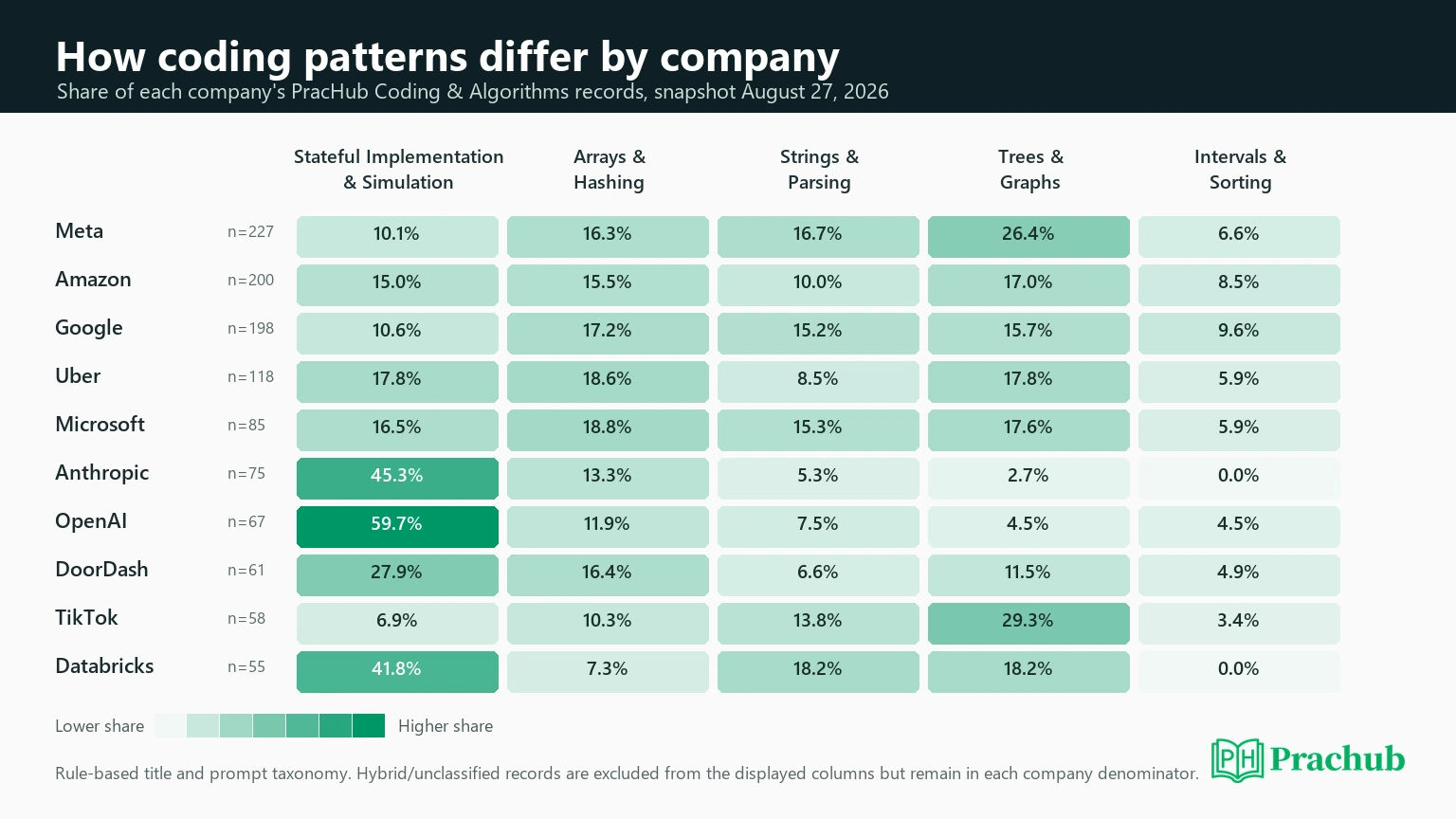
The company differences were larger than the overall ranking suggests. Trees and graphs led at Meta and TikTok, while stateful implementation dominated the mapped records for Anthropic, OpenAI, and Databricks. The practical conclusion is simple: build a broad coding core, then change the mix for the company you are targeting.
Use the PracHub interview question bank to inspect the underlying company records and practice the patterns actively. These records are preparation material, not predictions of the exact questions in any future interview.
Key findings
- Practical implementation is now a first-class coding pattern. Stateful stores, ledgers, caches, schedulers, simulators, and small in-memory systems formed the largest recognizable group.
- Classic data structures still matter. Strings, graphs, trees, arrays, and hash maps together represented 41.3% of all coding records in the analysis.
- Company-specific preparation changes the priority order. Trees and graphs made up 26.4% of Meta's coding records and 29.3% of TikTok's, while stateful implementation reached 45.3% at Anthropic, 59.7% at OpenAI, and 41.8% at Databricks.
- No taxonomy captures every real prompt cleanly. 18.9% remained hybrid or unclassified under a conservative rule set. That is a useful warning against forcing every interview task into a familiar LeetCode label.
- The data should guide allocation, not prediction. PracHub coverage is candidate-reported and changes over time. A higher share means “practice this earlier,” not “this company will ask this next.”
How this analysis was built
The analysis used a public PracHub question snapshot collected on August 27, 2026. The starting set contained 5,398 records whose role was Software Engineer. We then retained only records with the native category Coding & Algorithms and a named company, producing 2,818 records across 317 companies.
PracHub does not currently expose one standardized fine-grained algorithm-pattern field for every record. We therefore applied a reproducible rule-based taxonomy to the complete title and the opening portion of the enhanced prompt. A title match received more weight than a prompt match. Each record received one primary pattern, and ambiguous records stayed in Other / Unclassified instead of being assigned aggressively.
| Method decision | Rule used |
|---|---|
| Role scope | Software Engineer records only |
| Native category | Coding & Algorithms only |
| Unit of analysis | One PracHub question record |
| Pattern assignment | One primary rule-based pattern per record |
| Coverage | 81.1% assigned; 18.9% hybrid or unclassified |
| Company comparison | Share of that company's coding records, including unclassified records in the denominator |
This is a question-bank analysis, not a randomized survey of employers. Multiple records can come from one interview report, companies have unequal sample sizes, and candidate reporting can overrepresent memorable questions. The taxonomy also undercounts techniques that are required by a solution but never named in the title or opening prompt. For those reasons, the percentages describe the current PracHub dataset, not universal company probabilities.
The most common patterns overall
| Pattern family | Records | Share of 2,818 coding records | What the family includes |
|---|---|---|---|
| Stateful implementation and simulation | 682 | 24.2% | In-memory stores, ledgers, caches, schedulers, games, event processing, and mutable APIs |
| Strings and parsing | 406 | 14.4% | Encoding, decoding, tokenization, text processing, substrings, and structured input |
| Trees and graphs | 390 | 13.8% | Traversal, dependencies, reachability, paths, components, and tree operations |
| Arrays and hashing | 369 | 13.1% | Lookup, counting, subarrays, grids, prefix information, and duplicate handling |
| Intervals and sorting | 166 | 5.9% | Bookings, conflicts, ordering, ranges, calendars, and resource allocation |
| Other or unclassified | 534 | 18.9% | Hybrid prompts or records without enough explicit pattern evidence |
| Recognizable long tail | 271 | 9.6% | Stacks, queues, heaps, DP, linked lists, backtracking, sliding windows, binary search, greedy, and math |
The standout result is the stateful implementation category. These questions often ask for a small system with commands that mutate state across stages: add a record, query it, delete it, rank it, expire it, or roll it back. The code may fit in one file, but success depends on API interpretation, invariants, data-structure choices, and edge-case discipline.
That finding lines up with broader hiring research without proving the same thing. CoderPad's 2026 State of Tech Hiring found that 43% of surveyed recruiters still used algorithmic questions, while 38% used real-world scenario simulations. HackerRank's 2025 Developer Skills Report reported that 66% of developers preferred practical challenges and 96% believed problem-solving should matter more than memorization. PracHub's question data shows how those two worlds can coexist inside coding interviews.
How the pattern mix changes by company
The table below reports each company's largest recognizable pattern. Hybrid records remain in the denominator, so the shares do not hide classification uncertainty.
| Company | Coding records | Leading recognizable pattern | Share | Secondary signal |
|---|---|---|---|---|
| Meta | 227 | Trees and graphs | 26.4% | Strings 16.7%; arrays 16.3% |
| Amazon | 200 | Trees and graphs | 17.0% | Arrays 15.5%; stateful implementation 15.0% |
| 198 | Arrays and hashing | 17.2% | Trees 15.7%; strings 15.2% | |
| Uber | 118 | Arrays and hashing | 18.6% | Trees and stateful implementation both 17.8% |
| Microsoft | 85 | Arrays and hashing | 18.8% | Trees 17.6%; stateful implementation 16.5% |
| Anthropic | 75 | Stateful implementation and simulation | 45.3% | Stacks and queues 18.7% |
| OpenAI | 67 | Stateful implementation and simulation | 59.7% | Arrays 11.9% |
| DoorDash | 61 | Stateful implementation and simulation | 27.9% | Arrays 16.4%; trees 11.5% |
| TikTok | 58 | Trees and graphs | 29.3% | Strings 13.8% |
| Databricks | 55 | Stateful implementation and simulation | 41.8% | Strings and trees both 18.2% |
Meta and TikTok make traversal hard to ignore
Trees and graphs were the leading recognizable family for both companies. That does not mean every candidate should grind obscure graph theory. It means the preparation baseline should cover BFS, DFS, dependency ordering, reachability, tree recursion, iterative traversal, and explaining visited-state invariants without hesitation.
Meta's broader distribution also matters: strings and arrays were close behind. A candidate who studies only graphs would miss a large part of the observed mix.
Amazon, Google, Uber, and Microsoft reward breadth
No single recognizable family exceeded 19% for these four companies. Their distributions suggest a generalist core: hash-based lookup, array scanning, strings, traversal, intervals, and practical implementation. The preparation risk here is over-specialization. Knowing one advanced pattern deeply is less useful if basic parsing or state management still produces bugs.
Anthropic, OpenAI, and Databricks look more implementation-heavy
Stateful implementation represented 45.3% of Anthropic's coding sample, 59.7% of OpenAI's, and 41.8% of Databricks'. Typical practice should therefore include progressive requirements, mutable state, rollback or versioning, command processing, and tests that verify behavior after a sequence of operations.
This is not the same as a full system-design interview. The candidate still writes working code. The design signal appears through the interface, data structures, invariants, and ability to extend the implementation without breaking earlier behavior.
A better preparation plan than memorizing one list
Start with a portable core, then add a company overlay.
- Build the universal base. Practice arrays and hash maps, strings and parsing, trees and graphs, intervals, stacks, queues, and heaps. Explain time and space complexity after every solution.
- Add stateful implementation. Implement an in-memory store, cache, scheduler, or ledger. Write down the state invariant before coding, and test operation sequences rather than isolated calls.
- Inspect the company distribution. Use the relevant PracHub company page, but check sample size and recent records before changing your plan.
- Practice mixed prompts. Real records frequently combine parsing with a graph, a cache with a queue, or intervals with resource allocation. Train yourself to identify the dominant constraint without pretending only one technique exists.
- Run timed reviews. After coding, spend five minutes checking empty input, duplicates, ordering, mutation, overflow, and repeated operations. Many practical prompts are lost on hidden cases rather than asymptotic complexity.
A useful two-week split is 40% arrays, strings, and traversal; 30% stateful implementation; 15% intervals, stacks, queues, and heaps; and 15% company-specific timed work. Adjust that mix when the target company's data is strong enough to justify it.
Practice representative PracHub questions
The following question-bank records represent five major families in the analysis. They are not predictions of your exact assessment or interview.
| PracHub question | Company | Pattern | Why it helps |
|---|---|---|---|
| Count Subarrays with a Target Sum | Meta | Arrays and hashing | Builds prefix-state reasoning and careful frequency updates. |
| Decompress encoded string with nested repeats | Strings and parsing | Tests nested structure, index management, and malformed-edge reasoning. | |
| Find a valid course order from prerequisites | TikTok | Trees and graphs | Exercises graph construction, cycle detection, and topological order. |
| Build a Versioned In-Memory Database | Anthropic | Stateful implementation | Forces explicit APIs, version semantics, invariants, and progressive extension. |
| Assign tennis bookings to minimum courts | Atlassian | Intervals and sorting | Trains boundary handling, resource reuse, ordering, and concurrency reasoning. |
Attempt each problem before opening the solution. Then record the missed invariant or edge case, not merely whether your final answer passed.
Frequently asked questions
What is the most common coding interview pattern in the PracHub data?
Stateful implementation and simulation was the largest identifiable family at 24.2% of the 2,818 coding records. Among more traditional algorithm families, strings and parsing ranked first at 14.4%, followed by trees and graphs at 13.8% and arrays and hashing at 13.1%.
Does a company's leading pattern predict my next interview question?
No. It describes the current composition of candidate-reported PracHub records. Interview teams, roles, levels, locations, and recruiting cycles vary. Use the distribution to order practice, not to eliminate other topics.
Why does dynamic programming look uncommon in this analysis?
The classifier is conservative and relies on explicit wording in the title and opening prompt. A problem can require DP without naming subsequences, memoization, knapsack, or another detectable signal. The measured DP share should not be read as the true probability that an interviewer expects a dynamic-programming solution.
What does “stateful implementation” mean in a coding interview?
It means implementing behavior that evolves across operations: a cache, ledger, scheduler, versioned store, game, or event processor. The interviewer can evaluate requirements handling, data structures, invariants, extensibility, and testing while still asking for executable code.
How often should this analysis be refreshed?
Refresh it whenever the question bank grows materially or a new recruiting season changes the company mix. The useful comparison is not only the latest percentage, but whether a company's leading families remain stable across snapshots.
Sources and Further Reading
- PracHub Interview Questions
- PracHub Meta Software Engineer Questions
- PracHub Google Software Engineer Questions
- PracHub OpenAI Software Engineer Questions
- CoderPad State of Tech Hiring 2026
- HackerRank 2025 Developer Skills Report
- Google Tech Dev Guide: Data Structures Resources
Research note: The PracHub snapshot was collected and classified on August 27, 2026. Counts can change as records are added, corrected, or recategorized. The archived analysis includes the source snapshot, classification script, and per-record assignment file.
Comments (0)